
Most healthcare leaders treat an EMR transition as a simple software installation, yet the reality is that a failed rollout usually stems from a fundamental disconnect between technical architecture and clinical workflows. You already know the high stakes involved when selecting an EMR implementation consultant to manage this complex transition. A single oversight in interoperability or a disruption to patient charting doesn’t just hurt your bottom line; it compromises provider morale and patient safety.
Finding the right expert is the difference between a fragmented system and a unified, high-ROI environment. With mandatory USCDI v3 standards now in effect and updated HIPAA Security Rule requirements finalized in August 2026, the technical margin for error has disappeared. You need a partner who understands that stability requires more than just software configuration. True success requires a steady hand at the wheel of your entire IT infrastructure to ensure every system communicates effectively.
This guide provides a strategic roadmap for selecting a consultant who aligns your technical foundations with your long-term operational goals. We’ll explore how to verify technical expertise, ensure seamless billing automation, and achieve the high staff adoption rates necessary for a successful go-live. By the end, you’ll have a clear framework for securing a stable, HIPAA-compliant future for your organization while minimizing friction for your clinical team.
Key Takeaways
- Learn why 2026 interoperability mandates like USCDI v3 make hiring a strategic EMR implementation consultant essential for maintaining regulatory compliance and system stability.
- Understand the critical importance of aligning your underlying network infrastructure with clinical workflows to prevent performance bottlenecks and staff frustration during go-live.
- Evaluate the risk profiles of independent contractors versus managed consultancy models to ensure your project benefits from redundant expertise and a “steady hand” at the wheel.
- Discover a specialized vetting framework that prioritizes clinical specialty alignment and rigorous HIPAA security verification to protect your organization’s data and reputation.
- Explore how fractional CIO leadership and integrated managed IT services provide the long-term roadmap needed to achieve a high-ROI transition and seamless billing automation.
The Strategic Role of an EMR Implementation Consultant in 2026
An Electronic Health Record (EHR) is no longer a static digital filing cabinet; it’s the central nervous system of a modern healthcare practice. In 2026, an EMR implementation consultant serves as a strategic architect who ensures this system functions reliably. They don’t just teach staff where to click. Instead, they align sophisticated technical capabilities with the specific pressures of your clinical environment to prevent operational collapse.
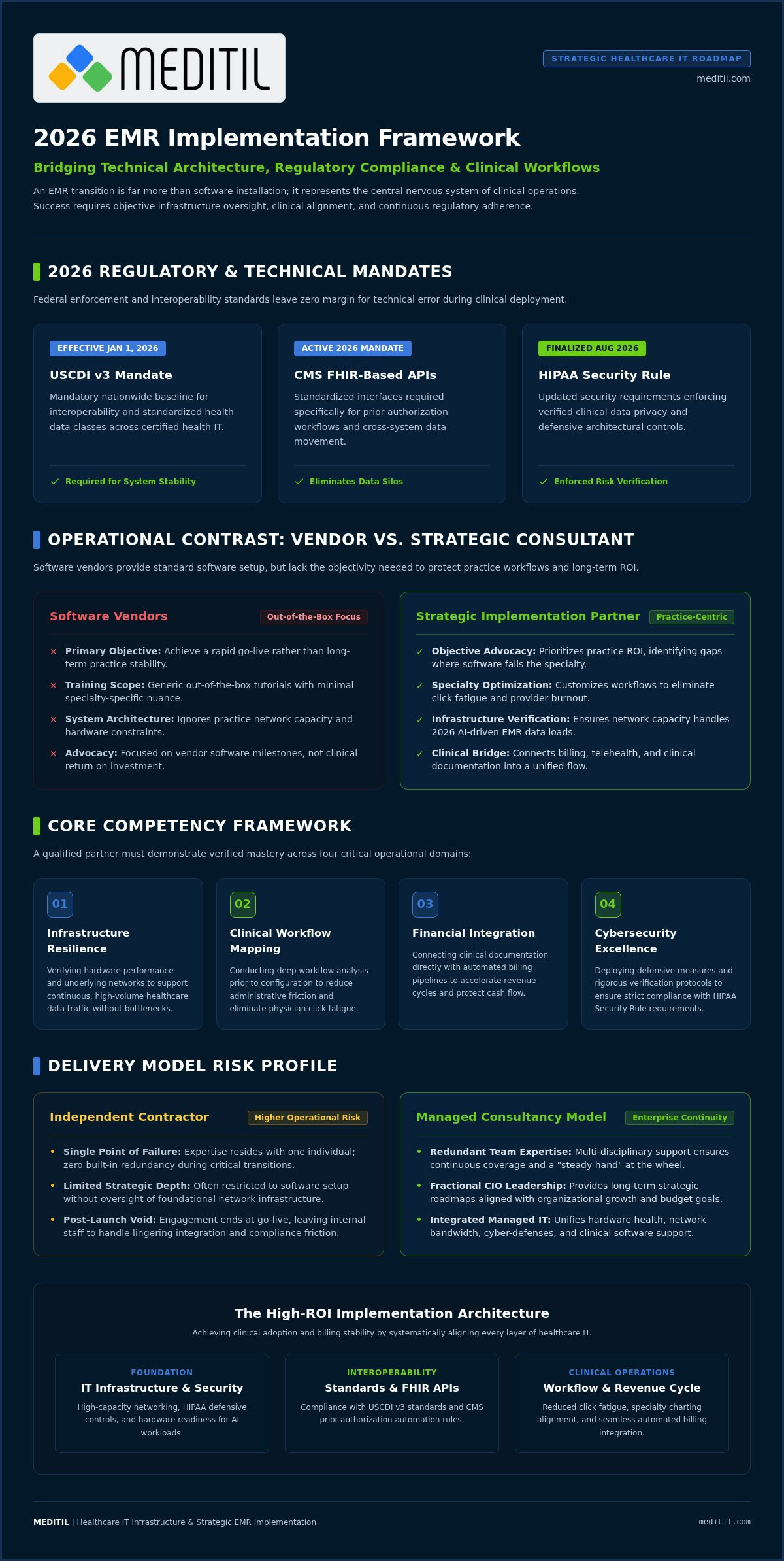
Professional guidance has become non-negotiable due to tightening federal mandates. As of January 1, 2026, organizations must comply with USCDI v3 standards, while new CMS rules require FHIR-based APIs for prior authorization workflows. These aren’t just technical checkboxes; they’re fundamental shifts in how data moves. A strategic consultant provides the steady hand at the wheel needed to navigate these complexities, ensuring your practice remains compliant without sacrificing efficiency.
The most significant risk during any transition isn’t technical downtime, but physician and staff burnout. Poorly mapped workflows lead to “click fatigue” and administrative bloat. A strategic consultant mitigates this by conducting deep workflow analysis before configuration begins. They identify friction points early, ensuring the system supports the provider’s natural rhythm rather than forcing clinicians to adapt to rigid, counterintuitive software logic.
The Evolution of EMR Consulting Standards
Consulting has moved beyond basic data entry setup toward advanced data management and patient-centric interoperability. Modern standards require a focus on how information flows between billing, telehealth, and clinical modules. EMR implementation consultancy acts as a bridge between clinical needs and technical infrastructure. This ensures that your technology serves the patient care mission rather than becoming a barrier to it.
Why Software Vendors Are Not Implementation Partners
Software vendors provide “out-of-the-box” training, but their primary objective is a rapid go-live rather than long-term practice stability. They often lack the objectivity to advocate for your specific needs. An independent EMR implementation consultant acts as your representative, identifying gaps where the software might fail your medical specialty. They bridge the divide between software capabilities and clinical reality, ensuring the final environment is customized for your actual daily operations.
- Objective Advocacy: Consultants prioritize your ROI, not the vendor’s bottom line.
- Infrastructure Verification: Ensuring your network can handle the increased data load of 2026 AI-driven EMR features.
- Customized Training: Moving beyond generic tutorials to specialty-specific workflow optimization.
Core Competencies: What to Look for in a Strategic Partner
Identifying a qualified EMR implementation consultant requires looking beyond software certifications. While vendor knowledge is necessary, it’s insufficient for organizational stability. A strategic partner must demonstrate mastery over the technical and administrative environment that surrounds the software. This includes achieving the official benefits of EHRs, such as improved care coordination and diagnostic accuracy. These outcomes are only realized when the system is properly integrated into the practice’s unique ecosystem, rather than being treated as a standalone tool.
A true partner demonstrates mastery over four core domains:
- Infrastructure Resilience: Ensuring the hardware and network can support high-volume data traffic.
- Clinical Workflow Mapping: Reducing the administrative burden on providers through intuitive design.
- Financial Integration: Connecting clinical data with billing automation to accelerate revenue cycles.
- Cybersecurity Excellence: Implementing defensive measures that exceed baseline regulatory requirements.
Technical Infrastructure and Network Stability
The EMR is a data-intensive application. If your network fails, your clinic stops. A qualified consultant evaluates your hardware and bandwidth to ensure they can handle high-volume traffic without latency. They advocate for N+1 redundancy, ensuring that a single component failure won’t lead to a complete system blackout. This proactive approach prevents the costly disruptions that occur when infrastructure is an afterthought. For a deeper look at the foundational requirements of a modern practice, consult our Managed IT Services for Healthcare: The 2026 Definitive Strategic Guide.
Interoperability and Data Management
Interoperability isn’t just a buzzword; it’s a regulatory requirement. Your EMR implementation consultant must possess the expertise to connect your system with external labs, pharmacies, and specialist portals using standardized FHIR APIs. During the migration phase, they must prevent “garbage in, garbage out” scenarios by auditing legacy data before it enters the new environment. This precision extends to financial integration. By embedding billing automation directly into the clinical workflow, a consultant helps ensure cleaner claims and accelerated revenue cycles. They map every touchpoint to reduce friction, ensuring that data flows effortlessly from the exam room to the billing office.
Finally, your partner must be an expert in medical data cybersecurity. With the August 2026 updates to the HIPAA Security Rule mandating multi-factor authentication and encryption, your implementation must be secure by design. A consultant should verify that every integration point meets these rigorous standards to protect patient privacy and practice reputation. Choosing a partner who offers specialized healthcare IT consulting ensures your infrastructure isn’t just functional, but defensible against evolving threats. This comprehensive oversight is what separates a successful rollout from a costly liability.
Individual Contractor vs. Managed Consultancy Model
Deciding between a lone freelancer and a professional firm is a pivotal choice for any healthcare organization. While recruitment sites often highlight the perceived cost-effectiveness of individuals, they frequently overlook the operational risks inherent in that model. A specialized EMR implementation consultant working within a managed consultancy offers a level of stability and breadth that an independent contractor simply cannot match. This choice isn’t just about filling a role; it’s about securing the future of your practice’s technical infrastructure.
A managed consultancy provides a depth of resources that protects your investment. This model allows for scalability, meaning you can adjust support levels during different implementation phases without the friction of new hires. More importantly, a firm-based approach provides superior long-term technical debt management. They ensure that configurations made during the initial setup don’t become expensive liabilities as software versions evolve and regulatory requirements shift.
The Single Point of Failure Risk
Hiring an individual creates a single point of failure. If your consultant leaves mid-project or faces an emergency, your implementation stalls, potentially costing thousands in delayed go-live dates. A managed consultancy mitigates this through an augmented IT team. This structure ensures that multiple experts are familiar with your specific environment, maintaining institutional knowledge even if individual team members shift. You gain access to a collective brain trust rather than relying on the limited experience of one person. It’s a strategy that prioritizes continuity over convenience.
Fractional CIO Oversight in EMR Projects
A technical consultant focuses on the “how” of software configuration, but they often lack the “why” of strategic business alignment. This is where a Virtual CIO provides essential value. A vCIO offers a high-level roadmap that ensures your EMR performance aligns with your broader business intelligence goals. They look past the immediate setup to consider how your system will integrate with future telehealth or remote monitoring initiatives.
By choosing a managed model, you ensure your EMR implementation consultant is backed by a full suite of healthcare application support. This integrated approach ensures that your clinical workflows, billing automation, and cybersecurity protocols remain unified under a single, disciplined strategy. This steady hand at the wheel allows your leadership to focus on patient outcomes while the consultancy manages the complex technical maneuvers in the background.
Selection Framework: Vetting Your EMR Implementation Partner
Vetting a potential EMR implementation consultant requires a disciplined approach that transcends basic technical checklists. You must evaluate whether a partner understands the specific clinical nuances of your medical specialty. A consultant who excels in high-volume primary care might lack the experience needed for the complex imaging and longitudinal tracking required in oncology. This clinical fit ensures that the final configuration supports, rather than hinders, specialized patient care protocols.
Security verification is equally paramount. With the February 16, 2026, deadline for updated HIPAA Notices of Privacy Practices, your partner must demonstrate a proactive stance on regulatory compliance. Request specific documentation on their protocols for multi-factor authentication and encryption at every data touchpoint. A partner who cannot provide a detailed security roadmap is a liability your organization cannot afford. You should also evaluate their training methodology to ensure it’s sustainable. If the training is too dense or lacks follow-up support, staff adoption will plummet.
The Workflow Audit: The First Step of a True Partner
A qualified consultant should never suggest software changes without first observing your team in action. They must identify clinical friction points, such as redundant data entry or poorly placed charting triggers, that contribute to provider frustration. A workflow audit is the foundation of any successful 2026 EMR rollout. By mapping existing processes before configuration begins, the consultant can ensure the technology mirrors the provider’s natural movement through the clinic.
Billing and Revenue Cycle Integration
A successful implementation must protect your practice’s financial health. If clinical data doesn’t map correctly to billing codes, your revenue cycle will stall immediately after go-live. Evaluate your EMR implementation consultant on their ability to integrate third-party applications and automated financial systems. You need a partner who ensures that every clinical interaction translates into an accurate, billable event. For detailed strategies on maintaining financial alignment during technical transitions, review our Medical Billing Automation Solutions: A Strategic Guide for Healthcare Leaders in 2026.
To ensure your transition is managed by experts who prioritize both clinical efficiency and financial stability, explore our comprehensive healthcare IT consulting options today.
Optimizing the Implementation Lifecycle with MEDITIL
A successful transition requires more than a software configuration checklist; it demands a comprehensive evaluation of your technical foundations. MEDITIL serves as your strategic partner, offering an infrastructure-first methodology that acts as a steady hand at the wheel during complex rollouts. By resolving network vulnerabilities before deployment, we ensure your EMR implementation consultant can focus on optimizing clinical workflows rather than troubleshooting connectivity issues. This proactive approach minimizes downtime and protects your operational revenue.
Our methodology focuses on long-term stability and high staff adoption. We don’t believe in generic tutorials that leave clinicians frustrated. Instead, we design customized training programs tailored to the specific rhythms of your medical specialty. By aligning the software interface with your actual daily workflows, we reduce administrative friction, accelerate charting speeds, and ensure your team feels supported from day one of go-live.
Beyond the Go-Live Date
The conclusion of initial training shouldn’t mark the end of your technical support. True system optimization requires transitioning from basic implementation to ongoing healthcare application support and advanced business intelligence reporting. MEDITIL manages your entire IT operations to ensure sustained EMR performance, allowing your leadership to leverage data analytics for strategic decision-making. We monitor system health continuously, addressing minor database latencies before they disrupt patient care or complicate your billing cycles.
Securing Your Clinical Roadmap
In a highly regulated environment, infrastructure management is the ultimate insurance policy for your technology investments. With the industry shifting toward mandatory compliance and interconnected health networks, security cannot be treated as an afterthought. We integrate advanced data protection protocols directly into your system architecture, shielding sensitive information from evolving external threats. To understand how we defend your practice against sophisticated vulnerabilities, review our Healthcare Cybersecurity Services: A Strategic Guide for 2026.
Future-proofing your organization requires a unified strategy that connects network performance, compliance, and clinical efficiency. Ready to stabilize your transition? Consult with our EMR implementation experts to secure a resilient, high-ROI environment for your practice.
Securing a Resilient Digital Foundation for Your Practice
Achieving a seamless software transition requires shifting your focus from basic data configuration to comprehensive infrastructure resilience. Selecting a qualified EMR implementation consultant is the first step toward aligning your clinical workflows with tightening federal interoperability standards. By prioritizing a managed consultancy model over an independent contractor, your organization secures the redundant expertise needed to prevent operational downtime and safeguard patient data.
MEDITIL provides the steady hand your practice needs during high-stakes technological updates. Through our Comprehensive Healthcare IT Management and Fractional CIO Strategic Oversight, we ensure your long-term clinical roadmap remains stable and profitable. Our team delivers Specialized Interoperability & Billing Integration to eliminate administrative friction and protect your revenue cycle from day one. Partner with MEDITIL for a Strategic EMR Implementation and confidently lead your team into a secure, highly efficient operational future.
Frequently Asked Questions
What is the difference between an EMR trainer and an implementation consultant?
An EMR trainer focuses on teaching staff how to navigate the software interface, while an EMR implementation consultant provides strategic oversight for the entire project. The consultant manages the technical infrastructure, clinical workflow mapping, and system interoperability. They ensure the technology aligns with your long-term business goals, whereas a trainer handles the tactical end-user education necessary for the final phase of go-live.
How long does a typical EMR implementation take with a professional consultant?
A typical EMR implementation timeline varies based on organizational size and complexity. Small practices with one to three providers generally complete the process within four to eight weeks. Larger or multi-location practices should expect a duration of three to six months. A professional consultant streamlines this lifecycle by identifying infrastructure bottlenecks early, preventing the delays that often arise from unplanned network upgrades or data migration errors.
Does an EMR implementation consultant help with data migration from legacy systems?
Yes, a consultant is essential for managing data migration from legacy systems. They perform a comprehensive audit to identify “garbage in, garbage out” risks, ensuring that only accurate, high-quality records enter the new environment. This process involves mapping legacy data fields to the new system requirements and verifying that patient history, allergies, and diagnostic records remain intact and accessible for clinicians immediately upon go-live.
Can a consultant help us switch from one EMR to another without losing data?
Transitioning between systems requires a specialized focus on interoperability and data integrity. A consultant facilitates this by using standardized protocols to move information securely. They create a strategic mapping roadmap that accounts for the differences in database architecture between the two systems. This ensures that no critical patient or billing data is lost during the transfer, maintaining clinical continuity and financial accuracy across the organization.
How does an EMR consultant improve billing and revenue cycle management?
An EMR implementation consultant improves revenue cycle management by integrating billing automation directly into clinical workflows. They ensure that every charting event triggers the correct billable code, reducing the manual administrative burden on staff. By connecting the EMR with your financial systems, the consultant helps accelerate claim submissions and reduces the rate of denials, resulting in a more predictable and stable revenue stream for the practice.
What technical infrastructure is required to support a modern EMR system?
A modern EMR requires a resilient network foundation to handle high-volume data traffic without latency. Key requirements include:
- High-speed, redundant internet bandwidth
- N+1 redundancy for critical hardware components
- Secure access points with multi-factor authentication
- Workstations that meet or exceed vendor hardware specifications
A consultant verifies these components are in place to ensure system uptime and performance.
Is it better to hire a consultant specifically for Epic, Cerner, or Athenahealth?
While vendor knowledge is valuable, it is often better to hire a partner who understands the broader healthcare IT ecosystem. Specialized consultancy firms provide objective advocacy that vendor-specific representatives may lack. They focus on how the software integrates with your medical specialty and existing infrastructure. This ensures you aren’t forced into a generic setup that fails to account for your unique clinical workflows or third-party application requirements.
How do EMR implementation consultants ensure HIPAA compliance during the transition?
Consultants ensure HIPAA compliance by implementing rigorous technical safeguards throughout the transition. This includes configuring end-to-end encryption for all patient data and establishing strict access controls. They also set up comprehensive audit logs to track data movement and verify that the environment meets the latest 2026 regulatory standards. This proactive security posture protects your practice from breaches and potential federal penalties during the vulnerable migration phase.