
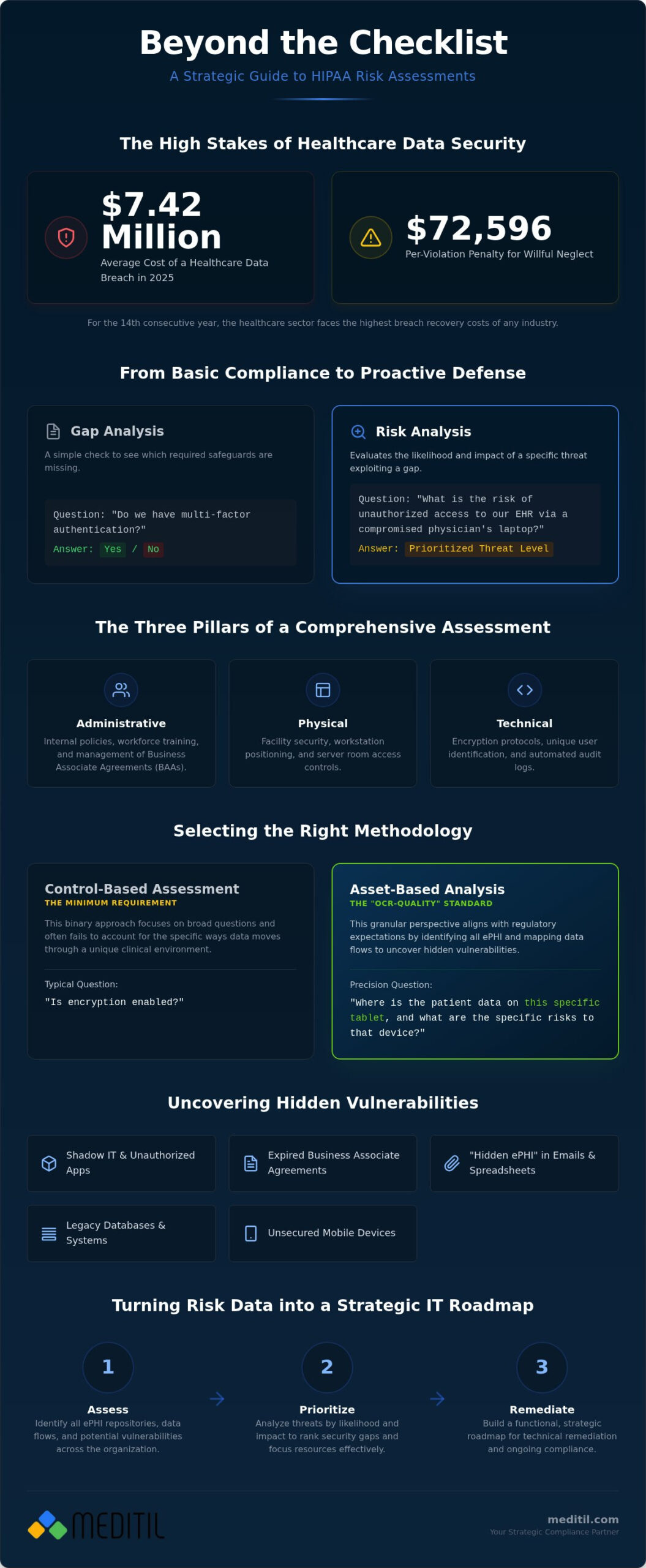
In 2025, the average cost of a healthcare data breach reached $7.42 million, marking the 14th consecutive year this sector has faced the highest recovery expenses of any industry. For many healthcare leaders, the annual security review feels like a defensive maneuver against the looming threat of OCR audits or the staggering $72,596 per-violation penalties for willful neglect. It’s understandable if you view this process with a degree of exhaustion, especially when managing fragmented IT systems across EHR, telehealth, and billing platforms that seem to complicate data tracking at every turn.
This guide demonstrates how to move beyond basic compliance by utilizing professional hipaa risk assessment services to build a resilient operational foundation. You’ll learn how to transform a mandatory exercise into a strategic roadmap that prioritizes your most critical vulnerabilities and secures patient data across all digital touchpoints. We will examine the 2026 regulatory landscape, provide a framework for unifying your security protocols, and offer a clear path toward long-term technical stability and peace of mind.
Key Takeaways
- Understand the transition from mandatory compliance checklists to a dynamic process of identifying where ePHI resides across all digital platforms.
- Compare control-based and asset-based methodologies to determine which approach offers the most robust protection for your specific infrastructure.
- Uncover hidden vulnerabilities, such as shadow IT and expired business associate agreements, by utilizing expert hipaa risk assessment services.
- Learn to prioritize security gaps into a functional roadmap that aligns remediation efforts with your organization’s broader strategic objectives.
- Explore the benefits of partnering with a specialized provider that manages both the initial assessment and the subsequent technical remediation.
What are HIPAA Risk Assessment Services and Why Are They Mandatory?
Professional hipaa risk assessment services provide a systematic framework for identifying where electronic Protected Health Information (ePHI) is stored, transmitted, or accessed. This process goes beyond a simple inventory of hardware. It involves a granular analysis of how data flows through your organization, from the initial patient intake to long-term cloud storage. By evaluating potential threats and vulnerabilities, you establish a baseline for your security posture and operational stability.
The legal requirement for this process is rooted in the Health Insurance Portability and Accountability Act (HIPAA). Specifically, the Security Rule mandates that covered entities and business associates conduct an accurate and thorough assessment of the potential risks and vulnerabilities to the confidentiality, integrity, and availability of ePHI. In 2026, the standard for “reasonable care” has shifted. With the rise of AI-driven phishing and sophisticated ransomware, utilizing specialized hipaa risk assessment services is the only way to satisfy modern regulatory scrutiny and protect against escalating civil monetary penalties.
It’s vital to distinguish between a gap analysis and a risk analysis. A gap analysis identifies which required safeguards are missing, such as the absence of multi-factor authentication. In contrast, a risk analysis evaluates the likelihood and impact of a specific threat exploiting that gap. Checking a box satisfies a list; assessing a threat protects a practice and ensures that your security investments are directed toward the most significant dangers.
The Administrative, Physical, and Technical Safeguards
A comprehensive assessment evaluates three distinct pillars of security. Administrative safeguards focus on internal policies, workforce training, and the management of business associate agreements. Physical safeguards address the security of the facility, including workstation positioning and server room access controls. Technical safeguards involve the complex layers of protection such as encryption protocols, unique user identification, and automated audit logs that track every interaction with sensitive patient records.
Who Needs a Professional Risk Assessment?
This requirement applies to both Covered Entities, such as hospitals and private clinics, and Business Associates, including billing companies and IT providers. Beyond avoiding penalties, these assessments are often a prerequisite for federal reimbursement programs. Failing to document a thorough risk analysis can jeopardize your standing with MIPS or Meaningful Use incentives, creating a direct financial impact on your organization’s revenue stream and long-term viability.
The Methodology: Control-Based vs. Asset-Based Risk Analysis
Selecting the right methodology is the difference between a superficial checklist and a defensible security posture. Many organizations rely on control-based assessments, which focus on broad questions like “Do we have a firewall?” or “Is encryption enabled?” While these questions are necessary, they represent the bare minimum of compliance. This binary approach often fails to account for the specific ways data moves through a unique clinical environment. For a truly “OCR-Quality” report, a shift toward an asset-based methodology is required to ensure every vulnerability is accounted for.
An asset-based analysis asks a more precise question: “Where is the patient data on this specific tablet, and what are the specific risks to that device?” This granular perspective aligns with the AMA on HIPAA risk analysis, which highlights that a thorough analysis must identify all ePHI created, received, maintained, or transmitted. By mapping data flows, healthcare leaders can identify hidden vulnerabilities that generic hipaa risk assessment services might overlook. This methodical approach ensures that your infrastructure is evaluated with the precision required for modern regulatory standards.
Step 1: Identifying ePHI Repositories
The first stage involves locating every instance of electronic Protected Health Information across the enterprise. This includes obvious repositories like EHR systems and local servers, but it also extends to mobile devices used by clinical staff. A significant challenge is the “Hidden ePHI” problem, where sensitive data resides in unencrypted Excel sheets, email attachments, or legacy databases that are no longer in active use. A comprehensive Asset Inventory serves as the foundational architecture of cybersecurity, ensuring that no data point remains unprotected or unmonitored within your network.
Step 2: Threat and Vulnerability Identification
Once assets are identified, the focus shifts to potential threats. External threats often include sophisticated hackers, malware, and social engineering tactics designed to breach the perimeter. However, internal threats are equally critical; these encompass accidental data deletion, disgruntled employees, or simply poor password hygiene among staff members. Our Healthcare Cybersecurity Services proactively monitor these threats to prevent exploitation before it impacts patient care. By understanding these risks through professional hipaa risk assessment services, leaders can move from a reactive state to a position of disciplined, long-term stability.
5 Critical Gaps Often Missed by Generic HIPAA Assessments
Generic assessments often provide a false sense of security by ignoring the operational realities of a modern medical practice. While basic tools help identify obvious flaws, they frequently miss subtle vulnerabilities that sophisticated attackers exploit. Professional hipaa risk assessment services specialize in uncovering these “blind spots” that exist at the intersection of technology and clinical workflow. Identifying these gaps is the first step toward moving from a defensive posture to a position of strategic stability.
One primary gap is Shadow IT, where clinical staff use personal messaging apps or unapproved cloud storage to share patient information for the sake of speed. Another critical oversight involves Business Associate Agreements (BAAs). Many organizations possess outdated contracts that don’t reflect current regulatory requirements or the vendor’s actual access levels. Additionally, the rapid expansion of telehealth has introduced insecure endpoints in patient homes that often fall outside the scope of a standard, office-based review.
Legacy user accounts also present a significant threat to data integrity. When employee turnover occurs, EHR access isn’t always revoked across every integrated system, leaving “orphan accounts” vulnerable to credential stuffing attacks. Finally, many generic assessments rely solely on self-reported questionnaires. Without an actual vulnerability scan to verify technical controls, you’re essentially grading your own homework without knowing if the digital doors are actually locked against external threats.
The Danger of ‘Check-the-Box’ Compliance
Free resources, such as the HHS Security Risk Assessment Tool, are excellent for establishing a baseline. However, relying exclusively on these checklists can be dangerous for complex organizations. They often fail to account for the friction that security policies create within a busy clinical environment. If a protocol is too cumbersome, staff will inevitably find a workaround. True compliance requires verifying that written “Security Rule” policies are consistently followed in daily practice, rather than just existing as documentation in a binder.
Addressing Interoperability and Data Silos
As data moves between billing systems, EMRs, and laboratory portals, security “seams” are created. These integration points are frequently unmonitored, allowing data to leak during transmission or through insecure API connections. Implementing Medical Billing Automation Solutions helps secure the financial data flow by ensuring that interoperability doesn’t come at the cost of encryption. Expert hipaa risk assessment services evaluate these silos to ensure that every system integration remains compliant and that patient data is protected as it traverses the entire healthcare ecosystem.
Turning Risk Data into a Strategic IT Roadmap
A successful risk assessment doesn’t end with a list of vulnerabilities; it begins with a plan of action. Many healthcare leaders treat the final report as a compliance trophy to be filed away until the next audit. However, professional hipaa risk assessment services provide the raw data necessary to build a dynamic IT roadmap. This document should serve as your organization’s primary guide for infrastructure investment and operational security over the coming years.
The first step in this transformation is rigorous risk prioritization. We categorize every finding based on its potential impact and the likelihood of exploitation. High-priority items, such as unencrypted data backups or critical server vulnerabilities, require immediate remediation. Medium and low-priority risks are scheduled into a logical timeline. This ensures that resources are allocated efficiently without disrupting clinical operations. Each task is assigned a specific owner and a deadline, creating a culture of accountability that extends beyond the IT department.
The vCIO Advantage in Risk Management
Effective remediation requires more than technical skill; it requires strategic leadership. Our Virtual CIO Services provide the ongoing oversight needed to ensure your remediation plan stays on track. A vCIO translates technical vulnerabilities into business risks that administrative boards can understand, facilitating better decision-making. This partnership allows you to look beyond immediate fixes and create a 3-year strategic roadmap that anticipates future growth and regulatory shifts.
Strategic IT Budgeting for Compliance
Data from your assessment is a powerful tool for justifying necessary IT expenditures. Rather than presenting a list of expensive hardware requests, you can demonstrate how these investments directly mitigate documented risks to patient data. This approach helps you move away from costly “Emergency IT” interventions toward a model of planned, predictable spending. For a deeper look at financial planning, see our guide on Strategic IT Budgeting for Medical Practices.
In the 2026 threat environment, an annual assessment is no longer sufficient for maintaining a secure posture. Continuous compliance monitoring ensures that as your practice evolves, your security controls evolve with it. If you’re ready to move from a static report to a proactive strategy, contact MEDITIL today to discuss our comprehensive assessment and remediation services.
Why MEDITIL is Your Strategic Compliance Partner
Choosing a partner for your compliance needs requires more than technical proficiency; it requires a deep understanding of the medical environment. MEDITIL provides specialized hipaa risk assessment services designed specifically for the unique demands of clinical operations. Unlike generalist IT firms, our team focuses exclusively on healthcare. This ensures that every security recommendation respects the pace and precision of your clinical workflow while maintaining a disciplined regulatory posture.
We operate as an extension of your internal team. While many consultants provide a report and leave the technical implementation to you, our integrated managed services mean we handle the remediation ourselves. We don’t just identify the gaps; we apply the necessary patches, infrastructure upgrades, and configurations to secure your network. This “steady hand at the wheel” approach provides the continuity required for long-term operational stability and prevents the fragmented management of sensitive ePHI.
Our proactive monitoring offers 24/7 surveillance of your infrastructure, detecting potential breaches before they escalate into significant incidents or OCR reports. This technical vigilance is paired with our Fractional CIO leadership. This strategic oversight ensures that the IT roadmap discussed earlier is executed with precision, providing the high-level guidance your practice needs to scale safely in a complex regulatory environment. Organizations looking to learn more about Unisphere Solutions can discover how this type of strategic IT leadership supports digital transformation and cybersecurity.
Beyond Compliance: Improving Clinical Outcomes
A secure, stable network does more than satisfy regulators; it improves clinical outcomes. System downtime and technical friction contribute significantly to provider burnout and administrative fatigue. By leveraging Managed IT Services for Healthcare, you ensure that your systems remain available when they are needed most. Reliable IT uptime directly supports patient safety by ensuring that clinicians have immediate access to accurate medical records without the delays caused by legacy infrastructure.
Your Audit-Ready Documentation
Documentation is the cornerstone of a defensible compliance program. We generate comprehensive reports that meet the rigorous standards of the OCR and cyber insurance providers. By utilizing professional hipaa risk assessment services, you maintain a central repository for all compliance evidence, from risk analysis to remediation logs. This methodical approach provides the peace of mind that comes from knowing your organization is protected by verified security standards and is prepared for any external scrutiny.
Securing Your Practice’s Strategic Future
The landscape of healthcare compliance in 2026 demands a shift from reactive checklists to proactive, asset-based security strategies. By moving beyond basic gap analysis, you protect your organization from escalating penalties and ensure that patient data remains secure across every digital touchpoint. A thorough evaluation of your infrastructure isn’t just about satisfying a legal mandate; it’s about building a foundation for operational stability and provider confidence. It ensures that your technology serves your clinical mission rather than creating unnecessary friction.
Our specialized hipaa risk assessment services provide the technical depth and strategic clarity required to transform vulnerabilities into a prioritized roadmap for growth. With MEDITIL as your partner, you gain access to healthcare-specific IT experts who understand the nuances of your clinical workflows. We provide vCIO-led strategic roadmaps and comprehensive managed cybersecurity to ensure your remediation plan is executed with precision. This disciplined approach allows you to focus on patient care while we manage the complexities of your digital infrastructure.
Don’t let fragmented systems or outdated assessments leave your practice vulnerable to modern threats. Schedule your Strategic HIPAA Risk Consultation with MEDITIL to begin your transition toward a more secure and resilient future. We’re here to help you navigate these complexities with a steady hand and expert guidance.
Frequently Asked Questions
How often should a medical practice perform a HIPAA risk assessment?
You should perform a HIPAA risk assessment annually or whenever significant changes are made to your infrastructure, such as implementing new software or moving to a different facility. While the law requires regular reviews, the 2026 threat landscape makes a yearly cycle the industry standard for maintaining reasonable care. Continuous monitoring is also recommended to address emerging vulnerabilities between formal assessments. This disciplined approach ensures that your security protocols evolve alongside your practice’s operational needs.
Is the free HHS Security Risk Assessment (SRA) Tool enough for compliance?
The free HHS SRA Tool provides a foundational checklist but is generally insufficient for a comprehensive security posture. It relies on self-reported data and lacks the automated vulnerability scans or deep asset analysis provided by professional hipaa risk assessment services. For organizations managing complex EHR integrations or telehealth platforms, relying solely on this tool may leave critical technical gaps unmonitored and unprotected. Professional verification is necessary to ensure that your safeguards are actually functional.
What is the difference between a HIPAA audit and a HIPAA risk assessment?
A risk assessment is a proactive, internal process used to identify and mitigate vulnerabilities before they are exploited. In contrast, a HIPAA audit is typically conducted by the Office for Civil Rights (OCR) to verify that your organization is already in compliance with federal standards. Think of the assessment as your strategic preparation and the audit as the official examination of your existing security infrastructure. Regular assessments are your best defense against a negative audit outcome. For organizations that require professional auditing expertise in other business sectors, consultfitris.com provides comprehensive internal and external audit services.
Can a business associate be held liable for not performing a risk assessment?
Yes, business associates are directly liable under the HIPAA Security Rule and must conduct their own risk assessments. In 2025, an estimated 65% of individuals affected by healthcare data breaches were exposed through a business associate. Failure to perform these assessments can result in significant civil monetary penalties, even if a breach hasn’t occurred, as the OCR prioritizes willful neglect in its enforcement actions. Both covered entities and their vendors share this legal burden.
How much does a professional HIPAA risk assessment service typically cost?
The cost of a professional assessment varies based on the size and complexity of your organization. Industry data for 2026 suggests that small practices might invest between $2,000 and $10,000, while mid-size organizations often see ranges from $20,000 to $100,000. These figures reflect the depth of technical testing and the sophistication of the strategic roadmap provided by professional hipaa risk assessment services. Investing in this process prevents the far higher costs associated with data breaches and recovery.
What happens if a risk assessment reveals major security vulnerabilities?
If an assessment reveals significant vulnerabilities, you must document these findings and initiate a prioritized remediation plan immediately. The OCR looks for a “good faith effort” to correct gaps. By assigning timelines and owners to each issue, you demonstrate a commitment to protecting patient data. This proactive approach can significantly mitigate potential fines if a breach occurs before the fix is fully implemented. Documentation of the plan is as important as the fix itself.
Do I need a new risk assessment after switching EHR systems?
Yes, switching EHR systems constitutes a material change to how you maintain and transmit ePHI, necessitating a new risk assessment. This ensures that the new system is configured correctly and that all integration points with billing or lab portals are secure. A new review helps identify any “security seams” or data silos that may have been created during the implementation and training phases. It’s a critical step in maintaining continuity of security during a transition.
How long do I need to keep documentation from my HIPAA risk assessment?
You are required to maintain documentation from your HIPAA risk assessment for at least six years from the date of its creation or the date when it was last in effect. This includes the final report, remediation plans, and evidence of corrective actions taken. Keeping these records in a centralized, secure repository ensures that your organization remains audit-ready and can prove a history of compliance to regulatory bodies or insurance providers during an investigation.