What if your IT help desk was no longer a source of physician frustration but a primary driver of clinical efficiency? Every minute a clinician spends fighting a login screen is a minute taken away from patient care. Technical friction contributes directly to provider burnout. You’ve likely experienced the stress of slow response times for critical systems or the anxiety of inconsistent HIPAA compliance. Implementing strategic healthcare it help desk solutions is the first step toward reclaiming that lost time and stabilizing your clinical operations.
This article outlines how to transition your infrastructure into a strategic asset. We’ll show you how to move from a reactive “break-fix” model to a proactive framework that reduces downtime and ensures seamless connectivity across your practice. By aligning your support protocols with the latest industry standards, you can achieve predictable IT costs and clear, data-driven reporting.
We’ll examine the specific requirements of the 2026 HIPAA Security Rule updates, including mandatory multi-factor authentication and annual risk assessments. You’ll also learn how the ITIL 5 framework provides a roadmap for managing AI-driven digital environments. This comprehensive approach ensures your help desk serves as a reliable partner in your mission to deliver stable, high-quality healthcare.
Key Takeaways
- Learn why “clinical friction” has become the primary metric for measuring help desk success and its direct impact on reducing physician burnout.
- Understand the critical distinction between help desk software and comprehensive healthcare it help desk solutions that manage configuration, updates, and compliance monitoring.
- Discover how a structured, multi-tiered support model ensures that technical issues are resolved according to clinical urgency while maintaining strict HIPAA data handling protocols.
- Identify how to audit your current IT infrastructure to eliminate common failure points and establish Service Level Agreements (SLAs) tailored to medical workflows.
- Explore the role of a Fractional CIO in transforming support ticket data into actionable insights for strategic practice growth and infrastructure stability.
Defining Healthcare IT Help Desk Solutions in 2026
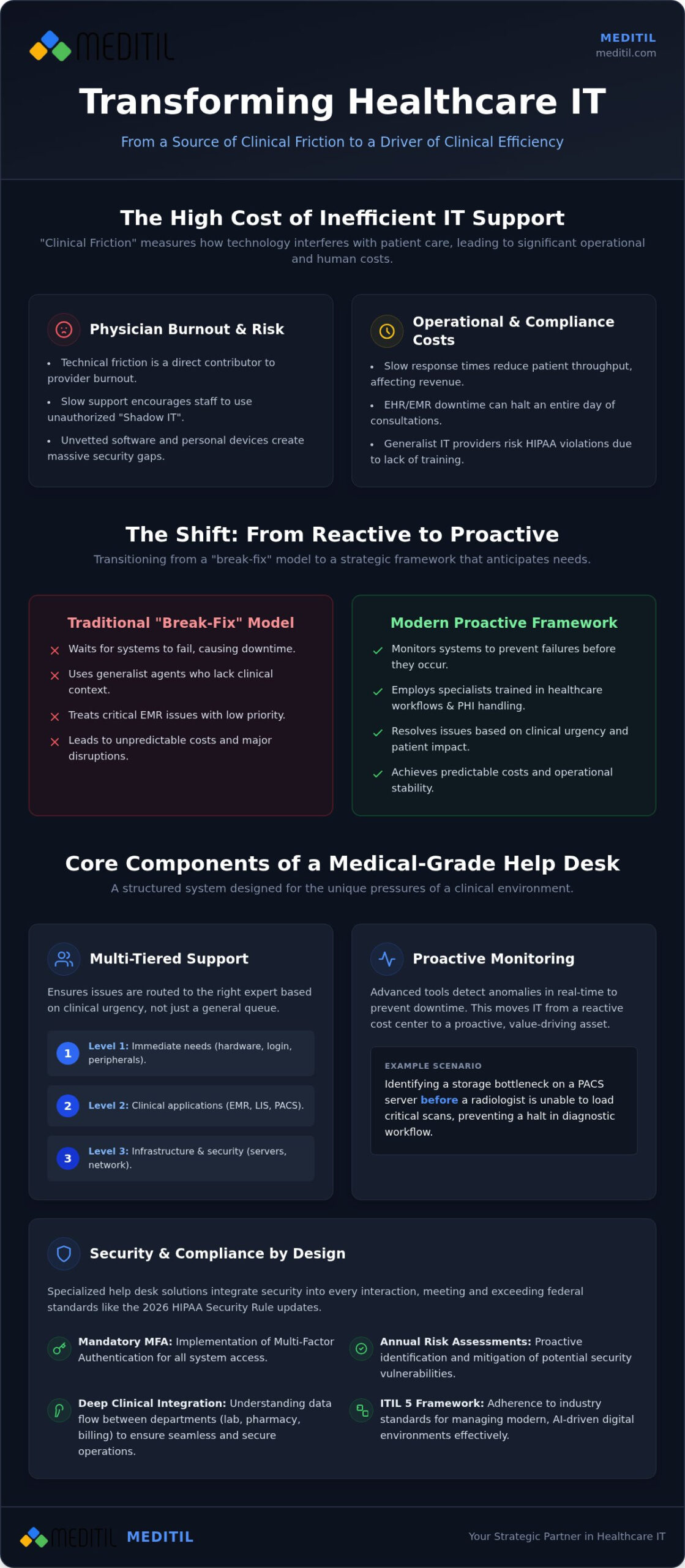
Modern healthcare it help desk solutions represent a fundamental shift from traditional technical support. In a clinical environment, a help desk isn’t just a department that resets passwords or fixes printers. It’s a critical infrastructure component that directly influences patient outcomes. A healthcare help desk is a clinical support system that prioritizes patient-care continuity. This definition reflects the high-stakes nature of the industry, where technical failures can lead to delayed treatments or compromised patient safety.
The primary metric for evaluating these systems in 2026 is “Clinical Friction.” This concept measures the degree to which technology interferes with a provider’s ability to deliver care. High friction occurs when login processes are cumbersome, applications lag, or support response times are slow. By focusing on reducing this friction, organizations can ensure that technology serves as an enabler rather than a barrier. This approach requires a deep integration of technical expertise with a thorough understanding of medical workflows and the ITIL framework, which provides the structure for managing complex digital services.
Why General Managed IT Fails Medical Practices
Generic IT support providers often lack the specialized context required to navigate a medical environment. In a standard business setting, a server delay might be a minor inconvenience. In a clinic, that same delay can halt an entire afternoon of patient consultations. Generalist agents frequently fail to recognize the urgency of EHR or EMR downtime, treating critical clinical applications with the same priority as a standard office suite.
There is also a significant risk regarding data protection. Non-specialized agents may not be trained in the specific nuances of handling Protected Health Information (PHI) during a support session. With the 2026 updates to the HIPAA Security Rule making measures like multi-factor authentication and annual risk assessments mandatory, a generalist’s lack of specialized knowledge becomes a liability. Specialized healthcare it help desk solutions ensure that every interaction remains compliant with evolving federal standards.
The Cost of Inefficient Support
The financial and operational impact of poor IT support is substantial. Physician burnout is often exacerbated by technical friction; when doctors spend more time troubleshooting software than seeing patients, job satisfaction plummets. Latency in help desk response times also reduces patient throughput, directly affecting the practice’s revenue and the patient’s experience.
Inefficient support often forces staff to implement “Shadow IT” solutions. When the official help desk is too slow or unhelpful, clinicians may use unauthorized personal devices or unvetted software to complete their tasks. This creates massive security gaps and undermines the organization’s compliance posture. A managed help desk avoids these risks by providing timely, expert assistance that respects the clinician’s time and the patient’s privacy.
Core Components of a Medical-Grade Help Desk
A medical-grade help desk is far more than a technical call center. It’s a structured response system designed to handle the specific pressures of a clinical environment. To be effective, healthcare it help desk solutions must utilize a multi-tiered support architecture. Level 1 support manages high-volume, immediate needs such as hardware resets or peripheral connectivity. Level 2 agents possess deeper expertise in clinical applications, resolving complex issues within the EMR or LIS. Level 3 support involves senior infrastructure specialists who address backend network stability and security escalations. This tiered approach ensures that critical clinical failures aren’t left in a general queue.
The transition from reactive troubleshooting to proactive monitoring is a hallmark of modern medical support. Rather than waiting for a system to fail, advanced monitoring tools detect anomalies in real-time. For example, identifying a storage bottleneck on a PACS server before a radiologist attempts to load a study prevents a total halt in diagnostic workflows. Integration with clinical systems is mandatory; support teams must understand how data flows between the pharmacy, lab, and billing departments to maintain seamless operations.
HIPAA Compliance and Least Privilege Access
Security protocols must be integrated into every support interaction to meet the standards set by the HITECH Act and HIPAA. A medical-grade help desk operates on the principle of “least privilege access,” meaning agents only have the permissions necessary to complete a specific task. Before any remote session begins, a strict identity verification protocol must be followed to confirm the user’s credentials. Every support action is documented in an immutable audit log, providing a clear record of data access. During screen-sharing, agents are trained to avoid viewing Protected Health Information (PHI) unless it’s strictly required for the technical resolution.
Clinical Workflow Knowledge Base
Effective support relies on a specialized knowledge base that reflects actual medical workflows. Standard Operating Procedures (SOPs) should be documented for common EHR glitches, billing automation hurdles, and pharmacy interoperability issues. When agents understand the context of a “stat” request or a failed lab integration, they can prioritize and resolve tickets with greater precision. This specialized training reduces the burden on clinicians who otherwise have to explain their processes to non-medical IT staff. If your practice requires this level of specialized oversight, exploring Managed IT and Infrastructure services can provide the necessary framework for stability.
Help Desk Software vs. Managed Help Desk Services
Acquiring a subscription for a “healthcare help desk” platform is often mistaken for a complete solution. In reality, software typically represents only 20% of the operational requirement. The remaining 80% consists of the human expertise, configuration, and ongoing management needed to maintain a high-performance environment. Without a dedicated team to update protocols and monitor system health, even the most advanced platform becomes an expensive, underutilized tool. The management gap is where most practices struggle; they possess the tool but lack the personnel to configure it for complex clinical workflows or monitor it for security anomalies.
Organizations must decide between managing an in-house team, fully outsourcing, or utilizing an augmented IT team to support existing staff. A software-only approach often fails because it lacks the strategic oversight required to address sophisticated Security and privacy threats in healthcare. When a practice experiences frequent downtime or inconsistent support, it is a clear signal they have outgrown a basic tool and require professional management. Comprehensive healthcare it help desk solutions bridge this gap by providing both the platform and the expert oversight needed to ensure stability.
The Myth of the ‘Self-Service’ Healthcare Portal
Many software vendors promote self-service portals as a primary way to reduce ticket volume. However, clinicians rarely utilize these portals during active patient encounters. A physician in an exam room does not have the time to search a knowledge base or fill out a detailed web form while a patient waits. Effective healthcare it help desk solutions prioritize immediate, multi-channel access through phone, integrated chat, or desktop shortcuts. Balancing automation with human expertise ensures that technology supports the medical setting rather than obstructing it. True efficiency comes from meeting the provider where they work, not forcing them into a generic administrative portal.
Total Cost of Ownership (TCO) Analysis
Evaluating the TCO of an internal help desk reveals significant hidden costs. Beyond base salaries, organizations must account for ongoing training, benefits, and the technical infrastructure required to support 24/7/365 operations. This level of coverage is essential for emergency departments and urgent care centers where technical failures directly impact patient safety. Transitioning to Managed IT Services for Healthcare offers a more predictable budgeting model. By consolidating support into a managed service agreement, practices gain access to specialized expertise and strategic leadership without the overhead of maintaining a full-scale internal department.
Steps to Implementing a High-Performance Help Desk
Implementing effective healthcare it help desk solutions requires a methodical approach that begins with a comprehensive audit of your existing infrastructure. This audit must move beyond basic hardware inventories to identify specific failure points that frequently disrupt clinical workflows. For instance, mapping recurring network drops in specific exam rooms or slow EHR synchronization speeds provides a baseline for improvement. Once these vulnerabilities are mapped, you can establish Service Level Agreements (SLAs) rooted in clinical urgency. In a medical setting, response times shouldn’t be arbitrary; they must reflect the time-sensitive nature of patient care.
A successful implementation also integrates help desk reporting directly into your strategic IT roadmap. Rather than viewing support as a standalone cost center, use ticket data to drive long-term infrastructure decisions. Establishing a continuous feedback loop between clinicians and IT management is equally vital. This ensures that the technical environment evolves alongside changing clinical needs, allowing providers to voice frustrations before they lead to burnout.
Establishing Tiered Escalation Paths
A medical-grade help desk distinguishes between ‘Critical’ and ‘High’ priority based on immediate patient impact. A ‘Critical’ ticket might involve a total system outage affecting an entire department, while a ‘High’ priority issue could be a single workstation failure in a busy diagnostic suite. Clear escalation paths ensure that deep application glitches are quickly routed to specialized EMR/EHR implementation teams. Designating an onsite technical contact facilitates faster hardware resolutions and maintains local connectivity, serving as a reliable bridge to remote support teams.
Leveraging Data for Infrastructure Improvement
Support data serves as a powerful diagnostic tool for the health of your entire practice. By analyzing ticket trends over time, management can identify aging hardware or network bottlenecks before they result in systemic failures. Performing root cause analysis on frequent requests prevents the same issues from resurfacing, moving the practice from reactive firefighting to a stable, optimized state. Aligning help desk data with Strategic IT Budgeting ensures that capital expenditures are directed where they will have the greatest impact on clinical throughput.
If you’re ready to stabilize your operations with expert oversight, consider our End-User Support and Help Desk services to bridge the gap between technical challenges and clinical excellence.
The MEDITIL Approach: Strategic Help Desk Management
MEDITIL treats the help desk as a diagnostic sensor for the entire medical organization. While many healthcare it help desk solutions focus solely on closing tickets, our approach uses support data to drive strategic growth. We analyze the root causes of technical friction to identify where infrastructure requires modernization. Our customized support frameworks are designed to meet the unique operational demands of specialty clinics and large healthcare systems. Whether we are managing the entire operation or augmenting your existing team, we ensure a seamless integration that respects your established clinical workflows.
This strategic perspective prevents the help desk from becoming a siloed cost center. By examining the frequency and nature of support requests, we can identify systemic issues before they escalate into clinical downtime. This method provides a “steady hand at the wheel” for your IT operations, ensuring every technical intervention contributes to the long-term stability and efficiency of the practice.
Fractional CIO Oversight
Strategic leadership provides the necessary context for technical support. Our Virtual CIO Services transform support data into actionable strategy. We don’t just report on uptime; we conduct quarterly business reviews that focus on how IT performance impacts clinical efficiency and patient throughput. This oversight ensures that your current infrastructure supports long-term initiatives such as telehealth integration and remote patient monitoring. Having a seasoned expert oversee help desk performance ensures that every technical decision aligns with your practice’s broader financial and operational goals.
Security-First Support Culture
In the high-stakes environment of modern medicine, support and security are inseparable. We integrate Healthcare Cybersecurity Services into every help desk interaction. Our support protocols include proactive threat hunting where agents monitor for anomalous login patterns or unauthorized data access attempts during routine troubleshooting. This disciplined approach ensures that your organization remains resilient against evolving cyber threats while maintaining strict compliance with regulatory standards. If you are ready to stabilize your clinical network management and eliminate technical friction, we invite you to request a consultation to discuss a tailored support framework for your organization.
Securing the Future of Your Clinical Infrastructure
The evolution of medical technology in 2026 requires a fundamental shift from basic troubleshooting to a comprehensive clinical support framework. Successfully transitioning to modern healthcare it help desk solutions means prioritizing the reduction of clinical friction above all else. By moving beyond software-only tools and adopting structured, tiered escalation paths, your practice can eliminate the recurring technical delays that contribute to provider burnout. This methodical approach ensures that your infrastructure remains a reliable asset rather than a clinical barrier.
True operational stability is achieved through a combination of technical precision and strategic leadership. Our framework provides 24/7 healthcare-specialized support teams alongside deep expertise in EHR/EMR interoperability. This ensures your systems remain seamless and compliant while our Fractional CIO strategic oversight turns daily support data into a clear roadmap for long-term growth. Establishing a reliable IT foundation allows your clinicians to return their full focus to patient care.
Optimize your clinical operations with MEDITIL’s strategic IT help desk solutions.
We’re ready to serve as your dedicated partner in navigating the complexities of the modern healthcare environment. Let’s work together to build a more stable and efficient future for your practice.
Frequently Asked Questions
What is the difference between a standard IT help desk and a healthcare IT help desk?
A healthcare-specific desk prioritizes clinical continuity and patient safety over general office productivity. Agents must understand the high-stakes nature of medical workflows and the specific technical requirements of EMR systems. Unlike standard support, healthcare it help desk solutions integrate deep knowledge of regulatory standards and the immediate impact of technical downtime on provider burnout. This specialized context ensures that critical systems remain operational when patient care is on the line.
Are all healthcare help desk solutions HIPAA compliant?
HIPAA compliance is not a default feature for all support providers. Many generic IT firms don’t sign Business Associate Agreements (BAAs) or maintain the necessary audit trails for remote sessions. Medical-grade help desks implement specific protocols, such as identity verification before remote access and strict audit logging. These measures ensure that every interaction involving Protected Health Information (PHI) meets the updated 2026 security requirements for data encryption and least-privilege access.
How does a help desk improve physician and nurse productivity?
Effective support improves productivity by eliminating the technical barriers that lead to clinical friction. When physicians and nurses can rely on seamless login processes and responsive EHR systems, they spend more time with patients and less time troubleshooting hardware. Structured support models reduce the cognitive load on staff, allowing them to focus on clinical outcomes. Predictable IT performance directly correlates with higher throughput and reduced provider frustration within the clinic.
Should we outsource our healthcare IT help desk or keep it in-house?
The decision depends on your internal capacity for strategic management and 24/7 coverage. Keeping a help desk in-house requires significant investment in specialized training, benefits, and infrastructure to meet 2026 compliance standards. Outsourcing to a managed partner provides access to a seasoned expert team and fractional CIO leadership. This model often delivers better results by providing predictable costs and high-level technical expertise that a single in-house generalist can’t match.
What are the common tiers in a healthcare IT support model?
Most medical support models utilize a three-tiered structure to manage urgency and complexity:
- Tier 1: High-volume, immediate needs like hardware resets or peripheral connectivity.
- Tier 2: Specialized clinical application support for resolving EHR and LIS workflow glitches.
- Tier 3: Senior infrastructure specialists who manage network stability and complex security escalations.
This tiered approach ensures that technical resources are allocated based on the clinical impact of each request, preventing critical failures from being buried in a general queue.
How can help desk data help in medical billing automation?
Support data reveals the technical bottlenecks that disrupt the flow of data from clinical encounters to the billing office. By analyzing recurring errors in billing automation integrations, IT teams can perform root cause analysis to fix the underlying synchronization issues. This proactive management reduces manual data entry and ensures that claims are processed accurately and without delay. Strategic healthcare it help desk solutions use this data to improve the practice’s overall financial health.
What happens if our EMR goes down after hours?
If your EMR fails after hours, a specialized healthcare support team initiates established emergency downtime protocols to maintain operations. These teams provide 24/7/365 coverage to address critical system outages whenever they occur. Agents work directly with your software vendors and internal onsite contacts to restore connectivity as quickly as possible. This constant availability is essential for urgent care and emergency environments where system access is a prerequisite for patient safety.
Can a help desk assist with telehealth and remote monitoring technical issues?
Help desk teams are essential for maintaining the stability of telehealth and remote monitoring programs. They troubleshoot the technical barriers that prevent successful virtual visits, such as audio/visual failures or peripheral device connectivity. By resolving these issues for both clinicians and patients, support teams ensure that virtual care remains a reliable extension of the practice. This specialized support includes verifying that all remote monitoring data flows securely and accurately into the patient’s record.