
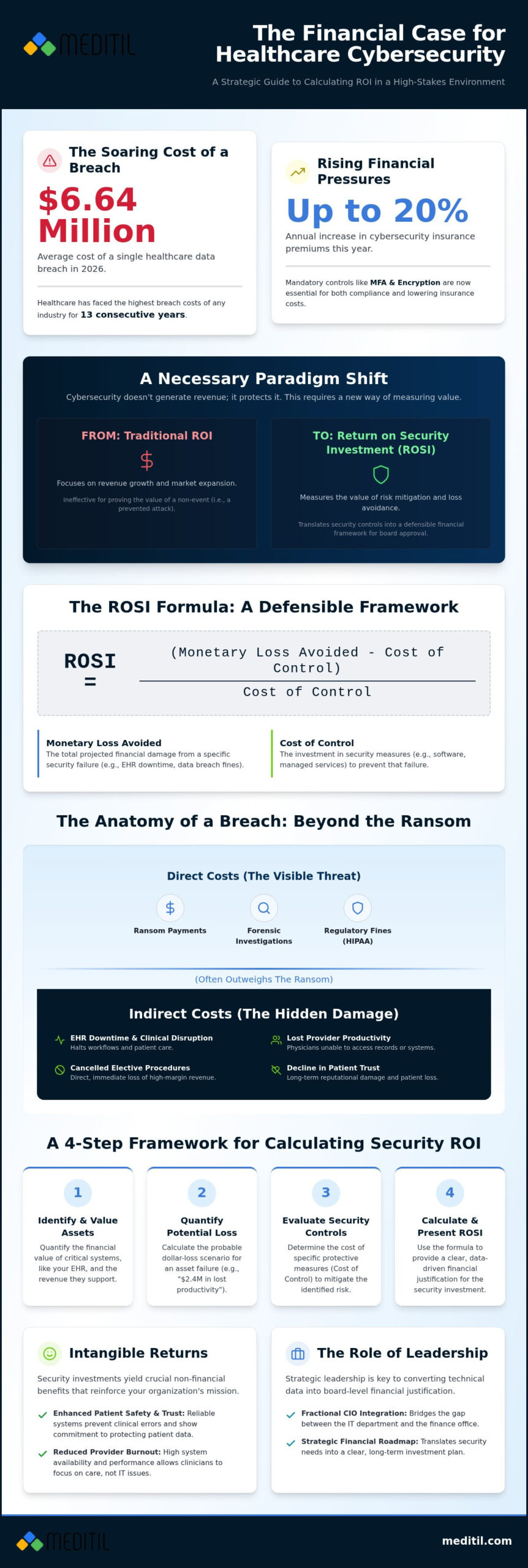
In 2026, the average cost of a single healthcare data breach has climbed to $6.64 million, marking the 13th consecutive year this sector has faced the highest financial impact of any industry. For many leaders, the challenge isn’t understanding the threat; it’s the difficulty of calculating roi on healthcare cybersecurity investments when the primary goal is ensuring that nothing happens. You’re likely facing immense pressure to balance clinical innovation with rigid security budgets while watching insurance premiums rise by up to 20% this year alone.
We understand that a defensible financial framework is essential for board approval and organizational stability. This guide provides the strategic metrics and risk quantification models needed to justify every dollar spent on infrastructure and protection. You’ll master the Return on Security Investment (ROSI) formula and learn how to leverage mandatory controls like MFA and encryption to lower insurance costs. We’ll examine how a structured approach to security not only prevents loss but also minimizes clinical disruption, ensuring your organization remains a reliable, high performing specialist in a regulated environment.
Key Takeaways
- Transition from traditional revenue-focused metrics to Return on Security Investment (ROSI) to accurately measure the value of risk mitigation.
- Account for both direct ransomware costs and indirect clinical impacts; these include EHR downtime and diminished provider productivity.
- Utilize a structured 4-step framework for calculating roi on healthcare cybersecurity investments by quantifying the financial impact of specific asset failures.
- Align cybersecurity protocols with patient safety initiatives to enhance institutional trust and reduce burnout through reliable system availability.
- Integrate Fractional CIO leadership to convert complex technical security data into a strategic financial roadmap for board-level justification.
Beyond Traditional ROI: Understanding ROSI in Healthcare
Traditional Return on Investment (ROI) models are designed to measure revenue growth and market expansion. In the clinical environment, these metrics often fail because cybersecurity does not generate direct income. Instead, it serves as a protective shield for existing assets and operational continuity. For executive leadership, the challenge lies in the “Security Paradox.” When your defenses are effective, nothing happens. Proving the financial value of a non-event requires a shift from traditional ROI to Return on Security Investment (ROSI).
The urgency for this transition has intensified in 2026. With the U.S. Department of Health and Human Services (HHS) finalizing updates to the HIPAA Security Rule, mandatory controls like encryption and multi-factor authentication are no longer optional. These regulatory shifts, combined with the Health Care Cybersecurity and Resiliency Act, have transformed calculating roi on healthcare cybersecurity investments into a mandatory board-level requirement. Leaders must now demonstrate how security spend directly preserves the organization’s valuation and clinical integrity.
The Formula for Healthcare ROSI
To move beyond qualitative assumptions, organizations utilize a specific mathematical framework. The standard ROSI equation is: (Monetary Loss Avoided – Cost of Control) / Cost of Control. In a medical context, the “Monetary Loss Avoided” must be weighted more heavily than in other sectors. You aren’t just calculating the cost of a leaked record; you’re accounting for the $6.64 million average cost of a healthcare breach and the potential for a $11.5 million impact seen in large-scale U.S. incidents.
Strategic healthcare cybersecurity services play a vital role here by stabilizing the “Cost of Control” side of the equation. By utilizing managed services, organizations can replace unpredictable emergency spending with a fixed, predictable investment. This allows for a more accurate and defensible ROSI calculation when presenting to the board or insurance underwriters.
Risk Quantification vs. Qualitative Guesswork
The era of “High, Medium, and Low” risk heatmaps is ending. Modern healthcare leadership requires data-driven forecasting that translates technical vulnerabilities into probable dollar-loss scenarios. This process, known as risk quantification, allows IT departments to speak the language of the finance office. Instead of reporting a “critical server vulnerability,” a team might report a “$2.4 million projected loss in physician productivity” if a specific EHR system fails.
- Move away from heatmaps: Replace colors with currency to show the real-world impact of downtime.
- Utilize industry benchmarks: Incorporate the 2026 average breach statistics to ground your projections in reality.
- Focus on probability: Use the Annualized Rate of Occurrence (ARO) to determine how often a specific threat is likely to strike.
This methodical approach ensures that IT budgeting is no longer a guessing game. It creates a direct, logical connection between a specific security challenge and its financial resolution. When calculating roi on healthcare cybersecurity investments, this level of precision builds the trust necessary for long-term strategic advancement.
Quantifying the Hidden Costs of Healthcare Cybersecurity Failures
When leadership teams begin calculating roi on healthcare cybersecurity investments, they often focus on the most visible threats, such as ransomware payments. While a ransom can cost millions, it’s merely the tip of the iceberg. The financial impact of a breach includes forensic investigations, which average hundreds of dollars per hour, and extensive legal fees required to manage class-action lawsuits and regulatory inquiries. These direct costs hit the balance sheet immediately, but the long-tail expenses of a security failure are often more damaging to the organization’s stability.
Indirect costs frequently outweigh the ransom itself. EHR downtime halts clinical workflows, leading to lost physician productivity and the mass cancellation of elective procedures. If a hospital must divert ambulances to a competitor, the immediate revenue loss is compounded by a decline in patient trust. In 2026, the updated HIPAA Security Rule has also increased the stakes for regulatory non-compliance. Tier 4 penalties now carry significant financial weight, often accompanied by years of costly monitoring by the Office for Civil Rights (OCR). Utilizing the Security Risk Assessment (SRA) Tool is a vital first step in uncovering these vulnerabilities before they manifest as financial liabilities.
The Price of Clinical Friction
Poorly implemented security can create its own set of hidden costs. If multi-factor authentication (MFA) or EMR login protocols are too cumbersome, they add seconds to every patient encounter. Across a large health system, these seconds aggregate into thousands of lost clinical hours annually. Furthermore, restrictive security often drives clinicians toward “shadow IT,” where they use unauthorized personal devices to bypass friction. This creates unquantified risks that are difficult to track or insure. Balancing interoperability with protection is essential to maintain workflow efficiency. A fractional CIO can help align these technical requirements with clinical realities to ensure security doesn’t come at the expense of care delivery.
Insurance Premiums and Audit Readiness
Cyber insurance has evolved into a rigorous technical audit in 2026. Carriers now demand proof of phishing-resistant MFA and immutable backups before even offering a quote. Robust internal controls don’t just protect data; they directly lower insurance deductibles and premiums, which are forecasted to rise by up to 20% this year. Being audit-ready for CMS or HIPAA requirements also saves the immense cost of emergency remediation during an active investigation. In 2026, the average cost of healthcare downtime is estimated to reach $740,000 per hour for large health systems, driven by lost procedure revenue and emergency diversion costs. Proactive investment is the only way to stabilize these volatile operational risks.
A 4-Step Framework for Calculating Your Security ROI
For leaders tasked with calculating roi on healthcare cybersecurity investments, the process must move from abstract concern to actuarial precision. This framework allows you to present a defensible financial case to the board by quantifying the value of risk reduction. By following these four steps, you can transform technical vulnerabilities into a prioritized investment roadmap.
- Step 1: Determine Single Loss Expectancy (SLE). This represents the total financial impact of a single security incident on a specific asset. It includes the cost of data recovery, legal fees, and the $11.5 million average cost of a U.S. healthcare breach.
- Step 2: Estimate the Annualized Rate of Occurrence (ARO). Based on 2026 threat intelligence, determine how often a specific threat is likely to strike. For example, phishing attempts are near-constant; however, a successful ransomware deployment might have a lower, yet devastating, probability.
- Step 3: Calculate the Annualized Loss Expectancy (ALE). Multiply your SLE by the ARO (SLE x ARO = ALE). This figure represents the projected annual cost of doing nothing to mitigate the risk.
- Step 4: Factor in the Mitigation Ratio. This final step determines the Return on Security Investment (ROSI). Subtract the cost of the security control from the loss avoided, then divide by the cost of the control.
Identifying High-Value Medical Assets
Not all data carries the same weight in your financial models. It’s essential to differentiate between basic Personally Identifiable Information (PII) and Protected Health Information (PHI) or proprietary clinical research. PHI is significantly more valuable on the dark web and carries heavier regulatory penalties under the 2026 HIPAA updates. Data silos often concentrate this risk, making a single server a multi-million dollar liability. Utilizing strategic it budgeting for medical practices helps you prioritize these high-value assets, ensuring that your most critical clinical data receives the highest level of protection.
Calculating the Mitigation Ratio
Calculating the true impact of a security tool requires realistic expectations. While vendors may promise total protection, 100% mitigation is a myth. Most effective frameworks model an 80% to 90% reduction in breach probability through tools like phishing-resistant MFA or continuous vulnerability scanning. When calculating roi on healthcare cybersecurity investments, you must also account for the total cost of ownership. This includes the implementation fees and the ongoing managed it services for healthcare required to maintain the system. By using realistic mitigation percentages, your ROSI remains defensible during board-level scrutiny and insurance audits.
Intangible Returns: Patient Trust and Provider Satisfaction
Beyond the actuarial tables and risk quantification models, cybersecurity serves a profound mission-driven purpose: protecting the patient-provider relationship. While the math of ALE and SLE provides a necessary foundation, calculating roi on healthcare cybersecurity investments must also account for the qualitative value of institutional reputation. In 2026, security resilience has become a core component of patient safety. When clinical systems remain available and data remains private, trust is preserved. A single breach can lead to immediate patient churn, particularly in elective healthcare sectors where privacy is a primary decision-making factor for consumers.
Provider satisfaction is equally dependent on a stable IT environment. Chaotic security protocols that introduce excessive clinical friction often lead to provider burnout and the emergence of shadow IT. By ensuring reliable EHR access and seamless authentication, organizations protect their most valuable asset: their clinical staff. Verified compliance also strengthens ties with interoperability partners. Health systems are increasingly hesitant to share data with entities that can’t demonstrate a robust security posture through technical audits.
Security as a Foundation for Telehealth
The expansion of remote patient monitoring and telehealth services requires an infrastructure that’s secure by design. Security shouldn’t be a barrier to digital health adoption; it should be the catalyst. By investing in resilient telehealth frameworks, organizations can unlock new revenue streams and reach underserved populations without expanding their risk profile. This growth is only sustainable when patients feel confident that their home-monitored data is shielded from unauthorized access. Quantifying the growth enabled by these secure platforms reveals a long-term return that far exceeds the initial implementation costs.
Culture of Security and Staff Retention
A major breach creates a toxic work environment characterized by emergency remediation and operational paralysis. The cost of staff turnover following such an event is significant, often exceeding the direct technical costs of the incident. Proactive security builds a culture of professional excellence where staff feel supported by reliable, high-performing tools. Cybersecurity awareness training serves as a high-ROI, low-cost control by transforming the workforce into a proactive human firewall against social engineering. To ensure your security strategy supports both clinical goals and patient trust, partner with a healthcare cybersecurity expert to align your technology with your mission.
Executing the Strategy: The Role of the Fractional CIO
Technical tools alone cannot deliver or measure the value of a security program. While software provides data, it lacks the strategic context required for calculating roi on healthcare cybersecurity investments in a way that satisfies a board of directors. A Fractional CIO acts as the architect of your security strategy, transforming raw technical metrics into a financial narrative centered on risk mitigation and capital preservation. They ensure that every dollar spent on infrastructure aligns with the organization’s long-term clinical roadmap and regulatory obligations.
Communicating with the board requires a shift from technical jargon to the language of business risk. Instead of discussing firewall throughput, a Fractional CIO explains how a specific investment reduces the probability of a multi-million dollar operational shutdown. This leadership role is essential for navigating the 2026 regulatory environment, where compliance is no longer a checklist but a continuous technical audit. Fractional leadership offers a disciplined, results-oriented presence, providing the expertise of a seasoned executive without the significant overhead of a full-time, permanent CISO.
Strategic Oversight and Ongoing Optimization
The Fractional CIO provides the “steady hand at the wheel” necessary for maintaining a proactive security posture. Rather than reacting to the latest headline-grabbing threat, they implement a methodical cycle of continuous risk assessment and ROI reporting. This ensures that your virtual cio services don’t just maintain the status quo but drive strategic advancement. By moving away from reactive patching and toward a structured maturity model, your organization can demonstrate a reliable, high-performing specialist persona to insurance underwriters and clinical partners alike.
Customized Implementation for Medical Practices
One-size-fits-all security often fails because it doesn’t account for the unique workflows of specialty clinics. A surgical center’s needs differ significantly from those of a primary care network, and rigid protocols shouldn’t impede care delivery. MEDITIL focuses on tailoring infrastructure and network services to maximize ROSI by eliminating unnecessary clinical friction. We help you take the next step in your risk quantification journey by auditing your existing systems and identifying where calculating roi on healthcare cybersecurity investments can reveal immediate opportunities for cost stabilization. This customized approach ensures that your security framework is as precise and efficient as the medical care you provide.
Securing Your Financial and Clinical Future
The 2026 regulatory landscape and the rising costs of data breaches make a rigorous approach to security mandatory for healthcare leaders. By shifting from traditional revenue-based metrics to a Return on Security Investment (ROSI) model, you can preserve enterprise value and ensure clinical continuity. Protecting high-value assets like PHI isn’t just a compliance requirement; it’s a strategic move that stabilizes insurance premiums and reinforces patient trust.
Mastering the process of calculating roi on healthcare cybersecurity investments allows your organization to move beyond qualitative guesswork toward data-driven stability. As a specialized healthcare IT authority, MEDITIL provides the fractional CIO strategic guidance needed to translate technical risks into a defensible financial roadmap. Our HIPAA compliance and cybersecurity experts help you build a resilient infrastructure that supports both innovation and protection. Schedule a consultation with a MEDITIL Fractional CIO to quantify your security ROI and ensure your organization remains a reliable leader in a complex environment. We’re ready to partner with you for long-term operational success.
Frequently Asked Questions
What is the difference between ROI and ROSI in healthcare?
Traditional ROI measures revenue gain or profit generated from an investment. In contrast, Return on Security Investment (ROSI) measures the financial value of avoided losses and prevented disasters. In the medical sector, where cybersecurity doesn’t generate direct income, ROSI is the standard metric. It evaluates the cost of a security control against the potential expense of a data breach or clinical downtime, focusing on capital preservation rather than income.
How do I calculate the cost of a data breach for a small medical practice?
Small practices should total the direct expenses of forensic investigations, patient notification, and legal fees. You must also account for indirect costs like lost revenue during system downtime and potential HIPAA Tier 4 penalties. While smaller than a hospital system, a clinic’s breach costs often exceed its remaining capital. Factoring in the rising price of cyber insurance, which can top $20,000 annually, is also essential for an accurate total.
Does HIPAA compliance guarantee a positive cybersecurity ROI?
Compliance alone doesn’t guarantee a positive return, but it’s a vital baseline for avoiding catastrophic regulatory fines. While calculating roi on healthcare cybersecurity investments, you’ll find that compliance acts as a shield against the financial impact of willful neglect. However, true ROI comes from implementing proactive controls that go beyond basic checklists. These advanced measures actually stop malicious actors from disrupting your clinical workflow and damaging your institution’s reputation.
Can cybersecurity investments actually lower my clinical operating costs?
Yes, strategic security investments lower operating costs by reducing emergency IT remediation and stabilizing system uptime. Proactive protection prevents the expensive “firefighting” mode that drains administrative budgets. Additionally, robust controls often lead to lower cyber insurance premiums, which are forecasted to rise by up to 20% in 2026. Efficient security protocols also reduce the time clinicians spend dealing with system failures, allowing them to focus entirely on patient care.
How often should a healthcare organization re-calculate its security ROI?
Healthcare organizations should re-calculate their security ROI at least annually or whenever significant infrastructure changes occur. The threat landscape shifts rapidly; for example, AI-enabled attacks rose by 56% this year. Regular reviews ensure that your investment strategy remains aligned with current risks and regulatory updates. This methodical approach helps maintain board confidence and ensures that your IT budget is prioritized for the high-value assets that require the most protection.
What are the most important cybersecurity metrics to report to a healthcare board?
Boards prioritize risk reduction and financial stability over technical logs. Report on metrics like Mean Time to Detect (MTTD), Mean Time to Respond (MTTR), and the percentage of incidents handled through automation. When calculating roi on healthcare cybersecurity investments, always link these technical metrics to clinical continuity and patient safety. Presenting these figures alongside your Annualized Loss Expectancy (ALE) provides a clear picture of the enterprise value your security program preserves.
How does a Fractional CIO help in calculating and proving security ROI?
A Fractional CIO acts as a strategic architect who translates complex technical data into a defensible financial narrative. They identify high-value medical assets and apply the ROSI formula to justify security spending to the board. This leadership ensures that your IT roadmap is aligned with business goals. They provide the expert oversight needed to manage technical audits from insurers and regulators, providing a steady hand at the wheel for your organization.
Is cyber insurance a substitute for investing in cybersecurity controls?
Cyber insurance is a risk-transfer mechanism, not a substitute for robust security controls. In 2026, insurers require specific technical safeguards, such as phishing-resistant MFA and immutable backups, as a condition for coverage. Relying solely on insurance leaves your organization vulnerable to reputational damage and clinical disruption that money can’t fix. Insurance helps with financial recovery, but only strong defenses can ensure the continuous delivery of care and long-term patient trust.