
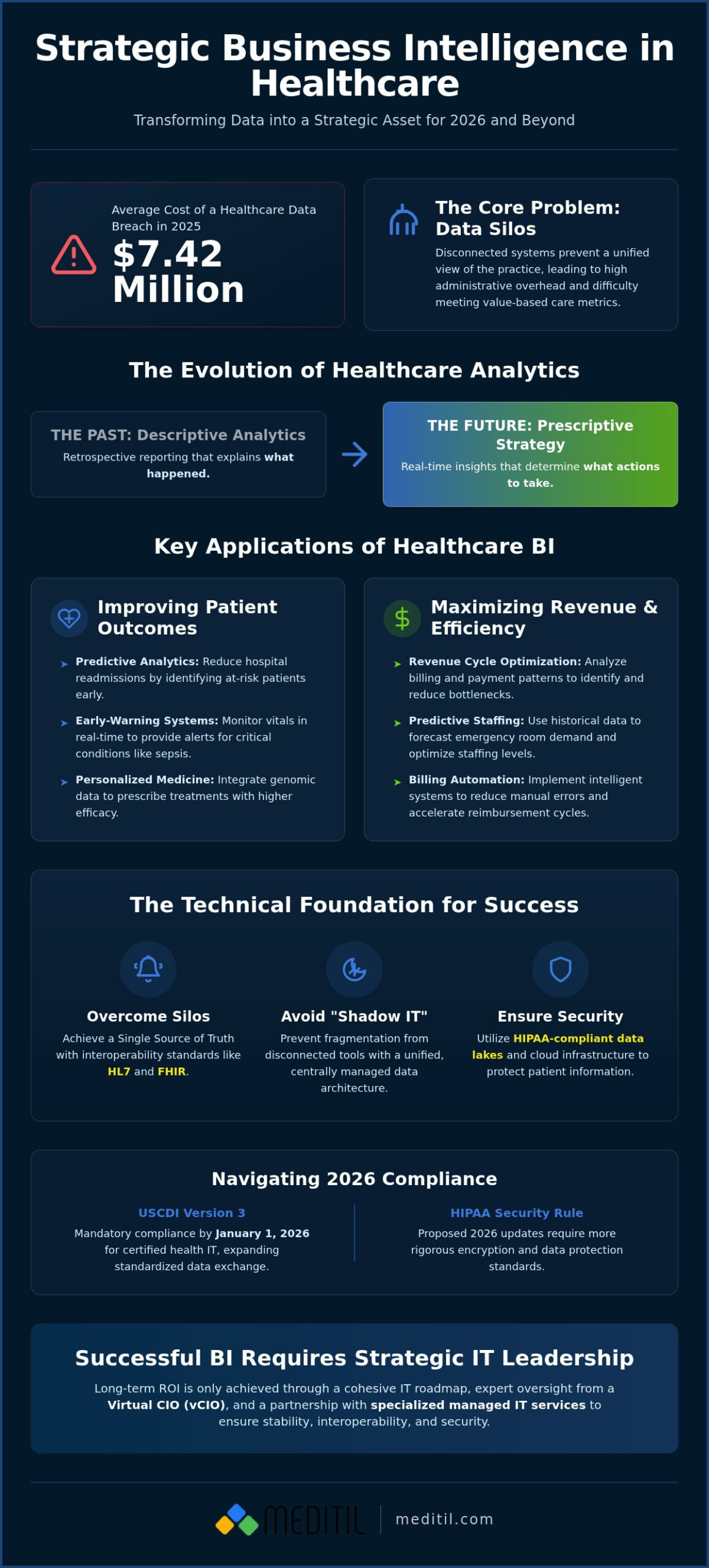
The average cost of a healthcare data breach reached $7.42 million in 2025, highlighting a critical need for more disciplined data management. While your organization likely captures immense volumes of information, the presence of data silos often prevents a unified view of the practice. You’re likely dealing with high administrative overhead and the increasing difficulty of meeting value-based care metrics. By analyzing real-world business intelligence in healthcare examples, you can identify how to bridge these gaps and transform clinical data into a strategic asset.
We’ll provide a clear roadmap for BI implementation that addresses the technical and regulatory complexities of 2026. You’ll learn how healthcare leaders leverage analytics to achieve concrete ROI while navigating mandatory requirements like USCDI Version 3 compliance and updated HIPAA privacy rules. This article explores the role of a strategic IT partner in building a secure data engine and highlights how billing automation serves as a primary driver for operational success. Discover how to move beyond retrospective reporting to a future defined by predictive insight and stable growth.
Key Takeaways
- Learn how predictive analytics can reduce hospital readmissions and provide early-warning alerts for critical conditions like sepsis.
- Explore concrete business intelligence in healthcare examples that optimize revenue cycles and predict emergency room staffing needs.
- Understand the critical role of interoperability standards like HL7 and FHIR in creating a secure, unified data ecosystem.
- Discover why successful BI implementation requires a strategic IT roadmap and the oversight of a Virtual CIO to ensure long-term ROI.
- Identify how to overcome the limitations of data silos by shifting from simple data collection to prescriptive strategic action.
Beyond Data Collection: Defining Strategic BI in Modern Healthcare
In the current regulatory environment, simply amassing patient records is no longer sufficient for operational success. Strategic business intelligence (BI) has evolved from descriptive analytics, which merely explain what happened in the past, into a framework for prescriptive strategy. This evolution allows healthcare leaders to determine exactly what actions to take to improve clinical and financial outcomes. This broader field of business analytics provides the foundation for turning raw data into a competitive advantage. When examining business intelligence in healthcare examples, the most successful organizations are those that have moved past static reporting toward dynamic, real-time decision support.
The primary barrier to this evolution remains the data silo. Many Electronic Health Records (EHRs) still operate as closed systems, preventing a unified view of the practice. As of January 1, 2026, compliance with USCDI Version 3 is mandatory for certified health IT. This mandate expands the scope of standardized data exchange to include social determinants of health, yet achieving a Single Source of Truth still requires active systems integration. This level of synchronization is only possible when the underlying infrastructure is robust. Professional managed IT services for healthcare provide the stability and interoperability required to process high-volume data streams without compromising performance or security.
The 2026 Healthcare Data Landscape
The volume of unstructured data continues to surge, driven by the proliferation of IoT devices and remote patient monitoring tools. Cloud-native infrastructure has become the standard for scaling these BI capabilities, allowing practices to ingest diverse data types simultaneously. This transition enables a move from retrospective reporting to real-time clinical insights. Providers can now adjust care plans based on live data feeds rather than waiting for month-end summaries, which is essential for meeting modern value-based care metrics.
Why BI Fails Without Strategic IT Alignment
Without a cohesive roadmap, organizations often fall victim to “shadow IT,” where individual departments implement disconnected tools that create further fragmentation. Ensuring data integrity across multiple clinical platforms is a technical necessity that requires expert oversight. To protect against the rising cost of data breaches, which averaged $7.42 million in 2025, organizations must utilize HIPAA-compliant data lakes. These repositories allow for secure, centralized analysis while maintaining the rigorous encryption standards expected under proposed 2026 HIPAA Security Rule updates. Effective business intelligence in healthcare examples show that long-term success depends on a disciplined, unified approach to data architecture.
Clinical Business Intelligence Examples: Improving Patient Outcomes
Clinical business intelligence goes beyond static dashboards; it actively changes provider behavior at the bedside. By integrating advanced analytics into daily workflows, organizations can transition from reactive treatment to proactive intervention. These real-life examples demonstrate how data-driven insights prevent adverse events and support the shift toward value-based care. When clinical teams have access to actionable data, they can focus resources on the patients who need them most. This precision is essential in an era where patient outcomes are directly tied to financial viability.
Reducing Clinical Friction with Predictive Modeling
Predictive modeling serves as a vital safeguard against preventable complications. To be effective, these insights must be integrated directly into the EHR workflow to avoid the friction of manual data cross-referencing. Industry data suggests that implementing predictive modeling can reduce hospital readmission rates by as much as 25% in high-risk patient populations. This automation helps mitigate physician alert fatigue by ensuring that notifications are both relevant and timely. If your practice needs to build these advanced capabilities, specialized business intelligence and analytics support can provide the necessary technical framework.
Population Health Management
Managing chronic diseases requires a comprehensive view of population health metrics across the entire practice. BI tools allow providers to track diabetic and cardiac patients at scale, identifying gaps in care that might otherwise go unnoticed. This is particularly critical for meeting value-based care reimbursement criteria, where success is tied to long-term wellness rather than service volume. By monitoring immunization and screening compliance across specific demographics, organizations can launch targeted outreach programs. This disciplined approach ensures that every patient receives appropriate preventative care, fulfilling the requirements of modern health equity standards and USCDI Version 3 mandates.
Operational BI Examples: Maximizing Revenue and Efficiency
Operational stability ensures clinical longevity. While the previous section focused on patient outcomes, business intelligence in healthcare examples also extend into the financial and administrative engine of a practice. By leveraging advanced analytics, administrators can identify specific bottlenecks in the revenue cycle that lead to capital leakage. This data driven approach allows for a disciplined transition from guesswork to precise resource allocation. It’s no longer just about seeing more patients; it’s about optimizing the infrastructure that supports their care.
A primary application of these tools is the integration of medical billing automation solutions to feed operational BI systems. These systems don’t just process transactions. They analyze claim denial patterns to identify root causes, such as recurring coding errors or specific payer behavior trends. This level of insight is critical as the industry faces tighter margins and increased regulatory scrutiny. Understanding the business intelligence roles in healthcare required to manage these systems is a vital step for any organization aiming for long term financial health.
Optimizing the Revenue Cycle
In 2026, managing the revenue cycle requires real time tracking of “Days in AR” (Accounts Receivable) to maintain healthy cash flow. BI tools provide a transparent view of underpaid claims, allowing staff to focus their efforts on high value recoveries rather than manual data entry. By automating the identification of these discrepancies, practices can significantly reduce administrative overhead. This shift allows billing teams to operate with greater precision, ensuring that every service rendered is accurately compensated and every denial is systematically addressed.
Capacity and Resource Planning
Predictive analytics also plays a major role in capacity management and staffing. By analyzing historical data, administrators can predict peak emergency room hours and adjust nursing shifts accordingly. This prevents both understaffing during surges and unnecessary labor costs during quiet periods. Similar logic applies to operating room scheduling, where BI insights help reduce gaps between procedures. Furthermore, supply chain analytics can track inventory in real time to reduce surgical suite waste. Even high value medical imaging equipment benefits from predictive maintenance schedules, which use BI to signal potential failures before they cause clinical downtime. These practical business intelligence in healthcare examples demonstrate how data creates a more resilient, efficient practice.
The Infrastructure Foundation: Securing Your BI Ecosystem
Infrastructure is the silent partner of every analytical insight. While clinical dashboards and financial reports often receive the focus, the underlying architecture determines whether those insights are reliable or a liability. In 2026, selecting the right architecture, whether cloud-native or a hybrid on-premise model, is a strategic decision that impacts both data security and processing speed. Effective business intelligence in healthcare examples rely on a foundation that can handle massive data ingestion while maintaining strict regulatory boundaries. This is where healthcare cybersecurity services become essential, acting as the protective shell for your organization’s most sensitive data assets.
Cybersecurity is the invisible component of successful BI. Given that the average cost of a healthcare data breach reached $7.42 million in 2025, the stakes for data protection have never been higher. Proposed 2026 updates to the HIPAA Security Rule suggest a shift toward mandatory encryption for ePHI and defined schedules for vulnerability scans. A robust infrastructure ensures that as you scale your analytical capabilities, your risk profile doesn’t expand alongside them. It requires a disciplined approach to network segmentation and proactive monitoring to keep the data engine running without interruption.
Maintaining HIPAA Compliance in Analytics
Compliance in a BI context requires more than just a secure server. Organizations must implement sophisticated data masking and anonymization techniques, especially when using clinical data for broader research BI or population health studies. This ensures that while patterns are identified, individual patient identities remain protected.
- Business Associate Agreements: Healthcare providers must execute a Business Associate Agreement (BAA) with any BI vendor that handles ePHI to satisfy federal compliance requirements.
- Audit Trails: Systems must maintain immutable logs that track who accessed specific data sets and when the access occurred.
- Encryption: Both data at rest and data in transit must meet modern encryption standards to mitigate the risk of unauthorized interception.
Interoperability as a BI Catalyst
Interoperability is the bridge between legacy systems and modern analytical platforms. As of January 1, 2026, compliance with USCDI Version 3 is mandatory, which standardizes the exchange of health equity and social determinants data. Utilizing HL7 and FHIR standards allows for seamless connectivity across disparate departments. This standardization ensures that a lab result from an external facility is interpreted with the same accuracy as an internal record. By using APIs for real-time data ingestion, your BI tools can provide a current snapshot of the practice rather than a delayed retrospective. If your current infrastructure lacks this connectivity, you can schedule a consultation for systems integration to begin building a unified data ecosystem.
Implementing BI: The Role of Strategic IT Leadership
Successful business intelligence implementation is rarely a matter of simply purchasing the right software. It is a leadership challenge that requires a cohesive vision to bridge the gap between technical capability and clinical utility. Without executive-level oversight, BI projects often stall in the pilot phase or fail to produce actionable results because they lack a clear connection to the organization’s mission. Strategic leadership ensures that every analytical tool serves a specific purpose, whether that is improving patient safety or protecting the practice’s financial health. The most effective business intelligence in healthcare examples are those where the technology is guided by a disciplined, long-term roadmap.
For many healthcare organizations, the primary obstacle to this level of oversight is a talent gap. Hiring a full-time Chief Information Officer (CIO) can be cost-prohibitive for independent practices or mid-sized groups. The Virtual CIO services model addresses this by providing high-level strategic guidance without the burden of an executive salary. A Virtual CIO acts as a steady hand at the wheel, helping leaders prioritize investments based on immediate ROI and long-term stability. This partnership allows organizations to scale their data capabilities with precision, moving from isolated reports to an enterprise-wide strategy that informs every department.
Developing a Strategic IT Roadmap
A strategic roadmap begins with an honest gap analysis of your current data capabilities. You must identify where data silos exist and which clinical or financial KPIs are currently invisible to leadership. By prioritizing BI use cases that offer the most significant impact, such as reducing readmission rates or optimizing the revenue cycle, you can build momentum for broader adoption. This methodical approach ensures that your BI engine is built on a foundation of verified, high-quality data rather than fragmented snapshots.
Partnering for Success
Organizations must eventually decide between building an in-house BI team or leveraging managed services. In specialized healthcare environments, augmented IT teams often provide the best balance of deep technical expertise and industry-specific knowledge. These partners understand the nuances of HIPAA compliance and the technical requirements of USCDI Version 3, allowing your internal staff to focus on patient care. Building a data-driven culture also requires training clinical staff to interpret and trust the insights provided by these systems. When physicians see tangible business intelligence in healthcare examples that improve their daily workflow, they become advocates for the technology. Ready to turn your data into a strategic asset? Consult with a MEDITIL specialist today.
Securing a Competitive Advantage Through Data Maturity
The transition from descriptive reporting to prescriptive strategy is no longer a luxury; it’s a requirement for clinical and financial survival in 2026. We’ve explored how a robust infrastructure and interoperability standards like USCDI Version 3 create the data engine necessary for modern analytics. By reviewing these business intelligence in healthcare examples, it’s clear that long-term success depends on the disciplined integration of clinical data into daily operational workflows.
Building this ecosystem requires more than just technical tools. It demands a strategic partner who understands the high-stakes nature of the industry. MEDITIL provides managed IT services tailored specifically for healthcare, supported by national cybersecurity and compliance expertise. Our Fractional CIO services offer the executive-level guidance needed to navigate complex regulatory changes; we ensure your technology investments yield a measurable ROI.
Scale Your Practice with Strategic Healthcare IT and BI Guidance. Your organization has the potential to turn every data point into a roadmap for better care and improved profitability. We’re ready to help you take that next step with precision and confidence.
Frequently Asked Questions
What are the most common examples of BI in healthcare?
Common business intelligence in healthcare examples include predictive modeling for hospital readmissions and revenue cycle pattern analysis. These tools allow administrators to identify clinical risks and financial bottlenecks before they impact the organization. By integrating disparate data sources, practices can transition from retrospective reporting to real-time operational oversight and precise resource allocation.
How does business intelligence improve patient safety?
BI improves patient safety by providing real-time clinical decision support and early-warning alerts. For instance, systems can monitor vital signs to detect early indicators of sepsis or identify potential medication errors before they occur. This proactive approach reduces the reliance on manual monitoring and helps clinical teams intervene immediately when a patient’s condition begins to deteriorate.
Is BI implementation HIPAA compliant?
BI implementation is HIPAA compliant when the underlying architecture adheres to strict security standards. This includes the use of data masking for research and the execution of Business Associate Agreements with all vendors. Under proposed 2026 rules, organizations must also ensure mandatory encryption for ePHI and maintain immutable audit trails to track every instance of data access.
What is the difference between healthcare analytics and business intelligence?
Business intelligence focuses on providing actionable insights for immediate operational and clinical decisions. Healthcare analytics is a broader discipline that includes advanced data mining and complex statistical modeling. While BI tells you what to do next based on current performance, analytics often explores long-term trends and theoretical correlations across massive, historical datasets.
How much does it cost to implement BI in a medical practice?
The cost of implementation isn’t standardized and varies based on the scope of the project and the complexity of existing systems. Factors such as the volume of data, the number of necessary integrations, and the level of expert consulting will influence the total investment. Practices should focus on projected ROI and long-term operational savings when evaluating these customized solutions.
Do I need a full-time CIO to manage my BI strategy?
You don’t need a full-time CIO to manage a successful BI strategy. Many organizations utilize a Fractional CIO to provide executive-level guidance and develop a strategic IT roadmap. This model provides the expertise required to oversee complex systems integrations and ensure regulatory compliance without the overhead of a full-time executive salary and benefits package.
How can BI reduce physician burnout?
What data sources are needed for healthcare business intelligence?
Effective BI requires a combination of clinical, financial, and operational data sources. This typically includes EHR records, billing systems, and unstructured data from remote patient monitoring devices. Standardizing these formats through HL7 or FHIR protocols ensures that the data is accurate and accessible across different departments, providing a unified view of the practice’s performance.