
What if your EHR system functioned as a catalyst for clinical efficiency rather than a primary driver of physician burnout? Most healthcare leaders recognize that manual data entry and fragmented systems are draining vital resources. You’ve likely felt the mounting pressure of Information Blocking penalties while navigating the prohibitive costs of custom API development. To stay competitive, your facility requires robust ehr integration services that bridge the gap between disparate platforms and clinical workflows.
It’s clear that interoperability isn’t just a software purchase; it’s a strategic infrastructure that demands expert oversight and precision. You deserve a system where data moves securely and automatically, allowing your clinicians to focus on patient care instead of administrative hurdles. This guide will help you master the technical landscape of modern interoperability to eliminate silos and ensure long-term regulatory compliance.
We’ll explore a comprehensive framework for 2026 that prioritizes seamless data flow between EHR and billing systems. You’ll learn how to leverage fractional leadership and managed integrations to meet the rigorous requirements of the 21st Century Cures Act. By the end of this article, you’ll have a clear roadmap for improving patient outcomes through a more coordinated, stable, and digitally unified care environment.
Key Takeaways
- Understand why the 2026 healthcare landscape demands more than simple data sharing to meet the strict requirements of the 21st Century Cures Act.
- Learn how modern communication protocols like HL7 FHIR and SMART on FHIR serve as the technical foundation for secure, third-party application connectivity.
- Discover how professional ehr integration services eliminate semantic gaps and data silos to ensure a seamless flow of information between clinical and billing systems.
- Identify the specific steps for conducting a clinical workflow audit to define clear interoperability goals for specialty clinics.
- Explore how fractional CIO leadership provides the strategic stability needed to manage complex infrastructure without the overhead of internal team expansion.
The State of EHR Interoperability in 2026
EHR interoperability is the secure, seamless exchange and subsequent use of health data across disparate systems. In 2026, the healthcare industry has moved past the era of simply sending a file. The current mandate requires that data isn’t just shared, but is actually computable and contextually relevant at the point of care. The Office of the National Coordinator (ONC) has established rigorous standards to ensure that information follows the patient. This liquid data flow is essential for improving patient safety and empowering clinical decision-making. When you implement professional ehr integration services, you’re not just checking a box; you’re ensuring your clinicians have the right data at the right time to make life-saving choices.
The Four Levels of Health Data Exchange
Achieving true interoperability requires a structured approach across four distinct levels. Foundational exchange is the most basic, involving the movement of data from one system to another without the receiving system needing to interpret it. Structural exchange moves a step further by ensuring data fields map correctly across platforms, often using standardized formats like HL7. Semantic exchange represents the gold standard. At this level, systems understand the context and meaning of the data, allowing for advanced clinical decision support. Finally, organizational exchange aligns workflows and policies across different entities. This is frequently managed through a Health Information Exchange (HIE), which provides the governance and infrastructure needed for cross-institutional collaboration. Each level builds upon the last to create a reliable ecosystem for patient information.
Regulatory Drivers: The 21st Century Cures Act
Compliance is a primary driver for modernizing clinical infrastructure. The Information Blocking Rule, part of the 21st Century Cures Act, has reached a critical enforcement phase in 2026. Specialty clinics and small practices can no longer afford to maintain data silos. You’re required to ensure that electronic health information is accessible and exchangeable without unnecessary interference. Professional ehr integration services help you meet these requirements by deploying standardized APIs that facilitate patient-directed data exchange. These APIs allow patients to access their records through third-party applications securely. Staying compliant isn’t just about avoiding penalties; it’s about building a transparent, patient-centered practice that thrives in a regulated environment. It’s a complex landscape, but with the right strategic framework, your facility can turn these mandates into a competitive advantage.
Core Technologies Powering Interoperability Solutions
Effective ehr integration services depend on a standardized technical architecture that prioritizes both speed and accuracy. While HL7 has served the industry for decades, Fast Healthcare Interoperability Resources (FHIR) has emerged as the definitive framework for modern connectivity. These protocols work alongside the United States Core Data for Interoperability (USCDI) to ensure that clinical data remains consistent as it travels between systems. By adhering to federal rules on interoperability, facilities can transform their data into a liquid asset that moves securely across cloud-based hubs. This alignment ensures that every specialist and primary care provider sees the same clinical picture without manual intervention.
The Power of Modern APIs in Healthcare
The transition from legacy batch file transfers to RESTful APIs has revolutionized clinical efficiency. These modern interfaces allow for instantaneous data requests, providing clinicians and patients with real-time access to vital health information. FHIR is the standard that allows different EHRs to speak the same language. This common tongue is further enhanced by SMART on FHIR, which enables third-party applications to integrate directly into existing workflows without disruptive custom coding. Cloud-based Health Information Exchanges (HIEs) act as centralized hubs in this ecosystem, facilitating the secure distribution of records across a network of providers. It’s a level of modularity that allows for rapid scaling and improved user experiences across the care continuum.
Cloud Infrastructure and Data Security
Interoperability cannot exist without a foundation of trust and protection. As data moves between disparate cloud environments, maintaining a robust healthcare cybersecurity services posture becomes a non-negotiable requirement. Data integrity must be verified at every hop to prevent corruption or unauthorized access during transit. Strategic infrastructure planning involves implementing N+1 redundancy to ensure that interoperable systems remain operational even during hardware or network failures. This approach provides the stability needed for high-stakes environments where downtime isn’t an option. It ensures that your ehr integration services provide a reliable, high-performing environment for your clinical staff.
If you’re looking to bridge these technical gaps with a clear strategy, our consultants can help you align your infrastructure with long-term clinical outcomes. A strategic IT partner can guide you through the complexities of modern healthcare technology to ensure your systems remain both compliant and efficient.
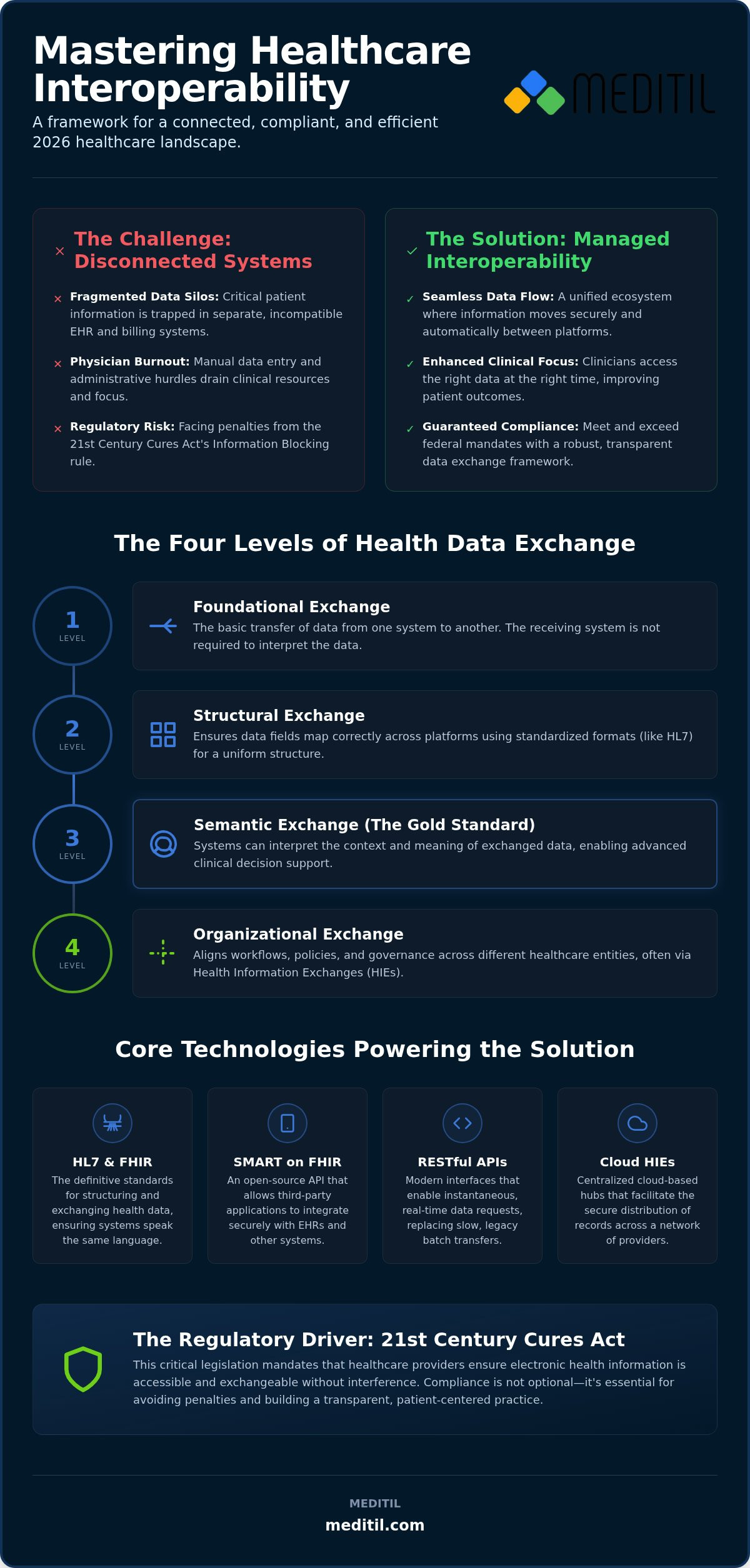
Common Challenges vs. Managed Interoperability Solutions
Many healthcare organizations struggle with data silos that prevent a unified patient view. Legacy systems often lack the modern architecture needed for real-time exchange. This fragmentation doesn’t just hinder operations; it directly contributes to physician burnout. When clinicians must search multiple platforms for a single lab result, patient care suffers. Professional ehr integration services address these inefficiencies by creating a cohesive data layer that serves the entire clinical team. It’s about moving away from reactive data retrieval toward a proactive, unified infrastructure.
Even when systems connect, they often fail to understand each other. Semantic gaps occur when different platforms use conflicting codes for the same diagnosis or procedure. Bridging these gaps is a core component of high-quality ehr integration services, ensuring that clinical context isn’t lost during transmission. Without this precision, data becomes a liability rather than an asset. You need a system where a diagnosis in one platform is recognized and actionable in another without manual re-entry.
In 2026, the penalties for Information Blocking have transitioned from warnings to strict financial consequences. Organizations that fail to facilitate the seamless exchange of health data aren’t just behind the curve; they’re in violation of federal mandates. Consulting The State of EHR Interoperability in 2026 provides the necessary context for avoiding these penalties through standardized connectivity. It’s a high-stakes environment where compliance and clinical excellence are inextricably linked.
Overcoming Technical Debt in Legacy EHRs
Legacy EHRs often carry significant technical debt that prevents them from meeting modern standards. You must identify which systems are interoperability-ready and which require a complete replacement. Strategic migration paths allow for upgrades without pausing clinical operations. This process requires strategic IT budgeting for medical practices to ensure that connectivity goals are financially sustainable over the long term. It’s a methodical approach that prioritizes stability while phasing out obsolete technology.
Managed Integration: The Strategic Alternative
Custom-built integrations often come with high upfront costs and ongoing maintenance burdens. Managed integration offers a strategic alternative that scales with your practice. A managed IT partner handles the complex API management and provides continuous monitoring of data feeds. This proactive approach prevents synchronization errors before they impact patient care. By automating billing and data entry, you reduce the administrative load on your staff. This allows your team to focus on high-value clinical tasks rather than troubleshooting software connections.
Implementation Roadmap for Specialty Clinics
Successfully deploying ehr integration services requires a methodical approach that respects the unique workflows of specialty practices. Unlike generic primary care settings, specialists often operate in multi-vendor environments that demand high precision. A structured roadmap ensures that technical upgrades don’t compromise clinical stability or patient safety. By following a disciplined sequence, your organization can move from fragmented data silos to a unified, compliant ecosystem.
- Step 1: Conduct a comprehensive audit of existing data silos and clinical workflows to identify where manual entry is failing.
- Step 2: Define your interoperability goals; prioritize high-impact areas such as billing integration or HIE participation to see immediate ROI.
- Step 3: Establish a secure network foundation capable of handling increased data traffic without introducing latency into the provider’s day.
- Step 4: Implement standardized APIs and conduct rigorous testing of data flow across all endpoints to ensure integrity.
- Step 5: Provide targeted staff training so that enhanced data access translates directly to improved clinical efficiency.
Specialty-Specific Integration Needs
Cardiology, radiology, and other specialty groups face distinct hurdles that generic software often ignores. Connecting diagnostic imaging (PACS) with primary EHR systems is a critical requirement for reducing diagnostic turnaround times. Integrating remote patient monitoring (RPM) data is equally vital for modern chronic care management, allowing real-time alerts to reach clinicians through their primary interface. These specialized ehr integration services ensure that data flows seamlessly between your clinic and larger hospital networks, preventing the loss of critical information during the referral process.
The Role of the Virtual CIO in Integration
Expert leadership is essential for navigating the complexities of modern clinical infrastructure. Utilizing virtual CIO services provides the strategic oversight needed to manage difficult vendor negotiations and contract renewals. A vCIO ensures that every technical integration aligns with your long-term business intelligence and financial goals. They manage the transition from foundational connectivity to true semantic interoperability, serving as a steady hand at the wheel. This proactive guidance prevents costly implementation errors and ensures your technology serves your clinical mission.
If you’re ready to modernize your specialty clinic’s infrastructure and eliminate manual data hurdles, contact our integration specialists today for a comprehensive workflow assessment.
MEDITIL: Your Partner in Healthcare Data Connectivity
MEDITIL provides the specialized technical oversight required to unify fragmented clinical systems. We recognize that interoperability isn’t merely a software feature; it’s a managed infrastructure strategy that demands constant vigilance. Our team bridges the gap between disparate healthcare technologies by focusing on the operational realities of your practice. We deliver ehr integration services that prioritize clinical stability, ensuring that data moves with precision across your entire network. This proactive methodology allows your clinicians to remain focused on patient care while we manage the complex underlying architecture. Our mission-driven focus ensures that every integration point strengthens the overall reliability of your facility.
Strategic Leadership through Fractional CIOs
Navigating the 2026 regulatory environment requires more than just basic technical support. It requires executive-level foresight and a deep understanding of how technology impacts the bottom line. Through our fractional CIO services, your clinic gains access to high-level IT strategy without the overhead of a full-time executive salary. We develop customized interoperability roadmaps that address your specific clinical needs and long-term business objectives. This includes a proven track record in deploying medical billing automation solutions that reduce administrative friction and improve cash flow. By aligning technical integration with business intelligence, we transform your data from a storage burden into a strategic asset that informs better care.
A Steady Hand for Your Clinical Infrastructure
The reliability of your data exchange is paramount to patient safety and practice reputation. Our managed it services for healthcare include 24/7 monitoring of your integrated network to prevent synchronization errors before they disrupt care. This compliance-first mindset ensures that your practice stays ahead of Information Blocking rules and evolving cybersecurity threats. We provide comprehensive EMR/EHR implementation and interoperability training to ensure your staff can leverage new connectivity effectively. Our role is to be a steady hand at the wheel, managing every technical detail with disciplined precision and technical confidence. This level of partnership allows you to navigate the high-stakes industry of healthcare with total security.
Are you ready to modernize your clinical infrastructure and ensure seamless data flow? Our expert consultants are prepared to guide you through the complexities of the 2026 regulatory landscape. Contact MEDITIL today for a strategic IT evaluation to determine how our ehr integration services can optimize your workflows and protect your practice’s future.
Securing Clinical Excellence through Strategic Connectivity
Mastering healthcare interoperability is no longer optional for leaders navigating the 2026 regulatory landscape. By moving away from fragmented data silos and adopting standardized protocols, your organization can eliminate the clinical friction that leads to provider burnout. A successful transition requires a disciplined roadmap that balances technical precision with long-term business intelligence. Professional ehr integration services provide the necessary foundation for this transformation, ensuring your data remains secure and compliant with the 21st Century Cures Act.
MEDITIL offers the fractional CIO leadership and managed IT solutions required to navigate these complexities with confidence. We focus on the underlying infrastructure so your team can remain focused on patient outcomes. Our expertise ensures that your facility meets every mandate while maintaining a high-performing environment for your clinicians. If you’re ready to stabilize your digital ecosystem and enhance your care delivery, we’re here to help.
Schedule a Strategic IT Consultation with MEDITIL to evaluate your current infrastructure and secure your practice’s future.
Frequently Asked Questions
What is the difference between EMR and EHR interoperability?
EMR interoperability typically refers to data exchange within a single clinical organization. EHR interoperability is broader, focusing on the seamless flow of information between different health entities, specialists, and hospital systems. While EMRs focus on the internal patient record, EHRs are designed to follow the patient across the entire care continuum. Achieving true EHR interoperability ensures that comprehensive clinical data is available regardless of where the patient receives treatment.
How much do EHR integration services typically cost for a mid-sized clinic?
The cost of these services varies significantly based on the complexity of your existing infrastructure and the number of endpoints being connected. Factors such as the age of your legacy systems, the volume of data being synchronized, and the specific APIs required will influence the total investment. Instead of looking for a flat fee, clinics should evaluate the long-term value of reduced manual entry and improved billing accuracy. A strategic IT assessment provides a more tailored outlook.
Can legacy EHR systems be made interoperable with modern standards like FHIR?
Yes, legacy EHR systems can often be made interoperable through the use of middleware or specialized API wrappers. While older systems might not natively support FHIR, professional ehr integration services can bridge this gap by translating legacy data formats into modern standards. This approach allows organizations to meet current regulatory requirements without the immediate need for a complete system replacement. It preserves your existing clinical data while enabling secure, real-time exchange with modern platforms.
What are the penalties for information blocking in 2026?
In 2026, the Office of Inspector General enforces strict financial penalties for Information Blocking. Healthcare providers and entities found to be intentionally interfering with the access, exchange, or use of electronic health information may face civil money penalties. For certain actors, these fines can reach up to $1 million per violation. Staying compliant requires a proactive strategy that ensures your data remains accessible and exchangeable through standardized APIs as mandated by the 21st Century Cures Act.
How does interoperability improve the medical billing process?
Interoperability improves medical billing by automating the data flow between clinical documentation and financial systems. When your EHR is seamlessly integrated with your billing software, demographic and coding information transfers instantly without manual re-entry. This reduces the risk of human error, speeds up claim submission times, and lowers denial rates. By creating a unified data environment, your practice can achieve higher revenue cycle efficiency and more predictable cash flow while reducing administrative overhead.
Is a Health Information Exchange (HIE) necessary for interoperability?
While an HIE isn’t strictly necessary for point-to-point connections, it serves as a critical infrastructure hub for broader regional or national interoperability. HIE participation simplifies the process of finding and sharing patient records across different organizations that may use different software platforms. For many clinics, joining an HIE provides a scalable way to meet regulatory data-sharing requirements. It acts as a trusted intermediary, ensuring that clinical summaries and lab results are available to authorized providers.
What role does cybersecurity play in healthcare data exchange?
Cybersecurity is the foundational layer of any interoperable system, ensuring that data remains protected during transit and at rest. As you implement ehr integration services, you must employ advanced encryption, multi-factor authentication, and continuous monitoring to guard against unauthorized access. A breach during data exchange can lead to severe regulatory fines and damage your practice’s reputation. Maintaining a robust security posture is essential for building the trust required to share sensitive patient information across disparate environments.
How do I choose between a custom integration and a managed interoperability service?
Choosing between custom and managed solutions depends on your clinic’s internal technical capacity and long-term goals. Custom integrations offer high specificity but often carry significant upfront costs and ongoing maintenance burdens. Managed interoperability services provide a more stable, predictable alternative where a strategic partner handles API management and feed monitoring. For most mid-sized clinics, the managed model is more sustainable because it reduces the administrative load and ensures systems stay updated with evolving federal standards.