
By 2026, a healthcare IT roadmap that focuses solely on software upgrades isn’t just incomplete; it’s a liability to patient safety and financial health. You likely feel the weight of legacy systems that create more friction for your staff than they resolve for your patients. Between mounting technical debt in your EMR and the constant pressure of evolving cybersecurity threats targeting medical data, the gap between your current infrastructure and a high-performing clinical environment can feel insurmountable. Effective healthcare IT roadmap development requires a steady hand and a disciplined approach to strategic advancement.
This guide provides a professional framework to move beyond reactive troubleshooting and build a resilient, clinical-first ecosystem. We’ll help you master the complexities of technology planning by aligning technical investments with physician workflows and long-term financial stability. You’ll learn how to replace fragmented systems with a phased, intentional plan that reduces operational costs through automation. We’ll also preview the necessary steps to future-proof your infrastructure for emerging AI capabilities and the latest interoperability standards, ensuring your organization remains both secure and competitive.
Key Takeaways
- Understand why a specialized healthcare IT roadmap development process is essential for aligning technical infrastructure with clinical workflows and patient safety in 2026.
- Identify the critical components of a modern strategy, moving beyond basic HIPAA compliance toward proactive risk management and high-volume clinical connectivity.
- Evaluate the strategic advantages of the Fractional CIO model to gain executive-level leadership and cost-effective planning without the overhead of a full-time hire.
- Learn a structured, step-by-step framework for auditing technical debt and securing stakeholder alignment across clinical and administrative departments.
- Discover how to transition from strategic planning to seamless execution through managed services that scale your infrastructure and reduce operational friction.
Healthcare IT Roadmap: Why It’s Critical in 2026
A healthcare IT roadmap is a living strategic document that aligns your organization’s technology investments with its clinical and operational objectives. Unlike generic corporate IT planning, which often prioritizes standard ROI and general office productivity, healthcare-specific planning must account for the high-stakes environment of patient care. In this sector, a system failure isn’t just a loss of productivity; it’s a potential threat to patient safety. To understand the broader context of these systems, one might ask: What is Health Information Technology (HIT)? At its core, it’s the framework that supports every medical decision made within your walls.
Many practices remain trapped in a cycle of reactive IT. They address problems only after they occur, leading to unpredictable costs and fragmented systems that don’t communicate effectively. Proactive healthcare IT roadmap development shifts this paradigm by anticipating technical needs before they become emergencies. This approach directly addresses “clinical friction,” the technical burden that disrupts the patient-provider encounter. When physicians struggle with slow logins or disconnected data, care quality suffers. Errors increase. A structured plan ensures that technology acts as a silent partner in care delivery rather than a constant obstacle.
The 2026 Healthcare Tech Landscape
By 2026, the shift toward AI-driven diagnostics and automated billing is no longer optional for competitive practices. These tools require high-performance infrastructure and seamless data integration to function effectively. Interoperability mandates, such as the adoption of TEFCA, are also increasing the pressure on administrators to ensure data flows securely between disparate systems. Legacy infrastructure that can’t support these modern demands becomes a liability. It creates bottlenecks that jeopardize compliance and financial stability, making a strategic overhaul necessary for long-term survival.
Strategic IT as a Patient Care Tool
Stable network management is a direct contributor to positive patient outcomes. When infrastructure is reliable, providers can focus on the person in front of them rather than the hardware on the desk. High infrastructure uptime reduces the cognitive load on staff, which is a critical factor in preventing physician burnout. We view this as Infrastructure as a Foundation. By establishing a robust technical baseline, you ensure that every digital tool serves the mission of care. This focus on stability creates a reassuring environment for both staff and patients.
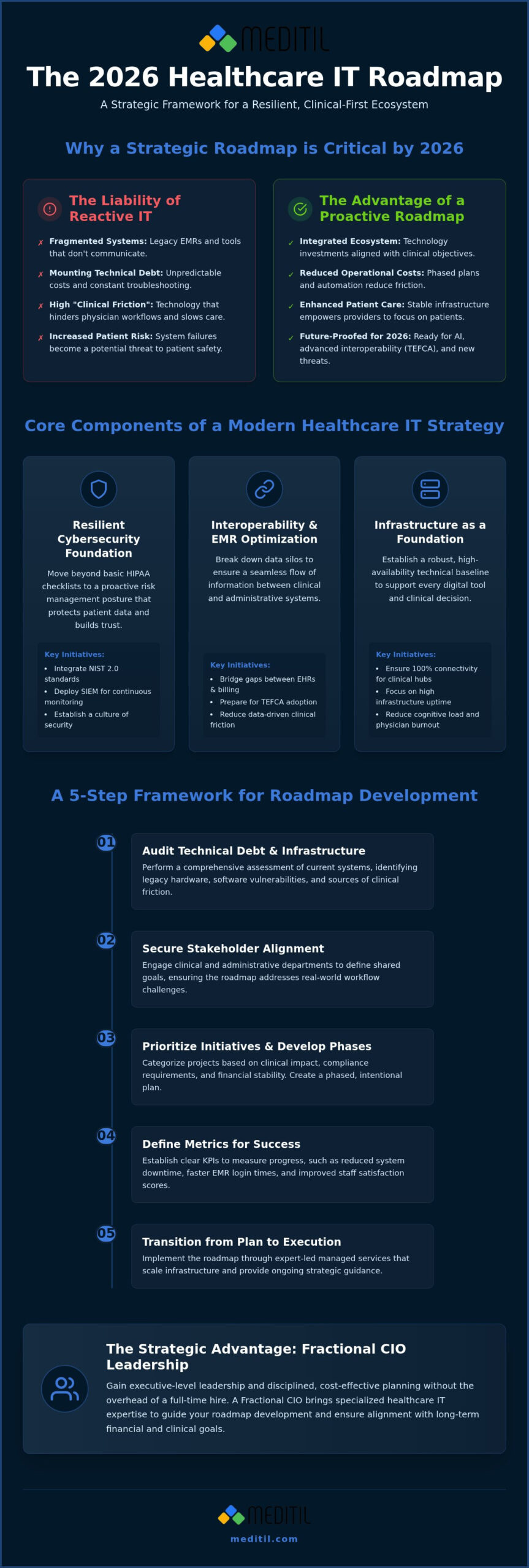
Core Components of a Modern Healthcare Technology Strategy
Modern healthcare IT roadmap development requires more than a simple inventory of hardware. It demands a holistic architecture where infrastructure, security, and data flow operate in unison. High-volume clinical hubs must maintain 100% connectivity to support real-time patient data access. Without this foundation, even the most advanced clinical tools fail to deliver value. For organizations looking to secure and optimize these complex environments, EL ABB Technology offers expert advisory and integration services. A successful healthcare IT roadmap development strategy ensures that technology serves as a bridge rather than a barrier to care.
Transitioning from basic HIPAA compliance to a proactive risk management posture is a 2026 imperative. Your roadmap should integrate NIST 2.0 standards, which emphasize a culture of security rather than just technical checklists. Implementing Security Information and Event Management (SIEM) allows for continuous monitoring of life-critical systems, detecting anomalies before they escalate into breaches. Protecting medical data is not just a regulatory hurdle; it’s a fundamental aspect of patient trust. For a deeper analysis of these protective layers, consult MEDITIL’s healthcare cybersecurity guide to understand modern defense protocols.
Interoperability and EMR Optimization
The “data silo” problem remains a primary driver of clinical friction. A strategic roadmap must bridge the gaps between EHRs and administrative functions, such as billing. With the 2026 landscape focusing on the national adoption of TEFCA, ensuring your systems can exchange data across networks is critical. This connectivity supports the seamless integration of telehealth and remote monitoring, which are now core expectations for patient care. Addressing these gaps often involves medical billing automation to ensure financial stability matches clinical excellence.
Turning raw patient data into actionable clinical insights is the final pillar of a mature strategy. By leveraging Business Intelligence (BI), administrators can identify workflow bottlenecks and improve resource allocation. For example, a data-driven roadmap case study demonstrates how structured data analysis can significantly improve claims processing and operational efficiency. Building these components into a unified plan is a complex undertaking that often benefits from expert strategic advising to ensure every detail is handled with precision.
Internal vs. Fractional CIO-Led Roadmap Development: A Strategic Comparison
Relying on internal IT staff for high-level strategy often leads to a “maintenance trap.” Most in-house teams are consumed by day-to-day help desk tickets and immediate infrastructure failures. While they possess deep knowledge of your current systems, they often lack the bandwidth or specialized training required for long-term healthcare IT roadmap development. This creates a strategic vacuum where technology decisions are made based on immediate needs rather than future scalability or regulatory evolution.
The Fractional CIO model offers a disciplined alternative. Unlike project-based consulting, which delivers a one-time report and exits, a Fractional CIO provides ongoing strategic leadership. This role bridges the gap between technical execution and clinical outcomes. They ensure that every dollar spent on IT is a deliberate step toward a more efficient, secure practice. By aligning IT budgets with clinical goals, they transform technology from an expense into a strategic asset. This partnership provides a steady hand at the wheel, ensuring every detail is handled with precision.
The Fractional CIO Advantage
A primary value proposition of this model is “strategy without the salary.” Most mid-sized practices don’t require a full-time, six-figure executive to manage their technology vision. However, they do need the seasoned expertise that such a professional provides. An outside perspective is invaluable for identifying HIPAA compliance gaps that internal teams might overlook due to familiarity. We encourage leaders to explore Virtual CIO services to secure this high-level guidance. This expertise is critical for navigating the complex 2026 regulatory environment without the overhead of a full-time hire.
Budgeting for Innovation vs. Maintenance
Many organizations fall into the trap of “break-fix” financial planning. This approach focuses on the cost of repairing existing hardware rather than investing in future-proof systems. There are several common pitfalls in IT budgeting for medical practices, including underestimating the cost of technical debt. A structured healthcare IT roadmap development process shifts the focus from maintenance to innovation. Instead of simply keeping the lights on, you begin to scale operations through automation and better data integration. Calculating ROI on new clinical technology becomes clearer when you can measure it against reduced physician burnout and improved patient throughput.
A Step-by-Step Framework for Developing Your Healthcare IT Roadmap
Effective healthcare IT roadmap development requires a methodical progression from discovery to governance. It’s not a one-time event but a disciplined cycle that ensures your technology remains aligned with clinical realities. This framework prevents the common mistake of implementing tools that create more work for providers than they save. By following a structured path, you build a resilient foundation that supports both current operations and future innovation—to explore platforms that help manage these initiatives, learn more about Ideawake.
- Step 1: Clinical and Technical Audit. Begin by identifying technical debt and existing workflow bottlenecks. This includes evaluating the age of your hardware and the efficiency of your current network architecture.
- Step 2: Stakeholder Alignment. Gather direct input from physicians, billing specialists, and administrative leaders. Their perspective ensures the roadmap solves real-world problems rather than theoretical technical issues.
- Step 3: Prioritization. Rank projects based on their impact on risk mitigation, regulatory compliance, and projected ROI. Addressing security vulnerabilities always takes precedence over aesthetic software updates.
- Step 4: Phased Implementation. Develop a clear 12 to 36 month execution timeline. This prevents organizational fatigue by breaking large-scale transitions into manageable segments.
- Step 5: Governance and Review. Establish a regular cadence for roadmap adjustments. Technology and regulations change rapidly; your plan must be flexible enough to adapt without losing its strategic focus.
Auditing for Clinical Friction
The first step in any successful audit is identifying specific friction points that disrupt patient care. Slow EMR login times and repetitive manual data entry are common indicators of a failing technical strategy. Infrastructure upgrades, such as high-speed wireless access points and optimized server configurations, often resolve these clinical issues more effectively than software changes alone. Technical debt is the compounded cost of choosing easy tech fixes over strategic solutions. Left unaddressed, this debt eventually cripples a practice’s ability to innovate or even maintain standard operations. Identifying these costs early allows you to allocate resources where they’ll have the most significant impact on provider satisfaction.
Phasing Your Implementation
Distinguishing between “Quick Wins” and “Strategic Shifts” is essential for maintaining momentum. Quick wins include critical security patches or minor hardware replacements that provide immediate relief. Strategic shifts, such as a full EHR migration or implementing billing automation, require longer lead times and more intensive resource allocation. A sample 12-month timeline for a specialty clinic might look like this:
- Months 1-3: Security hardening and network optimization.
- Months 4-6: Interoperability testing and initial staff training.
- Months 7-12: Phased rollout of new clinical applications and post-implementation review.
Staff training is a critical component during any EMR or EHR implementation phase. Without proper education, even the most advanced systems will fail to gain clinical acceptance. If you’re ready to move from planning to execution, contact our strategic advisors to begin your organizational audit.
Executing the Vision: Scaling Infrastructure with MEDITIL
Transitioning from a strategic document to operational reality is where many healthcare organizations falter. MEDITIL serves as a comprehensive partner to bridge this gap, moving beyond the planning phase into the high-stakes execution of your technical goals. We facilitate the entire healthcare IT roadmap development lifecycle by providing a steady hand at the wheel during complex infrastructure projects. Our focus remains on creating a stable environment where technology supports the clinical mission without interruption or friction.
For organizations that already have internal staff, we offer augmented IT teams. This model allows you to maintain your current personnel while injecting specialized expertise in areas like cybersecurity, interoperability, and billing automation. We provide the management layer necessary to ensure these teams remain focused on the strategic objectives defined in your roadmap. This collaborative approach ensures that every detail is handled with precision, from the initial audit to the final implementation of your systems.
Managed Services as a Strategic Foundation
Ongoing managed IT services provide the daily stability required to support long-term strategic shifts. When you partner with a single entity for both high-level strategy and end-user support, you eliminate the communication gaps that often plague fragmented IT environments. This unified approach ensures that even minor help-desk tickets are resolved through the lens of your broader clinical goals. Precision management in these high-stakes environments is about more than just fixing hardware; it’s about maintaining a secure, compliant foundation that evolves with your practice. It’s the reassurance that your infrastructure is being monitored by experts who understand the nuances of healthcare regulations.
Next Steps: Your 2026 Roadmap Assessment
The path toward a future-proofed practice begins with a thorough evaluation of your current technical landscape. A Fractional CIO acts as the primary architect for this journey, identifying immediate HIPAA vulnerabilities or infrastructure risks that may be hidden within your technical debt. Identifying these risks early is the only way to prevent them from becoming costly emergencies. We encourage you to schedule a discovery call to assess your organization’s readiness for the 2026 landscape. Professional strategic advising is the starting point for any successful roadmap journey, providing the clarity and discipline needed to scale your operations safely.
Building a Resilient Future for Your Practice
Transitioning to a clinical-first technology strategy is a fundamental requirement for navigating the 2026 healthcare landscape. By prioritizing healthcare IT roadmap development, you move beyond the cycle of reactive fixes and begin to build a foundation of operational stability. A successful plan integrates expert leadership with a disciplined approach to cybersecurity and interoperability. This ensures your systems remain a tool for care rather than a source of burnout.
MEDITIL provides the steady hand at the wheel needed to execute this vision. We offer managed IT services tailored for clinical stability and expert Fractional CIO leadership to guide your long-term strategy. Our focus on HIPAA-focused cybersecurity and compliance ensures that your medical data remains protected as you scale your infrastructure. Secure your practice’s future with a tailored Healthcare IT Roadmap from MEDITIL. We’re ready to help. Let’s transform your technical debt into a strategic asset that supports your mission of clinical excellence.
Frequently Asked Questions
How often should a healthcare IT roadmap be updated?
A healthcare IT roadmap should be reviewed quarterly and comprehensively updated on an annual basis. This frequency allows your leadership to adapt to rapid shifts in regulatory standards and emerging security threats. While the 36 month vision remains the target, shorter review cycles ensure that tactical execution stays aligned with clinical needs. Regular updates prevent your strategy from becoming obsolete as new interoperability mandates reach full implementation across the national landscape.
What is the difference between a vCIO and a traditional IT consultant?
A vCIO, or Fractional CIO, provides ongoing strategic leadership and is deeply embedded in your organizational goals. In contrast, a traditional IT consultant usually focuses on a specific, time bound project. While consultants offer specialized expertise for a single implementation, a vCIO acts as a long term partner. They ensure your technical investments consistently align with clinical outcomes and financial stability, providing a steady hand at the wheel for all technology decisions.
Does a healthcare IT roadmap help with HIPAA compliance audits?
Yes, a structured roadmap is an essential asset during HIPAA compliance audits. It provides a documented history of your proactive risk management and security protocols. By demonstrating a phased approach to protecting medical data, you prove to auditors that your organization treats compliance as a continuous process rather than a reactive task. Effective healthcare IT roadmap development ensures that every security upgrade is verified and mapped to specific regulatory requirements.
Can we develop a roadmap if we are currently in the middle of an EHR migration?
It’s actually the ideal time to develop a roadmap because it ensures your new system doesn’t exist in a vacuum. A roadmap identifies how the migration affects your broader infrastructure, cybersecurity posture, and billing automation workflows. By planning now, you prevent the migration from creating new technical debt. This strategic oversight helps align the implementation with your long term goals for interoperability and clinical efficiency, ensuring a seamless transition for your staff.
What are the most common technical debt issues in medical practices?
The most common issues include legacy server hardware, unpatched operating systems, and fragmented databases that don’t communicate. Many practices also struggle with “shadow IT,” where staff use unauthorized tools to bypass slow official systems. These problems lead to clinical friction and increased security risks. A healthcare IT roadmap development audit identifies these compounded costs, allowing you to prioritize the replacement of outdated systems that jeopardize patient safety and operational uptime.
How do we balance IT security with clinical workflow efficiency?
Balancing security and efficiency requires a clinical first approach to infrastructure design. You should prioritize tools that enhance security without adding unnecessary steps for providers, such as single sign on and secure mobile access. By involving physicians in the planning phase, you can identify where security protocols might cause friction. The goal is to build a “silent” security layer that protects medical data while allowing clinicians to focus entirely on patient care.
Is a fractional CIO cost-effective for a mid-sized clinic?
A fractional CIO is highly cost effective because it provides executive level expertise without the burden of a full time executive salary and benefits package. Mid sized clinics often face complex technical challenges that require sophisticated leadership but don’t have the budget for a permanent C suite hire. This model allows you to pay only for the strategic guidance you need. It ensures your IT budget is spent on high impact projects that improve clinical workflows.
What role does AI play in a 2026 healthcare IT strategy?
In 2026, AI is a primary driver for improving diagnostic accuracy and automating complex administrative tasks like billing. Your strategy should focus on building the high performance infrastructure needed to support these data heavy applications. AI also plays a critical role in proactive cybersecurity by detecting anomalies in network traffic before a breach occurs. Integrating these capabilities into your roadmap ensures your organization remains competitive and capable of delivering the highest standard of modern care.