
Research indicates that unnecessary or duplicative imaging tests account for up to $11.95 billion in wasteful U.S. healthcare expenditures annually. Much of this loss stems from fragmented systems that fail to provide outside image availability when it’s needed most. You likely recognize the operational strain this creates, as connecting diagnostic imaging to EHR platforms remains a significant hurdle for many high-volume clinical hubs. Manual data entry errors often lead to frustrating billing delays, while your radiologists lose valuable time jumping between multiple software windows just to view a single study. It’s a systemic challenge that compromises both physician well-being and clinical accuracy.
This guide provides the technical roadmap for modernizing these connections using the latest 2026 standards. You’ll learn the technical requirements and step-by-step strategies to replace legacy DICOM vulnerabilities with secure, high-performance infrastructure. We’ll examine the shift toward DICOMweb RESTful protocols, the role of HL7 FHIR in modern workflows, and the strategic steps required to automate billing triggers the moment an image is completed. By the end of this article, you’ll have a clear strategy to achieve a unified clinical workflow and faster diagnostic turnaround times.
Key Takeaways
- Identify the clinical and financial impacts of fragmented systems, including the high cost of duplicative imaging and manual data entry errors.
- Understand the evolution of technical standards, moving from legacy DIMSE protocols to RESTful DICOMweb and FHIR-based integration.
- Compare architecture models to determine if a direct interface, integration engine, or cloud-native PACS best serves your facility’s volume and growth goals.
- Follow a structured, two-phase implementation guide for connecting diagnostic imaging to EHR platforms to ensure bi-directional data flow and automated billing.
- Discover how strategic IT oversight through a Fractional CIO provides the steady hand needed to navigate regulatory compliance and infrastructure upgrades.
The Interoperability Gap: Why Connecting Diagnostic Imaging to EHR is Essential
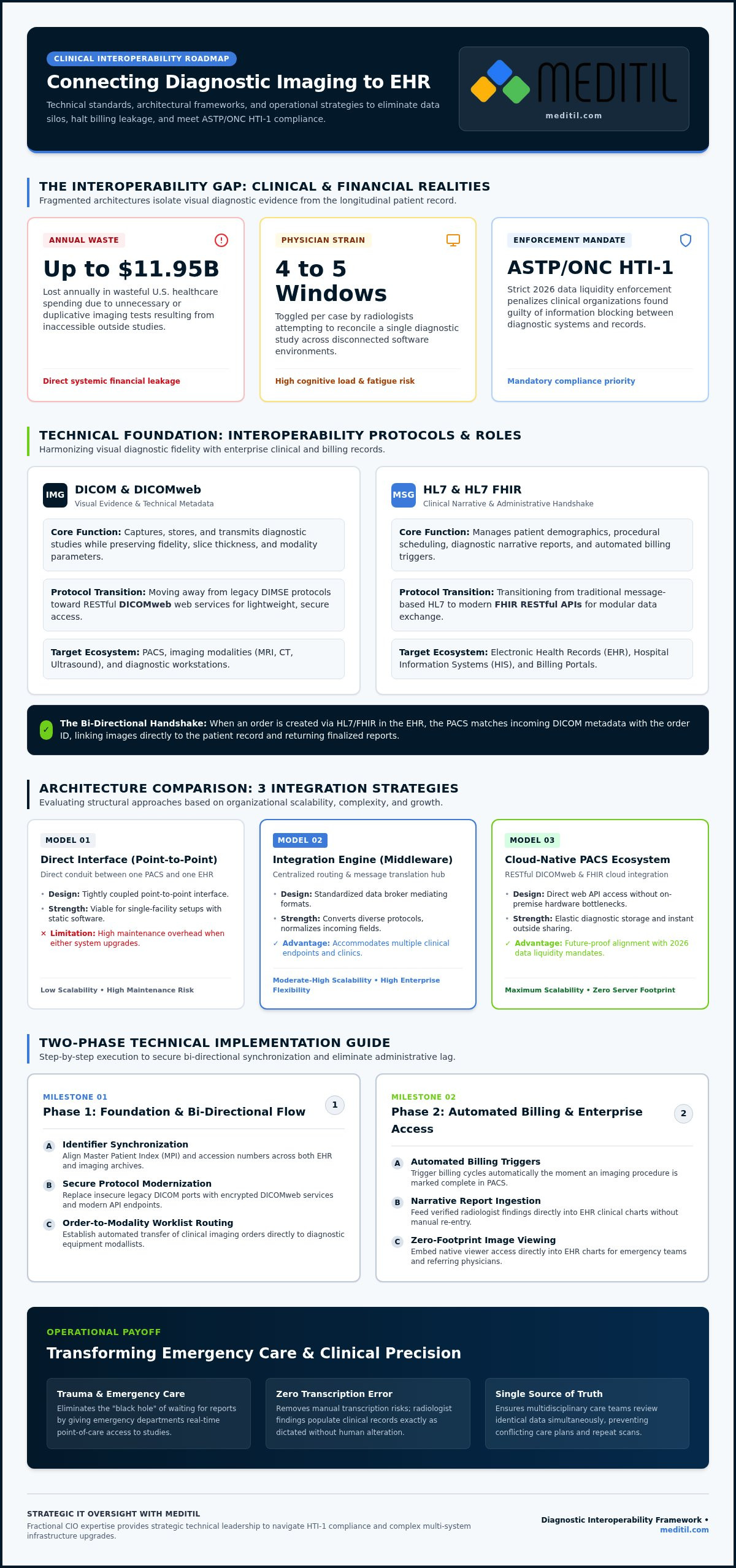
The “imaging-EHR gap” describes the functional disconnect between diagnostic visual evidence and the patient’s comprehensive medical record. This separation forces clinicians to act as manual data bridges, a process that is both inefficient and dangerous. Effective strategies for connecting diagnostic imaging to EHR platforms bridge this divide by synchronizing patient identifiers across the enterprise. When these systems don’t communicate, the result is a fragmented view of patient health that leads to redundant testing and delayed treatments. Research suggests that duplicative imaging accounts for nearly $12 billion in annual healthcare waste; much of this is preventable through better system alignment.
The clinical cost of these silos is measurable in physician burnout and patient risk. Radiologists often jump between four or five different software windows to reconcile a single case. This cognitive load increases the likelihood of fatigue-related errors. From a financial perspective, disconnected systems cause significant billing leakage. When an imaging procedure isn’t automatically logged in the EHR, the billing cycle fails to trigger, leading to lost revenue and administrative rework. By 2026, regulatory pressure has intensified; the ASTP/ONC now enforces strict data liquidity standards under the HTI-1 rule. Organizations found to be “information blocking” face substantial penalties, making connecting diagnostic imaging to EHR a top priority for compliance officers.
Breaking Down Data Silos in Radiology
Historically, picture archiving and communication systems (PACS) were built for specialized diagnostic viewing, while EHRs were designed for administrative and narrative documentation. These platforms functioned as isolated repositories due to incompatible data architectures. We’ve seen a shift from simple image viewing to true data integration, where the image is just one part of a larger clinical dataset. Imaging-EHR interoperability is the seamless exchange of DICOM metadata and clinical reports.
Impact on Patient Safety and Clinical Outcomes
Fragmented systems rely on manual transcription, which introduces a high risk of error in diagnostic reports. Automation ensures that the radiologist’s findings populate the EHR exactly as intended. In emergency departments, every minute matters. Real-time access to imaging studies allows trauma teams to make critical decisions without waiting for paper reports or phone calls. When results are available immediately at the point of care, it eliminates the “black hole” of waiting for data to cross between departments, directly improving patient survival rates. This synchronized approach also ensures that all members of a multidisciplinary care team see the same version of the truth at the same time, reducing the risk of conflicting treatment plans.
The Technical Foundation: DICOM, HL7, and FHIR Standards
Successful connecting diagnostic imaging to EHR systems requires more than a simple cable. It relies on a sophisticated hierarchy of communication protocols that ensure data remains accurate as it travels between modalities, archives, and clinical charts. Think of these standards as a shared vocabulary. Without them, a high-resolution MRI would be nothing more than a collection of unreadable pixels to an EHR.
DICOM remains the universal standard for capturing, storing, and transmitting medical images. It preserves the diagnostic fidelity of the study while embedding vital metadata, such as slice thickness and modality settings. In contrast, HL7 acts as the backbone for administrative and clinical messaging. It handles the paperwork of healthcare, including patient demographics, scheduling, and narrative reports. These protocols must perform a precise handshake. When an order is placed in the EHR via HL7, the PACS must recognize that specific request and link the resulting DICOM images back to the correct patient record.
DICOM vs. HL7: Roles in the Integration Ecosystem
In a high-performing environment, these two standards manage distinct but overlapping domains. DICOM ensures the radiologist sees the exact visual data required for a diagnosis. HL7 ensures the billing department and the referring physician receive the correct identifiers. Achieving true imaging informatics and EHR interoperability involves mapping these protocols so that no data is orphaned. For instance, an HL7 ORU message typically carries the text of a radiology report, while a DICOM object contains the actual scan. If the accession numbers between these two files don’t match exactly, the system fails. Ensuring this alignment often requires specialized systems integration and interoperability support to manage the complex data translation.
The Rise of FHIR in Diagnostic Imaging
The industry is rapidly moving toward Fast Healthcare Interoperability Resources (FHIR). Unlike legacy HL7 v2 messages, which are pushed from one system to another, FHIR uses modern, web-based APIs. This allows an EHR to pull specific imaging data on demand. As of 2026, the adoption of FHIR R5 has enabled zero-latency access to imaging reports on mobile devices. This shift from legacy DIMSE protocols to RESTful DICOMweb architecture reduces the strain on your network infrastructure. It eliminates the need for rigid Application Entity (AE) title mapping and allows for lightweight browser viewing. Preparing your infrastructure for this API-driven future is essential for successful connecting diagnostic imaging to EHR workflows.
Integration Strategies: Direct Interface vs. Middleware vs. Cloud PACS
Selecting the right architectural framework is the most consequential decision when connecting diagnostic imaging to EHR workflows. Your choice determines the long-term stability of the clinical environment and the total cost of ownership. Organizations typically choose between three primary models: direct point-to-point interfaces, middleware integration engines, or cloud-native PACS architectures.
Direct interfaces connect an EHR to a specific PACS using dedicated HL7 sockets. While this eliminates intermediate license fees, it often creates a maintenance trap. These connections are brittle; a minor update to either system can break the custom code, leading to clinical downtime and expensive emergency repairs. In contrast, the middleware approach uses an integration engine to act as a centralized data hub. This strategy is ideal for scalability, as it normalizes disparate data dialects and manages queue buffering during high-volume periods.
Cloud-native PACS solutions represent the most modern tier, bypassing on-premise hardware limitations by hosting studies in scalable repositories. This architecture leverages the HL7 FHIR ImagingStudy resource to fetch images dynamically via web services. This reduces the strain on local infrastructure and ensures that clinicians have access to high-fidelity images regardless of their physical location.
Evaluating the ‘Build vs. Buy’ Dilemma
Custom-coded EHR interfaces carry significant hidden costs in the form of technical debt. While a “build” approach offers total customization, pre-configured vendor solutions often provide a more predictable ROI by reducing implementation timelines. Streamlining these connections is a prerequisite for successful Medical Billing Automation Solutions. When data flows seamlessly from the modality to the patient record, billing cycles trigger automatically, eliminating the “leakage” caused by manual entry errors.
Infrastructure Requirements for High-Volume Imaging
High-volume clinical hubs must account for the massive bandwidth required to move modern 3D imaging sets. Moving terabytes of data without clinical lag requires a robust network backbone and a strategic approach to data routing. We recommend N+1 redundancy in all imaging gateways to ensure that a single hardware failure does not paralyze radiology operations. Additionally, cybersecurity protocols must include end-to-end encryption and multi-factor authentication to protect PHI during transit across these high-speed bridges. A steady hand at the wheel of your infrastructure management ensures that these complex systems remain both performant and secure.
Step-by-Step Guide: Implementing Your Imaging-to-EHR Workflow
Successful implementation of a unified imaging environment requires a methodical, five-phase approach. This isn’t merely a software installation; it’s a fundamental restructuring of how clinical data flows through your organization. By following a disciplined roadmap, you ensure that connecting diagnostic imaging to EHR systems results in a stable, high-performance bridge that serves both clinicians and administrators.
- Phase 1: Workflow Audit and Gap Analysis. We begin by mapping the current state of data movement to identify where manual intervention is currently required.
- Phase 2: Technical Standard Selection. Based on your volume, we coordinate with vendors to select between HL7 v2, FHIR, or DICOMweb protocols.
- Phase 3: Infrastructure Hardening. This involves layering security protocols and ensuring your network can handle the throughput of high-resolution studies.
- Phase 4: Clinical Validation and UAT. Physicians test the interface in a sandbox environment to ensure the user experience matches their real-world needs.
- Phase 5: Go-Live and Monitoring. Post-deployment, continuous monitoring prevents performance degradation and ensures data integrity remains high.
The Pre-Implementation Audit
The audit phase focuses on mapping the “Life of an Order” from the moment it’s entered in the EHR to its arrival at the modality. We look for hardware bottlenecks, such as outdated local servers or insufficient bandwidth, that could cause clinical lag once the software is active. Involving your radiologists and technologists early is essential. If the new interface doesn’t align with their existing workflow, adoption will suffer, leading to workarounds that compromise data accuracy. This proactive step ensures the technology supports the user rather than creating new administrative burdens.
Security and Compliance Checkpoints
Protecting patient data during transit is a non-negotiable requirement. Your strategy must include end-to-end encryption for all DICOM images and the implementation of granular audit logs. These logs allow you to track exactly who accessed an image and when, which is a key requirement for HIPAA compliance. For a more comprehensive look at protecting your clinical data, we recommend reviewing our guide on Healthcare Cybersecurity Services. Ensuring these security layers are integrated from day one prevents vulnerabilities that often plague legacy transfers. If you are ready to modernize your clinical infrastructure, you can consult with our systems integration experts to begin your audit.
Strategic Oversight: How MEDITIL Optimizes Interoperability
Technical integration of clinical systems is often viewed as a discrete project, yet the reality of healthcare IT demands continuous strategic leadership. Successfully connecting diagnostic imaging to EHR platforms requires a steady hand to navigate the evolving regulatory environment and the increasing complexity of data standards. MEDITIL serves as that strategic partner, providing the technical oversight necessary to transform fragmented software into a unified clinical ecosystem. We focus on the underlying infrastructure, ensuring that your data bridges remain performant, secure, and compliant with 2026 interoperability mandates.
Fractional CIO Leadership for Mid-Sized Organizations
Mid-sized medical organizations often face enterprise-level challenges without the budget for a full-time executive technology team. Our Virtual CIO Services bridge this gap by providing high-level strategic IT leadership tailored to your specific clinical objectives. We align your technology spend with patient care goals, ensuring that every infrastructure investment directly supports faster diagnostic turnaround times and reduced physician burnout. A primary responsibility in this role involves managing the complex relationships between your EHR vendor, your PACS provider, and your modality manufacturers. By centralizing this vendor coordination, we eliminate the finger-pointing that often occurs when integration issues arise; this allows your clinical staff to focus on patient outcomes rather than troubleshooting software conflicts.
Ongoing Managed Services for Interoperability
The work does not end once the initial connection is established. Maintaining a robust link between imaging archives and patient records requires proactive monitoring and disciplined maintenance. Our Managed IT Services for Healthcare are designed to ensure 99.9% uptime for your critical integration engines. We monitor your data queues in real-time to prevent the bottlenecks that lead to delayed reports or orphaned studies. Additionally, we manage the constant cycle of software updates and security patches. Our team ensures that an update to your EHR does not inadvertently break the connection to your diagnostic archive. This level of oversight includes specialized help desk support that understands the unique technical needs of radiologists and imaging technologists.
The ultimate goal is to move your organization from being merely “integrated” to being truly “optimized.” This means leveraging your clinical data for better business intelligence and automated billing triggers. By stabilizing the technical foundation, we enable your facility to scale its operations without increasing administrative overhead. Strategic oversight ensures that your technology remains a reliable tool for clinical excellence rather than a source of operational friction. Do you have the infrastructure in place to support your long-term growth objectives?
Building a Resilient Clinical Data Ecosystem
Transitioning from fragmented data silos to a unified clinical environment requires a precise balance of technical standards and strategic foresight. By adopting modern protocols like FHIR R5 and RESTful DICOMweb architecture, your organization can eliminate the clinical lag that often delays critical patient care. Successfully connecting diagnostic imaging to EHR platforms ensures that radiologists and referring physicians operate from a single version of the truth; this reduces burnout and improves diagnostic accuracy across the enterprise.
As specialized healthcare IT infrastructure experts, MEDITIL provides the steady hand needed to navigate these complex transitions. We offer Fractional CIO strategic advisory and comprehensive EHR implementation and training services to ensure your technology supports your long-term growth. Our team manages the underlying technical burden, allowing your staff to focus on clinical excellence rather than software troubleshooting. We invite you to Schedule a Strategic Interoperability Consultation with MEDITIL to begin optimizing your facility’s data liquidity. With the right infrastructure in place, your practice can achieve the stability and performance required for the future of medicine.
Frequently Asked Questions
What is the difference between a PACS and an EHR integration?
A PACS focuses on the high-fidelity storage and specialized viewing of medical images for diagnostic purposes. Integration involves creating a bi-directional data flow so those images and their narrative reports appear directly within the patient’s clinical chart. While the PACS handles the heavy visual data, the integration ensures clinical context remains synchronized. This eliminates the need for clinicians to log into separate systems, streamlining the diagnostic workflow and reducing the risk of mismatched patient records.
Can legacy imaging equipment be connected to a modern cloud EHR?
Legacy imaging equipment can connect to a modern cloud EHR using specialized DICOM gateways or integration middleware. These tools act as translators that convert older DIMSE protocols into modern, web-standard DICOMweb or FHIR APIs. This approach preserves your investment in existing hardware while enabling the benefits of cloud-based storage. It’s essential to audit your network infrastructure to ensure it can support the throughput required for connecting diagnostic imaging to EHR systems without clinical lag; you can find out more about how cloud-integrated radiology solutions bridge the gap between legacy systems and modern clinical environments.
A typical integration project ranges from three to six months, though the timeline depends on the complexity of your environment. Initial phases involve workflow audits and vendor coordination, which usually take four to six weeks. Technical configuration and infrastructure hardening follow, often requiring another two months. The final phase includes clinical validation and user acceptance testing. Timelines can extend if you’re managing multiple legacy modalities or if vendors have significant backlogs for interface activations.
Does connecting imaging to EHR increase HIPAA security risks?
Integration actually enhances security when implemented with modern encryption and audit protocols. While moving data creates transit risks, a centralized integration eliminates the vulnerabilities of manual transfers, such as physical disks or unencrypted emails. Robust connecting diagnostic imaging to EHR strategies include end-to-end encryption and granular access logs. These features provide a clear trail of who viewed specific studies, which is a requirement for HIPAA compliance that siloed systems often struggle to meet.
What are the common causes of integration failure in healthcare IT?
Integration failures often stem from a lack of clinical workflow mapping or insufficient network bandwidth. If the technical setup doesn’t match how radiologists actually work, the system becomes an administrative burden rather than a tool. Other common causes include poor vendor coordination and the failure to account for data normalization. Without a steady hand managing these vendor relationships, mismatched accession numbers can lead to orphaned studies and significant delays in both diagnosis and billing.
Do I need a separate integration engine to connect my RIS to my EHR?
While many modern EHRs offer direct interface options, a separate integration engine is often the superior choice for scalability. These engines act as a centralized hub that can normalize disparate data formats from your RIS, PACS, and various modalities. This prevents vendor lock-in and makes future upgrades much simpler. Using a dedicated integration engine allows for more complex data morphing and queue management, ensuring that high-volume clinical hubs maintain 99.9% uptime across all systems.
How does imaging integration affect medical billing automation?
Integration is a prerequisite for effective billing automation. When the PACS and EHR are synchronized, the completion of a diagnostic study can trigger an automated billing event. This eliminates the leakage caused by manual entry errors and ensures that claims are submitted immediately after the radiologist signs the report. By automating these triggers, organizations reduce their days in accounts receivable and minimize the administrative overhead associated with reconciling disconnected clinical and financial records.
What is the role of a vCIO in an EHR integration project?
A vCIO provides the strategic oversight needed to align your IT infrastructure with patient care objectives. In an integration project, they manage vendor relationships and ensure the technical roadmap supports long-term growth. They serve as a consultant invested in your outcomes, helping you choose between direct interfaces or middleware based on your organization’s scale. This leadership role is vital for navigating the regulatory landscape and ensuring that complex systems integration projects remain on schedule and within budget.