
The traditional model of isolated internal IT departments is becoming a liability for healthcare organizations facing the complexities of 2026. You likely see the daily strain on your staff as they struggle to keep pace with evolving regulatory demands. Internal teams are often buried under a mountain of help desk tickets and legacy system patches, which leaves no room for the high-level strategy required to stay ahead. It’s exhausting to watch talented professionals battle physician burnout caused by inefficient EHR workflows or the constant anxiety of a looming HIPAA audit. This is where co-managed IT services for healthcare provide a critical pivot point for organizational stability.
We understand that your internal team possesses invaluable institutional knowledge that shouldn’t be replaced. This article demonstrates how to augment that expertise with executive-level leadership and clinical-grade infrastructure to eliminate technical debt. You’ll discover how to create a collaborative environment that ensures seamless data interoperability between clinical and billing systems. We’ll also outline the steps to establish a three to five year technology roadmap that aligns every digital investment with improved patient outcomes and long-term security.
Key Takeaways
- Understand the transition from reactive support to a proactive information strategy. This shift is vital for maintaining clinical stability.
- Learn how co-managed it services for healthcare relieve internal teams of daily tickets while introducing executive-level security. This partnership ensures your staff doesn’t burn out.
- Identify strategies to eliminate data silos between EHR and billing systems. It’s the most effective way to improve clinical workflows and data accuracy.
- Discover the essential phases of building a strategic technology roadmap. This plan will help you meet the specific regulatory demands expected in 2026.
- Explore how fractional CIO leadership manages complex infrastructure. It provides a steady hand for national medical practices seeking long-term growth.
Defining the Healthcare OCIO: Information Strategy vs. Asset Management
In many industries, the term OCIO refers to an Outsourced Chief Investment Officer. However, for medical groups looking toward 2026, the definition shifts toward the Outsourced Chief Information Officer. This distinction is critical because healthcare leadership is no longer just about managing physical assets like servers or desktops. It’s about the strategic management of clinical data and its movement across complex ecosystems. Traditional support often comes from a standard Managed service provider focusing on hardware uptime. While essential, this reactive approach doesn’t address the digital transformation required to remain competitive and compliant in a modern regulatory environment.
The 2026 landscape demands executive-level oversight that bridges the gap between technical infrastructure and clinical operations. By utilizing co-managed it services for healthcare, organizations can move beyond simple asset management. They gain a partner that views technology through the lens of patient outcomes and administrative efficiency. This leadership ensures that every technical decision supports the overarching mission of the practice rather than just fixing what’s broken. When internal teams are supported by co-managed it services for healthcare, they can focus on immediate needs while the OCIO handles the long-term roadmap.
The Evolution of the Healthcare CIO Role
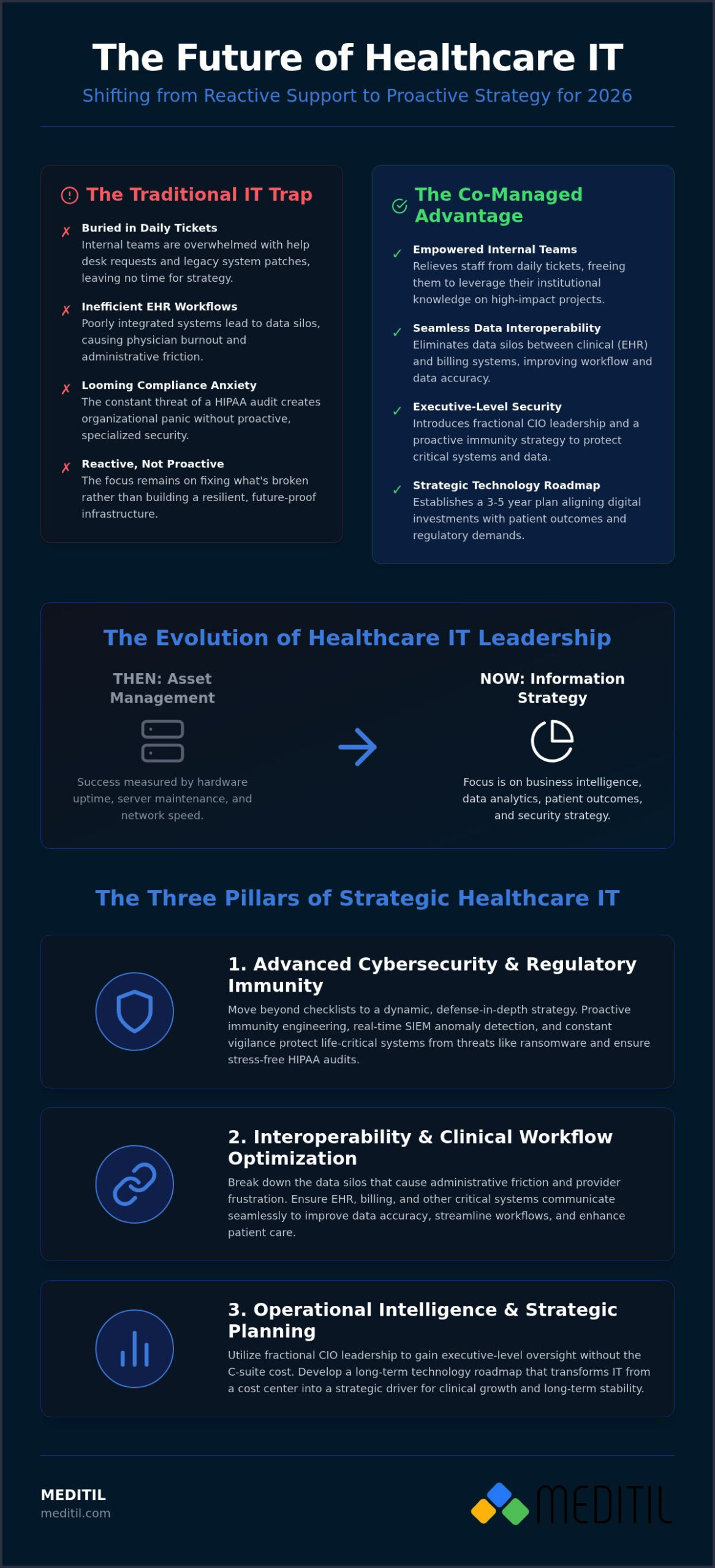
The role of the CIO has changed significantly. In the past, success was measured by server maintenance and network speed. Today, the focus has shifted toward business intelligence and data analytics. Digital health and the rapid expansion of telehealth services have broadened the scope of IT leadership. Mid-sized practices often find themselves in a difficult position; they need this level of expertise but can’t justify the cost of a full-time executive. Fractional and co-managed models provide a scalable solution, offering high-level strategy without the overhead of a traditional C-suite hire.
Why Healthcare-Specific Expertise is Non-Negotiable
Generalist IT providers often struggle in clinical environments. They lack an understanding of specialized protocols like HL7 or FHIR, and they don’t speak the language of providers and medical administrators. This knowledge gap can lead to dangerous friction points during EHR integrations or billing audits. Specialized expertise is required to ensure that technology serves the clinician rather than hindering them. The Healthcare OCIO serves as a strategic partner dedicated to maintaining patient safety and data integrity through technical precision.
The Three Pillars of Strategic Healthcare IT Leadership
Strategic leadership in Health Information Technology requires a departure from reactive troubleshooting. Many practices find that their internal teams are stretched thin by the daily demands of help desk support and hardware maintenance. Implementing co-managed it services for healthcare allows for a logical division of labor where high-stakes pillars are handled by specialists. This partnership ensures that your infrastructure doesn’t just function; it scales with clinical volume while maintaining strict regulatory standards. Success in 2026 depends on stabilizing three foundational areas: security, connectivity, and operational intelligence.
Advanced Cybersecurity and Regulatory Immunity
Compliance is often treated as a static checklist, but modern threats require a more dynamic approach. Real security is about proactive immunity, where systems are engineered to withstand attacks rather than just recover from them. Protecting life-critical systems from ransomware requires constant vigilance and a sophisticated defense-in-depth strategy. By integrating specialized healthcare cybersecurity services into daily operations, practices can utilize SIEM (Security Information and Event Management) to detect anomalies in real-time. This level of protection is a necessity for maintaining data integrity and ensuring that HIPAA audits don’t become a source of organizational panic.
Interoperability and Clinical Workflow Optimization
Data silos are a primary cause of administrative friction and provider frustration. When EHR systems don’t communicate effectively with billing platforms or telehealth tools, the resulting manual data entry leads to errors. Utilizing medical billing automation solutions ensures that data flows seamlessly across all platforms. This connectivity reduces the burden on administrative staff and helps mitigate physician burnout. Seamless data flow is not just an IT metric; it’s a clinical requirement that improves patient care and provider satisfaction. If your practice struggles with these technical friction points, seeking fractional CIO leadership can provide the strategic direction needed to bridge these gaps.
Infrastructure scalability and business intelligence represent the third pillar of this leadership model. Your network must be prepared for the high-volume demands of modern clinical operations, including high-definition imaging and remote patient monitoring. Once the infrastructure is stable, you can leverage operational data to drive practice efficiency. Business intelligence tools allow you to analyze patient flow and billing cycles with precision. This data-driven approach transforms IT from a cost center into a strategic engine for growth. Using co-managed it services for healthcare provides the external expertise needed to turn these complex datasets into actionable insights for your practice leadership.
Co-Managed IT vs. Fully Outsourced: Which Model Fits Your Practice?
Deciding between a fully outsourced model and maintaining a dedicated internal team is a common challenge for medical administrators. Often, this choice is framed as a binary decision. However, co-managed it services for healthcare offer a strategic hybrid approach that preserves your internal institutional knowledge while injecting executive-level expertise. This model doesn’t simply add headcount. It engineers a partnership where external leadership guides your internal technicians toward specific clinical outcomes. This collaborative environment ensures that your staff isn’t just reacting to fires but is actively contributing to the practice’s long-term growth.
The Limitations of Standard Managed Services
Standard managed services typically prioritize tactical support. They focus on resolving help desk tickets and managing hardware uptime. While these tasks are essential foundation-level needs, as detailed in our managed it services for healthcare guide, they don’t constitute a complete strategy. Relying solely on reactive support creates a dangerous gap between day-to-day operations and necessary infrastructure roadmaps. Without strategic direction, your practice risks accumulating technical debt. This debt is the long-term cost of choosing quick fixes or legacy patches over scalable, modern solutions. In a 2026 regulatory environment, “keeping the lights on” is no longer a sufficient metric for success.
The Strategic Advantage of Co-Managed Leadership
The co-managed model functions as a form of team augmentation. It empowers your current IT staff by providing them with specialized tools and the executive oversight they need to succeed. A Fractional CIO offers C-suite expertise at a fraction of the cost of a full-time executive hire. This leader helps align it budgeting for medical practices with actual clinical goals. They ensure that every digital investment contributes directly to patient care or operational efficiency. Furthermore, they provide objective, vendor-neutral technology selection for EHR systems and core infrastructure, preventing your practice from being locked into suboptimal software contracts that don’t support interoperability.
Choosing co-managed it services for healthcare allows you to maintain the internal relationships your staff has built while gaining the specialized security and compliance knowledge required for modern healthcare. It’s a disciplined approach that addresses the hidden price of technical debt before it leads to system failure or a compliance breach. By choosing this model, you’re not just buying a service; you’re securing a proactive guide that’s invested in your practice’s stability and long-term performance. This steady hand at the wheel is what separates high-performing medical groups from those struggling with legacy infrastructure.
Building a 2026 Strategic IT Roadmap for Clinical Growth
Building a strategic roadmap isn’t a one-time event; it’s a methodical progression toward operational stability. When you utilize co-managed it services for healthcare, you gain access to a structured framework that transforms technical debt into a scalable clinical asset. This roadmap begins with a Phase 1 comprehensive audit of your current infrastructure and HIPAA compliance status. We verify every entry point and data repository to ensure your foundation is secure and ready for future growth. Phase 2 focuses on identifying clinical friction points and EHR data silos that hinder provider efficiency and data accuracy.
By Phase 3, the focus shifts to the implementation of redundant, high-availability networks. These systems are engineered to guarantee uptime during critical patient care hours, ensuring that practitioners never lose access to life-critical information. Finally, Phase 4 establishes a cadence of performance analytics and executive strategy meetings. These sessions ensure your technology remains aligned with clinical growth and shifting regulatory demands. If you’re ready to stabilize your practice’s digital future, consider a fractional CIO consultation to begin your roadmap development.
Optimizing the EHR and Billing Ecosystem
A significant gap in modern healthcare IT is the friction between clinical documentation and financial reimbursement. Streamlining EHR workflows is essential to reduce physician documentation time and mitigate the risk of burnout. Our approach focuses on integrating disparate systems to create a unified patient view, ensuring that clinical data flows naturally into billing platforms. This seamless integration eliminates the need for manual data reentry, which reduces administrative errors and accelerates the revenue cycle. It’s vital that staff training remains aligned with these system implementations to ensure maximum proficiency across the organization.
Infrastructure as a Foundation for Scalability
Scalability requires a network that can handle increasing data loads without performance degradation. Cloud migration strategies for sensitive medical data must prioritize both accessibility and strict encryption standards. We recommend implementing N+1 redundancy for critical clinical hubs to prevent downtime during hardware failures or scheduled maintenance windows. This level of reliability is a prerequisite as practices prepare for AI-driven diagnostics and expanded remote patient monitoring. By building this foundation now through co-managed it services for healthcare, you ensure your practice can adopt emerging technologies without needing a complete infrastructure overhaul later.
Scaling Healthcare Operations with MEDITIL’s Co-Managed Leadership
MEDITIL acts as a steady hand at the wheel for organizations navigating high-stakes technical environments. Many medical groups reach a point where technical chaos prevents meaningful growth. Transitioning from this state to operational stability requires more than just additional help desk staff; it requires a disciplined methodology and executive oversight. Our approach to co-managed it services for healthcare provides the necessary leadership to bridge the gap between your current technical state and your future clinical potential. We work with you to identify the specific leadership gaps in your IT structure, providing a customized path toward clinical-grade infrastructure that supports national scalability.
The transition to a co-managed model is a strategic move toward maturity. It’s about ensuring that every digital asset and workflow is verified for compliance and efficiency. By integrating external expertise, you aren’t just fixing existing problems; you’re preventing future ones through proactive management. This level of oversight is essential for practices that manage complex, multi-site operations where downtime or data silos can have significant financial and clinical consequences. Our team provides the focus and results-oriented discipline needed to turn technology into a reliable engine for your practice’s success.
Comprehensive Team Management and Leadership
We don’t aim to replace your internal IT professionals. Instead, MEDITIL leads existing IT departments to achieve peak performance through structured guidance and professional development. Our virtual cio services play a pivotal role in ensuring this long-term stability by providing a clear roadmap for your team to follow. This partnership is built on precision, trust, and a deep clinical understanding of the unique pressures healthcare providers face. It allows your internal team to maintain their valuable institutional knowledge while we handle the high-level strategic advancement of the practice’s digital ecosystem.
Securing the Future of Your Practice
Waiting for a security breach or a system failure to occur is a failed strategy for healthcare leaders. Strategic IT leadership directly impacts patient retention and practice reputation by ensuring that clinical workflows are seamless and data is always protected. A reliable technical environment builds trust with both providers and patients, serving as a competitive advantage in a crowded market. If you’re ready to move beyond reactive support and technical debt, the next step is to evaluate your current structure for leadership gaps. We invite you to schedule a consultation with MEDITIL to learn how co-managed it services for healthcare can secure your practice’s future and drive sustainable clinical outcomes.
Securing Long-Term Stability Through Strategic IT Partnership
The shift toward 2026 demands a transition from reactive troubleshooting to a proactive information strategy. By integrating co-managed it services for healthcare, your practice gains the specialized oversight necessary to eliminate technical debt. This partnership doesn’t replace your team. Instead, it empowers them with executive-level leadership and sophisticated security tools. We’ve explored how a phase-based roadmap provides the foundation for scalable growth and strict HIPAA compliance.
MEDITIL provides fractional CIO leadership for national medical practices, focusing on healthcare IT infrastructure and security. Our expertise in clinical interoperability ensures your billing and EHR systems function as a unified ecosystem. It’s time to move beyond the limitations of standard support. We invite you to Schedule a Strategic IT Consultation with MEDITIL to identify the leadership gaps in your current structure. We’re committed to being your strategic partner in achieving a secure and efficient digital future.
Frequently Asked Questions
What is the difference between a vCIO and an Outsourced CIO in healthcare?
vCIO services generally provide high-level strategic advisory and technology alignment on a consulting basis. An Outsourced or Fractional CIO takes a more integrated leadership role, often managing the entire IT team and overseeing complex infrastructure projects directly. Both roles bridge the gap between clinical operations and technical execution. The choice depends on whether your practice requires occasional strategic guidance or a steady hand at the wheel for daily management.
How do co-managed IT services work with our existing internal IT team?
Co-managed it services for healthcare function as a team augmentation model where external experts support your internal staff. Your internal team retains their institutional knowledge and handles immediate on-site needs while the external partner provides specialized security, compliance, and strategic leadership. This collaboration eliminates the burden of routine ticket management for your staff. It allows them to focus on clinical workflows while the partner ensures the infrastructure remains stable and secure.
Can an outsourced CIO help our practice pass a HIPAA audit?
A Fractional CIO provides the technical oversight and documentation required to meet strict regulatory standards. They conduct comprehensive infrastructure audits and implement proactive security measures like SIEM and data encryption. This leadership ensures that your practice moves beyond basic compliance checkboxes to a state of proactive immunity. By establishing verified protocols and maintaining accurate logs, the CIO prepares your organization to navigate 2026 HIPAA audit trends with confidence and precision.
How much do co-managed IT services for healthcare typically cost?
The cost of co-managed it services for healthcare varies based on the size of your practice and the complexity of your infrastructure. Pricing is typically structured as a monthly agreement or project-based fee rather than a full-time executive salary. This model allows medical groups to access C-suite expertise and clinical-grade security without the overhead of a traditional hire. We recommend a consultation to determine a customized plan that aligns with your specific clinical and operational goals.
Does an outsourced CIO manage our EHR and billing software vendors?
Yes, an Outsourced CIO acts as a vendor-neutral advocate who manages relationships with your EHR and billing software providers. They ensure that these disparate systems are properly integrated to allow for seamless data interoperability. This management reduces administrative friction and prevents vendor lock-in with suboptimal contracts. By overseeing these technical partnerships, the CIO ensures that your software ecosystem supports efficient clinical workflows and accurate financial reimbursement without clinical staff needing to intervene.
Is a fractional CIO model suitable for mid-sized medical groups?
The fractional CIO model is specifically designed for mid-sized medical groups that require sophisticated leadership but don’t need a full-time executive. It provides a scalable solution for organizations managing multi-site operations or complex regulatory demands. This model offers the same level of expertise found in large hospital systems at a fraction of the cost. It’s a disciplined approach that ensures mid-sized practices can compete by maintaining high-performance infrastructure and secure data management.
What is the first step in creating a strategic IT roadmap for a practice?
The first step is a comprehensive infrastructure and HIPAA compliance audit to identify existing vulnerabilities and technical debt. This assessment provides a clear baseline of your current digital environment. Once the audit is complete, we identify clinical friction points and data silos that hinder daily operations. This data-driven approach ensures that the resulting roadmap is grounded in reality and focused on achieving specific clinical and financial outcomes for your organization.
How often does a co-managed IT partner meet with our executive leadership?
A co-managed IT partner typically holds monthly or quarterly executive strategy meetings to ensure technical initiatives remain aligned with clinical growth. These sessions focus on reviewing performance analytics, updating the technology roadmap, and addressing emerging regulatory changes. Regular communication ensures that practice leadership remains informed about infrastructure stability and security status. This intentional rhythm of collaboration builds trust and ensures that every technical investment continues to support the practice’s long-term strategic objectives.