
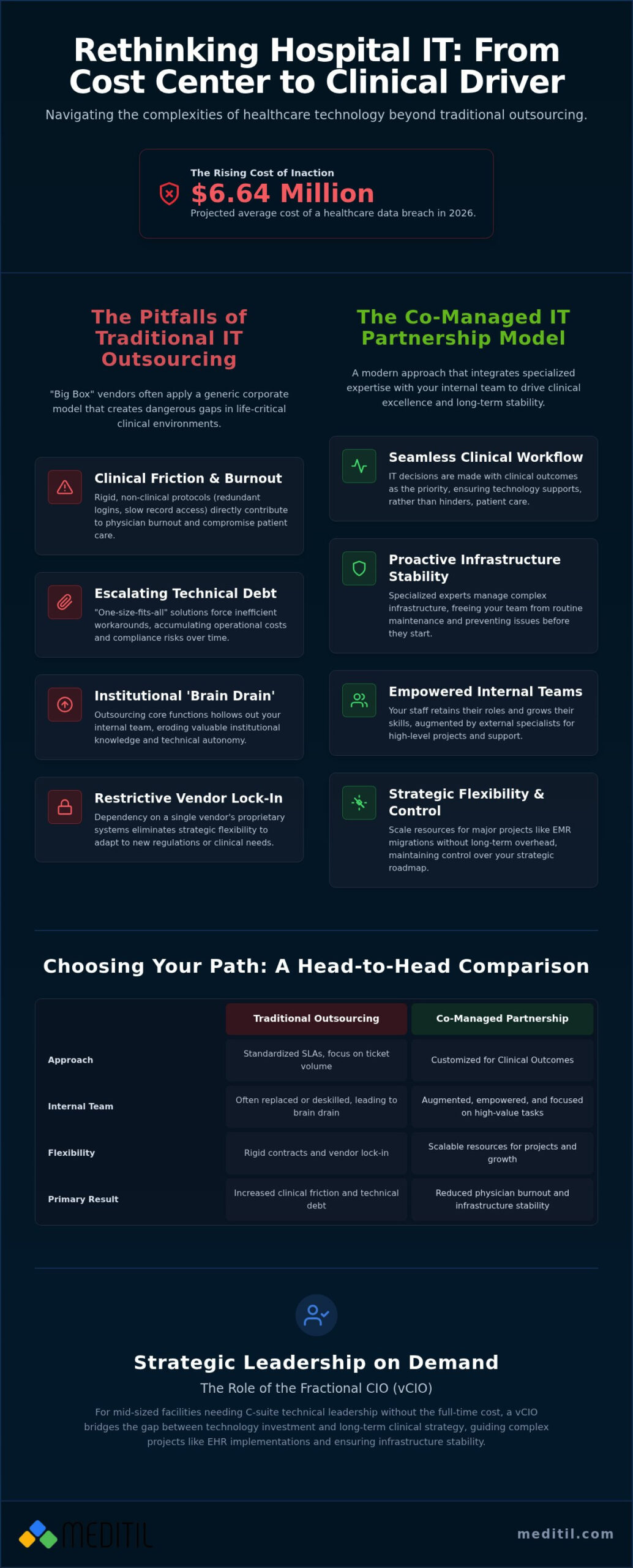
With the average cost of a healthcare data breach reaching $6.64 million in 2026, the margin for technical error has effectively vanished. Your internal IT team possesses invaluable institutional knowledge, yet they’re likely struggling to maintain life-critical systems while simultaneously implementing the latest mandatory HIPAA encryption and multi-factor authentication standards. The pressure to eliminate clinical friction often conflicts with the rigorous demands of modern cybersecurity. Utilizing co-managed IT services for hospitals allows you to bridge this gap without replacing your trusted existing staff.
It’s understandable that you want to maintain your internal culture while seeking a more stable, predictable infrastructure. This guide explores how to integrate specialized healthcare expertise into your current operations to reduce physician burnout and secure your long-term strategic roadmap. We’ll examine the transition to ITIL v5 standards, the impact of new 72-hour data restoration mandates, and the specific ways a strategic partner acts as a steady hand for your clinical environment. By the end of this guide, you’ll understand how to transform your technical infrastructure from a point of friction into a driver of clinical excellence.
Key Takeaways
- Identify why generic IT outsourcing models often fail to meet the urgent, specialized demands of life-critical clinical environments.
- Learn how co-managed IT services for hospitals integrate specialized expertise with your internal team to eliminate technical debt and clinical friction.
- Analyze the true ROI of IT partnerships by accounting for hidden costs like physician burnout and system downtime.
- Determine the ideal balance of internal and external support by assessing whether your current challenges are technical, strategic, or cultural.
- Explore the role of a fractional CIO in providing the steady leadership required for complex EHR implementations and long-term infrastructure stability.
The Limitations of Traditional Hospital IT Outsourcing
Traditional hospital IT strategy often relies on “Big Box” vendors. These entities prioritize high volume and standardized service level agreements (SLAs) to maintain their own margins. While these IT outsourcing models offer scale, they frequently lack the customization required for life-critical healthcare operations. A generic vendor views a hospital as another corporate endpoint, ignoring the nuance of clinical workflows. This disconnect creates a “Ticket Number” problem. In a surgical suite or emergency department, a technician’s adherence to a rigid response time is irrelevant if they don’t understand the clinical urgency of the request. Clinicians don’t need a ticket; they need a resolution that respects the patient’s immediate needs.
Standardized IT solutions often force hospitals into expensive workarounds. When a vendor pushes a “one-size-fits-all” update, it may disrupt Electronic Health Record (EHR) workflows during peak surgery hours. These gaps in clinical context manifest in several ways:
- Updates scheduled during high-volume clinical windows without consulting department heads.
- Security protocols that require redundant logins during emergency procedures.
- Lack of interoperability between specialized medical devices and generic network configurations.
These issues lead to technical debt. In a 2026 healthcare context, technical debt is the accumulated operational cost of maintaining legacy systems and inefficient workarounds that compromise patient data integrity and regulatory compliance. Many facilities are turning to co-managed IT services for hospitals to bridge these gaps while retaining their internal expertise.
The Erosion of Institutional IT Knowledge
Large-scale outsourcing often triggers a “brain drain” within the hospital’s internal staff. As external vendors take over core functions, your long-term employees lose the opportunity to grow with the technology. This creates a dangerous dependency on proprietary, non-transferable vendor processes. If the relationship sours, the hospital is left with a hollowed-out department and no clear path toward technical autonomy. You become locked into a vendor’s ecosystem, losing the strategic flexibility required to adapt to new healthcare regulations or clinical needs.
Clinical Friction and Physician Burnout
There’s a direct, measurable link between inadequate IT support and medical staff frustration. Traditional vendors focus on “uptime” as their primary metric. However, 99.9% uptime is meaningless if system latency hinders clinical throughput. If a physician has to wait thirty seconds for a patient record to load, that friction compounds over a twelve-hour shift. This technical friction is a primary driver of physician burnout. Rigid IT policies, designed for generic security rather than clinical flow, ultimately compromise both the patient experience and safety. Adopting co-managed IT services for hospitals ensures that technical decisions are made with clinical outcomes as the priority.
Beyond professional support, it is equally important for medical staff to find balance in their private lives. To connect with peers who truly understand your schedule and challenges, you might explore Premium Membership options on social platforms built specifically for the healthcare community.
Strategic Alternatives: Co-Managed and Fractional CIO Models
In 2026, the choice is no longer a binary one between purely in-house departments or total outsourcing. This rigid perspective often leaves hospitals vulnerable to either technical stagnation or a total loss of control. Instead, healthcare leaders are embracing a spectrum of support. Co-managed IT services for hospitals provide a middle ground where internal staff retain their roles while gaining access to specialized infrastructure experts. This model ensures that your team isn’t buried under routine maintenance, allowing them to focus on high-touch clinical support.
Scaling resources becomes effortless with an augmented IT team. Whether you’re facing a massive EMR migration or a facility expansion, you can inject specialized talent into your workflow without the long-term overhead of permanent hires. This flexibility is essential for maintaining stability during periods of rapid change. It allows for a surgical application of expertise exactly where your current team needs it most.
The Fractional CIO: Strategic Leadership for Mid-Sized Hospitals
Mid-sized facilities often lack the budget for a full-time, C-suite technical executive. Accessing virtual CIO services solves this by providing strategic leadership on a fractional basis. A vCIO doesn’t just manage hardware; they bridge the gap between clinical needs and technical infrastructure. They are instrumental in IT budgeting for medical practices, ensuring that every dollar spent aligns with long-term clinical goals and ROI. By managing vendor relationships and interoperability roadmaps, they prevent the creation of technical silos that hinder data flow.
The Hybrid Model: Retaining Control While Scaling Expertise
A hybrid approach allows you to keep “boots on the ground” for immediate, face-to-face support. While your local team handles the daily needs of physicians and nurses, you can outsource complex, 24/7 requirements like threat monitoring. Ensuring HIPAA compliance is increasingly difficult as regulations evolve, but specialized healthcare cybersecurity services provide the necessary oversight. This model allows you to scale resources instantly during peak patient volumes or unexpected regulatory audits. Integrating co-managed IT services for hospitals ensures that your facility remains agile without sacrificing the institutional knowledge of your core team. If you’re looking to stabilize your operations, you might consider how an augmented IT team can support your existing staff.
Comparing ROI: Big Box Vendors vs. Specialized Partners
Evaluating the return on investment for technical support requires looking beyond the monthly invoice. While “Big Box” vendors often lead with lower upfront costs, their Total Cost of Ownership (TCO) is frequently inflated by clinical downtime and high staff turnover. When a generic vendor’s rigid SLA fails to prioritize a critical system failure, the resulting idle time for surgical teams and diagnostic departments costs the facility far more than any service fee savings. In 2026, a strategic partnership focuses on preventing these losses by aligning technical responses with clinical necessity.
Agility often proves more valuable than sheer scale in a hospital environment. National giants rely on standardized scripts that can’t account for the unique network configurations of a local facility. Specialized partners, however, resolve clinical issues faster because they maintain a deep understanding of your specific infrastructure. Integrating co-managed IT services for hospitals allows for a targeted approach that addresses these specific clinical needs while maintaining a lean internal department. This model ensures that your high-value clinical staff isn’t wasting time on technical workarounds.
Revenue cycle management is another area where specialized expertise yields a clear financial return. Implementing medical billing automation solutions requires a partner who understands the intersection of clinical documentation and financial reimbursement. By automating these workflows, hospitals can reduce manual errors and accelerate their time-to-payment. Furthermore, security becomes a significant ROI driver. With the average cost of a healthcare data breach reaching $6.64 million in 2026, specialized HIPAA-first monitoring is no longer a luxury; it’s a vital safeguard for your hospital’s financial stability.
Interoperability and EHR Optimization
Specialized partners excel at EHR implementation and clinical staff training because they speak the language of healthcare. They don’t just install software; they optimize it to reduce data silos and improve physician speed. This technical precision ensures that patient data flows seamlessly between departments, which is essential for both safety and efficiency. In 2026, a high-performance interoperability architecture directly influences hospital revenue by reducing documentation gaps and ensuring that every billable clinical action is accurately captured and transmitted to payers without manual intervention.
Responsiveness and Clinical Alignment
Clinical alignment requires a partner who knows the difference between a simple printer failure and a PACS server outage. When support teams understand the clinical stakes, they prioritize tickets based on patient impact rather than a generic chronological queue. Personalized support drastically improves staff morale by replacing frustrating automated call trees with direct access to experts. Utilizing tailored managed IT services for healthcare acts as a growth engine, allowing your facility to adopt new technologies like telehealth or remote monitoring without compromising the stability of your core systems.
Assessing Your Facility: Which IT Model Fits Your Workflow?
Selecting a technical partner isn’t a mere procurement task; it’s a strategic decision that dictates clinical efficiency for years. You must first categorize your existing pain points with clinical precision. Are they technical, such as aging hardware? Are they strategic, like a lack of a clear digital transformation roadmap? Or are they cultural, where staff feel alienated and unsupported by your current technical framework? Identifying these roots helps determine if co-managed IT services for hospitals can provide the specific relief your facility requires.
The “Scale Test” is a vital metric for mid-sized hospitals. At what point does a large vendor’s size become a bureaucratic liability? If your IT director spends more time navigating a vendor’s account management layers than solving clinical issues, you’ve failed the test. Bureaucracy in a hospital environment isn’t just an inconvenience; it’s a risk to patient safety. When technical support is filtered through multiple layers of non-clinical management, the urgency of the bedside is lost in transition.
Conduct an internal capability audit to decide what functions to retain. You should keep roles that are core to your hospital’s unique culture and patient safety protocols in-house. Strategic oversight and high-touch clinical support are often best handled by those who walk the halls every day and understand the specific needs of your physicians. Everything else, from 24/7 network monitoring to complex cybersecurity, can be augmented by a specialized partner. Before signing any new contract, define a three-year strategic roadmap that accounts for facility growth and shifting regulatory standards.
The Infrastructure and Security Audit
Begin by assessing the stability of your current network management and redundancy. A single point of failure in a life-critical environment is unacceptable. Identify gaps in your regulatory compliance and disaster recovery protocols, especially as 2026 mandates stricter restoration windows and mandatory encryption standards. Determine if your current vendor is ignoring the technical debt that compromises your long-term stability. If you’re uncertain about your current posture, you can consult with our strategic healthcare IT experts to identify hidden vulnerabilities.
Choosing a Specialized Partner
When evaluating alternatives to large vendors, ask specific questions about their “Healthcare-Only” focus. A partner who also serves retail or law firms won’t understand the nuance of clinical urgency or the complexities of medical device integration. Verify their direct experience with your specific EHR/EMR interoperability needs. A specialized partner acts as a steady hand, ensuring that technical upgrades never compromise the physician’s ability to deliver care. This focus ensures that co-managed IT services for hospitals remain a clinical asset rather than a departmental expense.
Implementing a Specialized IT Model with MEDITIL
Transitioning from a legacy big-box vendor requires a partner who prioritizes stability over rapid, disruptive change. MEDITIL serves as a steady hand for facilities moving toward more agile, high-performance models. Our approach combines high-performance infrastructure with the strategic foresight of a Fractional CIO. This synergy ensures that your technical foundation supports your clinical goals without the friction common in generic outsourcing. By focusing exclusively on the healthcare sector, we eliminate the learning curve associated with clinical workflows.
Minimizing transition risk is a core component of the MEDITIL onboarding process. We conduct a thorough clinical integration audit to understand how your specific departments utilize technology before any changes occur. This methodical pace prevents the chaos often associated with vendor switches. By aligning our deployment schedules with your clinical windows, we protect the continuity of care. You don’t have to worry about system updates disrupting a surgical schedule or an emergency department intake process.
Our proactive monitoring protocols go beyond standard uptime checks. We analyze system performance through a clinical lens, identifying potential bottlenecks before they escalate into patient safety crises. If a latency issue begins to affect EHR responsiveness, our team intervenes before a physician even notices a delay. This level of vigilance is a hallmark of high-quality co-managed IT services for hospitals. It transforms your IT department from a reactive help desk into a proactive clinical asset.
Customized Managed IT for Your Clinical Volume
Network and cloud configurations must scale with your specific patient throughput. A rural hospital has different infrastructure needs than a high-volume urban trauma center. MEDITIL tailors these services to ensure your connectivity remains robust during peak admission periods. Integrating virtual CIO services into your leadership team provides the executive-level guidance needed to manage these complex systems. For specialty clinics, MEDITIL’s approach to augmented IT teams provides the niche expertise required for specialized medical imaging and diagnostic software without the cost of full-time hires.
Next Steps for Hospital Leadership
The path toward technical stability begins with a clear understanding of your current environment. Requesting a strategic IT assessment allows you to identify hidden inefficiencies that may be draining your budget or frustrating your clinical staff. This evaluation serves as the foundation for a Fractional CIO engagement, offering immediate strategic relief and a roadmap for long-term improvement. Integrating co-managed IT services for hospitals provides the balance of control and expertise your facility deserves. Schedule a consultation with MEDITIL to explore your hospital IT alternatives today.
Securing Your Hospital’s Technical Future
Transitioning to a specialized technical model ensures that your hospital isn’t just maintaining systems, but actively enhancing clinical safety. By moving away from generic outsourcing, you protect your institutional knowledge while gaining the agility needed to meet 2026 standards. Co-managed IT services for hospitals provide the necessary balance between local culture and specialized infrastructure expertise. This approach allows your internal team to remain focused on bedside support while external experts handle the high-stakes demands of cybersecurity and interoperability.
MEDITIL serves as a strategic partner, offering a specialized healthcare IT focus and national infrastructure management experts to stabilize your operations. Our fractional CIO strategic leadership bridges the gap between complex technical requirements and the daily reality of patient care. It’s time to move past the “ticket number” mentality of big-box vendors that prioritize volume over clinical outcomes. Request a Strategic IT Assessment from MEDITIL to identify hidden inefficiencies and secure your facility’s long-term roadmap. We’re ready to help you build a technical foundation that truly supports your clinical mission.
Frequently Asked Questions
What are the main risks of hospital IT outsourcing to large vendors?
The primary risks include a significant loss of institutional knowledge and a persistent misalignment between rigid service level agreements and clinical urgency. Large vendors often prioritize volume over customization, leading to a “ticket number” mentality that fails in life-critical environments. This disconnect creates technical debt as hospitals implement inefficient workarounds to bypass standardized IT limitations that don’t account for specific clinical workflows, medical device integration, or patient safety protocols.
How does a Fractional CIO differ from a traditional IT consultant?
A Fractional CIO serves as an embedded member of your leadership team, whereas a traditional consultant typically focuses on specific, short-term project advisory. This executive role provides ongoing strategic oversight, managing long-term IT budgeting and vendor roadmaps. Unlike consultants who offer advice and then depart, a Fractional CIO is invested in your hospital’s long-term operational stability and clinical outcomes, acting as a steady hand for your strategic roadmap and growth.
Can a smaller IT partner handle the cybersecurity needs of a large hospital?
Specialized healthcare partners often provide superior cybersecurity because they focus exclusively on the high-stakes regulatory landscape of medicine. While they may be smaller in total headcount than national giants, they utilize national-scale monitoring tools tailored to life-critical systems. This specialized focus allows for faster threat detection and a deeper understanding of mandatory 2026 HIPAA encryption standards, ensuring your hospital isn’t just another endpoint in a generic, non-clinical security queue.
What is the “Hybrid IT” model in a healthcare setting?
The Hybrid IT model involves a strategic partnership where your internal IT staff manages daily clinical support while an external partner handles complex infrastructure and 24/7 security. This approach, often delivered through co-managed IT services for hospitals, ensures you retain your internal culture and institutional knowledge. It allows your “boots on the ground” team to focus on physician needs while specialists manage the heavy lifting of backend technical architecture and compliance.
How long does it typically take to transition from a large vendor to a specialized partner?
A successful transition typically takes between three to six months, depending on the complexity of your current infrastructure and existing vendor contracts. This process begins with an exhaustive audit of your network and clinical workflows to prevent technical gaps. A phased onboarding approach is essential to ensure that each department is stabilized before moving to the next phase, which minimizes the risk of operational disruption during the partner handover.
Will switching IT partners disrupt my EHR or patient data access?
Disruption is avoidable through a methodical clinical integration process that prioritizes data continuity and system uptime. Specialized partners schedule migrations and updates during low-volume windows, ensuring that EHR access remains seamless for physicians and nurses. By conducting thorough testing in a mirrored environment before the final cutover, technical teams can verify that interoperability remains intact and patient data access is never compromised during the switch to a new partner.
Is co-managed IT more expensive than full outsourcing?
The total cost of ownership for co-managed IT services for hospitals is often lower than full outsourcing because it reduces clinical downtime and staff turnover. You avoid the high costs associated with physician burnout and the expensive technical workarounds required by generic solutions. By augmenting your existing team rather than replacing them, you maximize your current payroll investment while gaining the specialized expertise needed for long-term strategic stability and predictable budgeting.
How do specialized IT partners help with HIPAA compliance?
Specialized partners provide HIPAA-first monitoring that maps directly to the latest 2026 regulatory updates, such as mandatory multi-factor authentication and universal encryption. They maintain the detailed asset inventories and network maps required for audits, which generic vendors often overlook. This proactive approach ensures that your facility is always prepared for a regulatory review, transforming compliance from a periodic crisis into a continuous, verified state of technical readiness and patient protection.