
Clinical data analytics is an infrastructure challenge disguised as a software problem. You likely manage a complex web of EMR and EHR systems that don’t speak the same language, leading to inconsistent reporting and expensive technical debt. It’s frustrating to sit on a goldmine of patient information while struggling with manual data entry or fragmented workflows. Expert clinical data analytics consulting provides the strategic bridge between these isolated silos and the actionable business intelligence required for modern care delivery.
We understand the pressure to modernize while maintaining strict compliance with evolving standards like USCDI V3 and the 2026 HIPAA Security Rule updates. This article provides a clear roadmap for transforming your legacy infrastructure into a high-performing ecosystem. We’ll examine how strategic IT leadership can automate billing flows, optimize staffing through predictive modeling, and ensure your data remains a secure asset rather than a liability. By the end of this guide, you’ll have a framework to drive better patient outcomes through a disciplined, data-driven approach.
Key Takeaways
- Learn how to bridge the gap between fragmented EMR systems and executive decision-making by establishing a unified strategic data framework.
- Understand why interoperability is the non-negotiable foundation for any analytics initiative and how cloud services provide the necessary security and scale.
- Discover the strategic advantages of a Fractional CIO in aligning your IT budget with specific clinical outcomes and long-term financial stability.
- Identify how expert clinical data analytics consulting identifies bottlenecks in the patient billing journey to directly improve your revenue cycle management.
- Explore the benefits of a managed IT partnership that combines technical infrastructure with the professional advisory needed for complex data transitions.
The Challenge of Clinical Data Fragmentation in 2026
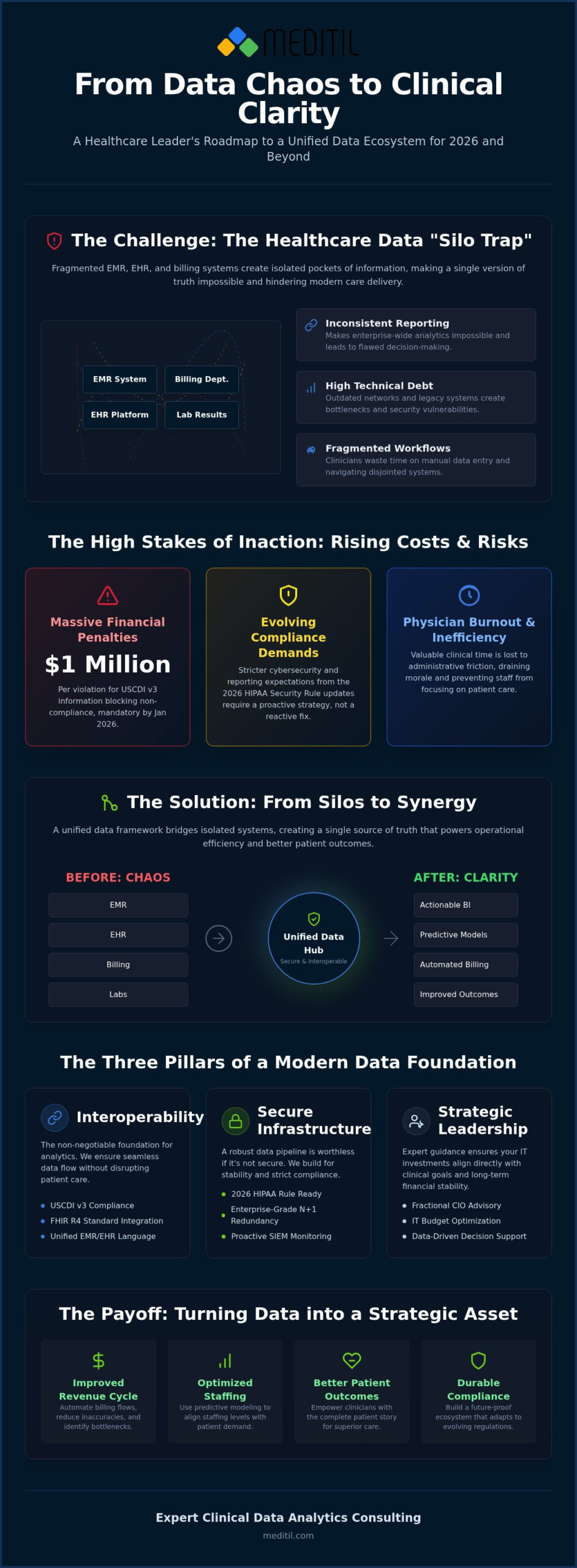
The “Silo Trap” is the primary obstacle to progress. Fragmented EMR and EHR systems create isolated pockets of information, making it impossible to achieve a single version of truth across the enterprise. When patient records are trapped in incompatible formats, real-time analytics becomes a technical impossibility. Much of this friction stems from legacy infrastructure. High levels of technical debt in outdated networks create significant bottlenecks, preventing the seamless flow of information needed for modern health care analytics and decision support.
Why General IT Consulting Fails Healthcare Analytics
General IT consultants often lack the deep regulatory nuance required for high-stakes medical environments. Non-specialized firms frequently overlook the specific requirements of the 2026 HIPAA Security Rule updates, which introduce stricter cybersecurity expectations. Beyond compliance, generalists often miss the clinical workflow context. They might understand how to move a data packet, but they don’t understand how a physician interacts with that data at the point of care. For specialized niches such as veterinary practices, Helpful.vet provides interactive workflow tools and clinic benchmarks to address these specific operational needs. True clinical intelligence requires a partner who understands the difference between simple data storage and active diagnostic support.
The Emotional and Financial Cost of Data Silos
The impact of fragmented data extends far beyond the server room. It contributes directly to physician burnout. Clinicians spend valuable time navigating disjointed systems instead of focusing on patient care. This administrative friction is a silent drain on morale and productivity. Financially, the cost of inconsistent reporting is equally high. Poor data flow leads to billing inaccuracies and potential audit failures. With USCDI V3 compliance mandatory as of January 2026, the financial penalties for information blocking or poor data management can reach $1 million per violation. A unified strategy is no longer a luxury; it’s a requirement for operational survival.
Building a Foundation for Healthcare Interoperability
Interoperability is the non-negotiable foundation for any successful analytics initiative. Without a seamless flow of data, even the most sophisticated algorithms fail to deliver value. As of January 2026, all health IT systems must comply with USCDI V3 standards to avoid significant financial penalties. Effective clinical data analytics consulting prioritizes this structural readiness by ensuring that your network can handle high-volume data ingestion. We achieve this through N+1 redundancy and enterprise-grade stability, providing the reliable backbone required for real-time processing. A stable environment ensures that healthcare interoperability isn’t just a compliance checkbox but a strategic asset. You can explore our healthcare interoperability guide for deeper insights into these technical requirements.
Bridging Systems: EMR/EHR Integration
Integrating disparate datasets from multiple EMR and EHR systems is a complex undertaking that must occur without disrupting patient care. The challenge isn’t the software itself but the workflow optimization surrounding it. Successful integration requires a meticulous mapping of data definitions to ensure consistency across the enterprise. It’s about creating a unified language using the FHIR R4 standard. When we approach system integration, the focus remains on training and clinical workflow context. This ensures that the data collected at the bedside is accurate and ready for executive-level analysis. True success is measured by how effectively systems communicate, not just how they are installed.
Securing the Data Pipeline
A robust data pipeline is worthless if it isn’t secure. Cybersecurity must be a core component of your data analytics infrastructure, especially with the 2026 HIPAA Security Rule updates introducing stricter compliance expectations. We utilize Security Information and Event Management (SIEM) systems to monitor data access and integrity in real time. This proactive monitoring detects anomalies before they become breaches. Protecting patient information requires a multi-layered approach that includes managed healthcare cybersecurity services. This protective layer ensures that your clinical data remains private and verifiable. Specialized clinical data analytics consulting helps verify that your security protocols align with both technical and regulatory requirements. If you’re concerned about your current security posture, a specialized managed IT services audit can identify critical gaps in your infrastructure.
The Strategic Role of a Fractional CIO in Data Analytics
Successful clinical data analytics consulting requires more than technical implementation; it demands executive leadership to align technology with organizational goals. A Fractional CIO provides this high-level guidance without the overhead of a full-time executive salary. This model allows healthcare organizations to access seasoned expertise for high-stakes decisions regarding infrastructure and interoperability. By utilizing virtual CIO services, practices can ensure their IT budget directly supports clinical outcomes rather than just maintaining legacy hardware.
A primary deliverable of this partnership is the Strategic IT Roadmap. This document serves as a blueprint for data maturity, systematically addressing the technical debt and fragmented systems that hinder progress. It defines how to move through different stages of Healthcare Analytics, from basic descriptive reporting to advanced predictive modeling. This structured approach prevents the common mistake of investing in sophisticated AI before the underlying data foundation is verified and stable. It’s a disciplined path toward turning raw information into a reliable strategic asset.
From Managed IT to Strategic Partnership
The transition from “break-fix” IT to a proactive partnership is essential for long-term analytics success. For organizations in the biotech, pharma, and MedTech sectors, this evolution often requires the specialized management and ERP consulting provided by LifeScience Services to unify disparate operational systems. Managed services shouldn’t just focus on uptime; they must focus on data integrity. An augmented IT team supports this by providing the specialized labor required for complex integration projects without disrupting daily operations. We move beyond managing servers to managing insights. This shift ensures that every technical update serves a broader clinical purpose. It’s about building a stable environment where data flows predictably from the point of care to the executive dashboard.
Maintaining HIPAA compliance while innovating with data requires a steady hand at the wheel. A vCIO ensures that every analytics project adheres to the strictest administrative and technical safeguards, especially as we navigate the 2026 compliance deadline for 42 CFR Part 2. Proactive monitoring is a core component of this strategy. We don’t just react to breaches; we build systems that detect anomalies in data access patterns in real time. This protective layer allows organizations to innovate with confidence, knowing their patient data is both accessible for analysis and secured against evolving cyber threats.
Turning Analytics into Operational ROI and Billing Efficiency
Clinical data accuracy directly dictates the success of your revenue cycle management. When clinical documentation is fragmented or inconsistent, the billing process inherently suffers from delays and increased denial rates. Many organizations treat these as separate silos, yet they’re inextricably linked. Through specialized clinical data analytics consulting, organizations can treat medical data as a primary financial driver. Identifying specific bottlenecks in the patient billing journey allows leaders to move from reactive recovery to proactive revenue management. This transformation provides the “Insight You Can Act On” required for tangible margin improvements that stabilize the organization’s fiscal future.
Optimizing the Revenue Cycle
Analytics allows for a granular review of under-performing billing codes and documentation gaps that often go unnoticed during manual audits. Real-time data flow ensures that claim submission accuracy is verified at the point of origin. This prevents the cycle of rejections that drains administrative resources. Implementing medical billing automation solutions reduces the burden of manual data reconciliation. This automation ensures that clinical inputs translate into billable outputs with high precision. Reducing the cost to collect is a direct result of these technical efficiencies. It turns the billing department into a streamlined, data-driven operation that supports the practice’s long-term growth.
Data-Driven Staffing and Resource Allocation
Beyond the billing office, analytics informs operational efficiency through predictive modeling of patient flow. Analyzing historical patient volumes and clinical acuity allows practices to optimize staffing levels to match actual demand. This prevents overstaffing during slow periods and avoids the high costs of emergency coverage during surges. Reducing technical debt in legacy networks also frees up capital for clinical innovation. Aligning these technical improvements with a long-term plan for it budgeting for medical practices ensures that IT remains a strategic investment. This methodical approach to resource allocation provides a stable foundation for scaling care delivery in a regulated environment.
If you’re ready to bridge the gap between clinical data and financial performance, our team is prepared to help. Schedule a consultation to explore how our billing automation and integration services can protect your margins and improve your operational resilience.
Partnering with MEDITIL for Clinical Data Success
Navigating the complexities of healthcare technology requires a partner who understands that data is the lifeblood of modern medicine. MEDITIL provides a comprehensive approach that integrates managed IT services with high-level strategic advisory and deep healthcare expertise. We serve as the steady hand at the wheel during complex data transitions, ensuring that your infrastructure remains stable while you pursue ambitious analytics goals. Whether you require a focused, project-based engagement or a long-term managed service agreement, our team delivers the technical precision necessary for high-stakes environments. Specialized clinical data analytics consulting ensures that every technical decision aligns with your clinical and financial objectives.
We believe that successful data modernization begins with a clear understanding of your current state. Before launching expensive analytics tools, it’s essential to conduct a proactive audit of your existing network and data flows. This verification process identifies the technical debt and fragmented systems that could undermine your investment. By addressing these foundational issues first, we help you build a reliable ecosystem where information is protected, accessible, and ready for analysis. Our commitment is to provide the stability and foresight required to turn your clinical data into a sustainable competitive advantage.
Our Methodology: Integration, Strategy, Security
Our methodology focuses on the seamless connectivity of all clinical and administrative systems. We manage entire IT departments to support your broader analytics goals, allowing your internal teams to focus on patient care rather than hardware maintenance. This mission-driven focus on stability is critical for life-critical systems where downtime isn’t an option. We prioritize proactive risk management by implementing multi-layered cybersecurity protocols that protect data integrity at every touchpoint. By combining infrastructure management with strategic clinical data analytics consulting, we ensure your data pipeline is both high-performing and fully compliant with the latest regulatory standards.
Next Steps: Assessing Your Data Maturity
The path toward data-driven excellence starts with a comprehensive IT infrastructure audit. This assessment provides a clear baseline of your data maturity and identifies the specific roadblocks preventing a unified version of truth. We help you set realistic milestones for modernization, ensuring that each phase of the project delivers measurable value without disrupting daily workflows. This structured progression prevents the “silo trap” and ensures that your technology scales alongside your practice. A disciplined roadmap is the best protection against technical debt and administrative friction. We invite you to consult with MEDITIL today to secure your clinical data roadmap and begin the journey toward operational clarity.
Securing Your Strategic Advantage in 2026
The transition from fragmented data silos to a unified intelligence ecosystem is the most critical infrastructure project your organization will undertake this decade. By establishing a foundation of interoperability and leveraging Fractional CIO leadership, you can finally align your technology investments with actual clinical and financial outcomes. Success in this high-stakes environment requires more than software; it demands a disciplined roadmap that systematically addresses technical debt and prioritizes cybersecurity resilience. Expert clinical data analytics consulting provides the specialized guidance needed to navigate these complexities without disrupting the continuity of patient care.
MEDITIL offers the managed infrastructure and specialized healthcare IT focus required to stabilize your operations and protect your data integrity. Our strategic leadership helps you transform raw medical data into a reliable asset for long-term growth and operational efficiency. It’s time to move beyond reactive reporting and embrace a proactive strategy that secures your practice’s future. Partner with MEDITIL for Expert Clinical Data Analytics Consulting to begin your comprehensive infrastructure audit today. We’re ready to serve as the steady hand at the wheel for your digital transformation.
Frequently Asked Questions
What is the difference between clinical data analytics and general business intelligence?
Clinical data analytics focuses on patient-centric information such as diagnostic results, treatment histories, and outcomes within a strictly regulated framework. General business intelligence often addresses broader operational metrics like marketing performance or general supply chain data. Clinical analytics requires a deep understanding of medical workflows to ensure data accuracy for diagnostic support. By utilizing specialized clinical data analytics consulting, leaders can interpret complex datasets like FHIR-based APIs to improve patient safety and care quality.
How does a fractional CIO help with clinical data strategy?
A Fractional CIO acts as the strategic architect of your data ecosystem, aligning IT budgets with specific clinical and financial outcomes. They provide the executive leadership required to create a Strategic IT Roadmap, which systematically addresses technical debt and system fragmentation. This role ensures that every technical update serves a broader clinical purpose. By leveraging professional clinical data analytics consulting, a vCIO bridges the gap between raw medical data and actionable executive decision-making without the overhead of a full-time hire.
Can clinical data analytics help with HIPAA compliance?
Clinical data analytics facilitates HIPAA compliance by providing granular visibility into how sensitive patient information is accessed and utilized across your network. Specialized consulting teams implement Security Information and Event Management (SIEM) systems to monitor data integrity in real time. These tools detect anomalies that might indicate unauthorized access or potential breaches. Proactive monitoring ensures your organization adheres to the 2026 HIPAA Security Rule updates and other evolving regulatory standards designed to protect patient privacy.
What are the most common barriers to healthcare data interoperability?
Common barriers include fragmented EMR and EHR systems, inconsistent data definitions, and legacy infrastructure that lacks modern API support. Many organizations fall into the Silo Trap, where patient records are trapped in incompatible formats across different departments. Additionally, a lack of standardized terminology leads to poor reporting and administrative friction. Overcoming these obstacles requires a disciplined approach to systems integration and a commitment to adopting foundational standards like FHIR R4 and USCDI V3 compliance by the 2026 deadline.
How much does clinical data analytics consulting typically cost?
The cost of consulting depends on the depth of the engagement and your organization’s current data maturity. Engagements are typically structured as ongoing managed service agreements, project-based implementations, or monthly fractional CIO retainers. Each model focuses on providing a stable environment and a clear roadmap for modernization. By addressing technical debt and automating billing flows, these services aim to deliver long-term fiscal health that outweighs the initial investment in professional strategic advisory and technical oversight.
How long does it take to see ROI from a clinical analytics project?
ROI often becomes visible within the first six to twelve months as organizations identify billing leaks and staffing inefficiencies through better data visibility. Initial gains frequently stem from automated data reconciliation and improved claim submission accuracy. Long-term value is realized through enhanced patient outcomes and the reduction of expensive administrative friction. Setting realistic milestones during the initial infrastructure audit ensures that each phase of modernization delivers measurable financial or clinical benefits while maintaining operational stability.
Do we need to replace our EHR to implement better data analytics?
You don’t necessarily need to replace your existing EHR to achieve high-quality analytics. The focus should be on improving interoperability and data flow between your current systems. Specialized consultants work to integrate disparate datasets and map them to a unified language without the disruption of a full system replacement. This approach maximizes the value of your existing technology investments while addressing the technical debt that causes bottlenecks. Modernization is about building a secure bridge, not starting from scratch.
What security measures are required for cloud-based clinical analytics?
Cloud-based analytics requires a multi-layered security approach, including end-to-end encryption, multi-factor authentication, and continuous SIEM monitoring. Organizations must ensure their cloud providers adhere to the 2026 HIPAA Security Rule updates and provide verifiable audit trails for all data access. Proactive risk management involves regular vulnerability assessments and strict access controls to protect data integrity. A stable, secure pipeline is the only way to innovate with patient data in a highly regulated environment where security is a mission-critical priority.