
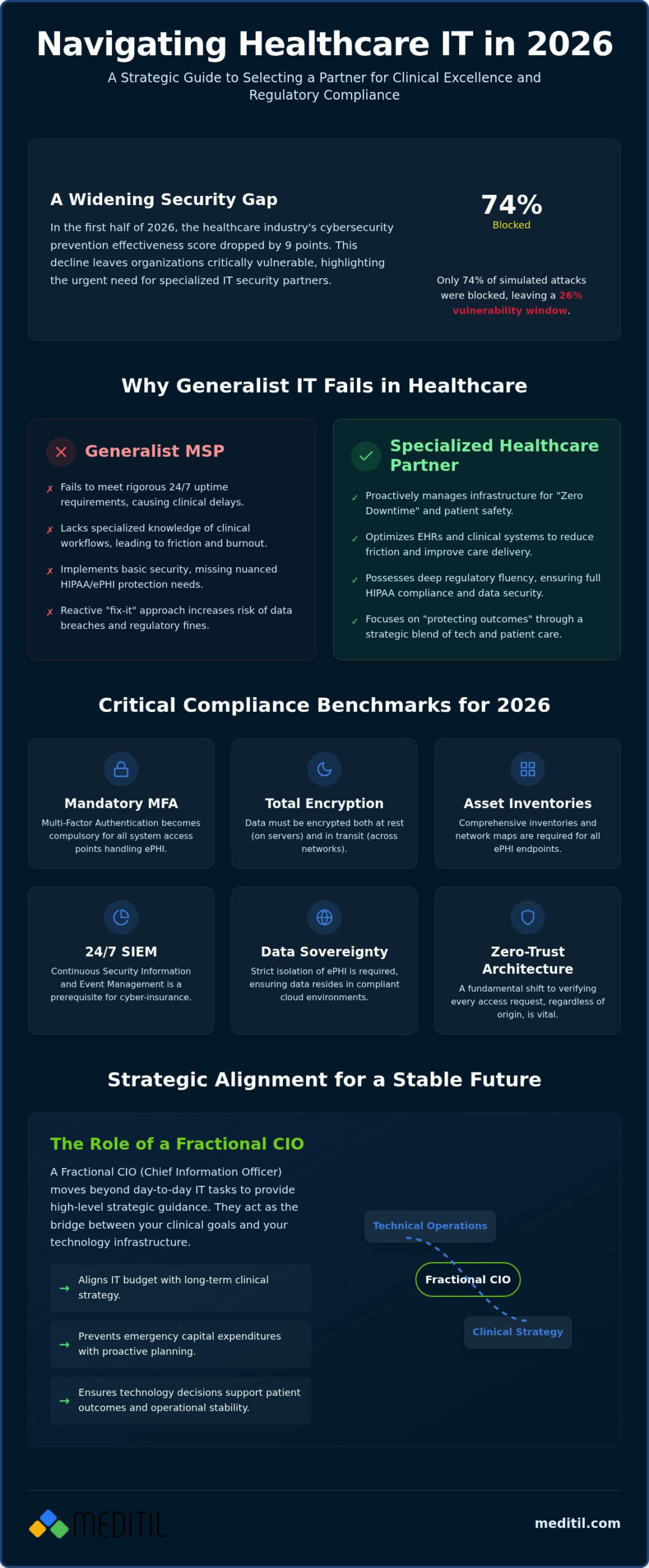
In the first half of 2026, the healthcare industry’s cybersecurity prevention effectiveness score dropped by nine points, leaving organizations vulnerable by blocking only 74% of simulated attacks. This decline occurs just as the Department of Health and Human Services moves toward mandatory multi-factor authentication and compulsory encryption for all data at rest. You likely recognize that the stakes for choosing a healthcare IT partner have never been higher. It’s frustrating when clinical friction from slow EHR systems hampers patient care, or when unpredictable IT expenses disrupt your strategic planning.
We understand that you need more than a help desk; you require a steady hand at the wheel to ensure seamless system interoperability and guaranteed regulatory compliance. This 2026 strategic guide will teach you how to identify, evaluate, and select a partner that aligns with your clinical goals and operational scale. We will explore the transition to enforced security controls, the advantages of the fractional CIO model, and how to establish a predictable IT budget that remains focused on your mission of patient stability and improvement.
Key Takeaways
- Identify why generalist IT providers often fail to meet the rigorous uptime and clinical workflow requirements essential for patient safety and operational stability.
- Evaluate critical 2026 compliance benchmarks, including mandatory encryption and MFA, when choosing a healthcare IT partner to ensure long-term regulatory adherence.
- Discover how a Fractional CIO bridges the gap between technical operations and clinical strategy to prevent emergency capital expenditures and stabilize your IT budget.
- Master the “Zero Downtime” philosophy for switching service providers, ensuring your practice maintains seamless patient care throughout the transition and discovery phase.
- Explore the benefits of an augmented IT team model to scale your existing resources while maintaining deep internal knowledge and operational precision.
Why General Managed IT Fails the Healthcare Sector
A standard Managed Service Provider (MSP) might excel at maintaining a law firm’s server or a retail chain’s point-of-sale system, but these environments lack the life-critical urgency of medical infrastructure. In healthcare, a system delay isn’t just an inconvenience; it’s a barrier to patient care. When choosing a healthcare IT partner, you must look beyond general technical proficiency. A generalist often fails to grasp the depth of Health information technology (HIT), where every second of latency translates into clinical risk. They may understand hardware, but they rarely understand the patient journey.
Generalist MSPs typically struggle with the specific uptime requirements of a 24/7 medical environment. They often lack the specialized knowledge required to optimize clinical workflows, leading to what we call “technical debt.” This debt manifests as chronic billing delays, lost revenue, and systemic inefficiencies that drain your organization’s resources. It’s a costly burden that standard IT teams aren’t equipped to solve. A true partner provides a blend of technical mastery and regulatory fluency, ensuring that technology serves as a reliable asset rather than a recurring liability.
The Clinical Friction Factor
Poorly managed infrastructure creates clinical friction that erodes the quality of care. When an EHR system responds slowly or login processes are cumbersome, physician productivity drops instantly. This leads to increased patient wait times and contributes heavily to provider burnout. Specialized support reduces these administrative burdens by ensuring that systems are optimized for the way clinicians actually work. Moving beyond a reactive help desk is a clinical necessity. Proactive infrastructure management ensures that your team can focus entirely on patients, not troubleshooting hardware or waiting for screens to load.
Regulatory Risks of Generalist Support
There is a significant gap between basic cybersecurity and healthcare-grade HIPAA compliance. Generalist IT providers often implement standard firewalls and antivirus software, but they may miss the nuances of medical data interoperability and the strict audit trails required by federal law. Without a partner who understands the granular requirements of ePHI protection, your organization remains vulnerable to data breaches and severe regulatory fines. Generalists focus on “fixing things,” whereas healthcare experts focus on “protecting outcomes.” A Healthcare IT Partnership is a strategic alignment of technology and patient care.
Critical Compliance and Cybersecurity Benchmarks for 2026
The regulatory landscape of 2026 marks a definitive shift from flexible safeguards to mandatory, enforced security controls. When choosing a healthcare IT partner, you must verify their ability to implement multi-factor authentication (MFA) and encryption for data both at rest and in transit. These are no longer just “addressable” suggestions; they are becoming compulsory requirements under updated HIPAA Security Rules. Organizations are now expected to maintain comprehensive asset inventories and detailed network maps to ensure every endpoint handling ePHI is accounted for and protected.
Cybersecurity insurance providers have also significantly raised their standards. Most carriers now mandate 24/7 Security Information and Event Management (SIEM) as a non-negotiable prerequisite for coverage. They require documented evidence of active threat hunting and rapid incident response capabilities. Furthermore, data sovereignty has become a primary concern in multi-tenant cloud environments. Your partner must ensure that electronic Protected Health Information (ePHI) is strictly isolated and that cloud configurations meet the highest standards of healthcare-specific security.
Proactive Monitoring vs. Reactive Patching
Waiting for a breach to occur is no longer a viable strategy for medical organizations. In the first half of 2026, the industry’s ability to block simulated attacks fell to 74 percent, a notable drop from the previous year. This decline highlights why automated threat detection is vital for life-critical systems. Implementing a zero-trust architecture ensures that every access request is verified, regardless of its origin within the clinical hub. You can see how Healthcare Cybersecurity Services provide a specialized roadmap for this transition. A recent Healthcare Cybersecurity Benchmarking Study by HHS confirms that organizations with mature operational mechanisms manage risk far more effectively than those relying on manual processes.
Compliance as a Continuous Process
The era of the “check-the-box” annual audit has effectively ended. Modern medical organizations require continuous monitoring and automated compliance reporting to provide executive leadership with real-time visibility into their risk posture. This proactive approach is necessary to manage third-party risks and ensure that Business Associate Agreements (BAAs) are consistently upheld across the entire supply chain. Managing these complex layers of protection requires a partner who acts as a steady consultant rather than a simple service provider. If you’re concerned about your current security posture, consulting with a specialist can help clarify your next strategic steps.
Strategic Alignment: The Role of a Fractional CIO
Technical proficiency is a baseline requirement, but true operational stability requires executive-level leadership. When choosing a healthcare IT partner, you must distinguish between a tactical service provider and a strategic consultant. A tactical provider reacts to tickets; a strategic partner anticipates the needs of your clinical environment. This is where the Fractional CIO becomes a vital asset. By bridging the gap between daily IT operations and long-term business strategy, this role ensures that technology investments directly support patient experience and clinical throughput. They act as a steady hand at the wheel, guiding your organization through the complexities of a highly regulated environment.
Mid-market healthcare organizations are increasingly adopting the fractional CIO model to gain expert vendor management and strategic oversight without the expense of a full-time executive. This leadership prevents emergency capital expenditures by developing a multi-year IT roadmap. Instead of reacting to hardware failures or software obsolescence, your organization can follow a disciplined, predictable path toward modernization. This shift in perspective transforms IT from a perceived cost center into a strategic engine for growth and stability.
IT Budgeting for Medical Practices
A disciplined financial approach is essential for maintaining clinical outcomes while controlling operational costs. You can maximize your return on investment by following a structured framework for Strategic IT Budgeting for Medical Practices. This process involves evaluating the cost-benefit of different staffing models, such as augmented IT teams versus full department outsourcing. An augmented model allows you to scale resources rapidly without losing the internal knowledge held by your existing staff. By aligning your technology spend with specific clinical goals, you ensure that every dollar invested contributes to reduced clinical friction and improved provider satisfaction.
Interoperability and Data Strategy
Data silos remain one of the most significant obstacles to efficient patient care. Leveraging a Virtual CIO provides the expertise needed to solve these interoperability challenges. This leadership is critical when integrating complex systems like telehealth, remote patient monitoring, and billing automation. A strategic partner ensures these tools communicate seamlessly, allowing for the aggregation of data that drives clinical decision-making. Using business intelligence and analytics, your leadership team can move beyond intuition and make data-driven choices that enhance both operational efficiency and the quality of care delivered to your patients.
Operational Continuity: Navigating the Transition to a New Partner
The transition to a new technology provider is often viewed with apprehension by medical leadership. The primary fear is that the handover process will disrupt patient care or lead to system outages. However, choosing a healthcare IT partner that operates with a “Zero Downtime” philosophy eliminates these risks. This approach prioritizes the continuity of clinical workflows by ensuring that new systems and protocols are layered over existing infrastructure without interrupting daily operations. A successful transition is built on a foundation of methodical discovery and precise execution.
The first 30 days of a new partnership are the most critical. This period is dedicated to a comprehensive audit and discovery phase, where every endpoint, server, and network protocol is verified and documented. Knowledge transfer is not a passive event; it’s an active integration of your organization’s unique operational DNA into the partner’s management framework. This ensures that when the final handover occurs, the new team has a steady hand at the wheel, fully aware of every nuance in your environment.
The Implementation Roadmap
A structured roadmap provides the clarity needed to manage a complex migration. The process typically unfolds in three distinct phases:
- Phase 1: A deep infrastructure audit and security vulnerability assessment are conducted to identify immediate risks and gaps in current protection.
- Phase 2: The focus shifts to stabilizing the network and establishing N+1 redundancy to prevent single points of failure in the clinical environment.
- Phase 3: The team begins optimizing Medical Billing Automation Solutions and EHR workflows to recapture lost revenue and reduce clinical friction.
Staff Training and Change Management
Technology transitions are as much about people as they are about hardware. Reducing “new system” anxiety among clinical and administrative staff is a priority. Clear end-user support protocols and help desk expectations must be established early to build trust. When staff members know exactly who to call and what the response time will be, their focus remains on the patient. Continuous feedback loops during the first 90 days allow for rapid adjustments, ensuring the partnership remains aligned with your clinical goals. If you’re ready to modernize your infrastructure without the risk of downtime, consider exploring our Managed IT Services for a seamless transition.
The MEDITIL Framework: Custom IT Infrastructure for Healthcare
The MEDITIL framework represents a disciplined shift from reactive support to a mission-driven partnership. When choosing a healthcare IT partner, national organizations require a specialist that understands the delicate balance between technical performance and patient safety. We serve as a strategic extension of your leadership, providing the infrastructure and advisory services needed to navigate the high-stakes environment of modern medicine. Our approach is built on the belief that every technical decision should ultimately reduce clinical friction and enhance the stability of care delivery.
One of the core components of our framework is the “Augmented Team” model. This approach is designed for organizations that already have internal IT personnel but require additional expertise or scale. Instead of replacing your staff, we manage and supplement your existing department with specialized knowledge in cybersecurity, interoperability, and fractional CIO leadership. This model ensures that you retain institutional knowledge while gaining the high-performing capabilities of a national consultancy. It’s a scalable solution that allows your organization to grow without the burden of hiring and training a full internal department for every new technical requirement.
Comprehensive Managed IT & Infrastructure
Our solutions are tailored to the specific needs of medical data management, high-performance networking, and secure cloud services. We prioritize seamless clinical connectivity to ensure that physicians and administrative staff have reliable access to the tools they need. You can find more details on our approach in our Managed IT Services for Healthcare guide. Our commitment is to provide precision and security across every layer of your infrastructure, from the clinical hub to remote monitoring endpoints. We don’t just maintain systems; we optimize them to support your clinical mission.
Securing Your Future Roadmap
MEDITIL is the preferred choice for healthcare leaders who seek a “steady hand at the wheel” during times of rapid regulatory and technical change. We provide proactive guidance on the integration of telehealth, billing automation, and complex interoperability standards. Our focus remains on your long-term success, ensuring that your IT roadmap is both predictable and aligned with your clinical outcomes. This strategic foresight prevents the emergency expenditures and system failures that often plague less prepared organizations.
The next step in your journey is a thorough evaluation of your current IT state to identify strategic gaps. We invite you to contact MEDITIL for a strategic consultation. Together, we can assess your infrastructure, compliance posture, and operational scale to ensure your technology is a true asset to your mission. Let’s build a foundation that protects your patients and empowers your clinicians.
Securing Your Clinical Infrastructure for 2026
The landscape of healthcare delivery in 2026 demands more than basic technical support; it requires a partnership built on clinical stability and regulatory precision. Successfully choosing a healthcare IT partner means finding a steady hand at the wheel that understands the nuances of EHR optimization and the high stakes of cybersecurity compliance. By prioritizing strategic leadership through a Fractional CIO, your organization can move away from reactive troubleshooting toward a long-term roadmap that protects both patients and providers. A seamless transition is possible when your partner possesses the technical mastery to manage complex medical environments without interrupting care.
MEDITIL provides the specialized focus necessary for national healthcare organizations to thrive. Our expertise in EHR implementation and optimization, combined with our Fractional CIO advisory services, ensures your infrastructure remains a strategic asset. We maintain a disciplined approach to regulatory requirements, providing the security needed to focus on your mission. If you’re ready to stabilize your operations and eliminate clinical friction, we invite you to Schedule a Strategic IT Consultation with MEDITIL. We look forward to helping you build a secure, efficient foundation for your future.
Frequently Asked Questions
What is the difference between a standard MSP and a healthcare IT partner?
A healthcare IT partner specializes in clinical workflows and regulatory standards rather than general business technology. While a standard MSP focuses on uptime and help desk tickets, a healthcare specialist manages systems integration and EHR interoperability. This ensures that technology supports patient safety and reduces clinical friction. Choosing a healthcare IT partner means gaining a consultant who understands the high-stakes nature of a regulated medical environment and the urgency of patient care.
How does a healthcare IT partner ensure HIPAA compliance?
Compliance is ensured through proactive monitoring and the enforcement of mandatory security controls. This includes implementing multi-factor authentication and encryption for data both at rest and in transit. A partner maintains comprehensive asset inventories and network maps to protect every endpoint handling ePHI. They also manage Business Associate Agreements and conduct regular risk assessments to align with the latest 2026 regulatory benchmarks. This methodical approach ensures your practice remains audit-ready and secure.
Can a new IT partner manage our existing internal IT team?
Yes, we provide an augmented IT team model that offers end-to-end management of existing departments. This allows your organization to scale resources without losing the institutional knowledge held by your current staff. We provide executive-level leadership and specialized technical support to supplement your team’s capabilities. This collaborative approach ensures that your internal resources are utilized efficiently while benefiting from the oversight of a seasoned healthcare IT consultancy. It’s a strategic way to improve stability.
What should be included in a Healthcare IT Service Level Agreement (SLA)?
A healthcare-specific SLA defines uptime requirements for life-critical systems and EHR access. It includes clear response times and incident protocols. Key components include:
- Guaranteed system availability percentages.
- Compliance reporting timelines for audits.
- Data backup and disaster recovery objectives.
- Security incident resolution windows.
This document serves as a roadmap for operational accountability and performance verification.
How do I know if my medical practice needs a Fractional CIO?
You likely need a Fractional CIO if your leadership team lacks a long-term IT roadmap or struggles with unpredictable capital expenditures. This role is essential for organizations that require strategic vendor management and systems integration to drive clinical outcomes. If your current technology doesn’t align with your strategic goals, a Fractional CIO provides the steady hand at the wheel needed to drive growth. They bridge the gap between technical operations and executive-level business strategy.
What are the common risks when switching healthcare IT providers?
The primary risks involve potential data loss and service interruptions that could impact patient care. Poor knowledge transfer during the handover phase can lead to security vulnerabilities or unresolved technical debt. To mitigate these risks, we utilize a “Zero Downtime” philosophy. This includes a deep infrastructure audit and a structured discovery period to ensure every operational detail is documented before the final transition occurs. This methodical process protects your clinical workflows from unexpected disruption.
How does IT interoperability impact patient care outcomes?
Interoperability ensures that patient data flows seamlessly between different systems, such as EHRs, billing automation, and telehealth platforms. When clinicians have immediate access to complete patient records, they can make more informed decisions and reduce the risk of medical errors. This connectivity eliminates data silos and reduces administrative burdens. Ultimately, choosing a healthcare IT partner that prioritizes interoperability leads to shorter wait times and improved clinical throughput across your entire national network.
What is the typical cost structure for managed healthcare IT services in 2026?
In 2026, the cost structure for healthcare IT is primarily based on a per-user, per-month subscription model. This fee typically covers ongoing infrastructure management, help desk support, and basic security. Organizations should expect a compliance premium for the specialized documentation and auditing required by HIPAA standards. It’s common for total costs to vary based on clinical operations and EHR integration complexity, especially when organizations require strategic leadership like a Fractional CIO to manage growth.