
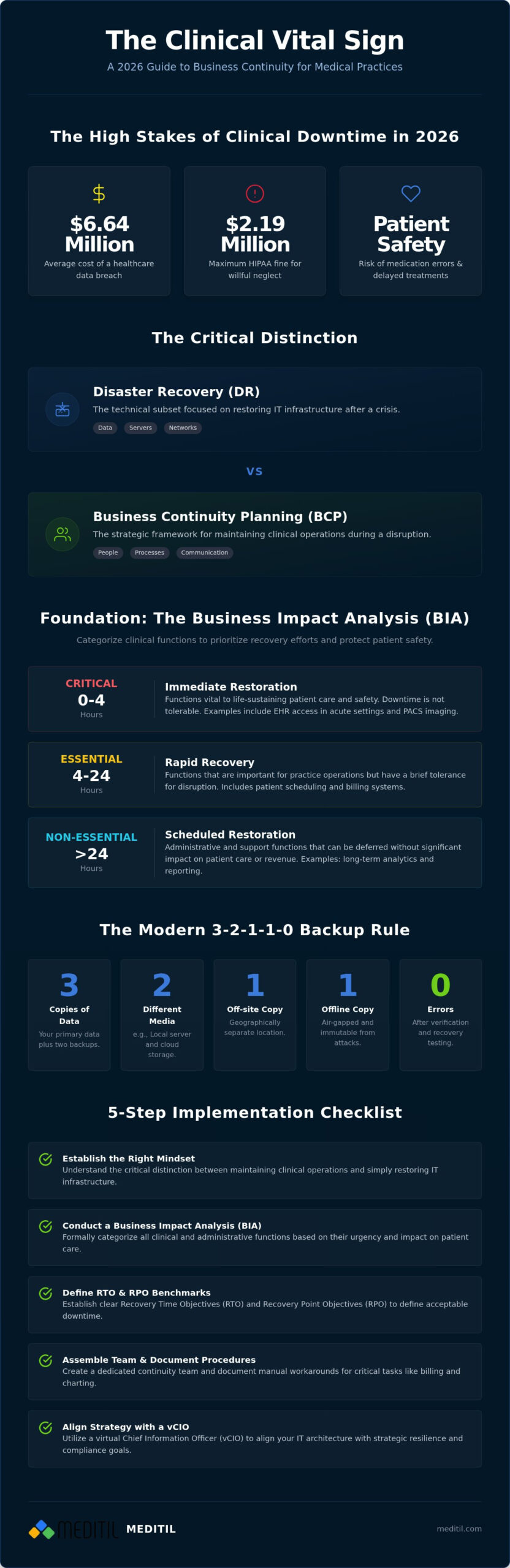
With the average cost of a healthcare data breach reaching $6.64 million in 2026, can your practice afford to treat its digital infrastructure as an afterthought? When systems fail, the primary concern isn’t just the lost revenue; it’s the immediate risk to patient safety and the threat of HIPAA fines that can now reach $2,190,294 for unrectified neglect. You likely recognize that a standard nightly backup is no longer sufficient to protect your patients or your professional reputation. Comprehensive business continuity planning for medical practices has evolved from a technical checkbox into a critical clinical vital sign that requires precision and strategic oversight.
This 2026 guide provides a definitive roadmap for building a resilient practice that maintains seamless patient care through any system failure or disaster. You’ll learn how to implement the modern 3-2-1-1-0 backup rule and align your IT recovery strategies with specific clinical workflows. We will also examine the latest ISO 22301 standards, including mandatory climate-related risk considerations, to ensure your practice remains compliant and operational regardless of external disruptions.
Key Takeaways
- Learn the critical distinction between maintaining continuous clinical operations and the technical restoration of infrastructure.
- Determine how to conduct a Business Impact Analysis to categorize clinical functions based on their urgency for patient care.
- Discover how business continuity planning for medical practices utilizes RTO and RPO benchmarks to define acceptable windows for data recovery and system uptime.
- Follow a practical 5-step checklist to assemble a continuity team and document manual procedures for billing and charting.
- Understand the role of a virtual CIO in aligning your practice’s IT architecture with its strategic resilience and compliance objectives.
Understanding Business Continuity for Medical Practices vs. Disaster Recovery
A common misconception exists in healthcare administration that having a backup server constitutes a complete safety net. While technical backups are essential, they represent only a fraction of a truly resilient organization. Disaster Recovery (DR) is a technical subset of the broader continuity strategy. It focuses specifically on the restoration of data, servers, and networks after a catastrophic event. While DR is vital, it doesn’t account for how a physician continues to treat a patient when the Electronic Health Record (EHR) is inaccessible. Business continuity planning, conversely, addresses the operational side of the equation. It encompasses the people, processes, and communication channels required to keep a clinic running during a crisis.
Medical practices face unique risks that other industries don’t encounter. Patient safety is the primary concern, but regulatory requirements add another layer of complexity. The HIPAA Security Rule explicitly mandates the “Availability” of Protected Health Information (PHI). If your systems are offline for forty-eight hours, you haven’t just suffered a technical glitch; you’ve failed a core regulatory requirement. Business continuity planning for medical practices is the strategic framework that ensures patient care is never interrupted by technical failure.
The High Stakes of Clinical Downtime in 2026
Downtime is no longer a mere inconvenience. In 2026, the clinical friction caused by system outages leads to tangible harm. Medication errors often occur when providers lack access to real-time allergy lists or dosage histories during an EHR outage. Delayed treatments can lead to worsening patient outcomes, particularly in acute care settings. The financial consequences are equally severe. Every hour a provider sits idle represents a loss of billable revenue that most practices cannot recover. Regulatory bodies have also increased scrutiny. As of January 2026, HIPAA fines for willful neglect can reach a maximum of $2,190,294 per violation, making a lack of continuity a massive financial and compliance risk.
The Shift from Reactive to Proactive Resilience
Many practices rely on general IT providers who lack a deep understanding of clinical workflows. These generalists often focus on uptime percentages rather than clinical outcomes. A robust foundation requires managed it services for healthcare that prioritize stability and interoperability. Modern resilience moves past outdated paper backups toward digital-first continuity. This involves maintaining immutable, air-gapped data copies as part of the 3-2-1-1-0 backup rule. This proactive approach ensures that even during a ransomware attack, your practice remains functional. It’s about building an ecosystem where IT infrastructure and clinical workflows are perfectly aligned, allowing your team to focus on medicine rather than troubleshooting.
The Business Impact Analysis (BIA): Identifying Essential Clinical Functions
The Business Impact Analysis (BIA) serves as the diagnostic foundation for any resilient healthcare organization. It identifies which clinical and administrative functions are vital to survival and patient safety. Without a BIA, business continuity planning for medical practices becomes a series of guesses rather than a strategic response. By quantifying the impact of downtime for specific departments, you can prioritize resources where they are needed most. This process moves beyond a simple inventory; it maps exactly how technical dependencies like your EMR, PACS imaging, or secure messaging systems support specific clinical outcomes. We typically categorize these functions into three tiers: critical (0 to 4 hours), essential (4 to 24 hours), and non-essential. Ultimately, BCP for healthcare is the strategic framework that ensures patient care is never interrupted by technical failure.
Many administrators feel they don’t have time for this level of detail. However, the BIA actually simplifies decision-making during a crisis. When systems fail, you shouldn’t be debating which department gets priority or which server to restore first. The BIA provides a pre-approved roadmap, allowing your team to act with technical confidence and precision. It removes the emotional burden from leadership during high-stress outages. For a deeper look at federal standards, the HHS COOP/BCP Topic Collection provides extensive frameworks for healthcare facilities.
Critical Patient Care Systems
Clinical functions often fall into the critical category, requiring restoration within zero to four hours to prevent patient harm. Immediate access to EMR/EHR data is paramount so providers can verify patient histories, current medications, and allergies. Maintaining the diagnostic loop through e-prescribing and lab result delivery prevents life-threatening delays in treatment. Additionally, telehealth and remote monitoring systems must remain active to preserve connections with patients who are not physically in the office. Tools like an assistant téléphonique médical IA can provide a 24/7 communication bridge, ensuring no patient inquiry goes unanswered during a crisis. These systems are the lifeblood of modern clinical care.
Administrative and Revenue Cycle Continuity
While patient care is the priority, the practice cannot survive without financial stability. Essential functions typically need restoration within four to twenty-four hours to prevent cash flow bottlenecks. This includes billing and claims processing. Utilizing medical billing automation solutions can provide a layer of resilience by ensuring revenue cycles continue with minimal manual intervention. Patient scheduling and communication systems are also vital for managing the surge of inquiries that typically occurs during an outage. If you are unsure where to begin your analysis, our consulting and advisory services can help guide your practice through the BIA process.
RTO and RPO: Technical Benchmarks for Medical Resilience
Technical benchmarks translate the clinical priorities identified in your BIA into measurable IT requirements. Effective business continuity planning for medical practices depends on the precise calibration of two technical metrics: Recovery Time Objective (RTO) and Recovery Point Objective (RPO). These figures determine the architecture of your network and the frequency of your data protection cycles. Without these benchmarks, IT teams and clinical staff often have mismatched expectations regarding how quickly operations will resume after a failure.
The Recovery Time Objective (RTO) defines the maximum duration your practice can tolerate a system being offline. For critical systems like the EHR, the RTO is typically near-zero, requiring immediate failover to a secondary environment. Conversely, administrative systems such as payroll or non-urgent accounting might have an RTO of twenty-four to forty-eight hours. The Recovery Point Objective (RPO) measures the maximum amount of data loss the practice can sustain, expressed in time. An RPO of fifteen minutes means that, in the event of a crash, you could lose up to fifteen minutes of charting data. For most medical environments, an RPO of twenty-four hours is clinically unacceptable and poses significant patient safety risks.
Sophisticated healthcare cybersecurity services play a vital role in protecting these objectives. Ransomware attacks often target backup sets to encrypt them, which can push your RTO from hours to weeks. By implementing immutable storage and air-gapped backups, you ensure that your technical benchmarks remain achievable even during a malicious intrusion. This technical confidence allows providers to focus on care rather than the stability of their tools.
Implementing N+1 Redundancy in the Medical Office
Redundancy is the physical manifestation of your RTO goals. An N+1 strategy ensures that for every critical component, at least one backup is ready to take over immediately. This includes secondary internet connections managed by SD-WAN, which automatically reroute traffic if your primary fiber line is cut. Power redundancy is equally vital. Medical-grade generators and robust UPS systems protect sensitive hardware from the data corruption often caused by sudden power loss. Automated server failover ensures that if on-premises hardware fails, your team is switched to a cloud-based instance without manual intervention.
Cloud vs. On-Premise Continuity Strategies
While cloud adoption is widespread, it’s a mistake to assume the cloud never experiences downtime. SaaS outages can be just as disruptive as local hardware failures. A hybrid approach often provides the best balance of resilience. By keeping local cached copies of critical patient files, your team can continue seeing patients even when the broader internet is down. When selecting vendor partners, you must demand Service Level Agreements (SLAs) that guarantee at least 99.99% clinical uptime. This level of verification ensures that your technology partners are as committed to patient care continuity as your clinical staff.
How to Implement Your Business Continuity Plan: A 5-Step Checklist
Transitioning from strategic benchmarks to operational reality requires a disciplined implementation process. Establishing a robust framework for business continuity planning for medical practices is a multi-disciplinary effort that extends far beyond the server room. It involves clear documentation, regular rehearsals, and a commitment to maintaining a state of constant readiness. When a system failure occurs, your staff shouldn’t be searching for a binder; they should be executing a practiced response with technical confidence.
A truly comprehensive plan considers all facility risks, including those that can halt operations as effectively as a server crash. For example, ensuring that physical infrastructure—such as waste management systems—is regularly inspected and maintained by a professional vendor like Lil’ Stinky Septic Service is a critical, yet often overlooked, component of clinical readiness.
- Step 1: Form a Continuity Team. Assemble a leadership group that includes clinical directors, administrative managers, and IT specialists. This ensures that every decision reflects the needs of patient care and business operations.
- Step 2: Document Standard Operating Procedures (SOPs). Create detailed guides for manual charting and billing. Your team must know how to maintain accurate records when the EHR is inaccessible.
- Step 3: Establish Emergency Communication Channels. Identify and test HIPAA-compliant messaging platforms that operate independently of your primary network. Clear communication is the backbone of crisis management.
- Step 4: Conduct Tabletop Exercises. Run simulated outages with your entire staff. These rehearsals identify gaps in your plan before a real disaster occurs.
- Step 5: Review and Update Quarterly. The healthcare landscape and your IT infrastructure change rapidly. Regular reviews ensure your plan accounts for new technology and evolving regulatory standards.
Staff Training and Cultural Readiness
Resilience is a cultural attribute, not just an IT capability. Every nurse, clerk, and technician needs to understand their specific role within the BCP. You can simplify this by using Action Cards. These are concise, role-specific documents that provide immediate instructions for the first sixty minutes of an outage. Emergency access protocols must also be clearly defined. Knowing who has the keys to the backup systems and how to authorize a failover prevents paralyzing delays during high-stakes incidents. Training should emphasize that continuity is a shared clinical responsibility.
Testing and Validating Your Backups
A common pitfall is confusing a successful backup with a successful restore. Your plan is only as good as your last verified restoration. Automated testing tools should be utilized to ensure data integrity without requiring manual intervention. These systems verify that the data is not only present but also usable and free from corruption. Documenting these test results is essential for HIPAA audits and cybersecurity insurance requirements. If your practice needs assistance in architecting these complex systems, partner with our managed IT experts to ensure your backups are always restoration-ready.
The vCIO: Architecting Your Practice’s Strategic Resilience
Effective business continuity planning for medical practices requires more than just technical implementation; it demands high-level strategic leadership. While technical staff often focus on the “how” of recovery, a virtual Chief Information Officer (vCIO) focuses on the “why” and the “when.” Leadership is frequently the missing component in resilience strategies, leaving practices with expensive tools but no clear direction during a crisis. By utilizing virtual CIO services, medical groups gain access to an expert who bridges the gap between clinical requirements and technical capabilities.
A primary responsibility of the vCIO is the alignment of it budgeting for medical practices with their specific continuity goals. Investing in resilience shouldn’t be a reactive expense following a system failure. Instead, it should be a planned, strategic allocation of resources based on the findings of your Business Impact Analysis. The vCIO ensures that every dollar spent on infrastructure directly supports the practice’s ability to maintain patient care during disruptions. Meditil acts as a strategic partner in this process, managing the augmented IT teams that execute these complex plans. This management ensures that your internal staff isn’t overwhelmed by technical maintenance, allowing them to remain focused on patient outcomes.
Strategic IT Roadmapping for 2026
The technological landscape of 2026 introduces new complexities that require forward-looking roadmaps. Interoperability mandates now require that data remains accessible and exchangeable even during localized outages. A vCIO integrates AI-driven monitoring into your ecosystem to predict hardware failure or network degradation before a crash occurs. This proactive stance transforms business continuity planning for medical practices from a recovery exercise into a prevention strategy. As your practice grows, the vCIO ensures that your BCP evolves, maintaining a steady hand at the wheel of your digital infrastructure.
Partnering with Meditil for Comprehensive Continuity
Meditil specializes in providing the technical confidence and mission-driven focus required by modern medical practices. Our approach prioritizes clinical uptime, ensuring that your managed IT environment is inherently resilient. For multi-site medical groups, our fractional CIO leadership provides the oversight necessary to maintain standard operating procedures across diverse locations. We don’t just provide a service; we offer a partnership invested in your long-term stability. A business continuity plan is only as strong as the managed infrastructure it sits on. Protect your practice with Meditil’s strategic IT solutions.
Ensuring Clinical Stability in an Unpredictable Landscape
Building a resilient medical organization requires moving beyond simple data backups to embrace a holistic operational strategy. You now understand that clinical uptime depends on a precise Business Impact Analysis and the rigorous application of technical benchmarks like RTO and RPO. These elements ensure that patient care remains the priority even when systems face disruption. By aligning your IT infrastructure with clinical workflows through a structured 5-step implementation, you protect both your patients and your practice’s financial health and regulatory standing.
Strategic resilience isn’t a one-time project; it’s an ongoing commitment to stability and compliance. Business continuity planning for medical practices is most effective when guided by expert leadership that understands the high-stakes nature of healthcare. Meditil provides tailored IT solutions specifically designed for the healthcare sector. We offer fractional CIO leadership for strategic advancement and proactive monitoring to manage risks before they escalate. Secure Your Practice’s Future with Meditil’s Strategic IT Leadership. Your team deserves the confidence that comes with a steady hand at the wheel, ensuring that your practice remains a reliable pillar of care for your community.
Frequently Asked Questions
What is the difference between disaster recovery and business continuity for doctors?
Disaster recovery focuses on the technical restoration of servers and data after a failure, while business continuity ensures clinical operations remain functional during the disruption. For a physician, disaster recovery might mean getting the EHR back online; whereas business continuity planning for medical practices involves established procedures for seeing patients and prescribing medications while the system is down. It’s the difference between fixing a technical tool and maintaining the practice of medicine.
Is a business continuity plan required for HIPAA compliance?
HIPAA explicitly requires a contingency plan as part of the Administrative Safeguards of the Security Rule. This mandate includes data backup plans, disaster recovery plans, and emergency mode operation plans to ensure Protected Health Information (PHI) remains available. Failing to document and test these procedures can lead to significant fines. In 2026, these penalties can reach over $2 million for instances of willful neglect that remain unrectified within thirty days.
How often should a medical practice test its business continuity plan?
You should conduct a formal review and test of your business continuity plan at least once per year, though quarterly updates are recommended for rapidly growing practices. These tests should include tabletop exercises to simulate common scenarios like ransomware or internet outages. Regular validation ensures that your staff remains familiar with emergency protocols and that your technical recovery objectives remain achievable as your clinical infrastructure evolves.
What are the most common causes of clinical downtime in 2026?
Cyberattacks, particularly AI-driven ransomware, remain the leading cause of clinical downtime in 2026. However, the industry is also seeing an increase in disruptions caused by SaaS provider outages and extreme weather events impacting local infrastructure. The 2024 amendment to ISO 22301 now requires practices to specifically account for these climate-related risks within their business continuity management systems to ensure long-term stability and patient safety.
Does a cloud-based EHR eliminate the need for a business continuity plan?
A cloud-based EHR does not eliminate the need for a comprehensive plan; it merely changes the nature of the risks your practice faces. While you aren’t responsible for local server hardware, you remain vulnerable to internet connectivity failures and outages at the provider’s data center. Effective business continuity planning for medical practices must include redundant internet connections and offline access to critical patient files to mitigate these external dependencies.
How much does it cost to implement a business continuity plan for a clinic?
The investment required to implement a business continuity plan depends on the size of your practice and the complexity of your existing IT infrastructure. Costs generally cover the time spent on Business Impact Analysis, the implementation of redundant hardware like SD-WAN or generators, and ongoing staff training. While initial setup requires a strategic allocation of resources, the expense is significantly lower than the average $6.64 million cost of a healthcare data breach.
What is N+1 redundancy and why is it important for medical offices?
N+1 redundancy is a configuration where you maintain at least one independent backup for every critical system component. In a medical office, this might involve having two separate internet providers or an on-site generator to support vaccine refrigerators and the server room. This approach ensures that if a single piece of equipment fails, your clinical operations can continue without interruption. It provides a steady hand during technical crises.
Who should be in charge of the business continuity plan in a small practice?
In a smaller practice, the responsibility for the continuity plan is typically shared between the practice manager and a clinical lead. However, because the technical and regulatory requirements are so complex, many groups utilize a virtual CIO to provide strategic oversight. This professional ensures that the plan isn’t just a stagnant document but a proactive roadmap that aligns with the practice’s growth and HIPAA compliance obligations.