
Purchasing a new software license won’t solve your data fragmentation; true EHR interoperability is a strategic infrastructure discipline, not a one-time product acquisition. You’re likely feeling the strain of physician burnout as your clinical team manually enters the same data across multiple systems while worrying about the strict enforcement of the 21st Century Cures Act. It’s frustrating to watch financial resources vanish into redundant testing simply because a patient record didn’t follow them from a specialist’s office. You aren’t alone in seeking EHR interoperability solutions that actually bridge these clinical gaps without requiring a total overhaul of your existing technology stack.
This guide provides a roadmap to achieve a unified view of patient data across the entire continuum of care through expert-led interoperability frameworks. We’ll explore how to automate your billing and clinical workflows while ensuring your IT strategy aligns with the mandatory USCDI Version 3 standards and FHIR R4 requirements. You will discover how to build a clear IT roadmap that moves beyond basic compliance to drive genuine business intelligence and operational stability. By treating data exchange as a core management function, you can finally eliminate manual entry and secure a seamless flow of information.
Key Takeaways
- Understand the four distinct levels of interoperability—foundational, structural, semantic, and organizational—to accurately assess your current data exchange capabilities.
- Learn why FHIR R4 and RESTful APIs have superseded legacy HL7 messaging as the mandatory standard for modern EHR interoperability solutions and regulatory compliance.
- Compare the strategic benefits of Health Information Exchanges (HIEs) against interoperability middleware to determine the most efficient integration path for your clinical environment.
- Discover a five-step implementation roadmap that prioritizes comprehensive data audits and network security to ensure HIPAA-compliant connectivity across disparate systems.
- Identify how strategic IT leadership and vCIO services bridge the gap between technical infrastructure and improved clinical outcomes.
Defining the EHR Interoperability Landscape in 2026
EHR interoperability is the seamless, secure exchange of health data across disparate platforms and organizations. It ensures that a patient’s medical history is available at the point of care, regardless of which software a specific provider uses. By June 2026, the industry has moved beyond simple document sharing toward real-time data liquidity and patient-directed exchange. This evolution requires robust EHR interoperability solutions that can handle complex data sets while maintaining strict security protocols and high availability.
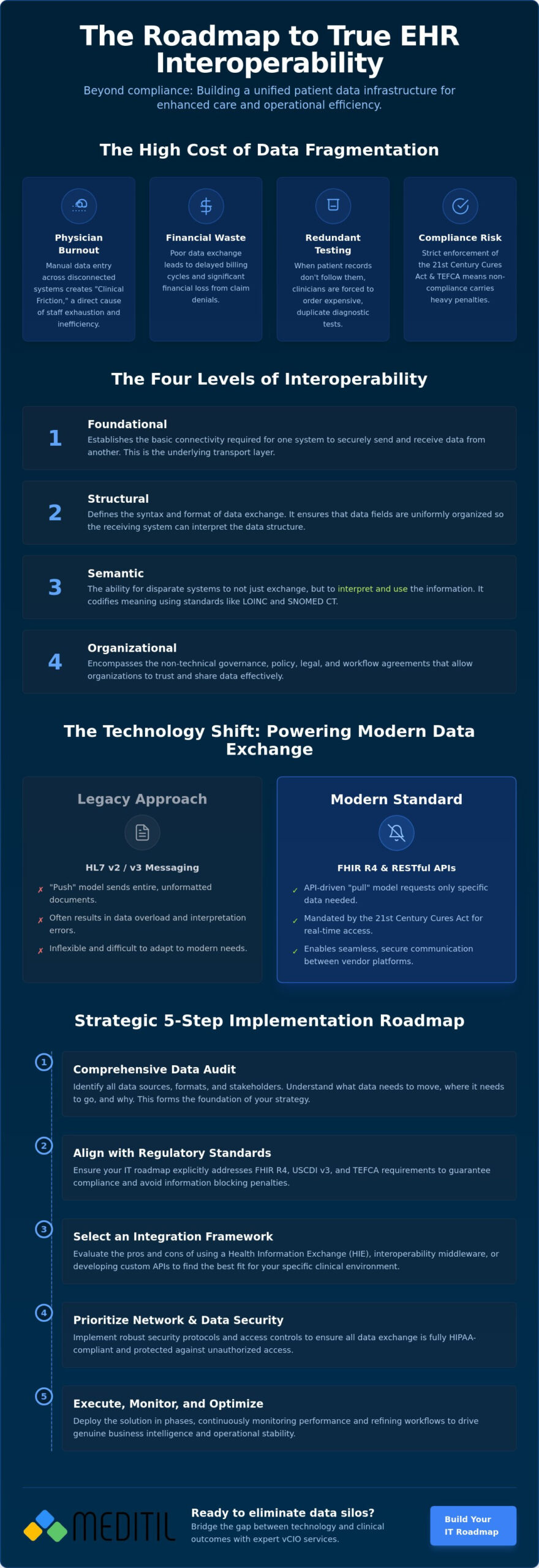
To understand the current environment, we must examine the four levels of interoperability. Foundational interoperability establishes the basic transport requirements for data to move from one system to another. Structural interoperability defines the format and syntax of the exchange, ensuring data is organized at the field level. Semantic Interoperability is the ability for systems to not only exchange but also interpret data automatically. Finally, organizational interoperability involves the non-technical aspects, such as legal agreements and clinical workflows, that allow entities to work together effectively.
The Economic Impact of Data Silos
Fragmented systems create significant technical debt, which manifests as administrative friction and physician burnout. When clinicians must manually re-enter data or hunt for missing records, it leads to “Clinical Friction,” a direct barrier to patient safety and operational efficiency. These gaps aren’t just an IT problem; they have a measurable financial cost. Poor data exchange often results in delayed billing cycles and expensive, redundant diagnostic testing. Strategic ehr interoperability solutions address these inefficiencies by creating a transparent, connected infrastructure that supports both clinical and financial health.
Regulatory Mandates: 21st Century Cures Act and Beyond
Compliance is no longer optional. The Office of the National Coordinator for Health Information Technology (ONC) has implemented strict “Information Blocking” rules that penalize practices for interfering with the legal exchange of electronic health information. As of 2026, the Trusted Exchange Framework and Common Agreement (TEFCA) requirements are in full effect, establishing a universal floor for interoperability across the Health Information Exchange (HIE) network.
CMS mandates now require patient-facing APIs to ensure total data transparency. These regulations, combined with the USCDI Version 3 mandate that became effective on January 1, 2026, mean that healthcare leaders must prioritize integration. Managing these complexities requires a partner who can provide virtual CIO services to align technical investments with long-term regulatory and business goals. This strategic oversight ensures that your facility meets current standards while preparing for future shifts in the regulatory environment.
Core Standards Powering Modern EHR Interoperability Solutions
Modern ehr interoperability solutions rely on a sophisticated technical foundation that has evolved rapidly leading into 2026. The shift from legacy messaging to API-driven exchange is anchored by Fast Healthcare Interoperability Resources (FHIR), specifically version R4. Unlike older protocols, FHIR R4 allows systems to communicate using the same RESTful technology that powers the modern internet. This transition is a core component of the official government perspective on interoperability, which emphasizes the need for standardized, accessible data. By adopting these protocols, healthcare data integration services can now facilitate seamless communication between disparate vendor platforms that were previously incompatible.
While legacy HL7 v2 and v3 messaging served the industry for decades, they often resulted in “push” models where entire, unformatted documents were sent regardless of the specific need. In contrast, modern RESTful APIs allow for targeted data queries. This efficiency is further enhanced by the United States Core Data for Interoperability (USCDI). As of January 1, 2026, compliance with USCDI Version 3 is mandatory. This standard defines the specific data classes and elements, such as social determinants of health, that must be available for exchange. These combined standards ensure that EHR interoperability solutions provide a consistent structure for every transaction.
FHIR APIs: The Engine of Data Liquidity
FHIR simplifies complex medical data into discrete “resources” like Patient, Observation, or Medication. This modularity allows developers to build specific tools that only pull the necessary information. For larger organizations, the implementation of Bulk FHIR is essential for population health analytics, enabling the export of large data sets without compromising system performance. Specialty clinics, in particular, require a robust healthcare api integration strategy to ensure their niche data remains compatible with broader hospital networks. If your current infrastructure feels fragmented, a professional assessment of your API architecture can identify immediate path-to-compliance opportunities.
Semantic Standards: SNOMED CT and LOINC
Structural connectivity is only half of the challenge; systems must also speak the same medical language. Standardized terminologies like SNOMED CT for clinical findings and LOINC for laboratory results ensure that a data point recorded in one system is interpreted identically in another. Without these semantic standards, data normalization becomes impossible, leading to errors in business intelligence and patient care. Terminology services play a vital role here, translating legacy local codes into these universal formats. This level of precision is what enables automated billing and advanced clinical decision support to function reliably across the care continuum.
Evaluating Interoperability Frameworks: HIEs vs. Middleware vs. Custom APIs
Selecting the appropriate framework for data exchange is a critical decision for healthcare administrators. While EHR interoperability solutions vary in complexity, they generally fall into three categories: regional hubs, translation layers, or bespoke connections. Health Information Exchanges (HIEs) serve as community-based hubs, facilitating regional data sharing to create a more complete patient narrative. In contrast, interoperability middleware acts as a strategic translator for facilities still operating on legacy systems, converting older data formats into modern standards. For high-volume specialty clinics with unique data requirements, custom API development provides the most tailored approach. While HIEs provide broad regional data, custom APIs offer the granular control needed for medical billing automation solutions.
Middleware is particularly effective for organizations that aren’t ready to replace their entire software stack but need to comply with modern standards. It functions as an intermediary, pulling data from legacy databases and pushing it through a standardized interface. This allows older systems to participate in modern ecosystems without expensive re-platforming. By implementing these intermediate layers, practices can maintain their existing workflows while benefiting from improved connectivity and reduced administrative friction. This approach offers a steady path toward modernization without the risks associated with a total system replacement.
The Role of Health Information Exchanges (HIEs)
Joining a state or regional HIE offers significant advantages for clinicians seeking longitudinal patient records. These exchanges aggregate data from various sources, providing a comprehensive view of a patient’s journey across different care settings. However, HIEs often face limitations regarding real-time data updates and the inclusion of niche specialty data fields. MEDITIL addresses these challenges by facilitating HIE onboarding and precise data mapping. We ensure your internal systems align with the exchange’s requirements, reducing the technical burden on your clinical staff and improving the accuracy of the shared records.
Cloud-Native Interoperability Solutions
The shift toward cloud-native infrastructure has centralized data exchange through platforms like AWS HealthLake and the Google Cloud Healthcare API. These environments are built to support FHIR (Fast Healthcare Interoperability Resources) natively, ensuring that data remains liquid and accessible. Cloud-based integration engines offer superior security compared to on-premise legacy servers, utilizing advanced encryption and automated patching. This infrastructure also provides the scalability necessary for growing medical groups to expand their EHR interoperability solutions without significant capital expenditure on hardware. By leveraging cloud services, you ensure your data remains protected while staying available at the point of care.
Strategic Implementation: A 5-Step Roadmap for EHR Integration
Implementing ehr interoperability solutions is a methodical process that requires technical precision and clinical alignment. Many projects falter because they overlook the initial assessment phase, diving straight into software configuration without understanding the underlying data architecture. A successful integration strategy follows a disciplined five-step roadmap designed to minimize disruption while maximizing data liquidity.
- Step 1: Interoperability Audit. Map existing data silos and identify high-priority integration points, such as specialist referrals and laboratory results. This phase ensures the project addresses the most significant clinical gaps first.
- Step 2: Network and Security Readiness. Verify that your infrastructure supports N+1 redundancy to prevent downtime. Implement HIPAA-compliant encryption for all data in transit to maintain patient privacy during exchange.
- Step 3: Standard Selection and Mapping. Determine the best protocol for each connection. While FHIR is the modern standard, certain legacy systems may still require HL7 v2 messaging or a middleware translation layer to function correctly.
- Step 4: Pilot Integration and Testing. Validate data integrity within a controlled sandbox environment. This prevents corrupt or incomplete records from entering the production database and protects clinical workflows.
- Step 5: Managed Optimization. Establish continuous monitoring of API performance. Regular audits of your security posture ensure that your EHR interoperability solutions remain resilient against evolving threats and regulatory changes.
Infrastructure as the Foundation
A stable network is the absolute prerequisite for real-time interoperability. Without high-speed connectivity and redundant systems, data liquidity remains a theoretical goal rather than an operational reality. Cybersecurity is equally critical, as every new connection point creates a potential vulnerability. Integrating robust healthcare cybersecurity services into your roadmap protects sensitive health information during cross-platform exchange. This proactive approach ensures that your connectivity doesn’t come at the expense of compliance or patient trust.
Interoperability and Billing Automation
Clinical data integration directly fuels the efficiency of your financial operations. When clinical systems communicate seamlessly, they provide the real-time documentation necessary for accurate coding and claim submission. This exchange supports real-time eligibility verification and reduces the likelihood of claim denials caused by missing clinical data. By aligning your clinical records with medical billing automation solutions, you eliminate the manual friction that typically delays revenue cycles. If your organization is struggling with administrative overhead, our team can provide a comprehensive IT assessment to identify where integration can streamline your billing workflows and capture lost revenue.
Beyond Software: Why Strategic IT Leadership is the Missing Link
Achieving true data liquidity is more than a technical milestone; it’s a management discipline that requires a steady hand at the wheel. Many healthcare organizations fail to see expected returns on their EHR interoperability solutions because they treat integration as a one-time software purchase rather than an ongoing strategic effort. Without executive-level oversight, multi-vendor projects often stall due to conflicting technical priorities and a lack of clear accountability. Strategic IT leadership ensures that every technical decision serves a specific clinical or operational objective while maintaining the stability of the entire network.
MEDITIL serves as the proactive guide that bridges the gap between complex infrastructure and clinical outcomes. We don’t just provide technical support; we manage your internal IT team and your interoperability roadmap simultaneously. This dual focus ensures that your systems remain secure and compliant while your clinical data flows where it’s needed most. By positioning IT as a strategic asset rather than a utility, you can transform EHR interoperability solutions from a regulatory burden into a competitive advantage that supports long-term growth.
The Fractional CIO Advantage
For many mid-sized practices, the cost of a full-time executive is prohibitive. Utilizing virtual CIO services provides high-level strategy and contract negotiation expertise without the full-time executive salary. A vCIO acts as your advocate, vetting interoperability vendors and ensuring that service-level agreements align with your business goals. MEDITIL specializes in managing entire IT departments during these digital transitions, providing the stability needed to navigate complex regulatory shifts without disrupting daily patient care. This leadership is essential for verifying that every integration point meets the highest standards of precision and security.
Managed IT Services for Sustainable Growth
Interoperability is not a “set and forget” capability. Ongoing managed it services for healthcare are essential to prevent technical debt from accumulating as standards evolve. Continuous 24/7 monitoring of critical interoperability endpoints ensures that data exchange remains functional and secure, even as your organization expands its footprint. This proactive maintenance protects your investment and ensures that your systems are ready for future mandates. If you’re ready to align your technology with your clinical mission, we invite you to schedule a strategic consultation to evaluate your current interoperability framework and identify opportunities for improvement.
Securing Your Practice’s Digital Future
The 2026 healthcare landscape demands that leaders move beyond basic compliance and embrace data liquidity as a core business function. By prioritizing semantic standards like FHIR R4 and following a disciplined implementation roadmap, you can eliminate the data silos that drive clinician burnout and financial waste. Implementing robust ehr interoperability solutions isn’t merely an IT project; it’s a commitment to precision, security, and superior patient outcomes across the care continuum.
Success in this environment requires more than just technical connectivity. It necessitates strategic oversight that aligns IT budgets with clinical results. MEDITIL provides the steady hand at the wheel needed to navigate these complex multi-vendor environments. Our expertise in Fractional CIO leadership and HIPAA-compliant network infrastructure ensures your organization remains resilient while achieving seamless data integration and billing automation. We have a proven track record of helping practices modernize their infrastructure without disrupting daily operations. We’re ready to help you align your technology with your clinical mission to drive sustainable growth.
Schedule a Strategic Interoperability Consultation with MEDITIL to bridge your clinical data gaps today.
Frequently Asked Questions
What is the difference between an EHR and an interoperable EHR solution?
An EHR is a localized digital repository of patient health information, whereas an interoperable EHR solution is the underlying technical framework that allows that information to be exchanged securely across different platforms. While a standard EHR might store data within a single clinic, an interoperable system ensures that data is accessible to specialists, hospitals, and pharmacies in real time. It transforms a static record into a liquid asset that follows the patient throughout their care journey.
How does the 21st Century Cures Act affect EHR interoperability in 2026?
As of 2026, the 21st Century Cures Act is in full enforcement mode, making compliance a mandatory requirement for all healthcare providers. The act strictly prohibits information blocking and requires EHR systems to utilize FHIR-based APIs for patient data access. Practices that fail to facilitate the seamless exchange of health information now face significant regulatory scrutiny and potential penalties. Staying compliant requires a proactive approach to data sharing and technical transparency.
What are the main barriers to achieving semantic interoperability in healthcare?
The primary barriers to semantic interoperability include the inconsistent use of standardized terminologies like SNOMED CT and LOINC across different clinical settings. Even when systems are technically connected, they often fail to interpret the data if the underlying codes don’t match. This lack of data normalization prevents automated analytics and requires manual intervention to ensure that a lab result or diagnosis means the same thing in every system, regardless of the originating platform.
Can my practice achieve interoperability without replacing our current EHR software?
You can achieve high levels of connectivity without replacing your existing software by implementing middleware or custom EHR interoperability solutions. These tools act as a translation layer, pulling data from legacy databases and converting it into modern FHIR-compliant formats. This approach allows your practice to meet regulatory mandates and improve data exchange while preserving your current clinical workflows and avoiding the massive expense and disruption of a system-wide software overhaul.
How much does it typically cost to implement a custom EHR interoperability solution?
Industry data for 2026 indicates that the initial build of a healthcare data interoperability platform typically costs between $50,000 and $150,000. For organizations seeking a production-grade system with enhanced features and full FHIR R4 integration, development costs can range from $150,000 to $350,000. These figures represent general market estimates for custom software development. They don’t include the ongoing managed IT costs or specialized infrastructure support required to maintain long-term system stability and security.
What is the role of FHIR APIs in modern healthcare data exchange?
FHIR APIs function as the standardized connectors that allow different healthcare applications to speak the same language using modern web technology. By breaking down complex medical records into discrete resources like Medications or Observations, FHIR allows for targeted data queries rather than the exchange of bulky, unformatted documents. This technology is the foundation of modern EHR interoperability solutions, ensuring that clinical data remains secure, accessible, and ready for real-time use by authorized providers.
How does EHR interoperability improve patient safety and clinical outcomes?
Interoperability improves patient safety by providing clinicians with a comprehensive, longitudinal view of a patient’s medical history at the point of care. This visibility reduces the risk of medication errors, prevents redundant diagnostic testing, and ensures that critical allergies or chronic conditions aren’t overlooked during transitions of care. When clinical data flows seamlessly, providers make more informed decisions. This leads to higher precision in treatment and significantly better long-term outcomes for the patient.
What is an HIE and should my practice join one?
A Health Information Exchange (HIE) is a community-based hub that aggregates patient data from various regional providers into a single accessible network. Your practice should consider joining an HIE to gain access to records from local hospitals and specialists, which is essential for effective care coordination. While HIEs provide broad regional data, they often require technical assistance to ensure your internal data maps correctly to the exchange’s standards. This ensures your records are accurate and useful to others.