
In 2026, switching healthcare IT providers isn’t a technical migration. It’s a high stakes clinical continuity strategy where a single data gap can trigger a 9% MIPS penalty or a HIPAA violation. It’s understandable to feel anxious about transitioning away from a legacy partner when your clinical workflows and patient data are on the line. You’ve likely experienced the frustration of working with generalist IT firms that don’t grasp the nuances of EHR interoperability or the urgency of the latest CMS price transparency mandates.
This guide provides a structured roadmap to master the complexities of a strategic transition while maintaining absolute stability. We’ll explore how to align your IT infrastructure with clinical goals, secure your data migration, and ensure your practice remains compliant with the evolving 2026 regulatory landscape. By following a disciplined approach, you can transform a risky change into a strategic advancement for your entire organization. Moving forward with a steady hand ensures that patient care remains the priority while your technical foundations are modernized.
Key Takeaways
- Identify the critical indicators, such as chronic clinical downtime and stagnant data exchange, that necessitate a shift in your technical infrastructure.
- Establish a rigorous evaluation framework for switching healthcare IT providers that emphasizes HIPAA compliance and long-term strategic roadmapping.
- Execute a seamless transition through a structured roadmap involving comprehensive security audits and knowledge transfer from outgoing vendors.
- Mitigate post-migration risks by implementing proactive monitoring and addressing legacy vulnerabilities within your medical network.
- Shift from a vendor-client relationship to a strategic partnership that prioritizes interoperability and improved clinical continuity.
Recognizing the Indicators: When to Switch Healthcare IT Providers
Identifying the right time to transition is a matter of operational survival. If your current provider treats your network like a standard office environment, they’re likely missing the critical nuances of patient care. Chronic downtime doesn’t just frustrate staff. It creates bottlenecks that reduce daily patient volume and erode provider satisfaction. When technical glitches become a daily expectation rather than a rare occurrence, switching healthcare IT providers is no longer optional. It’s a necessity for maintaining clinical continuity.
Stagnant interoperability is another primary driver for change. In an era where data must move seamlessly between specialists and health systems, your infrastructure must be agile. An Electronic Health Record (EHR) system requires precise configuration to ensure that data exchange remains fluid and secure. If your current partner can’t facilitate these connections, your practice remains siloed and unable to participate effectively in value-based care models.
Inadequate cybersecurity response or failed HIPAA compliance audits represent immediate risks to your practice’s longevity. Federal agencies are actively enforcing CMS hospital price transparency rules in 2026. Your IT partner must be capable of managing detailed, machine-readable data files with precision. Additionally, with the 2026 MIPS performance year in full swing, any technical failure that drops your score below 75 points could result in a 9% Medicare payment reduction in 2028. A provider who lacks this industry-specific expertise is a significant compliance liability.
Generalist IT vs. Specialized Healthcare IT
Standard managed services often prioritize general uptime for email and printers. They frequently fail to account for complex clinical workflows. Generalist providers don’t always understand how a latency issue in the imaging suite affects the entire afternoon schedule or patient throughput. Specialized managed it services for healthcare bridge the gap between technology and care by aligning infrastructure with the specific needs of medical professionals. This expertise ensures your EMR/EHR environment is optimized for speed and reliability, not just basic connectivity.
The Hidden Cost of Technical Debt
Technical debt in a clinical setting manifests as outdated hardware, legacy software patches, and siloed data structures. Staying with a provider who offers “band-aid” solutions creates a compounding financial risk. These temporary fixes hinder practice scalability and leave you vulnerable to modern cyber threats. Switching healthcare IT providers becomes necessary when your current partner’s lack of strategic guidance leads to mounting infrastructure costs that offer no long-term value. Proactive planning replaces these reactive repairs with a stable, scalable foundation for growth.
Evaluating a New Partner: A Healthcare-Specific Framework
Selecting a new partner requires a framework that transcends basic technical support. When switching healthcare IT providers, the evaluation must prioritize deep expertise in regulatory compliance and clinical operations. A partner needs to demonstrate more than just a list of certifications. They must prove they can navigate the 2026 MIPS performance period, where scores below 75 points result in a 9% Medicare payment reduction. This requires a proactive approach to data management and quality reporting that generalist firms simply cannot provide.
Your evaluation should also focus on a provider’s history with EMR/EHR implementation and interoperability. A successful partner understands that these systems are the heartbeat of your practice. They should have a documented process for ensuring that patient data remains accessible and secure during any infrastructure shift. Proactive cybersecurity monitoring is equally vital. It must be tailored to medical data protection, utilizing advanced threat detection to safeguard sensitive information against increasingly sophisticated ransomware attacks targeting the healthcare sector.
Strategic Leadership: The vCIO Advantage
A reliable partner provides strategic oversight that extends beyond a standard help desk. Your next provider should offer virtual CIO services to align technical investments with long-term clinical goals. This leadership is essential for managing your existing IT team or acting as an augmented force. A vCIO ensures that every infrastructure update serves a specific business outcome, such as reducing provider burnout or improving patient throughput. They act as a steady hand at the wheel, guiding you through complex regulatory shifts without disrupting daily care.
Interoperability and Billing Integration Capabilities
Efficiency in 2026 hinges on how well your systems communicate. Assessing a provider’s ability to implement medical billing automation solutions is critical for protecting your revenue cycle. Ask potential partners how they handle the new CMS rules regarding prior authorization turnaround times, which now require decisions within 72 hours for urgent requests. A capable partner facilitates seamless data exchange between disparate specialty systems, ensuring that your practice remains compliant with the Patients Deserve Price Tags Act requirements for machine-readable pricing data. For those seeking a partner who understands these technical and financial intricacies, consulting with a healthcare-focused IT expert can clarify the transition path.
Ultimately, the right partner treats your practice’s stability as their primary mission. They don’t just fix broken hardware. They build a resilient infrastructure that supports growth and ensures that your clinicians can focus entirely on patient outcomes.
The Transition Roadmap: Ensuring Clinical Continuity
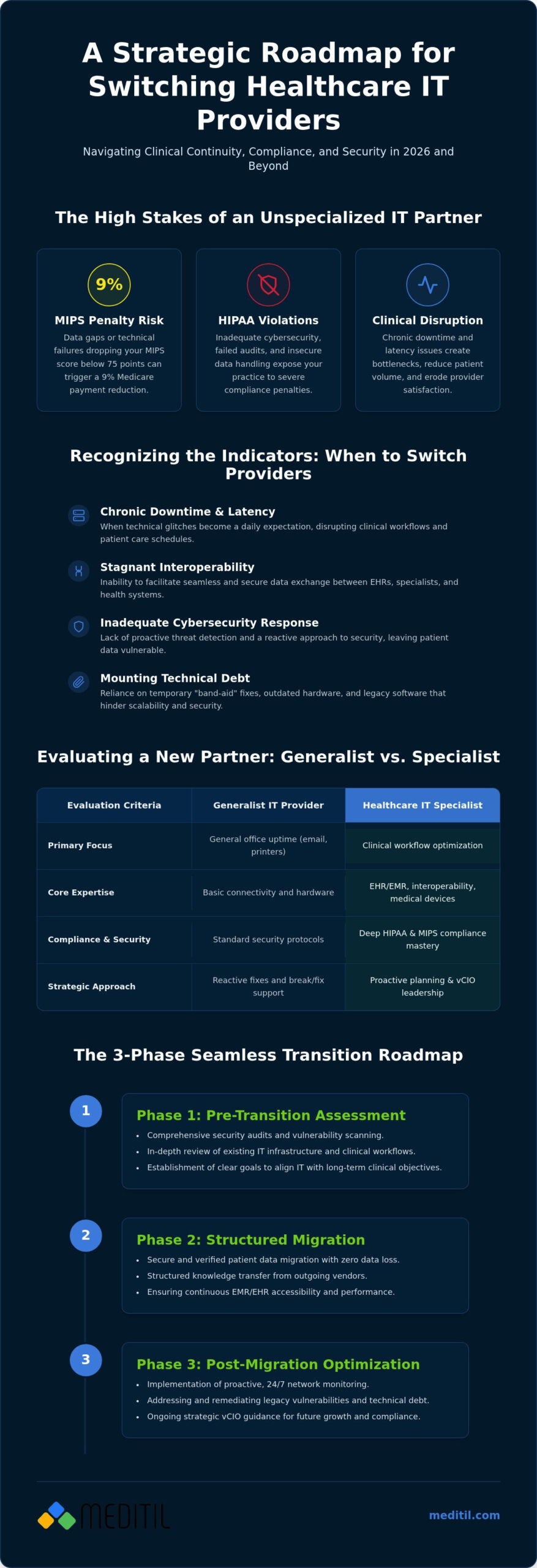
A successful transition relies on a methodical, phased approach rather than a single cut-over event. When switching healthcare IT providers, the first phase involves a comprehensive infrastructure and security audit to establish a technical baseline. This assessment identifies legacy vulnerabilities and ensures that the new environment can support 2026 interoperability requirements. Phase two focuses on silent shadowing. During this period, the incoming team observes your clinical workflows and coordinates knowledge transfer from the outgoing provider without disrupting daily operations.
The technical heavy lifting occurs in phase three with secure data migration and rigorous interoperability testing. This ensures that patient records move accurately between systems while maintaining compliance with the latest CMS data transparency rules. Finally, phase four centers on staff training and go-live support. Providing clinicians with immediate, on-site assistance during the initial hours of a new EMR environment prevents the frustration that often leads to charting delays and provider burnout.
Minimizing Downtime During Migration
Protecting patient schedules is the primary objective of any migration plan. Executing technical shifts during off-peak hours ensures that your clinicians never face a system down message while a patient is in the exam room. A steady hand approach maintains help desk support throughout the switch, providing a safety net for any unforeseen issues. To ensure long-term clinical stability, your network must meet specific resilience standards. N+1 redundancy refers to a system configuration where a backup component is always available to ensure uninterrupted operation in the event of a single component failure. This architecture is vital for maintaining the 24/7 availability required in modern medical environments. For expert guidance on establishing such resilient networks, check out Uptime Co.
Maintaining absolute data integrity is a non-negotiable requirement of the transition process. Every byte of patient data must remain encrypted during transit and at rest to satisfy HIPAA standards. Verifying the viability of data backups before terminating legacy contracts is a critical step that prevents catastrophic data loss. Utilizing specialized healthcare cybersecurity services ensures that your practice is protected from breaches during the vulnerable migration window. These services provide the proactive monitoring needed to detect anomalies in real-time, allowing your team to focus on patient care while technical experts secure the perimeter. A disciplined migration strategy for switching healthcare IT providers transforms a complex technical challenge into a predictable, manageable evolution of your practice’s capabilities.
Mitigating Risks: Addressing Technical Debt and Security Gaps
A successful transition doesn’t conclude on the day of the switch. Once the initial migration is complete, conducting a thorough post-migration risk assessment is essential to identify vulnerabilities left behind by legacy systems. Many organizations find that switching healthcare IT providers reveals years of accumulated technical debt, such as unpatched firmware or non-compliant data silos. Addressing these gaps immediately ensures that your practice isn’t just operational, but resilient against modern threats.
Implementing proactive monitoring through Security Information and Event Management (SIEM) provides the visibility needed to protect a medical practice’s digital perimeter. This oversight is particularly critical when remediating infrastructure gaps to support expanding services like telehealth and remote patient monitoring. To prevent the recurrence of these issues, establishing a strategic IT budget allows for planned lifecycle management rather than reactive, emergency repairs. This disciplined financial approach ensures that your technology remains an asset rather than a liability.
Advanced Cybersecurity for Life-Critical Systems
Medical devices and IoT equipment represent significant entry points for network intrusions. Unlike standard office hardware, these systems require specialized segmentation to prevent a breach from affecting life-critical functions. Ensuring regulatory compliance across all digital platforms involves more than just software updates. It requires a deep understanding of how data flows between clinical and administrative zones. Protecting your practice’s EBITDA also depends on automated billing security. By securing the revenue cycle from end-to-end, you defend against the data corruption or loss that often leads to claim denials and financial leakage.
Interoperability as a Defense Against Burnout
Modernizing infrastructure is a direct investment in your clinical team’s well-being. When systems are properly integrated, physicians experience significantly less clinical friction during their daily workflows. Optimizing EMR integration reduces the time spent on manual data entry, allowing providers to focus on patient interaction. Stable network management is the foundation of patient safety. It ensures that critical lab results and imaging are available the moment they’re needed. If you’re ready to secure your practice’s future, contact our healthcare IT specialists to begin your strategic assessment.
The MEDITIL Approach: Strategic Partnership for Seamless Transitions
Choosing a partner for switching healthcare IT providers requires more than a technical checklist. MEDITIL operates as a comprehensive healthcare IT partner. We don’t just act as a vendor. We integrate into your organization to ensure that every technical decision supports clinical outcomes. Our customized implementation plans prioritize the stability of your practice, ensuring that clinicians can focus on patient care while we manage the underlying complexity. By providing fractional CIO services within every managed agreement, we offer the high-level strategic oversight usually reserved for large health systems.
This partnership model focuses on two critical drivers of practice success: interoperability and billing automation. We recognize that technical efficiency directly impacts your practice yield. Our team works to eliminate the silos that prevent data from flowing between your specialty systems. This approach ensures that your administrative and clinical workflows are synchronized, reducing the risk of claim denials and improving overall operational speed. We act as the steady hand at the wheel, guiding your practice through the technical evolution required in 2026.
Managed IT and Infrastructure Excellence
Our methodology for managing and augmenting existing IT teams is built on precision and collaboration. We don’t replace your valuable internal knowledge. Instead, we provide the additional resources and specialized expertise needed to handle complex projects and high-volume support requests. Our 24/7 help desk is specifically tailored to medical staff needs. We understand the urgency of a physician who can’t access a patient record. By leveraging secure cloud services, we create a scalable environment that grows with your practice; for instance, Cornerstone Business Solutions highlights how virtual desktop infrastructure can enhance the flexibility and security of modern organizations. This infrastructure ensures that your data remains protected and accessible, regardless of your organization’s physical footprint.
Stability is the result of intentional planning rather than reactive maintenance. We build a 3-year IT roadmap for every partner. This plan evolves alongside regulatory changes, ensuring you’re never caught off guard by new mandates. We prepare your practice for the next generation of telehealth and remote patient monitoring, ensuring your network has the bandwidth and security to support distributed care models. This long-term focus eliminates the cycle of emergency repairs and recurring technical debt. Consult with a MEDITIL expert today to plan your strategic IT transition.
Securing Your Technical Foundation for 2026 and Beyond
A strategic transition is the catalyst for long-term clinical stability and operational growth. By identifying the indicators of a failing partnership and following a disciplined roadmap, you protect your practice from the financial risks of non-compliance and technical debt. Success in this environment requires a partner who understands that every server update and security patch directly impacts patient care. Switching healthcare IT providers doesn’t have to be a period of uncertainty. It’s an opportunity to align your infrastructure with the future of medicine through precision and expert oversight.
MEDITIL provides the steady hand at the wheel that complex transitions demand. Our specialized healthcare IT focus, expert fractional CIO advisory, and proven interoperability and billing automation expertise ensure your organizational goals remain the priority. We handle the technical intricacies so your team can focus on clinical excellence. It’s time to replace reactive fixes with a proactive, mission-driven strategy. Schedule a Strategic Transition Consultation with MEDITIL to begin your journey toward a more secure and efficient practice. Your clinicians and patients deserve a technical environment that never misses a beat.
Frequently Asked Questions
How long does it typically take to switch healthcare IT providers?
A standard transition typically spans 30 to 90 days. This timeframe allows for a methodical approach that includes infrastructure auditing, silent shadowing, and staff training. The complexity of your existing network and the volume of patient data influence the exact duration. Rushing this process increases the risk of clinical friction. A structured roadmap ensures that every technical dependency is identified and addressed before the final cut-over occurs.
Will our EMR/EHR system experience downtime during the transition?
Clinical downtime is preventable through meticulous planning and off-peak execution. By utilizing N+1 redundancy and maintaining help desk support throughout the switch, your EMR/EHR remains accessible to providers. The goal is to ensure that patient care never pauses while technical systems are modernized. Most migrations occur during weekends or evening hours to minimize impact on active clinical schedules and maintain the continuity of your daily operations.
How do we ensure HIPAA compliance is maintained during data migration?
Maintaining HIPAA compliance requires end-to-end encryption for all patient data during the migration process. We verify the integrity of all backups before terminating any legacy contracts to prevent data loss. Specialized healthcare cybersecurity services provide proactive monitoring to detect and neutralize threats during the vulnerable transfer window. This disciplined approach ensures that your practice meets all 2026 regulatory standards while protecting sensitive health information from potential breaches.
What happens to our legacy data when we switch providers?
Your legacy data is systematically audited, cleaned, and migrated to the new secure environment. We prioritize data integrity to ensure that historical patient records remain accurate and accessible for clinical decision-making. If certain data sets are no longer needed for active workflows, we establish secure, compliant archives. This process ensures that your practice remains aligned with interoperability requirements while eliminating the technical debt associated with fragmented or poorly managed data.
Can a new provider manage our existing internal IT team?
Yes, a specialized partner can provide comprehensive management of IT teams to optimize your internal resources. MEDITIL often serves as an augmented IT team, providing the strategic leadership and technical expertise that internal departments may lack. This arrangement allows your existing staff to focus on daily support while we handle high-level infrastructure projects and regulatory compliance. It creates a steady hand at the wheel for long-term operational stability.
What are the most common mistakes when switching healthcare IT partners?
The most frequent error is choosing a generalist provider who lacks a deep understanding of clinical workflows. This often leads to failed 2026 MIPS performance scores or HIPAA violations. Another mistake is neglecting interoperability and billing automation, which can cause revenue leakage. Switching healthcare IT providers requires a partner who focuses on specialized medical requirements rather than basic office technology to avoid these costly operational pitfalls.
How does a fractional CIO help during an IT provider switch?
A fractional CIO provides the strategic leadership necessary to align technology with your organization’s clinical and financial goals. They act as a consultant invested in your long-term success rather than just a service vendor. During a switch, the fractional CIO manages the roadmap, ensures interoperability, and prepares the practice for upcoming regulatory changes. This high-level oversight prevents the accumulation of technical debt and ensures a seamless transition for staff.
Is it possible to switch providers if we are in the middle of a major project?
It is possible to transition during a major project by utilizing an augmented IT team to maintain momentum. We can step in to provide project-based IT consulting, ensuring that your EMR implementation or infrastructure upgrade stays on track. This proactive approach prevents delays and ensures that the project aligns with your new strategic goals. We manage the handover from the outgoing provider to ensure that no critical technical details are lost.