What if the digital infrastructure designed to streamline patient care is actually the primary driver of physician burnout and operational stagnation within your organization? For many healthcare leaders, the burden of EMR friction and the escalating costs of maintaining a specialized in-house IT team have become unsustainable. You’re likely managing a complex web of legacy integrations that feel more like security vulnerabilities than strategic assets. It’s a common struggle, yet the pressure to maintain stability while pursuing innovation has never been higher.
This guide demonstrates how outsourced clinical application support serves as a proactive, steady hand to help you eliminate clinical friction and resolve technical debt. By partnering with experts who understand the nuances of life-critical systems, you can achieve the seamless interoperability required for modern care delivery. We’ll examine the shift toward expert-managed application support tailored for the 2026 regulatory environment, including upcoming HIPAA security updates. You’ll discover how to transition from reactive troubleshooting to strategic IT leadership that aligns every technical decision with superior patient outcomes and long-term institutional stability.
Key Takeaways
- Understand how clinical support is evolving from a reactive help desk model into a proactive strategy for workflow optimization.
- Learn how to bridge the data gap between EHRs, labs, and billing systems to ensure seamless interoperability across your clinical ecosystem.
- Evaluate the true cost of in-house IT management and discover how outsourced clinical application support provides access to a specialized talent pool without high recruitment overhead.
- Identify the critical steps for a seamless transition, including technical debt audits and the documentation of proprietary clinical workflows.
- Discover the role of fractional CIO leadership in aligning your IT infrastructure with life-critical stability and long-term patient outcomes.
What is Outsourced Clinical Application Support in 2026?
In 2026, outsourced clinical application support is no longer defined by a simple help desk ticketing system. It’s a specialized managed service providing technical oversight for Electronic Health Records (EHR), Electronic Medical Records (EMR), and the complex web of ancillary clinical software that powers modern medicine. This partnership ensures that the software clinicians rely on remains stable, secure, and fully aligned with the operational needs of the facility. It’s about maintaining a steady hand at the wheel of your digital infrastructure.
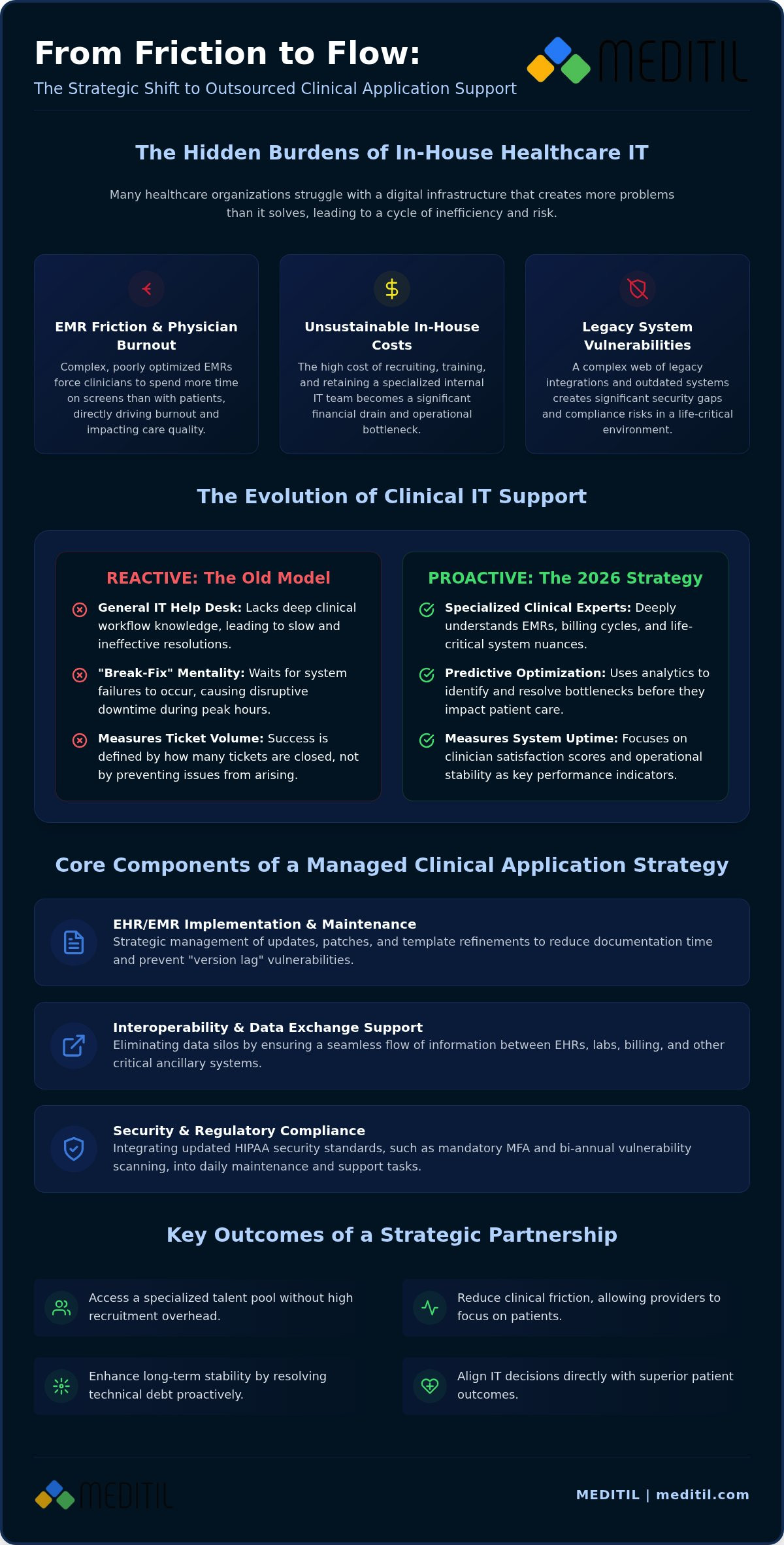
The industry has undergone a fundamental shift from reactive “break-fix” models toward proactive clinical workflow optimization. Instead of waiting for a system failure to occur, support teams now utilize predictive analytics to identify bottlenecks before they impact patient care. Success is measured through specific performance indicators: system uptime, resolution speed for high-priority tickets, and clinician satisfaction scores. In 2026, this support must also integrate rigorous regulatory standards, such as mandatory multi-factor authentication and bi-annual vulnerability scanning, into every daily maintenance task to meet updated HIPAA requirements.
The Evolution of Clinical IT Support
Clinical support has moved beyond the capabilities of a general IT help desk. It now requires deep, healthcare-specific expertise to manage the nuances of medical workflows. Modern support models leverage AI and automation to monitor system health in real-time, detecting anomalies in data flow or application performance that a human might miss. These tools allow for a level of precision that was previously unattainable. Clinical application support serves as the vital bridge between technical infrastructure and patient care delivery.
Why General Managed IT Fails the Clinical Environment
Many organizations discover that general IT providers lack the specialized knowledge required for life-critical environments. A generalist might understand server maintenance but often fails to grasp the complexities of medical billing cycles or the strict requirements of system interoperability. This knowledge gap can lead to significant delays and compliance risks. Medical outsourcing must be handled by partners who understand that a minute of downtime in a clinical setting is vastly different from a minute of downtime in a standard office. For a deeper analysis of these risks, see our guide on Why General Managed IT Fails the Healthcare Sector. Choosing a partner who lacks this focus puts your clinical data and patient workflows at risk.
Core Components of a Managed Clinical Application Strategy
A robust strategy requires more than simply keeping the lights on. It involves a holistic approach to the clinical ecosystem where technology serves as an enabler rather than a hurdle. Effective outsourced clinical application support ensures that every software layer, from the patient portal to the backend database, operates in harmony. This focus reduces the friction that leads to physician burnout and prevents the accumulation of technical debt that often plagues aging infrastructures. By prioritizing a well-structured support model, healthcare leaders can ensure their systems remain agile and responsive to changing patient needs.
EMR systems should empower providers, not hinder them. Optimization involves refining templates and automating repetitive tasks to ensure the software works for the clinician. This directly impacts the quality of care by allowing doctors to focus on patients rather than screens. When applications are finely tuned to clinical workflows, the entire organization benefits from increased efficiency and improved data accuracy.
EMR and EHR Implementation & Maintenance
Strategic implementation is the foundation of system stability. It’s not just about the initial rollout; it’s about the ongoing management of patches and software updates without disrupting patient care. By managing these technical requirements proactively, organizations can optimize clinical workflows and significantly reduce documentation time. This steady approach to maintenance prevents the “version lag” that often leads to security vulnerabilities and system crashes during peak hours.
Interoperability and Data Exchange Support
Data silos remain a significant hurdle in modern healthcare. Supporting modern standards like HL7 and FHIR is essential for seamless data exchange between disparate clinical systems. According to guidelines from the Office of the National Coordinator for Health IT (ONC), adherence to these standards is critical for patient safety and regulatory compliance. Bridging the gap between EHRs, labs, and imaging systems ensures that a patient’s history follows them throughout the continuum of care. This connectivity is also vital for implementing Medical Billing Automation Solutions, where accurate data transfer directly influences revenue cycles.
Maintaining HIPAA and HITECH standards across all application layers is a non-negotiable requirement in 2026. This includes managing the anticipated security updates, such as mandatory multi-factor authentication and regular penetration testing. Additionally, continuous end-user training is necessary to reduce user error and technical debt. If you’re looking to stabilize your clinical operations, choosing a partner for Healthcare Application Support can provide the specialized oversight your team needs to thrive in a regulated environment.
Evaluating the ROI of Outsourcing vs. In-House Teams
Healthcare organizations often view IT as a cost center, yet the true expense lies in the inefficiencies of an overburdened in-house team. Maintaining a specialized internal department involves significant hidden costs, including recruitment, retention, and continuous training. In a landscape where technology evolves monthly, the price of keeping staff updated on the latest regulatory changes can be prohibitive. By 2026, many practices report overall cost savings of 40% to 60% by transitioning to an outsourced model. This shift converts fixed labor costs into predictable, variable expenses that align with actual utilization.
Scalability is a primary driver for this transition. Investing in outsourced clinical application support allows leaders to access a deep bench of experts without the full-time salary overhead. This model provides the agility to scale support up during a major EMR rollout and scale down once the system stabilizes. It also mitigates risk by shifting the burden of cybersecurity and compliance to a partner whose sole focus is maintaining life-critical infrastructure. This partnership frees internal leaders to focus on patient outcomes and clinical excellence rather than managing a never-ending queue of support tickets.
Fractional CIO and Strategic Leadership
Many organizations lack the budget for a full-time Chief Information Officer but desperately need high-level strategy. Fractional leadership provides this executive-level guidance at a fraction of the cost, ensuring your IT budget aligns with long-term clinical and financial objectives. A strategic partner acts as a steady hand at the wheel, helping you navigate complex technology roadmaps. For organizations seeking this level of specialized oversight, our Virtual CIO Services offer the necessary leadership to stabilize and advance your digital environment.
Access to Specialized Healthcare IT Expertise
Finding in-house talent with both clinical and technical depth is increasingly difficult. A specialized partner brings broad experience gathered across multiple healthcare organizations, allowing them to identify and resolve issues faster than a generalist team. This expertise is critical for reducing technical debt through professional infrastructure management and proactive system tuning. By leveraging outsourced clinical application support, you ensure that your systems are managed by specialists who understand the intersection of data integrity and patient care. This disciplined approach results in a more resilient environment that supports both clinicians and administrators effectively. For organizations that also require precision in physical outputs like specimen or pharmacy labeling, you can learn more about DuraFast Label Company and their specialized in-house printing solutions.
Transitioning to outsourced clinical application support is not a single event but a disciplined, methodical progression. A successful shift requires a roadmap that prioritizes clinical stability and data integrity above all else. The process begins with a comprehensive Discovery and Assessment phase. During this stage, your partner audits current technical debt and application performance to identify bottlenecks that may have been masked by daily firefighting. This assessment provides the baseline necessary to measure future performance and ensures that the transition addresses your specific pain points.
Knowledge transfer serves as the most critical component of the roadmap. This phase involves documenting proprietary clinical workflows and the specific quirks of legacy system integrations. Without this documentation, even the most skilled external team will struggle to provide support that feels seamless to the end user. Documentation must be thorough enough to ensure that the “steady hand” remains steady even during complex system updates or regulatory shifts.
Phased Onboarding and Knowledge Transfer
A methodical onboarding process is essential to prevent disruption in patient care. By following a structured approach, organizations can build trust between clinicians and the new support team. This involves creating a comprehensive knowledge base that captures nuances unique to your facility. Establishing clear communication channels ensures that issues are escalated based on clinical priority rather than just technical severity.
- Discovery: Auditing environment and identifying performance gaps.
- Documentation: Mapping proprietary workflows and legacy quirks.
- Pilot Phase: Implementing support for a single department, such as Cardiology or Radiology, to test efficacy.
- Full Integration: Rolling out managed support across the entire clinical ecosystem once the pilot meets success metrics.
Compliance and Security Integration
During the transition, verifying security protocols and access controls is paramount. The 2026 regulatory environment, including anticipated HIPAA Security Rule updates and 21st Century Cures Act enforcement, requires that your outsourced team is fully integrated into your compliance roadmap. This ensures that multi-factor authentication and regular vulnerability scanning are maintained without interruption. For a deeper look at protecting your infrastructure during technical shifts, explore our Healthcare Cybersecurity Services.
A successful roadmap concludes with a commitment to continuous improvement. Establishing feedback loops between clinicians and the support team ensures that system optimizations are driven by real-world clinical needs. If you’re ready to stabilize your technical infrastructure and reduce clinical friction, contact MEDITIL to discuss your transition strategy.
MEDITIL’s Strategic Approach to Clinical Support
MEDITIL operates as a comprehensive Healthcare IT partner rather than a transactional service provider. We recognize that outsourced clinical application support must go beyond ticket resolution to address the underlying health of your technical ecosystem. Our approach centers on managed infrastructure and network services engineered for life-critical stability. By maintaining a steady presence, we ensure that your digital environment supports, rather than hinders, the delivery of patient care. We act as a strategic extension of your organization, focusing on long-term outcomes rather than short-term fixes.
Proactive monitoring and risk management are tailored specifically for the medical industry’s unique demands. We track application health in real-time to mitigate vulnerabilities before they escalate into clinical friction. This includes preparing for the 2026 HIPAA Security Rule updates, such as mandatory multi-factor authentication and annual penetration testing. Our focus extends to billing automation and interoperability solutions. These drive both revenue and operational efficiency by ensuring that data flows securely between EHRs and financial systems. By automating these critical pathways, we reduce the manual burden on administrative staff and minimize the risk of claim denials.
Augmented IT Teams and Department Management
We provide flexibility through the management of existing IT departments or the provision of specialized augmented teams. This ensures that your organization has access to a “steady hand at the wheel” even in the most complex clinical IT environments. Every support interaction is governed by a commitment to precision and stability. We act as an extension of your leadership, providing the technical depth required to manage life-critical systems without the burden of internal recruitment. Our specialists are trained to handle the specific nuances of healthcare applications, ensuring that updates and integrations are performed with minimal impact on clinical uptime.
Aligning IT Budgets with Clinical Outcomes
Every technical decision should contribute to a more stable practice. We help healthcare leaders develop a strategic IT roadmap that prioritizes clinical excellence over mere maintenance. This involves ensuring that your technology investments directly support improved patient outcomes. For a detailed guide on optimizing your financial planning, see our analysis of Strategic IT Budgeting for Medical Practices. By aligning your budget with clinical goals, we turn IT from a cost center into a strategic asset. Our goal is to provide the disciplined oversight necessary to foster a resilient and high-performing clinical environment.
Advancing Clinical Excellence through Strategic IT Partnerships
Achieving clinical stability in an increasingly complex technical environment requires a transition from reactive troubleshooting to a disciplined, managed strategy. By leveraging outsourced clinical application support, healthcare leaders can eliminate technical debt while ensuring their systems remain compliant with the evolving 2026 regulatory landscape. This model provides the agility needed to manage life-critical infrastructure without the prohibitive overhead of an expansive in-house department. It allows your leadership to pivot from managing tickets to driving meaningful patient outcomes.
MEDITIL offers tailored IT solutions designed specifically for the high-stakes healthcare sector. Our fractional CIO leadership provides the strategic roadmapping necessary to align your technical investments with long-term clinical excellence. With proactive cybersecurity and compliance monitoring, we provide a steady hand at the wheel to protect your data integrity and institutional reputation. We’re committed to ensuring every application layer functions with precision and reliability.
Secure your clinical roadmap with MEDITIL’s expert application support
Your organization deserves a digital foundation that empowers clinicians and secures the future of patient care. We’re ready to help you build it with confidence and expert oversight.
Frequently Asked Questions
What is clinical application support in a healthcare setting?
Clinical application support is a specialized managed service that provides technical oversight for EHR, EMR, and ancillary medical software. It ensures these digital tools align with the daily workflows of a healthcare facility. By acting as the bridge between technical infrastructure and patient care, this support maintains system stability. It allows clinicians to rely on their software for accurate data delivery without the frustration of frequent technical interruptions or system failures.
How does outsourced clinical application support improve physician burnout?
Outsourced clinical application support reduces burnout by removing the technical friction that often complicates medical documentation. When software is optimized to work for the clinician rather than against them, administrative burdens decrease significantly. This proactive management allows physicians to focus on patient outcomes instead of troubleshooting software errors. By automating repetitive tasks and ensuring seamless data flow, professional support teams restore the physician’s ability to practice medicine without constant digital distractions.
Is outsourced clinical application support HIPAA compliant?
Yes, specialized partners integrate rigorous security protocols to ensure full compliance with HIPAA and HITECH standards. In 2026, this includes implementing mandatory multi-factor authentication and bi-annual vulnerability scanning. Professional support teams also navigate the complexities of the 21st Century Cures Act. They provide a steady hand to manage electronic protected health information securely. This proactive risk management protects your institution from data breaches and the associated legal or financial penalties.
Can an outsourced team manage my specific EHR or EMR system?
Specialized partners provide implementation, training, and optimization for major EHR and EMR platforms without selling the software itself. They focus on making your specific system more efficient through billing automation and interoperability. This expertise ensures that your medical record system communicates effectively with labs, imaging, and financial departments. By documenting your proprietary clinical workflows, the support team provides tailored assistance that respects the unique quirks of your existing digital ecosystem.
How much does outsourced clinical application support cost compared to in-house?
In-house teams often involve high costs related to recruitment, retention, and ongoing training. Outsourcing replaces these variable expenses with a predictable fee structure tailored to your organization’s needs. While specific costs depend on the scope of services, many healthcare organizations report overall savings of 40% to 60% after transitioning. This model allows you to access a deep bench of specialized expertise and fractional CIO leadership without the full-time salary overhead.
What is the difference between general IT support and clinical application support?
General IT support typically focuses on broad infrastructure like servers, email, and hardware maintenance. Clinical application support requires a deep understanding of medical workflows and healthcare data standards like HL7 or FHIR. It addresses the specific needs of life-critical environments where downtime directly impacts patient safety. This specialized support ensures that clinical software integrates seamlessly with billing automation and interoperability solutions, which general IT providers often lack the expertise to manage effectively.
How long does it take to transition to an outsourced clinical support model?
A successful transition follows a methodical roadmap that usually includes discovery, knowledge transfer, and a pilot phase. This disciplined approach ensures that clinical workflows are documented and technical debt is audited before full integration occurs. While the duration depends on your system’s complexity, a phased onboarding process prevents disruption in patient care. It allows the support team to stabilize the environment while building trust with clinicians through consistent and reliable performance.
What qualifications should an outsourced clinical support partner have?
An ideal partner should demonstrate deep expertise in healthcare cybersecurity, interoperability, and managed infrastructure. They should offer strategic services like fractional CIO leadership to align your IT budget with clinical outcomes. Look for a team that acts as a proactive guide rather than just a help desk. Their qualifications must include a proven track record of managing life-critical systems and a thorough understanding of the 2026 regulatory environment.