Why does your technical support team consistently fail to resolve EHR and billing issues on the first attempt? For many providers, the answer lies in a disconnect between general technology services and the nuanced requirements of a clinical environment. An IT help desk for medical practices must be more than a reactive ticket system. It should function as a clinical-aware extension of your team. You likely feel the daily frustration of midday downtime or vendors who point fingers at your EHR provider while patient wait times climb. We understand that in a high-stakes medical setting, technical friction isn’t just an inconvenience; it’s a direct threat to patient care and practice stability.
This guide explores how specialized healthcare IT support eliminates clinical friction, ensures compliance with the February 2026 HIPAA requirements for substance use disorder records, and stabilizes your digital infrastructure. We’ll examine the shift toward proactive infrastructure management and how a strategic partner provides the predictable budgeting and regulatory expertise your practice requires to thrive. By moving beyond basic troubleshooting, you can transform your technology from a source of anxiety into a reliable foundation for clinical success.
Key Takeaways
- Learn why a specialized IT help desk for medical practices is essential for navigating the complex clinical terminology and software ecosystems that general vendors often fail to master.
- Identify the technical protocols required to maintain HIPAA compliance in 2026, focusing on advanced encryption and identity management for clinical staff.
- Discover how to eliminate clinical friction by ensuring seamless interoperability between your EHR, laboratory information systems, and imaging platforms.
- Understand the role of Fractional CIO leadership in transforming help desk data into a proactive roadmap for infrastructure stability and predictable budgeting.
- Explore the augmented IT team model to scale your practice nationally while maintaining lean administrative and operational overhead.
What is a Medical-Specific IT Help Desk?
A medical-specific help desk is a specialized support tier that bridges the gap between technical infrastructure and patient care. Unlike general technology providers, these teams possess a deep understanding of clinical terminology and the complex software ecosystems that drive modern healthcare. An IT help desk for medical practices doesn’t just fix hardware; it ensures that your digital tools function within the strict constraints of a regulated environment. This requires a sophisticated grasp of Health Information Technology (HIT) and how disparate systems, from imaging to billing, must communicate without fail.
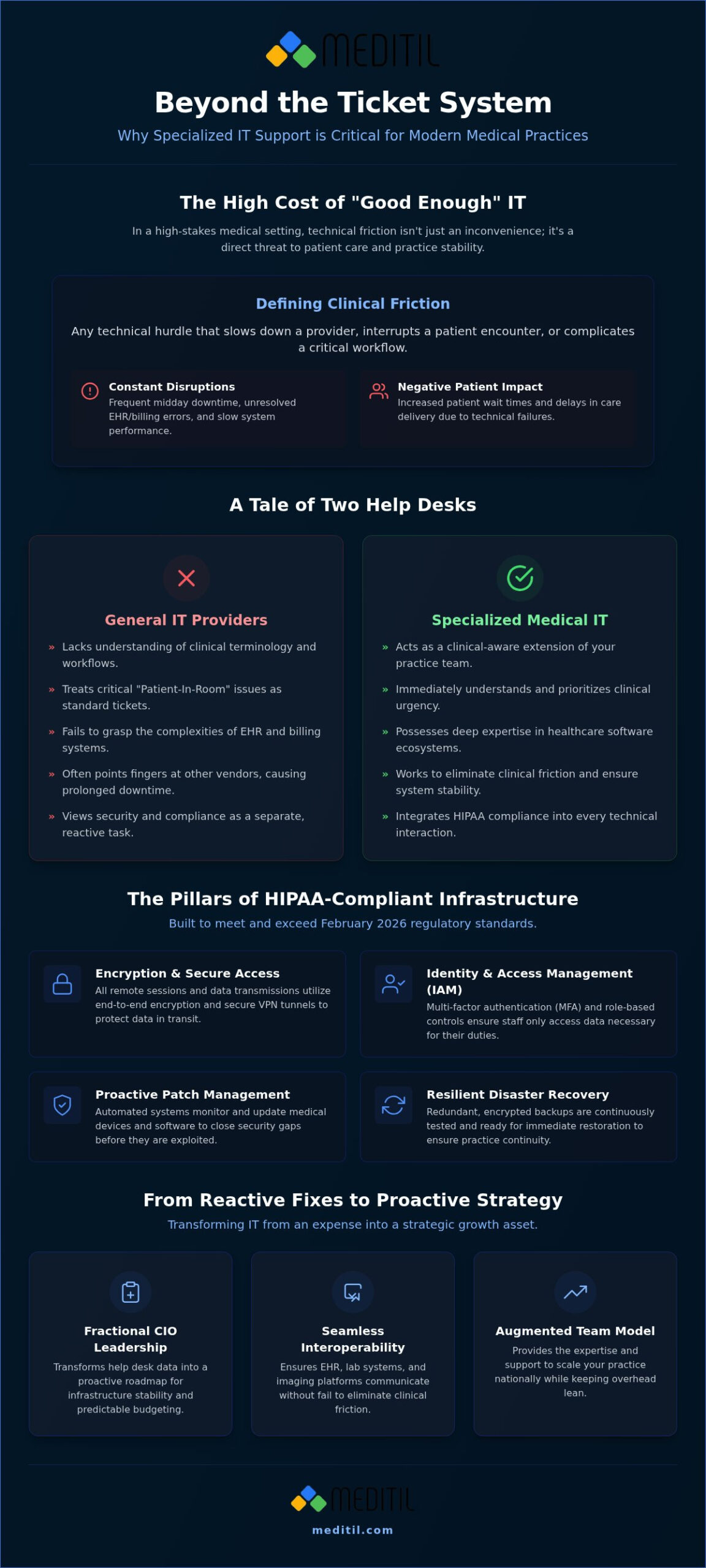
The primary metric for success in this field is the reduction of clinical friction. Clinical friction refers to any technical hurdle that slows down a provider, interrupts a patient encounter, or complicates a workflow. When a chart takes too long to load or a prescription won’t print, the results are more than just annoying. They directly impact the quality of care and the practice’s bottom line. A healthcare-focused help desk prioritizes stability and seamless connectivity to keep the clinic moving at peak efficiency.
HIPAA awareness is another critical differentiator. In a medical context, security isn’t a separate department; it’s a foundational element of every technical interaction. When a technician performs a remote session or resets a user’s credentials, they must follow verified protocols to protect sensitive data. This proactive stance ensures that technical support never becomes a liability during a regulatory audit or a security assessment.
The Gap Between Tech Support and Clinical Support
General IT providers often struggle with the high stakes of medical data management. They might treat an EHR migration like a standard file transfer, failing to account for the intricate database relationships required for clinical accuracy. This lack of specialization often leads to extended downtime. In a medical setting, many requests carry a “Patient-In-Room” status. This means a provider is currently with a patient and can’t proceed due to a technical failure. A clinical-aware technician understands this urgency immediately. By resolving these bottlenecks with precision, they help reduce physician burnout and maintain a steady rhythm of care.
Essential Certifications for Healthcare IT Teams
Expertise in this field requires more than basic technical knowledge. Every support professional must undergo rigorous HIPAA compliance training to handle protected health information safely. Beyond individual training, a reliable partner demonstrates their commitment to security through frameworks such as SOC 2. These standards verify that technical safeguards are consistently applied across the entire organization. It’s also vital for support teams to maintain vendor-neutral expertise. They shouldn’t be tied to a single software provider. Instead, they must understand the interplay between various EHR platforms and diagnostic tools to provide comprehensive, unbiased support for your unique infrastructure.
Core Pillars of HIPAA-Compliant Technical Support
Maintaining a professional IT help desk for medical practices requires more than basic technical proficiency; it demands a rigorous adherence to the HIPAA Security Rule at every touchpoint. In 2026, compliance is no longer a static checkbox. It’s a dynamic, integrated workflow that protects both patient privacy and practice continuity. This integration ensures that every support ticket is handled with a “security-first” mindset, preventing common vulnerabilities from becoming costly breaches.
Effective technical support for healthcare centers on five foundational pillars:
- Encryption and Secure Access: All remote support sessions utilize end-to-end encryption and secure VPN tunnels. This prevents unauthorized interception of data during troubleshooting.
- Identity and Access Management (IAM): We implement multi-factor authentication (MFA) and role-based access controls to ensure clinical staff only access data necessary for their specific duties.
- Proactive Patch Management: Automated systems monitor and update medical devices and workstations. This closes security gaps before they can be exploited.
- Resilient Disaster Recovery: Our protocols meet 2026 regulatory standards by ensuring redundant, encrypted backups are tested and ready for immediate restoration.
- Incident Response Planning: We maintain detailed playbooks for clinical data breaches. This allows for rapid containment and the fulfillment of federal reporting requirements.
If you’re concerned about how these standards apply to your current setup, our specialists can help you evaluate your Infrastructure & Network Services to ensure total alignment.
Securing the Clinical Endpoint
Modern practices rely heavily on mobility. With over 90% of physicians now using smartphones in clinical settings, managing these endpoints is vital. We secure tablets and mobile devices used for patient intake through robust mobile device management (MDM) solutions. This protection extends to Wi-Fi networks that host medical-grade IoT devices, such as vitals monitors. By standardizing workstation security, we provide a “steady hand at the wheel,” ensuring protection doesn’t create bottlenecks for busy clinical staff.
Proactive Compliance Monitoring
Audit readiness is a constant requirement. As of February 16, 2026, HIPAA-covered entities must comply with new requirements regarding the handling of substance use disorder (SUD) treatment records. Our systems provide automated logging of all data access to meet these rigorous documentation standards. To support this, we utilize Security Information and Event Management (SIEM) technology. SIEM provides real-time analysis of security alerts generated by applications and network hardware to detect potential threats before they compromise patient data. Regular risk assessments serve as the foundation for our help desk priorities, ensuring we address the most critical vulnerabilities first. For a deeper look at protecting your practice, explore our Healthcare Cybersecurity Services.
Beyond Password Resets: EMR/EHR and Interoperability Support
Standard technical support often stops where the software begins. For a modern clinic, this boundary is insufficient. A strategic IT help desk for medical practices takes ownership of the entire clinical software ecosystem, ensuring that your Electronic Health Record (EHR), Laboratory Information Systems (LIS), and Picture Archiving and Communication Systems (PACS) operate as a unified whole. When these systems are misaligned, data becomes fragmented. This fragmentation leads to diagnostic delays and administrative bottlenecks that compromise the patient experience.
One of the most significant challenges in healthcare administration is revenue cycle leakage. We address this by integrating billing automation directly into your existing workflows. By ensuring that your front-end documentation feeds accurately into your back-end billing systems, we help capture revenue that might otherwise be lost to coding errors or missing data. To prevent the common “finger-pointing” between software providers, MEDITIL serves as your single point of contact. We manage the relationships with your vendors directly, resolving conflicts and ensuring that updates to one system don’t disrupt the performance of another.
Optimizing the EHR User Experience
An EHR should adapt to the provider, not the other way around. We focus on customizing workflows to match the specific needs of your medical specialty. This customization reduces the number of clicks required for routine tasks and streamlines documentation. Beyond initial setup, we provide ongoing training to ensure your staff can leverage new features effectively. This is particularly vital when implementing Medical Billing Automation Solutions, where proper staff adoption is the key to maximizing return on investment.
Solving the Interoperability Challenge
Data silos are the enemy of efficient care. Our team works in real-time to resolve connectivity issues between disparate platforms, ensuring that telehealth and remote monitoring data integrate seamlessly with your primary EHR. This requires a deep technical understanding of the Interoperability Standards Advisory (ISA) and the practical application of HL7 and FHIR standards. By adhering to these frameworks, we enable secure and efficient data exchange across your entire network. This connectivity ensures that whether a patient is seen in person or via a remote monitor, their clinical record remains accurate, complete, and accessible to the entire care team.
Integrating Fractional CIO Leadership with Help Desk Operations
Many administrators view technical support as a reactive necessity. However, a high volume of recurring tickets at an IT help desk for medical practices is often a symptom of underlying structural issues. Strategic leadership transforms these daily disruptions into actionable intelligence. By integrating Fractional CIO leadership with help desk operations, a practice gains a “steady hand” to guide infrastructure decisions. This expert analysis moves your organization beyond simple troubleshooting toward long-term stability.
A Fractional CIO analyzes help desk data to identify systemic weaknesses. If a specific EHR module consistently causes clinical friction, the leader doesn’t just resolve the individual ticket. They evaluate the root cause, whether it’s a workflow misalignment or a vendor performance issue. This oversight ensures that IT budgets align with clinical and financial goals for 2026 and beyond. It prevents the common pitfall of spending on “band-aid” fixes that fail to address the core problem.
Proactive vs. Reactive IT Management
Transitioning from a “break-fix” mentality to a managed healthcare IT model is essential for practice growth. Reactive management leads to unpredictable costs and sudden downtime during patient hours. We utilize Quarterly Business Reviews (QBRs) to evaluate help desk performance and infrastructure health. This methodical approach ensures that your technology evolves alongside your clinical needs. For more on managing these costs, review our guide on Strategic IT Budgeting for Medical Practices.
The vCIO as a Clinical Partner
A virtual CIO (vCIO) acts as a bridge between your administrative objectives and technical execution. They ensure that every technology investment supports your practice’s long-term roadmap. By identifying and replacing obsolete systems before they fail, a vCIO significantly reduces the high cost of technical debt and emergency repairs. This strategic oversight is a core component of our Virtual CIO Services. Ready to move beyond reactive support? Partner with MEDITIL to integrate strategic leadership into your daily operations.
Scaling Your Practice with MEDITIL’s Managed IT Infrastructure
Scaling a medical practice requires more than just adding staff; it demands an infrastructure that expands without increasing administrative complexity. MEDITIL provides the national reach necessary to support multi-site organizations across the entire United States. Our IT help desk for medical practices serves as a centralized hub, ensuring that every clinic in your network adheres to the same high standards of security and performance. This unified approach eliminates the inconsistencies often found when managing regional vendors. It provides a stable foundation for geographic or service-line expansion.
The “Augmented IT Team” model is a core component of our growth strategy. This model allows your practice to scale its technical capabilities without the traditional overhead of recruiting, training, and managing an internal IT department. We act as a professional extension of your leadership, providing specialized expertise in areas like billing automation and interoperability. This partnership ensures that your technology remains an asset rather than a bottleneck as you increase patient volume. By leveraging our established systems, you can focus on clinical excellence while we handle the underlying complexity of your digital environment.
National Support with a Boutique Focus
Managing technical requirements across multiple locations requires precision. MEDITIL manages national IT teams that understand the specific regulatory nuances of different regions while maintaining a boutique level of attentiveness. By utilizing a single, unified help desk, your staff across all locations receives the same high-quality support. This consistency is vital for maintaining security standards nationwide, especially as federal requirements for data protection become more stringent. Our centralized management model ensures that security patches, compliance updates, and workflow optimizations are applied universally and simultaneously.
Getting Started with MEDITIL
Our transition process is methodical and thorough. We begin with a comprehensive infrastructure and compliance audit to identify existing vulnerabilities and performance gaps. This initial assessment forms the basis of your 2026 strategic IT roadmap, ensuring your technology aligns with upcoming regulatory changes and clinical objectives. By establishing a clear plan from day one, we provide the steady guidance your practice needs to achieve long-term excellence. To begin your transition to a stabilized environment, schedule a consultation with MEDITIL’s healthcare IT experts today.
Securing Your Clinical Future Through Strategic Partnership
Transitioning from a reactive to a proactive model is the only way to safeguard your practice against the regulatory and technical challenges of 2026. A specialized IT help desk for medical practices provides more than just troubleshooting; it offers a foundation of clinical awareness and EMR/EHR interoperability that general providers cannot match. By integrating Fractional CIO strategic leadership into your daily operations, you ensure that every technical decision supports your long-term financial and operational goals.
MEDITIL offers a specialized healthcare IT focus that prioritizes zero-friction clinical workflows and comprehensive data protection. Our team manages the complexities of vendor relationships and interoperability so you can focus entirely on patient outcomes. It’s time to replace technical anxiety with a stable, predictable infrastructure that grows with your vision. Partner with MEDITIL for specialized medical IT support and experience the confidence that comes with a steady hand at the wheel. Your practice deserves a partner invested in your long-term stability and success.
Frequently Asked Questions
What is the difference between a general IT help desk and a medical IT help desk?
A medical IT help desk understands the specific software and regulatory environment of a clinic, whereas a general desk lacks clinical awareness. An IT help desk for medical practices prioritizes “Patient-In-Room” requests and understands how EHR downtime stops care. This specialization ensures that technicians don’t just fix hardware but also optimize clinical workflows and maintain strict compliance standards.
How does an IT help desk ensure HIPAA compliance for my medical practice?
Technical support ensures compliance by embedding security protocols into every interaction. This includes using end-to-end encryption for remote sessions and enforcing Multi-Factor Authentication for all clinical staff. Every action is documented in an audit-ready log, which is essential for meeting the 2026 HIPAA Security Rule updates regarding asset inventories and logging requirements.
Can a medical IT help desk resolve issues with my specific EHR/EMR software?
Yes, specialized support teams manage the complex relationship between your EHR and other diagnostic tools. We act as a single point of contact for your software vendors, resolving interoperability issues with LIS or PACS systems. This ownership prevents the “finger-pointing” common with general IT providers and ensures your primary clinical tools remain functional and integrated.
Does MEDITIL provide 24/7 support for urgent clinical issues?
Support availability is tailored to the specific operational needs of your medical practice. While specific hours vary based on your service agreement, the focus remains on minimizing downtime during critical patient-care hours. You should evaluate your provider’s response times for high-priority clinical issues to ensure they align with your practice’s schedule and patient volume.
What is a Fractional CIO and how does it work with help desk services?
A Fractional CIO provides strategic leadership that transforms help desk data into long-term infrastructure improvements. While the help desk manages daily tickets, the CIO identifies recurring patterns that signal systemic weaknesses. This partnership allows your practice to move from reactive “break-fix” support to a managed model that reduces technical debt and aligns with your financial roadmap.
How much does managed IT support for a medical practice cost in 2026?
Managed IT costs for healthcare vary based on the number of users and the depth of compliance requirements. In 2026, practices typically budget based on a per-user or per-device model that includes cybersecurity and EHR support. While specific rates depend on the complexity of your infrastructure, investing in specialized support often reduces the long-term costs associated with downtime and regulatory penalties.
How does an IT help desk improve the patient experience?
What happens if our medical practice experiences a clinical data breach?
If a breach occurs, an established incident response plan is immediately activated to contain the threat. This process includes identifying the compromised data, securing the network, and fulfilling federal reporting requirements under the HIPAA Breach Notification Rule. Having a professional IT help desk for medical practices ensures that recovery is methodical and that all necessary documentation is preserved for regulatory review.