
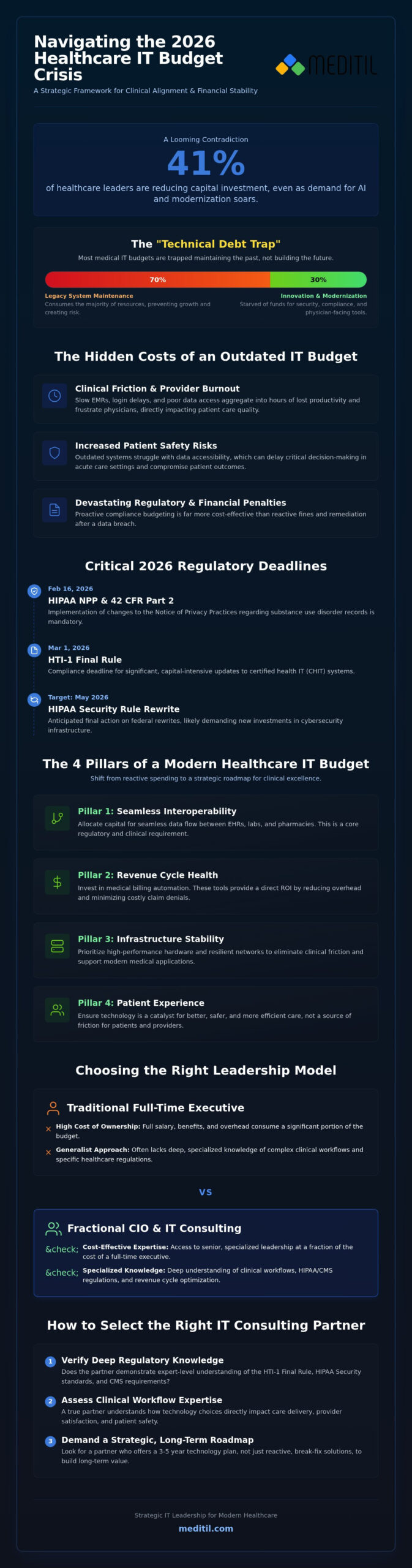
41% of healthcare C-suite leaders anticipate reducing their capital investments through 2027, even as regulatory pressure and the demand for AI integration reach a fever pitch. You likely feel the weight of this contradiction in your daily operations. Maintaining legacy systems often feels like paying a tax on your own growth; meanwhile, the scarcity of leaders who truly understand clinical workflows makes every spending decision feel like a high-stakes gamble. This is why specialized healthcare IT budget consulting has become a necessity for organizations aiming to stabilize their margins while modernizing their care delivery.
It’s possible to master the complexities of medical technology spending by aligning your IT budget with clinical outcomes and regulatory compliance through expert fractional leadership. This guide provides a strategic framework to help you manage the 2026 regulatory environment, including the HTI-1 Final Rule and updated HIPAA Security standards. We’ll outline how to build a 3-5 year technology roadmap that reduces technical friction for physicians, automates billing processes, and ensures your infrastructure remains a steady, reliable foundation for patient care.
Key Takeaways
- Understand how to transition from reactive accounting to strategic clinical alignment to ensure technology serves patient care rather than draining resources.
- Learn why specialized healthcare IT budget consulting is essential for identifying and eliminating the “Technical Debt Trap” that often consumes the majority of medical IT budgets.
- Discover the strategic pillars of 2026 budgeting, focusing on seamless interoperability and revenue cycle optimization through targeted billing automation.
- Compare the total cost of ownership between full-time executives and fractional CIO models to secure expert leadership at a fraction of the traditional cost.
- Gain a step-by-step framework for evaluating consulting partners based on their HIPAA/CMS regulatory knowledge and clinical workflow expertise.
The Crisis of Healthcare IT Budgeting: Why Traditional Models Fail in 2026
Standard financial planning often treats technology as a utility, similar to electricity or rent. In a clinical environment, this approach is fundamentally flawed. Traditional budgeting models are failing because they prioritize short-term cost containment over long-term operational stability. Specialized healthcare IT budget consulting shifts this paradigm. It moves beyond simple accounting to focus on strategic clinical alignment, ensuring that every dollar spent directly supports provider efficiency and patient safety. Without this specialized lens, organizations often find themselves reacting to crises rather than executing a proactive strategy.
A primary driver of this crisis is the “Technical Debt Trap.” Industry data suggests that maintenance of legacy systems now consumes approximately 70% of medical IT budgets. This leaves a meager 30% for innovation, security upgrades, or infrastructure modernization. Generalist IT consultants often fail to recognize this imbalance because they don’t understand the specific interdependencies of Health Information Technology (HIT) systems. They might suggest cutting “redundant” support costs that are actually critical for maintaining EMR uptime, leading to catastrophic failures during peak clinical hours.
The Hidden Cost of Clinical Friction
Poor budget allocation manifests physically as clinical friction. When a budget doesn’t account for the high-performance hardware or optimized networks required by modern medical applications, physicians experience slow EMR response times and login delays. These seconds of lag aggregate into hours of lost productivity and contribute significantly to provider burnout. Technical debt isn’t just a financial line item; it’s a risk to patient safety. Outdated systems struggle with data accessibility, which can delay critical decision-making in acute care settings. Transitioning from “keeping the lights on” to “driving clinical excellence” requires a disciplined redistribution of capital toward high-impact infrastructure.
Regulatory Pressures as Budget Drivers
The 2026 regulatory landscape has introduced non-negotiable financial burdens. Compliance with the HTI-1 Final Rule is required by March 1, 2026, necessitating significant updates to certified health IT. Additionally, changes to the HIPAA Notice of Privacy Practices (NPP) regarding 42 CFR Part 2 records must be implemented by February 16, 2026. These aren’t just administrative tasks; they are capital-intensive projects that require expert oversight.
Leaders must also account for the rising costs of cybersecurity insurance and the potential for federal rewrites of the HIPAA Security Rule, which the government targets for final action in May 2026. Aligning your IT spend with specialized healthcare cybersecurity services is no longer optional. It’s a foundational requirement to avoid the devastating financial and reputational penalties of a data breach. Proactive compliance budgeting is always more cost-effective than reactive remediation.
Strategic Pillars of a Modern Healthcare IT Budget
Building a budget that withstands the pressures of 2026 requires moving away from flat-line spending. Modern financial planning must prioritize operational resilience and clinical efficacy. Through healthcare IT budget consulting, leaders can categorize investments into four strategic pillars: interoperability, revenue cycle health, infrastructure stability, and patient experience. These pillars ensure that technology acts as a catalyst for growth rather than a source of friction. When these categories are clearly defined, the budget becomes a roadmap for clinical excellence rather than a list of expenses.
Interoperability remains a critical hurdle for many organizations. Budgeting for seamless data flow between EHRs, labs, and pharmacies is now a regulatory requirement that demands focused capital. Similarly, protecting the bottom line requires investing in medical billing automation solutions. These tools reduce administrative overhead and minimize the risk of claim denials, providing a direct return on investment. Beyond clinical and financial operations, a modern budget must also fund patient experience initiatives. This includes telehealth platforms and remote monitoring tools that extend care beyond the four walls of the clinic, meeting the expectations of a digitally savvy patient base.
Prioritizing Interoperability and Data Integration
Breaking down data silos is essential for providing real-time clinical decision support. When systems don’t communicate, providers lose valuable time searching for records, which impacts patient safety. Strategic budgets must account for the APIs and middleware that connect disparate medical applications into a unified ecosystem. Research indicates that technology spending in healthcare is a primary driver of overall costs; however, integrated systems pay for themselves by reducing duplicate testing and administrative errors. Efficient data integration ensures that the right information reaches the right clinician at the point of care, significantly reducing the cognitive load on staff.
Infrastructure as a Foundation for Growth
A stable clinical environment relies on N+1 redundancy. This means having backup systems ready to take over immediately if a primary component fails. Cloud migration is a strategic budget move for scalable healthcare organizations, as it shifts capital expenditure to operational expenditure while enhancing disaster recovery capabilities. Allocating funds for robust network management is equally vital to prevent the downtime that paralyzes modern practices. By leveraging AI and Business Intelligence in modern budget forecasting, leaders can predict infrastructure needs before they become emergencies. This proactive approach allows for a 3-5 year technology roadmap that aligns with long-term clinical goals rather than short-term fixes.
Partnering with a specialist for expert IT advising can help clarify these priorities for your specific clinical workflow.
Leadership Models: Full-Time CIO vs. Healthcare IT Budget Consulting
Many organizations mistake IT leadership for a purely administrative role. This often leads to the hiring of a full-time CIO whose total cost of ownership (TCO) includes not just a high base salary but also executive benefits and recruitment fees. For many mid-sized medical groups, this investment doesn’t align with their actual operational needs. Specialized healthcare IT budget consulting offers a more precise alternative. By choosing a fractional model, you gain access to high-level strategy and a “steady hand” at a fraction of the traditional cost. This shift toward agile leadership is supported by evidence in Healthcare Budgeting: A Systematic Review, which highlights the need for performance-based capital allocation rather than rigid, global budget models.
Scalability is a core benefit of the fractional approach. You can increase leadership intensity during high-stakes phases, such as an EHR migration or a major infrastructure overhaul, and then scale back once the project reaches a steady state. Utilizing virtual CIO services ensures that your strategic roadmap remains current and compliant without the burden of a permanent executive salary. This allows your organization to remain nimble in a rapidly shifting regulatory environment.
The Fractional CIO as a Budget Catalyst
Fractional leaders act as catalysts for financial health by conducting forensic audits of existing spend. They possess the expertise required to identify “zombie” software licenses and redundant hardware that drain resources monthly. They also bring deep vendor negotiation experience to the table, often reducing long-term contract costs by significant margins. Unlike a single internal hire, a consultant provides “bench strength.” You aren’t just hiring one person; you’re accessing the collective knowledge of a team of healthcare IT experts who understand the nuances of clinical workflows and technical debt reduction.
For organizations that determine a permanent executive is necessary to drive long-term transformation, Lindero Partners provides the specialized executive search and advisory services needed to match world-class talent with these critical roles.
Comparing Service Delivery Models
Not all external leadership models provide the same value. Staffing agencies are effective for providing “hands on keyboard” support but lack the vision required for long-term strategic roadmapping. Traditional consulting firms offer high-level advice but are often disconnected from daily clinical operations and charge exorbitant hourly rates. Fractional CIO partners bridge this gap. They provide strategic oversight that is deeply integrated with it support for medical practices. This ensures that the high-level budget strategy is actually achievable on the ground, preventing the strategic drift that often plagues large-scale technology projects.
Evaluating a Healthcare IT Budget Consulting Partner: A Buying Guide
Selecting a partner for healthcare IT budget consulting is a high-stakes decision that requires a disciplined approach to verification. You aren’t just hiring a financial advisor; you’re securing a strategic architect who must understand the nuances of a regulated clinical environment. The right partner should demonstrate a deep familiarity with the 2026 regulatory landscape, including the specific deadlines for HTI-1 compliance and the February 2026 HIPAA Notice of Privacy Practices updates. Without this specialized knowledge, a consultant might overlook critical non-discretionary spending requirements.
- Step 1: Verify healthcare-exclusive expertise. Generalist firms often lack the granular knowledge of HIPAA and CMS standards required to protect your organization.
- Step 2: Assess their framework for strategic IT budgeting for medical practices. A partner should provide a roadmap that accounts for both capital expenditure and ongoing operational costs.
- Step 3: Evaluate their track record in EHR interoperability and billing automation. Ask for specific examples where they’ve successfully reduced clinical friction.
- Step 4: Confirm their ability to manage and augment existing IT departments. A consultant should serve as a force multiplier for your current team, not a replacement.
- Step 5: Review their methodology for tracking IT ROI. If they can’t define how technology spending translates into clinical or financial gains, they aren’t a strategic partner.
Vetting for Strategic Alignment
A critical question to ask is whether the consultant speaks “clinical” or merely “technical.” A partner who only understands server uptime without considering physician login times or EMR response speeds will fail to address the root causes of provider burnout. You should request case studies that demonstrate a clear reduction in technical debt. Look for documented instances where they’ve achieved cost savings through vendor consolidation or license optimization without compromising care quality. Their primary goal should be to align your infrastructure with your long-term clinical objectives.
Operational Integration and SLAs
The first 90 days of an engagement are vital. You should define clear success metrics, such as a completed infrastructure audit or a prioritized list of security vulnerabilities. A reliable partner provides both high-level strategy and technical execution; they don’t just hand over a report and disappear. Red flags of generalist consulting include a lack of familiarity with medical-specific billing codes or an inability to explain the impact of 2026 CMS interoperability mandates. It’s essential that your partner can transition seamlessly from executive-level planning to ground-level support.
If you’re ready to stabilize your technology roadmap, you can consult with MEDITIL’s fractional CIO experts to begin your strategic audit.
MEDITIL: Your Strategic Partner for Healthcare IT Leadership
MEDITIL operates as a mission-driven extension of your executive leadership team. We recognize that healthcare technology is not a standalone cost center but a fundamental component of high-quality patient care. Our approach to healthcare IT budget consulting bridges the gap between high-level strategy and daily operational reality. By providing a synergy of Fractional CIO leadership and robust managed IT execution, we ensure that your technology investments are both visionary and practical. We don’t just offer advice; we provide the steady hand needed to implement it.
With a national reach across the United States, we specialize in supporting high-volume clinical networks where infrastructure stability and cybersecurity are non-negotiable. MEDITIL acts as the stabilizing force required to manage the ballooning maintenance costs of legacy systems while simultaneously driving clinical innovation. We help you move past the cycle of reactive spending mentioned earlier in this guide to build a resilient, future-proof organization that remains compliant with the evolving standards of 2026.
Comprehensive Management and Fractional Leadership
Our service delivery model is designed for maximum flexibility to meet the specific needs of your practice. We can manage your entire IT department or provide an augmented IT team to support complex projects such as EHR system integration and interoperability updates. Our specialized expertise in billing automation allows us to drive revenue and improve financial health by reducing administrative errors and clinical friction. We provide proactive risk management and cybersecurity compliance that is specifically tailored to the unique regulatory and operational needs of the medical industry.
Building Your 2026 Technology Roadmap
Every partnership begins with a comprehensive assessment process. We identify critical gaps in your current infrastructure, security posture, and budget allocation. This data-driven foundation allows us to customize a fractional engagement that fits your organization’s specific scale and long-term goals. Whether you’re addressing the “Technical Debt Trap” or preparing for new CMS interoperability mandates, we provide the disciplined oversight needed to succeed. Our goal is to ensure your technology serves as a foundation for growth rather than a hurdle for your providers.
Schedule a Strategic IT Consultation with MEDITIL to begin optimizing your technology roadmap and stabilizing your clinical budget today.
Securing Your Clinical and Financial Future
MEDITIL offers tailored IT solutions designed specifically for the healthcare sector. We provide comprehensive management of entire IT operations and teams, ensuring your infrastructure remains stable while you focus on patient care. Our expertise in billing automation and EHR interoperability allows us to stabilize your margins and ensure compliance with upcoming CMS mandates. You don’t have to face these regulatory and financial challenges alone. Schedule a Strategic IT Consultation with MEDITIL to begin building a roadmap that protects your practice and empowers your providers. With a steady hand at the wheel, your organization’s digital transformation is well within reach.
Frequently Asked Questions
What is the primary goal of healthcare IT budget consulting?
The primary goal is to align technology expenditures with strategic clinical outcomes and regulatory mandates. This process ensures that IT spending isn’t merely a utility cost but a strategic investment that reduces operational friction and enhances patient care. By auditing current expenditures, healthcare IT budget consulting helps organizations redistribute capital from legacy maintenance to meaningful innovation that supports long-term growth.
How much does a fractional CIO for healthcare typically cost?
Fractional CIO services are structured to provide executive leadership at a portion of the cost of a full-time hire. According to 2026 industry data, senior-level advisors and virtual Chief Information Security Officers typically command hourly rates between $250 and $500. This model allows mid-sized medical groups to access high-level strategy without the long-term burden of executive benefits, recruitment fees, and six-figure base salaries.
Can a budget consultant help our practice achieve 2026 CMS interoperability compliance?
Yes, a consultant is essential for navigating the HTI-1 Final Rule, which has a critical compliance deadline of March 1, 2026. They provide the technical roadmap necessary to meet these certification criteria and ensure your systems facilitate seamless data exchange. This proactive approach prevents the administrative penalties associated with non-compliance and ensures your practice meets evolving federal standards for patient data access and transparency.
What is the difference between an IT staffing agency and a fractional CIO service?
An IT staffing agency primarily provides technical labor to fill specific roles or complete manual tasks. In contrast, a fractional CIO service offers executive-level leadership and long-term strategic planning. While a staffing agency helps you find “hands on keyboard” support for daily tickets, a fractional CIO acts as a strategic partner who manages your technology roadmap and aligns your IT infrastructure with your broader clinical goals.
How does technical debt affect a healthcare organization’s bottom line?
Technical debt drains your bottom line by diverting significant portions of your IT budget toward maintaining outdated legacy systems. This leaves insufficient capital for modernization or cybersecurity upgrades, which increases the risk of costly data breaches. Over time, these inefficient systems slow down clinical workflows and lead to lost productivity. This creates a cycle of reactive spending that erodes your practice’s overall profitability and competitive edge.
Do I need a separate budget for cybersecurity and managed IT services?
Cybersecurity and managed IT services are often delivered together, but it’s best practice to line-item them separately in your budget for better visibility. This allows leadership to verify that enough resources are allocated to proactive protection versus daily support tasks. A clear distinction helps you track the return on investment for specific security initiatives and ensures compliance with the evolving HIPAA Security Rule standards targeted for 2026.
How can a fractional CIO help reduce physician burnout and clinical friction?
A fractional CIO reduces physician burnout by identifying and eliminating technical bottlenecks that cause clinical friction. By optimizing EMR response times and streamlining login processes, they ensure that technology supports rather than hinders the provider’s workflow. This disciplined approach to infrastructure management allows clinicians to spend more time with patients and less time navigating cumbersome digital systems, directly improving job satisfaction and care quality.
Is healthcare IT budget consulting suitable for small specialty clinics?
Healthcare IT budget consulting is highly suitable for small specialty clinics that must manage tight margins while meeting the same regulatory standards as larger systems. These clinics often lack the resources for a full-time IT director, making fractional leadership an ideal way to secure expert guidance. A consultant helps smaller practices prioritize essential upgrades and avoid overspending on unnecessary software that doesn’t fit their specific clinical needs.