
What if the primary obstacle to your remote care strategy isn’t the clinical protocol, but the technical friction felt by your staff and patients? For many healthcare leaders, the promise of virtual care is often overshadowed by the reality of clinicians spending hours acting as unofficial IT help desks. You’ve likely seen how fragmented data silos and security concerns regarding patient-owned devices can stall even the most well-funded initiatives. It’s a frustrating bottleneck that prevents your team from focusing on what matters most: patient outcomes.
A robust framework for remote patient monitoring technical support is no longer a luxury; it’s a foundational requirement for clinical efficiency. This 2026 guide provides a strategic roadmap for building a resilient infrastructure that ensures data integrity and strict HIPAA compliance. We’ll examine how to achieve seamless interoperability between devices and your EHR, create zero-friction onboarding for patients, and implement a scalable support model. By the end of this article, you’ll understand how to stabilize your technical environment so your providers can return to the bedside, even when that bedside is miles away.
Key Takeaways
- Identify the hidden costs of clinical burnout caused by technical troubleshooting and learn how to reclaim provider time for direct patient care.
- Establish a stable infrastructure for remote patient monitoring technical support that ensures data integrity through N+1 redundancy and seamless EHR interoperability.
- Mitigate cybersecurity risks by implementing proactive threat detection and SIEM protocols to protect sensitive patient data across the remote perimeter.
- Compare the financial impact of CapEx versus OpEx models to determine the most scalable and cost-effective path for your organization’s technical support needs.
- Discover how a strategic IT partnership eliminates clinical friction and creates a zero-friction onboarding experience for patients and staff alike.
The Technical Support Gap in Remote Patient Monitoring
Healthcare leaders often misidentify the scope of remote patient monitoring technical support by treating it as a standard help desk for patient inquiries. In reality, this support layer is the connective tissue between a patient’s home and the clinical record. As we move into 2026, the shift from device-centric programs to infrastructure-centric models is essential. A single device failure is a nuisance, but a systemic failure in data transmission is a liability. You need a strategy that prioritizes the stability of the entire remote patient monitoring ecosystem over individual hardware components. This proactive approach ensures that data integrity is maintained before a clinician even attempts to view a report.
Why General IT Support Fails RPM Programs
Standard IT providers typically operate on a “best effort” basis, which is incompatible with the high-stakes nature of life-critical data. These generalists often lack the sophisticated understanding of healthcare-specific regulatory standards required to manage complex, encrypted data flows. While they might resolve a basic login issue, they don’t have the expertise to bridge the gap between technical requirements and clinical workflows. A mature approach to remote patient monitoring technical support requires a deep familiarity with how data moves through secure tunnels into the EHR, ensuring that no information is lost or compromised during the journey. Without this industry-specific knowledge, your program remains vulnerable to both security breaches and operational downtime.
The Clinical Impact of Technical Friction
The true “hidden cost” of in-house support isn’t just the salary of an IT staffer; it’s the erosion of clinical efficiency and the resulting burnout. When nurses are forced to act as technical troubleshooters, their primary mission of patient care suffers. This technical friction creates a ripple effect that directly impacts patient compliance. If a patient encounters repeated connectivity issues or finds the onboarding process cumbersome, their engagement with the program inevitably declines. This leads to gaps in data that make longitudinal care nearly impossible. When technology becomes a hurdle rather than a tool, the clinical outcome is always at risk.
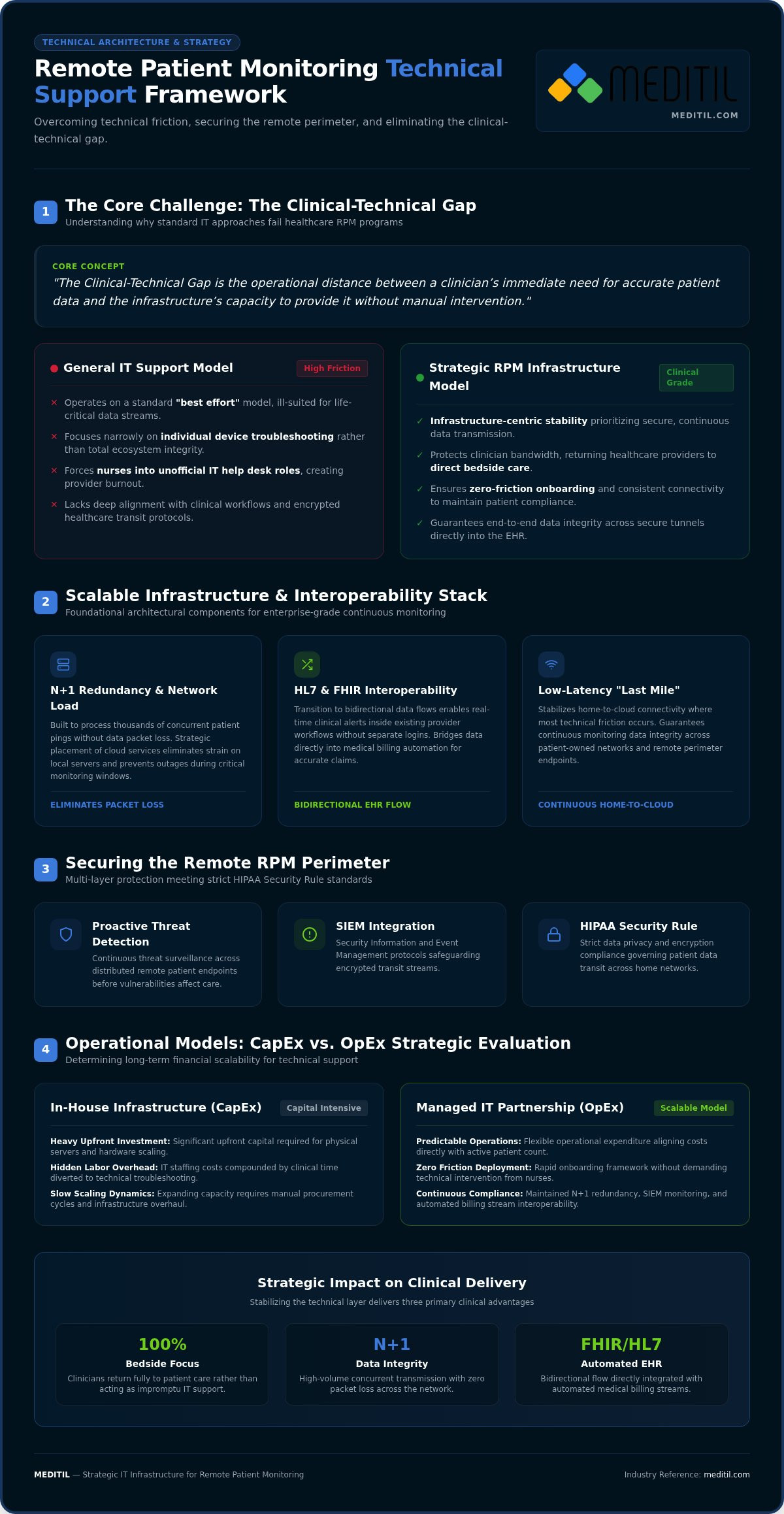
The Clinical-Technical Gap is the operational distance between a clinician’s immediate need for accurate patient data and the infrastructure’s capacity to provide it without manual intervention.
Building a Scalable RPM Infrastructure and Interoperability
Scalability in RPM relies on more than just purchasing more devices. It requires a resilient technical foundation built on N+1 redundancy and intelligent network management. When your infrastructure is designed to handle thousands of concurrent patient pings, you eliminate the risk of data packet loss during critical monitoring windows. Strategic placement of cloud services allows for high-volume data processing without taxing local servers, ensuring that your remote patient monitoring technical support team isn’t constantly reactive to system outages. This architectural foresight is what separates a pilot program from a sustainable, enterprise-grade solution.
EHR Integration and Data Silo Elimination
The transition to HL7 and FHIR standards in 2026 has made true interoperability a baseline expectation for healthcare leaders. Modern systems must support bidirectional data flow, allowing real-time clinical alerts to trigger within the provider’s existing workflow rather than requiring a separate login. By automating these data streams, organizations can significantly reduce the manual burden of clinical entry and minimize the risk of human error. This technical synergy is particularly vital when integrating medical billing automation solutions, which turn raw monitoring data into accurate, reimbursable claims without human intervention. Ensuring these systems comply with HIPAA Security Rule requirements is non-negotiable for protecting patient privacy during every stage of data transit.
Network Reliability for Continuous Monitoring
Designing a network for acute care RPM demands low-latency infrastructure that remains stable under heavy traffic loads. While the core network might be robust, the “Last Mile” of patient connectivity often presents the greatest challenge for remote patient monitoring technical support. This involves managing the connection from the patient’s home router to your secure cloud gateway, often across varying ISP quality. A strategic partner can help you design a network architecture that accounts for these variables, providing a steady hand at the wheel for your digital health initiatives. Organizations looking to stabilize their technical environment often benefit from expert infrastructure and network services to prevent clinical friction and ensure that every patient ping is accounted for. This level of precision is necessary to maintain clinical trust in the technology.
Securing the RPM Perimeter: Cybersecurity and Compliance
Data privacy remains the primary objection for healthcare leaders considering large-scale virtual care deployments. In a landscape where thousands of patient-owned devices act as network endpoints, the traditional hospital firewall is no longer sufficient. Securing this expanded perimeter requires a shift from reactive patching to proactive, continuous monitoring. Implementing Security Information and Event Management (SIEM) provides the real-time visibility needed to detect anomalies across remote monitoring streams before they escalate into breaches. Effective remote patient monitoring technical support must include these specialized cybersecurity protocols to ensure that every data touchpoint remains protected and verifiable.
Encryption standards for data in transit are non-negotiable. As sensitive health information traverses public internet connections from a patient’s home to the clinical gateway, it must be shielded by robust cryptographic protocols. This challenge is amplified in “Bring Your Own Device” (BYOD) models, where technical support teams must verify the security integrity of personal hardware without overstepping privacy boundaries. Establishing clear technical standards for these devices ensures that the convenience of BYOD doesn’t create a back door for malicious actors.
HIPAA Compliance Beyond the Basics
Maintaining HIPAA compliance in a remote environment demands more than signing a standard agreement. It requires conducting regular, documented risk assessments for every remote monitoring endpoint to identify potential vulnerabilities in the data chain. Business Associate Agreements (BAAs) must specifically outline the technical support provider’s responsibilities regarding data handling and incident response. Healthcare leaders should consult a comprehensive guide on healthcare cybersecurity services to establish these deep-dive protocols and ensure their infrastructure meets evolving regulatory demands.
Identity and Access Management (IAM) for Patients and Staff
Identity and Access Management (IAM) serves as the final line of defense in a distributed RPM ecosystem. While Multi-factor authentication (MFA) is a security gold standard, it often presents significant usability challenges for elderly patient populations. Remote patient monitoring technical support must find a balance between high-security requirements and patient accessibility, perhaps through simplified biometric or hardware-token solutions. On the provider side, role-based access controls (RBAC) ensure that technical personnel only interact with the specific systems necessary for their function. Every interaction with patient data should be captured in comprehensive audit logs, creating a traceable history that supports both clinical accuracy and regulatory reporting. This methodical approach to access ensures that the right people have the right data at the right time, without compromising the security of the broader network.
Operationalizing Support: Managed Services vs. In-House
Choosing between an in-house team and a managed service provider involves a fundamental shift in financial strategy. In-house models typically require significant Capital Expenditure (CapEx) for infrastructure and the recruitment of specialized personnel. Conversely, an outsourced model operates on Operational Expenditure (OpEx), providing a predictable monthly cost that scales with patient volume. This flexibility is critical during practice expansions or public health surges, where the demand for remote patient monitoring technical support can fluctuate rapidly. A tiered support model ensures that simple patient onboarding tasks don’t distract senior engineers from critical server maintenance or system-wide optimizations. It creates a structured environment where every technical issue is addressed by the appropriate level of expertise.
The Managed IT Advantage for RPM
A managed approach provides 24/7/365 monitoring and help desk availability that most mid-sized practices find impossible to sustain internally. You gain immediate access to a pool of specialized healthcare IT talent without the burden of multiple full-time salaries or the constant pressure of technical turnover. This stability allows your internal team to focus on clinical delivery while experts manage the underlying complexity of your digital health tools. For a deeper look at these operational benefits, review our managed it services for healthcare guide.
Strategic Roadmap: From Implementation to Optimization
Moving beyond basic troubleshooting requires sophisticated business intelligence and analytics to track the health of your RPM program. These data points allow you to identify recurring technical friction points, such as specific device connectivity failures or data latency issues, and optimize the patient experience. Integrating virtual cio services into your leadership team provides the strategic oversight needed to select the right vendors and ensure long-term interoperability. This high-level guidance ensures that your technology stack evolves alongside regulatory changes and clinical needs. The ROI of outsourced RPM technical support is realized through the immediate recapture of clinical hours and the elimination of the overhead associated with maintaining a specialized internal IT department.
If you’re ready to stabilize your infrastructure and reduce the burden on your clinical staff, consider partnering with an expert in managed IT services to secure your operational future.
The MEDITIL Approach: Strategic IT Partnership for RPM
MEDITIL functions as a strategic extension of your leadership team, providing the technical precision required for modern virtual care. We recognize that clinical friction often stems from a lack of infrastructure stability. Our approach to remote patient monitoring technical support is designed to absorb the technical burden, allowing your providers to focus exclusively on patient outcomes. By positioning ourselves as a dedicated Healthcare IT partner, we ensure that every component of your RPM ecosystem is verified, secure, and optimized for long-term performance. We don’t just provide a service; we offer a steady hand at the wheel for your digital transformation.
Seamless Implementation and Integration Services
Successful RPM deployment begins with a methodical integration process that aligns with your existing clinical workflows. Our team manages the complexities of EHR and EMR interoperability, ensuring that data flows securely and accurately into the patient record. We specifically focus on building billing automation into the workflow, which eliminates the manual task of capturing monitoring minutes and reduces the risk of reimbursement delays. For high-volume healthcare organizations, we design custom network architectures that provide the necessary bandwidth and redundancy to support thousands of concurrent connections. This foundational work ensures that the transition to digital care is smooth for both staff and patients. We handle the technical heavy lifting so your team doesn’t have to.
Proactive Support and Continuous Optimization
Our commitment to your program continues long after the initial implementation. We provide 24/7 end-user support that understands the clinical urgency inherent in healthcare environments. Regular infrastructure audits are a standard part of our methodology, allowing us to identify and resolve potential issues before they cause downtime. Beyond immediate troubleshooting, our Fractional CIO services provide the strategic advisory needed to align your technical roadmap with your organization’s growth objectives. We act as a consultant invested in your long-term success, ensuring that your remote patient monitoring technical support framework remains resilient as patient volumes increase and regulatory standards evolve. Partnering with MEDITIL means securing a stable, high-performing environment that supports the future of care delivery.
Securing the Future of Virtual Care Delivery
The path toward a sustainable RPM program requires more than just functional hardware. It demands a sophisticated infrastructure that prioritizes data integrity, seamless EHR integration, and proactive cybersecurity. By shifting from a reactive support model to a strategic partnership, you eliminate the technical friction that leads to clinical burnout and patient disengagement. This transition allows your team to focus on the high-stakes mission of improving patient outcomes rather than troubleshooting connectivity issues.
Establishing a resilient framework for remote patient monitoring technical support is the most effective way to ensure long-term scalability and compliance. MEDITIL provides the specialized healthcare IT focus and HIPAA-compliant infrastructure management required so you don’t have to manage these complexities alone. With our Fractional CIO expertise, we help you align your technical roadmap with your operational goals, ensuring every investment translates into improved care delivery.
Take the first step toward a more stable and efficient clinical environment today. Schedule a Strategic IT Consultation with MEDITIL to secure your infrastructure for 2026 and beyond. Your clinicians deserve the peace of mind that comes with a steady hand at the wheel.
Frequently Asked Questions
What is the difference between RPM technical support and clinical support?
Remote patient monitoring technical support focuses on the stability of the data tunnel, device connectivity, and software interoperability. In contrast, clinical support involves the medical interpretation of transmitted data and subsequent patient intervention. While tech support ensures that a data ping arrives securely and accurately at the clinical gateway, clinical support determines the appropriate medical response to that information. Both are necessary, but they require distinct skill sets to manage effectively.
How do we ensure HIPAA compliance when supporting patient-owned devices?
Ensuring HIPAA compliance for patient-owned devices requires implementing robust encryption for data both in transit and at rest on the endpoint. You must establish a clear Business Associate Agreement (BAA) with your technical partners to define data handling responsibilities. Organizations should also use secure mobile device management or encrypted application containers to isolate health data from personal information. Regular risk assessments of these remote endpoints are necessary to identify potential vulnerabilities in the data chain.
Does our existing EHR handle RPM data integration, or do we need a middleware solution?
Most modern EHRs support HL7 and FHIR standards, but they often require a middleware solution or a custom integration layer to handle high-volume RPM data without latency. Middleware can aggregate data from various device manufacturers and normalize it before it enters the clinical record. This prevents your EHR from becoming overwhelmed by raw data pings. A strategic IT partner can evaluate your current system’s capacity to determine if a direct integration or a specialized gateway is the most efficient path.
What are the common technical reasons for RPM patient attrition?
Technical friction is a leading driver of patient attrition in virtual care programs. Common issues include inconsistent home connectivity, complex multi-step device pairing processes, and software interfaces that aren’t optimized for elderly users. When a patient encounters repeated sync errors or data transmission failures, their trust in the system diminishes. Reducing these barriers through zero-friction onboarding and proactive technical monitoring is essential for maintaining high engagement and compliance rates over the long term.
How can a Fractional CIO help our practice select the right RPM technology?
A Fractional CIO provides the strategic oversight needed to evaluate vendors based on interoperability, security standards, and long-term scalability rather than just hardware features. They ensure the selected technology aligns with your clinical workflows and existing IT infrastructure. By conducting a thorough ROI analysis and vetting a vendor’s technical support capabilities, a Fractional CIO helps you avoid costly implementation mistakes. This leadership ensures the platform supports your specific patient outcome goals and future growth.
What level of network redundancy is required for continuous remote monitoring?
Continuous remote monitoring requires an N+1 redundancy model to ensure that a single component failure doesn’t result in data loss. This involves maintaining secondary network paths and automatic failover systems for your cloud gateways and data ingestion points. For acute care RPM, low-latency infrastructure is vital to support real-time alerts. Implementing diverse internet service providers at your primary data centers further protects against regional outages that could disrupt life-critical patient monitoring operations.
How does managed IT support reduce physician burnout in RPM programs?
Managed IT support offloads the technical troubleshooting burden from clinical staff, allowing them to focus exclusively on patient care. When remote patient monitoring technical support is handled by dedicated experts, nurses and physicians no longer spend valuable clinical hours resolving device connectivity or login issues. This stabilization of the technical environment reduces the daily friction that contributes to burnout. It ensures the digital tools provided are assets to the workflow rather than persistent obstacles.
What are the key security threats facing RPM systems in 2026?
In 2026, the primary security threats include sophisticated ransomware targeting distributed networks and vulnerabilities in unpatched patient-owned devices. Attackers often target the API connections between devices and the EHR to intercept sensitive health information. Identity spoofing and credential theft also remain significant risks, necessitating the use of adaptive multi-factor authentication. Proactive threat detection and SIEM protocols are essential for monitoring these expanded perimeters and identifying anomalies before they result in a significant data breach.