
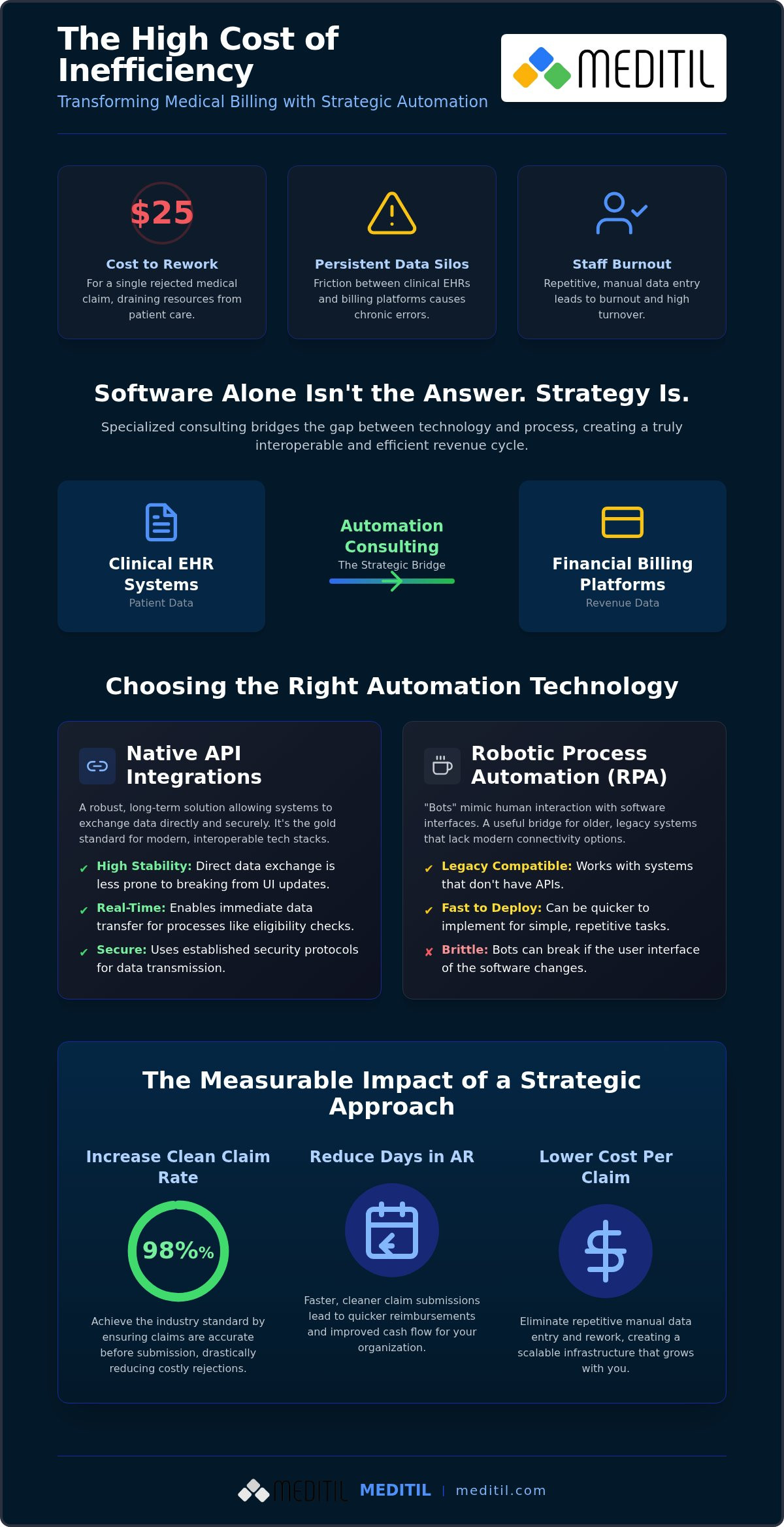
It costs an average of $25 to rework a single rejected medical claim, a figure that quickly compounds when clean claim rates remain stagnant despite expensive software upgrades. For many healthcare leaders, the promise of efficiency is often undermined by persistent data silos between clinical EHR systems and financial billing platforms. These friction points lead to chronic staff burnout and elevated overhead costs that drain resources away from patient care. You likely recognize that simply buying more software isn’t the solution to a fragmented revenue cycle.
This guide demonstrates how specialized medical billing automation consulting bridges the gap between disparate systems to create a truly interoperable tech stack. You’ll learn how a strategic approach to automation reduces Days in AR and lowers the cost per claim by eliminating repetitive manual data entry. We’ll explore the transition from manual workarounds to a steady, automated infrastructure that aligns with the 2026 CMS interoperability mandates. By the end of this article, you’ll have a roadmap for transforming your financial operations into a high-performing asset that requires minimal manual intervention.
Key Takeaways
- Understand why software-only solutions often fail to meet financial goals and how a strategic approach secures a higher return on investment.
- Identify the critical differences between Robotic Process Automation (RPA) and native API integrations to select the most efficient technology for your workflows.
- Engage specialized medical billing automation consulting to resolve interoperability hurdles and ensure seamless connectivity between clinical and financial platforms.
- Learn the essential steps for building a scalable roadmap, starting with comprehensive technical audits and the establishment of measurable success metrics.
- Leverage the fractional CIO model to gain expert strategic oversight and technical guidance for long-term revenue cycle stability.
The Strategic Value of Medical Billing Automation Consulting
Medical billing is no longer a back-office administrative task. It’s a complex data management challenge that requires a steady hand at the wheel. While many organizations view automation as a simple feature within their existing software, true efficiency requires a more holistic approach. This is where medical billing automation consulting serves as a strategic partnership. Instead of simply layering new tools over broken processes, a consultant evaluates the entire ecosystem to ensure technology serves the financial health of the practice. They act as a vital bridge between clinical IT departments and the finance team, ensuring that every patient encounter translates accurately into revenue.
The transition from manual revenue cycle management to intelligent, automated workflows is a significant shift. It moves the staff’s focus from data entry to exception management. This evolution is necessary to keep pace with a regulated environment where precision is the only path to stability. A consultant doesn’t just install a script; they build a resilient infrastructure that protects your organization’s bottom line.
Why Software Alone Isn’t the Answer
Most EHR platforms include basic billing modules, but these out-of-the-box solutions often lack the customization needed for complex specialty workflows. Relying solely on these tools frequently leads to “technical debt.” This occurs when legacy configurations and manual workarounds accumulate over time, making it harder to implement modern updates. These inefficiencies hinder the automation of the medical billing process because the underlying data structure is fragmented. A vendor-neutral assessment is essential for any leader who wants to stop the cycle of ineffective software upgrades. It identifies where software limitations end and process failures begin, allowing for a clean slate that prioritizes interoperability over proprietary constraints.
The ROI of Expert-Led Automation
The financial impact of a well-executed automation strategy is measurable and immediate. With the industry standard for clean claim rates sitting at 98%, any deviation represents significant lost revenue. When you consider that reworking a single rejected claim costs $25, manual intervention becomes a major liability. Expert-led automation targets these specific bottlenecks. It reduces Days in AR by ensuring claims are accurate before they ever reach the clearinghouse. Beyond the balance sheet, specialized medical billing automation consulting alleviates staff burnout by removing the burden of repetitive manual data entry. This creates a scalable infrastructure that can handle increased patient volume without a proportional increase in administrative headcount. It’s a disciplined approach to long-term growth.
Identifying High-Impact Automation Opportunities
A successful transition to an automated revenue cycle begins with a methodical audit of existing workflows. Expert medical billing automation consulting doesn’t just look for where technology can be added. It identifies where human intervention is currently causing the most friction. By analyzing historical data, consultants pinpoint bottlenecks where manual entry errors or processing delays are most frequent. This data-driven approach ensures that automation efforts are applied to the areas with the highest potential for financial recovery and operational stability. It’s about working smarter, not just faster.
One critical decision in this phase involves choosing between Robotic Process Automation (RPA) and native API integrations. RPA uses “bots” to mimic human interaction with software interfaces. This is often a useful bridge for older legacy systems that lack modern connectivity. However, native API integrations offer a more robust, long-term solution by allowing systems to exchange data directly through a secure handshake. While some competitors focus exclusively on RPA for large-scale systems, a specialized consultant evaluates which method provides the most stability for your specific tech stack. Prioritizing tasks based on their volume and error frequency allows for immediate gains in efficiency without overcomplicating the infrastructure.
Automating Front-End Processes
The revenue cycle begins long before a claim is generated. Effective automation starts at the front desk with real-time eligibility verification and patient demographic scrubbing. These tools ensure that insurance information is verified before the patient sees a provider, which directly reduces downstream denials. Additionally, automated prior authorization workflows are becoming essential as regulatory requirements tighten. Starting January 1, 2026, new CMS rules shorten the standard decision time for prior authorizations to seven days, making manual tracking nearly impossible for busy practices. Implementing self-service patient payment portals and automated estimation tools also improves transparency and collection rates at the point of service.
Back-End Revenue Cycle Optimization
Once clinical data is captured, it must be processed with precision. AI-driven medical coding audits can detect potential errors or missed opportunities before a claim is submitted. This proactive approach is far more efficient than reactive denial management. Automated claim submission and status tracking across multiple payers ensure that no claim falls through the cracks. If a denial does occur, intelligent management systems can categorize the reason and even generate automated appeals based on established payer rules. For organizations looking to implement these advanced capabilities, engaging with expert billing integration services provides the technical foundation needed for long-term success.
Overcoming Integration and Interoperability Hurdles
Interoperability is often the greatest barrier to a high-performance revenue cycle. While software vendors claim easy connectivity, the reality of linking disparate third-party systems is far more complex. Professional medical billing automation consulting addresses the “Data Silo” problem by creating a unified data architecture. This is especially critical for multi-specialty groups where clinical data from various departments must flow into a single financial clearinghouse. Without this integration, automation remains superficial, requiring manual workarounds to fill the gaps between systems. A strategic partner ensures that data moves fluidly, transforming fragmented pieces into a cohesive whole.
Protecting patient data during automated transfers is a non-negotiable requirement. As of January 2026, HIPAA violation penalties have been adjusted for inflation, with minimum penalties for willful neglect not corrected within 30 days rising to $73,011. Consultants ensure that every automated bridge uses end-to-end encryption and maintains detailed audit trails. This level of precision protects the organization from both financial loss and regulatory scrutiny. It’s about building a system that is as secure as it is efficient.
Bridging EHR and Billing Platforms
Achieving a seamless data flow requires a deep understanding of HL7 and FHIR standards. While many platforms offer standard integration adapters, these often fail to capture the nuances of specific clinical workflows. Custom API development provides a more tailored solution, ensuring that data integrity is maintained as information moves from clinical records to financial claims. This precision prevents the “garbage in, garbage out” scenario that plagues many automated systems. By aligning technical standards with operational needs, you create a reliable pathway for real-time revenue management.
Infrastructure Stability and Security
Automation is only as reliable as the network it runs on. A stable, high-bandwidth infrastructure is the essential foundation for real-time data processing. If the network experiences latency or downtime, the entire billing cycle halts, creating a backlog that can take weeks to clear. Implementing redundant systems and robust cybersecurity protocols ensures that financial data is both protected and accessible. This focus on infrastructure is what separates a truly automated practice from one that is constantly fighting technical fires. A proactive approach to network health prevents small technical glitches from becoming major operational crises.
Designing a Scalable Automation Roadmap
A strategic roadmap is the difference between a reactive software patch and a resilient financial infrastructure. Implementing automation requires a disciplined, multi-phase approach that prioritizes long-term stability over quick fixes. Through medical billing automation consulting, healthcare leaders can move through these stages with precision, ensuring that each technical layer supports the organization’s overarching financial goals. The process begins with a comprehensive audit of both IT infrastructure and clinical workflows to identify exactly where data friction occurs. This foundational step prevents the common mistake of automating an already broken process.
Once the audit is complete, the focus shifts to vendor-neutral technology selection. It’s vital to choose tools based on their ability to integrate with your specific EHR and clearinghouse, rather than following market trends. Before a full-scale rollout, a pilot program should target high-volume, low-complexity tasks. This allows the team to verify the system’s accuracy in a controlled environment. Only after successful validation should the organization proceed to full-scale implementation. If you are ready to move beyond fragmented billing, you can request a strategic roadmap consultation to begin this process.
Defining Key Performance Indicators (KPIs)
Success in automation is measured by data, not just perceived speed. Leaders must track the Clean Claim Rate (CCR) post-automation to ensure the system is meeting the industry benchmark of 98%. Additionally, monitoring the cost-to-collect and staff productivity metrics provides a clear view of ROI. Establishing a continuous feedback loop is essential. This allows the system to be refined based on payer response patterns and evolving regulatory requirements. It ensures your automation remains an asset rather than a static piece of legacy code.
Change Management and Staff Training
The human element of automation is often the most overlooked hurdle. Staff members frequently fear that automation equates to job insecurity. In reality, it shifts their role from repetitive data entry to managing “automation exceptions.” Training should focus on teaching billing teams how to interpret system alerts and resolve complex denials that the software cannot handle alone. Comprehensive documentation for new workflows provides a steady reference point during the transition. This structured approach to change management reduces friction and builds a culture of technical confidence. It turns your staff into expert supervisors of a high-performance engine.
The MEDITIL Advantage: Strategic Managed IT & Consulting
MEDITIL stands apart by operating as a strategic partner rather than a mere service provider. While many firms offer to take over your billing entirely, we focus on empowering your internal team through technical excellence. Our approach to medical billing automation consulting is fundamentally vendor-neutral. We don’t sell EMR or EHR software. Instead, we optimize the platforms you already have in place. This lack of bias ensures that our recommendations are based solely on what will drive the best financial results for your organization. We act as the steady hand at the wheel, guiding you through complex integrations with precision and discipline.
Fractional CIO Leadership for Revenue Cycles
Executive leadership is often the missing component in complex automation projects. By utilizing fractional CIO services, healthcare leaders gain access to high-level technical oversight without the expense of a full-time executive salary. This model is particularly effective for aligning IT infrastructure with long-term financial objectives. A fractional CIO ensures that every technology upgrade is budgeted with a clear path to ROI. They provide the disciplined technical strategy required to move from fragmented data silos to a unified revenue engine. This executive-level guidance helps you avoid costly implementation errors and ensures that your automation roadmap remains on track as regulations evolve.
Comprehensive Healthcare IT Support
Financial stability depends on the reliability of the underlying technology. Our managed IT services for healthcare are designed to support critical billing systems with a target of 99.9% uptime. Integration failures shouldn’t be discovered when a claim is rejected. They should be prevented through proactive monitoring and disciplined infrastructure management. We provide expert support for interoperability challenges, ensuring that clinical data moves seamlessly into the revenue cycle without manual interference. This comprehensive support structure protects your organization from the billing downtime that leads to revenue leakage. It provides the security and stability needed to focus on patient outcomes while we handle the technical complexities of your financial stack.
Securing Your Financial Future Through Strategic Automation
Transitioning to an automated revenue cycle is a fundamental shift in how your organization manages its financial health. It requires moving beyond isolated software modules toward a unified, interoperable ecosystem. By addressing technical debt and prioritizing seamless data flow, you can protect your practice from the rising costs of manual claim reworks. This evolution ensures that your staff focuses on high-value oversight rather than repetitive entry. It’s about creating a system that works for you, not the other way around.
Achieving this level of precision demands more than just a new tool; it requires expert guidance. Engaging in professional medical billing automation consulting provides the executive-level strategy and technical infrastructure needed to sustain growth. With specialized expertise in EHR interoperability and fractional CIO services, we act as a steady hand at the wheel for your most complex integrations. It’s time to transform your fragmented processes into a high-performance engine. You can Schedule a Strategic Automation Consultation with MEDITIL to begin building your roadmap today. Your path to a more stable and efficient revenue cycle starts with a single, disciplined step.
Frequently Asked Questions
What is the difference between medical billing software and billing automation consulting?
Medical billing software is the tool used to process transactions, while consulting is the strategic framework that ensures the tool works effectively. Software provides a basic interface, but medical billing automation consulting focuses on the underlying infrastructure and interoperability. Consultants address the data silos and workflow gaps that software alone cannot bridge. This strategic partnership ensures your technology stack is fully integrated and aligned with your financial goals.
How long does it typically take to see ROI from billing automation?
Most healthcare organizations begin observing measurable improvements in clean claim rates and reduced Days in AR within 90 to 120 days. The initial return on investment stems from a sharp decrease in the $25 average cost to rework rejected claims. Long-term gains are realized through lower administrative overhead and increased staff productivity. A disciplined implementation roadmap ensures these financial improvements are sustainable and scalable as your patient volume grows.
Can we automate billing if we use an older EHR system?
Yes, automation is achievable even with legacy EHR systems through Robotic Process Automation (RPA) or custom middleware solutions. While older platforms may lack modern APIs, consultants can deploy automated “bots” to handle repetitive data transfers between clinical and financial records. This approach modernizes your revenue cycle without the immediate need for a costly EHR replacement. It provides a steady path toward efficiency while maintaining your existing clinical workflows.
Will billing automation replace my current billing staff?
Automation is designed to augment your team by removing repetitive, manual data entry tasks rather than replacing human expertise. It shifts your staff’s focus toward managing “automation exceptions” and resolving complex payer denials that require professional judgment. This transition reduces burnout and allows your billing specialists to perform higher-value work. The result is a more disciplined environment where technical precision supports and enhances your team’s existing skills.
What are the most common risks associated with billing automation implementation?
The primary risks include data fragmentation and the propagation of errors if the system is incorrectly configured. Without a thorough audit, automation can inadvertently accelerate the submission of inaccurate claims. Professional medical billing automation consulting mitigates these risks by conducting rigorous technical testing and pilot programs. This methodical approach ensures that every automated bridge is verified for accuracy and security before it processes live financial data.
How does automation help with HIPAA compliance and data security?
Automation enhances security by implementing end-to-end encryption and reducing the number of manual touchpoints for sensitive patient data. Automated systems maintain comprehensive audit trails that track every data exchange between your EHR and the clearinghouse. This level of precision is essential for regulatory verification and protects against the manual errors that often lead to compliance breaches. It creates a more stable, predictable environment for managing high-stakes financial information.
What should we look for when selecting a healthcare IT consultant for automation?
Prioritize a partner with a vendor-neutral approach and deep expertise in healthcare interoperability standards. It is vital to select a consultant who understands the complexities of regulated environments rather than one who simply sells software. Look for firms that offer executive-level guidance, such as fractional CIO services, to ensure your technical roadmap supports long-term stability. A strategic partner should focus on creating a resilient infrastructure that delivers measurable financial outcomes.