
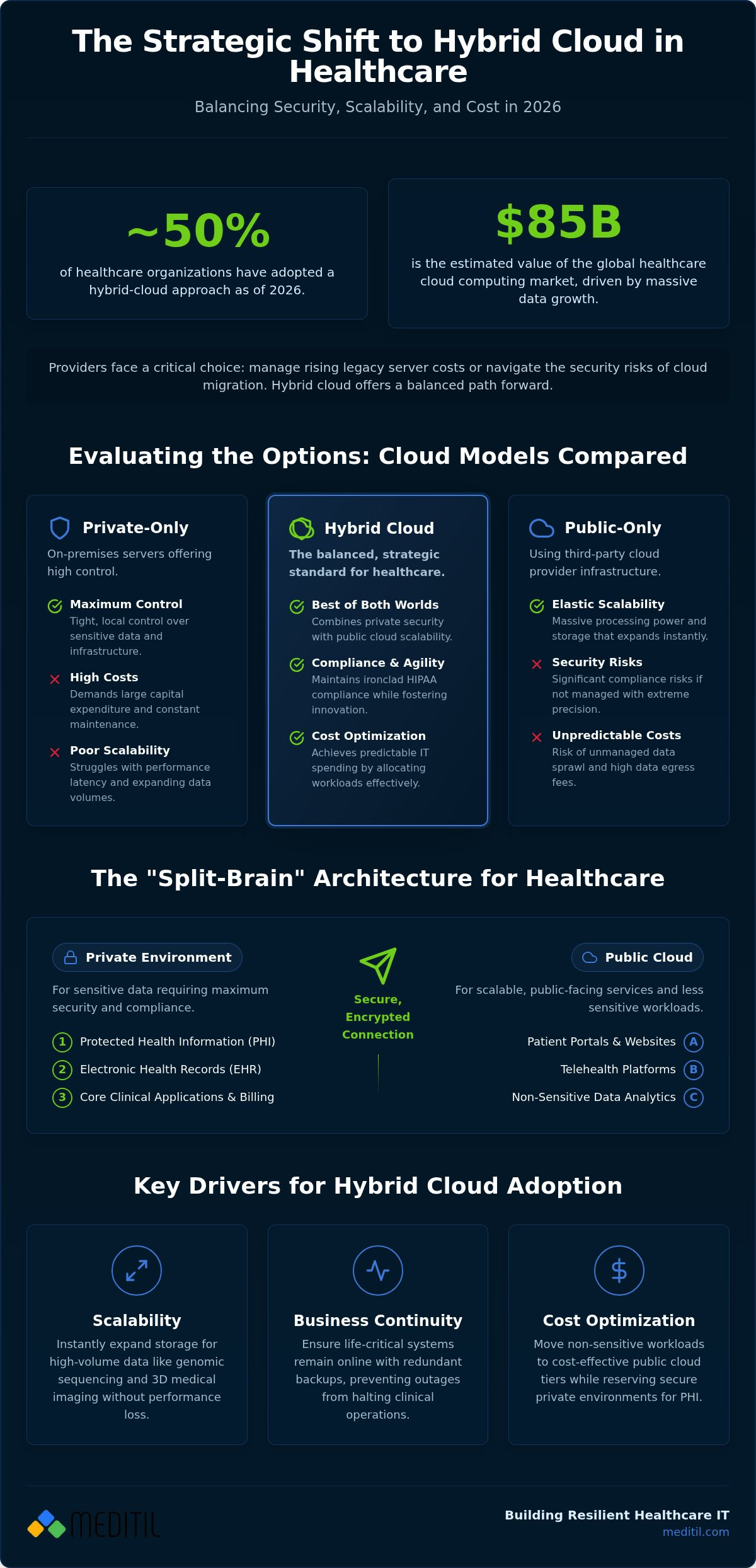
Nearly 50% of healthcare organizations have already transitioned to a hybrid-cloud approach to manage their clinical data as of 2026. It’s a logical shift, yet many providers still feel caught between the rising costs of legacy on-premises servers and the fear of a data breach during migration. You’re likely dealing with frustrating data silos between EHR and billing systems that hinder both patient care and operational efficiency. Finding the right hybrid cloud solutions for healthcare is the key to resolving these infrastructure challenges without compromising security.
This guide explains how a strategic hybrid model offers a balanced path forward. You’ll discover how a tailored strategy maintains ironclad HIPAA compliance while providing the agility required for modern clinical innovation and interoperability. We’ll examine the technical architecture needed for a stable, high-performance network and predictable IT spending. This approach ensures your systems remain functional and efficient while meeting the demands of a modern practice.
We will also review critical updates, such as the HITRUST CSF version 11.8.0 requirements, to ensure your infrastructure remains secure and fully connected. This methodical approach provides the steady hand at the wheel your organization needs to thrive in a highly regulated environment. By the end of this guide, you’ll have a clear roadmap for achieving seamless connectivity across all your medical applications.
Key Takeaways
- Learn why hybrid cloud solutions for healthcare are the industry standard for managing massive data volumes while maintaining ironclad security.
- Understand the “split-brain” architecture that isolates sensitive EHR data from public-facing portals to ensure strict HIPAA compliance.
- Identify strategies to eliminate data silos by creating seamless interoperability between clinical records and billing automation systems.
- Discover how strategic leadership, such as a Fractional CIO, provides the precise roadmap necessary for a stable migration from legacy infrastructure.
- Evaluate the trade-offs between hybrid, public, and private models to achieve predictable IT spending and high network performance.
The Evolution of Healthcare IT: Why Hybrid Cloud is the Standard in 2026
In the current medical landscape, a strategic approach to data management is no longer optional. A hybrid cloud model represents a deliberate mix of on-premises or private infrastructure combined with public cloud resources. This architecture allows organizations to keep sensitive patient records under tight, local control while leveraging the massive processing power of the public cloud for less sensitive tasks. By integrating these environments, hybrid cloud solutions for healthcare provide a flexible foundation that adapts to shifting regulatory demands and clinical needs.
The urgency for this transition stems from a massive explosion in medical data volume. By 2026, the global healthcare cloud computing market has reached an estimated value of nearly $85 billion, driven by the need to manage petabytes of patient information. Legacy servers, once the backbone of the clinic, now struggle to support the high-bandwidth requirements of modern telehealth and real-time remote monitoring. These aging systems often create “clinical friction,” where technical lag directly interferes with patient care and provider productivity. Transitioning to a hybrid model reduces this friction by optimizing where data lives and how it’s accessed.
Foundational knowledge of cloud computing models is essential for administrators who must balance innovation with security. It’s not about moving everything to the cloud; it’s about moving the right things to the right place. This methodical shift ensures that your infrastructure supports growth without sacrificing the stability of your core clinical applications.
The Problem with Cloud-Only and Private-Only Models
Relying solely on private, on-premises infrastructure is increasingly unsustainable. These setups demand high capital expenditure and constant manual maintenance, which often leads to performance latency during peak usage. Conversely, a purely public cloud approach can introduce significant security and compliance risks if not managed with extreme precision. Without the “steady hand” of a hybrid strategy, organizations risk unmanaged data sprawl and high egress fees. Implementing hybrid cloud solutions for healthcare offers the privacy of a dedicated server with the elastic scalability of a public provider, effectively providing the best of both worlds.
Key Drivers for Healthcare Hybrid Adoption
Several operational requirements make hybrid adoption a necessity in 2026:
- Scalability: High-volume data sets, such as genomic sequencing and 3D medical imaging, require storage that can expand instantly.
- Business Continuity: Life-critical systems must remain online. Hybrid models allow for redundant backups, ensuring that an outage in one environment doesn’t halt clinical operations.
- Cost Optimization: Organizations can save resources by moving non-sensitive workloads, like administrative emails or public-facing websites, to cost-effective public cloud tiers while keeping protected health information (PHI) in a more secure, private environment.
Balancing Security and Scalability: The Architecture of Healthcare Hybrid Cloud
The architecture of hybrid cloud solutions for healthcare relies on a “split-brain” strategy. This approach separates sensitive clinical data from public-facing services. By isolating Protected Health Information (PHI) within a private environment while hosting patient portals in a public cloud, organizations achieve a balance between security and high availability. This structure is essential for meeting data residency requirements. It ensures that sensitive records remain within specific network boundaries to maintain HIPAA compliance.
Security must be embedded into the fabric of the network fabric itself. This involves robust encryption for data both at rest and in transit across the entire hybrid environment. Following the NIST definition of cloud computing helps administrators understand the deployment models necessary to protect life-critical systems. For many organizations, achieving these standards requires specialized cybersecurity and compliance oversight to ensure every connection is verified. Using HITRUST and NIST frameworks as your gold standards provides a repeatable, auditable architecture that stands up to regulatory scrutiny.
Where Does Your Data Belong?
Determining the placement of data is a strategic decision that impacts both performance and risk. A methodical approach involves categorizing data by its sensitivity and use case:
- Private Cloud: This is the designated home for PHI, EMR/EHR databases, and sensitive billing records. These assets require the highest level of isolation and control.
- Public Cloud: This environment is ideal for patient education portals, appointment scheduling, and non-sensitive analytics. It offers the elasticity needed to handle fluctuating web traffic.
- Edge Computing: This layer handles real-time data from remote patient monitoring (RPM) devices. Processing data closer to the source reduces latency, which is critical for immediate clinical interventions.
Advanced Security Layers
Protecting a hybrid environment requires more than just a perimeter firewall. Identity and Access Management (IAM) serves as the primary line of defense. It ensures that only authorized personnel can access specific segments of the network. Security Information and Event Management (SIEM) systems provide the necessary visibility by monitoring cross-cloud traffic for anomalies in real time. Finally, implementing a Zero Trust architecture is vital. This model operates on the principle of “never trust, always verify,” which is particularly important for life-critical clinical systems. These layers work together to create a resilient infrastructure that protects patient data across the entire hybrid fabric.
Evaluating the Options: Hybrid Cloud vs. Public-Only and Private-Only Models
Selecting an infrastructure model is a strategic decision that impacts a clinic’s financial health and operational stability. Administrators must evaluate their options across four primary pillars: cost, security, control, and performance. Public-only models offer rapid deployment but often lead to vendor lock-in, where migrating data becomes prohibitively expensive. Private-only models provide maximum control but require significant internal resources for maintenance and hardware refreshes. Hybrid cloud solutions for healthcare offer a balanced alternative that mitigates these risks while reducing long-term technical debt.
The most common objection to a hybrid approach is the perceived complexity of managing two distinct environments. While it’s true that a “split” architecture requires precise configuration, modern orchestration tools allow for a unified management pane. This means your IT team can monitor and secure all assets from a single interface. By avoiding a single-provider dependency, you maintain the flexibility to move workloads based on performance needs or pricing changes. This strategic independence is vital for maintaining a high-performing medical network, and IT Cloud Consulting offers the professional cloud consulting services needed to help businesses adopt and optimize cloud technologies effectively.
Financial predictability is a core requirement for modern medical practices. A purely private cloud involves high upfront capital expenditure (Capex) for servers and networking hardware. In contrast, public cloud models rely on predictable monthly operating expenses (Opex). A hybrid strategy allows for “Cloud Bursting,” a capability where your network scales into the public cloud only during peak clinical demand. This ensures you don’t pay for idle capacity during slower periods. For a detailed breakdown of these financial models, see our guide on IT budgeting for medical practices.
Control and Customization
Specialty clinics often rely on bespoke software that requires specific hardware configurations. These unique applications thrive in the controlled environment of a private cloud. However, the same clinic may need to deploy telehealth services or patient portals rapidly. Using a hybrid cloud framework for medical record sharing allows providers to keep clinical databases on private servers while using the public cloud for patient-facing interactions. This dual approach ensures that unique software requirements don’t slow down the adoption of modern digital tools. It provides the customization you need without sacrificing the speed of clinical innovation.
Implementation Strategy: Bridging Data Silos and EHR Interoperability
Hybrid cloud architecture is the primary mechanism for dismantling the data silos that often plague legacy healthcare systems. By using an API-first approach, organizations can connect on-premises databases to advanced cloud analytics without the risks of a full data lift-and-shift. This connectivity is essential for meeting the 21st Century Cures Act requirements, specifically the USCDI v3 standards that took effect on January 1, 2026. Hybrid cloud solutions for healthcare ensure that legacy data remains accessible while newer, cloud-native applications provide the insights needed for value-based care. For global organizations implementing these architectures, Kagool provides the specialized expertise in Microsoft and Databricks required to unify complex data streams. This methodical bridge between environments allows for a steady progression toward modernization without disrupting daily clinical operations.
Interoperability is about more than just moving data; it’s about making that data actionable at the point of care. A hybrid setup allows for the high-speed processing of HL7 and FHIR standards, which are the backbone of modern medical data exchange. By July 4, 2026, networks must expose data via modern FHIR APIs. This mandate is significantly easier to manage with a hybrid infrastructure that bridges the gap between legacy servers and cloud endpoints. Reducing this technical friction directly impacts physician burnout. When clinicians don’t have to hunt for information across disparate systems, they can focus on patient outcomes rather than administrative hurdles.
Billing and Administrative Efficiency
One of the most significant benefits of a hybrid environment is the seamless connection between clinical records and financial operations. Integrating cloud-based medical billing automation solutions with private clinical databases ensures that claims are processed accurately and swiftly. This integration requires high-level security to ensure financial data is protected with the same rigor as clinical PHI. A methodical implementation ensures that data flows securely between the private EHR environment and the public cloud billing interface. If you’re ready to modernize your clinical workflow, consider exploring our specialized services for systems integration and interoperability to ensure your data remains both secure and accessible.
Navigating the Transition: How Strategic Managed IT Partners Execute Hybrid Migration
Successful migration to a hybrid cloud isn’t just about selecting providers; it’s about strategic alignment with clinical goals. Technical architecture represents only half of the challenge. The other half involves professional leadership to ensure that hybrid cloud solutions for healthcare align with budgetary constraints and long-term interoperability mandates. Without a clear roadmap, organizations often face scope creep or security gaps that could expose patient data during the transition. Specialized leadership is the defining factor between a fragmented network and a cohesive, high-performing infrastructure.
Strategic partners offer more than just technical support. They provide virtual CIO services that bridge the gap between technical execution and executive decision-making. This level of guidance ensures that migration projects stay on track and that the resulting environment is both scalable and compliant. Additionally, an augmented IT team can support your existing staff. These specialists provide the deep technical knowledge required for complex cloud configurations, allowing your internal team to focus on daily clinical support without becoming overwhelmed by the migration’s complexity.
The Strategic Roadmap
Execution requires a methodical, multi-phase approach to minimize disruption to patient care and ensure a stable transition:
- Phase 1: Assessment: A comprehensive audit of current legacy infrastructure, data volumes, and regulatory requirements identifies which workloads are ready for transition and which must remain on-premises.
- Phase 2: Pilot Migration: Moving non-critical systems, such as administrative portals or public-facing websites, to the public cloud allows the team to verify security protocols in a live environment before moving sensitive PHI.
- Phase 3: Full Integration: The final phase involves connecting private clinical databases with cloud analytics and billing systems, creating a unified, secure fabric across all environments.
Why a Specialized Healthcare Partner Matters
Generalist IT providers often struggle with the nuances of clinical workflows and the strict requirements of healthcare-specific regulations. A partner focused on managed it services for healthcare understands that a system outage isn’t just a technical glitch; it’s a potential risk to patient safety. This “Steady Hand” approach ensures that stability remains the priority throughout the transition. Security in a hybrid environment isn’t a one-time setup. It requires ongoing managed services to monitor for threats and maintain compliance as regulations evolve. By partnering with experts who specialize in this regulated space, you ensure your organization remains agile, secure, and ready for future clinical innovations.
Securing the Future of Clinical Infrastructure
Transitioning to a hybrid environment is a strategic imperative for organizations aiming to eliminate data silos while protecting patient privacy. By adopting a “split-brain” architecture, you ensure that sensitive clinical records remain under strict control while your public-facing applications scale to meet patient demand. Successful hybrid cloud solutions for healthcare depend on more than just technical integration; they require a disciplined approach to governance and long-term planning.
Managing this complexity alone can strain internal resources and introduce unnecessary risk. Our team provides the steady hand needed to navigate these transitions with precision. We offer deep expertise in HIPAA-compliant infrastructure and fractional CIO leadership to guide your strategic roadmap. With proactive cybersecurity monitoring for your medical data, we ensure your network remains stable and secure.
Contact MEDITIL for a strategic hybrid cloud consultation to begin building a more resilient and interoperable clinical environment. We’re ready to help you achieve a high-performing network that supports both your providers and your patients.
Frequently Asked Questions
What is a hybrid cloud in healthcare?
A hybrid cloud is an integrated infrastructure that combines on-premises or private cloud resources with public cloud services. In medical environments, this often means keeping sensitive clinical databases on a secure private server while hosting patient-facing portals or non-sensitive analytics in the public cloud. This architecture allows organizations to leverage hybrid cloud solutions for healthcare to achieve both the isolation required for security and the elasticity needed for growth.
How does hybrid cloud help with HIPAA compliance?
It assists with HIPAA compliance by allowing organizations to isolate Protected Health Information (PHI) within a strictly controlled private environment. Unlike purely public clouds where data management can be less transparent, a hybrid model provides the granular control needed for data residency and audit trails. This setup ensures that sensitive records remain behind a dedicated firewall while less critical administrative tasks scale externally, maintaining a secure posture that meets federal standards.
Is hybrid cloud more expensive than public cloud for medical practices?
While hybrid cloud requires an initial investment in private infrastructure, it’s often more cost-effective over the long term due to reduced technical debt. Purely public models can lead to unpredictable monthly costs as data volume grows. A hybrid approach allows for cloud bursting, where you only pay for extra public capacity during peak clinical demand. This keeps your baseline operational expenses stable and predictable for the medical practice.
Can hybrid cloud improve EHR interoperability?
Yes, a hybrid cloud architecture serves as a secure bridge that connects legacy on-premises EHR systems with modern, cloud-based medical applications. By using standardized APIs and FHIR protocols, hybrid cloud solutions for healthcare facilitate seamless data exchange between disparate systems. This reduces clinical friction and ensures that patient data is available at the point of care, regardless of whether the source system is a legacy server or a modern platform.
What are the biggest security risks of hybrid cloud in healthcare?
The primary security risks involve misconfigured access points and inconsistent security policies across the private and public environments. Managing a split infrastructure requires precise Identity and Access Management (IAM) to ensure there are no gaps between network boundaries. Without proactive monitoring and a Zero Trust architecture, organizations risk unauthorized access or data leaks during transit. This is why specialized cybersecurity oversight is essential to maintain a unified and verified security fabric.
How does a Fractional CIO assist with cloud migration?
A Fractional CIO provides the strategic leadership and technical roadmap necessary to execute a complex migration without disrupting clinical operations. They assess your current infrastructure, identify regulatory requirements, and manage the transition in methodical phases. This expert guidance prevents common pitfalls like scope creep or budget overruns. By serving as a steady hand at the wheel, a Fractional CIO ensures your new infrastructure supports long-term clinical innovation and interoperability.
Can hybrid cloud support telehealth and remote monitoring?
It’s the ideal foundation for telehealth and remote monitoring because it balances high-speed data processing with secure storage. Public cloud resources provide the scalability needed to handle high-bandwidth video consultations and real-time data from remote devices. Simultaneously, the private cloud ensures that the resulting patient records are stored securely. This dual-layer approach allows providers to offer modern digital care without compromising the privacy or integrity of the patient’s medical history.
What happens to my data if the public cloud goes down?
In a well-architected hybrid model, your life-critical clinical systems remain operational because they’re hosted in the private cloud or on-premises. Hybrid cloud provides inherent redundancy by allowing for localized backups and failover protocols. If the public cloud provider experiences an outage, your core clinical functions and EHR access continue uninterrupted. This business continuity is vital for medical practices where immediate access to patient information is a matter of safety and regulatory compliance.