
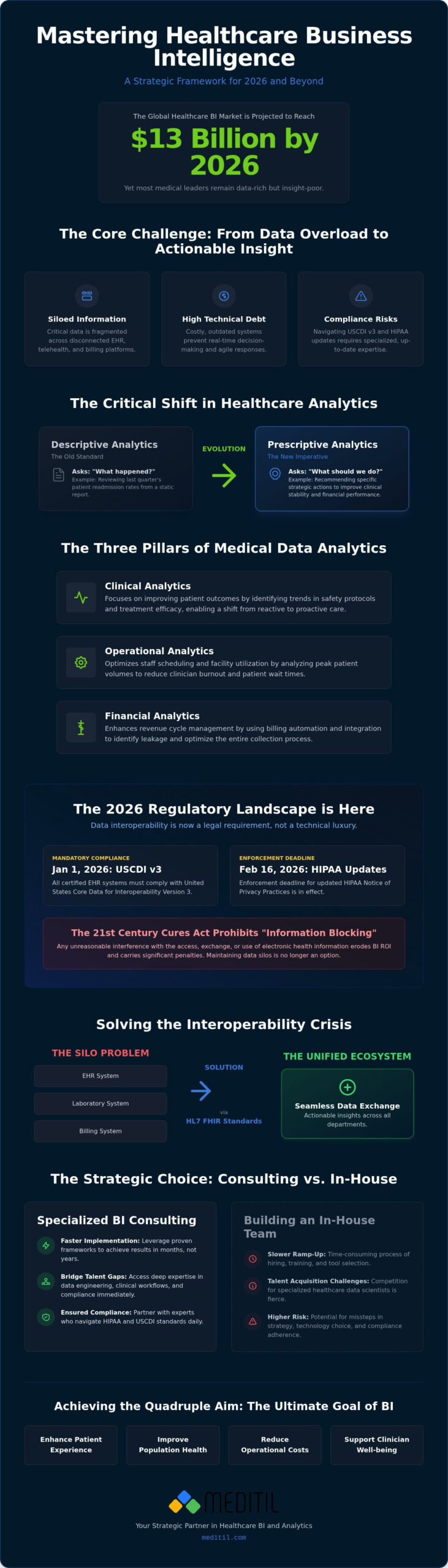
The global healthcare business intelligence market is projected to reach $13 billion in 2026, yet most medical leaders still find themselves data-rich but insight-poor. You’ve likely invested heavily in EHRs, telehealth, and billing systems, only to find your critical information siloed across fragmented platforms. This disconnect often leads to a high cost of technical debt and prevents real-time decision making. Engaging with specialized healthcare business intelligence consulting is no longer just a technical upgrade; it’s a strategic necessity to bridge the gap between clinical care and financial stability.
It’s frustrating to manage massive amounts of data without seeing a clear impact on patient outcomes or administrative efficiency. This guide provides a structured framework for mastering these complexities and selecting a consulting partner who understands the nuances of USCDI Version 3 compliance and HIPAA-regulated environments. We’ll examine how to unify your data ecosystem, leverage predictive analytics for better care, and optimize your billing cycles to ensure long-term operational resilience.
Key Takeaways
- Understand the critical shift from descriptive analytics to prescriptive models that recommend specific strategic actions for clinical and administrative stability.
- Utilize a structured framework to identify your organization’s Data Maturity Level before investing in new tools to ensure your infrastructure scales with patient volume.
- Learn why specialized healthcare business intelligence consulting provides a faster implementation timeline and bridges the talent gap more effectively than building an in-house team.
- Discover how implementing current HL7 FHIR standards can resolve the “Silo Problem” by enabling seamless data exchange between EHR, laboratory, and billing systems.
- Explore how integrating BI into a broader managed IT ecosystem with Fractional CIO leadership ensures your data strategy remains HIPAA-compliant and results-oriented.
What is Healthcare Business Intelligence Consulting in 2026?
Healthcare business intelligence consulting in 2026 is defined as a specialized advisory service that converts raw clinical and administrative data into a strategic asset. It’s not just about generating reports or maintaining databases. It’s a disciplined approach to engineering a data ecosystem where every metric serves a specific clinical or financial objective. The industry has moved decisively beyond descriptive analytics. It’s no longer enough to look at a dashboard to see how many patients were readmitted last quarter. Modern Health care analytics must be prescriptive, providing medical leaders with specific, data-backed pathways to improve stability and patient safety.
Many general IT firms struggle in medical environments because they lack an understanding of clinical workflows. A generalist might build a technically sound dashboard that fails in practice because it doesn’t account for the daily realities of a nursing station or the specific nuances of Relative Value Units (RVUs). Effective healthcare business intelligence consulting requires a deep familiarity with the regulated environment, ensuring that data insights are both actionable and compliant with evolving standards. This expertise is critical for achieving the Quadruple Aim: enhancing patient experience, improving population health, reducing costs, and supporting clinician well-being.
The Core Components of Medical Data Analytics
Why 2026 is the Year of Data Interoperability
The regulatory landscape has shifted significantly this year. As of January 1, 2026, compliance with the United States Core Data for Interoperability (USCDI) Version 3 is mandatory for all certified EHR systems. This mandate, alongside the 21st Century Cures Act, has made seamless data exchange a legal requirement rather than a technical luxury. Information blocking is the unreasonable interference with the access, exchange, or use of electronic health information, which effectively erodes the ROI of BI projects by maintaining expensive, isolated data pockets.
Navigating these regulatory benchmarks requires a partner who understands the technical requirements of HL7 FHIR standards and the administrative burden of HIPAA updates. Partnering with a healthcare business intelligence consulting firm ensures your organization isn’t just checking boxes for compliance but is actually using that mandated interoperability to drive better decision-making across the entire enterprise.
Evaluating BI Tools for Healthcare Analytics: A Selection Framework
Selecting a BI tool often feels like a technical hurdle, but it’s actually a test of organizational strategy. Before reviewing software features, medical leaders must identify their practice’s specific “Data Maturity Level.” This assessment determines whether your infrastructure is ready for advanced predictive models or if you first need to address foundational data silos. Specialized healthcare business intelligence consulting provides the objective lens needed to evaluate these internal capabilities. This ensures you don’t over-invest in complex features that your current team isn’t yet equipped to utilize effectively.
Scalability is the next critical priority. A solution that works for a single clinic may buckle under the data load of a multi-site health system. Given that the Importance of Business Intelligence in HealthTech is rooted in its ability to handle expanding data volumes, your chosen tool must scale seamlessly with patient growth. Security is equally vital. With the February 16, 2026, enforcement deadline for updated HIPAA Notice of Privacy Practices already in effect, your BI architecture must be HIPAA-native from the start. This means encryption, audit logs, and access controls are built into the core infrastructure, not added as a secondary layer.
Technical Criteria for Modern Healthcare BI
In 2026, the choice between cloud and on-premise solutions has largely shifted toward the cloud, which held a 52% market share as recently as 2025. Cloud-based BI offers superior accessibility for remote monitoring and telehealth data integration. However, you must also decide between real-time data processing and batch processing. Real-time analytics are essential for clinical alerts that prevent adverse events. Batch processing may suffice for monthly financial reporting. Finally, ensure the platform provides robust mobile accessibility. Physicians and administrators need actionable insights on their mobile devices to make informed decisions at the point of care.
The ‘Hidden’ Costs of BI Implementation
The initial price of a BI tool is rarely the total cost of ownership. Data cleansing and normalization often consume a significant portion of the budget, especially when migrating from legacy systems that lack standardized formatting. Additionally, you must account for staff training and cultural change management. If your clinical staff finds the tool difficult to navigate, adoption will stall and the projected ROI will vanish. Ongoing maintenance and managed IT support are also necessary to keep the system updated as regulatory standards evolve. Engaging a Fractional CIO can help you navigate these hidden expenses by providing a long-term strategic roadmap that accounts for both technical and human capital needs.
Consulting vs. In-House BI: Making the Strategic Choice
Choosing between an in-house team and external specialized expertise is a pivotal decision for any medical organization. While large payers often maintain massive internal departments, smaller and mid-sized practices must find a more efficient path to achieve similar strategic outcomes. The primary hurdle in building an internal team is the significant talent gap. Finding a data scientist who understands both advanced statistical modeling and the intricacies of HIPAA compliance is increasingly difficult. These specialists are in high demand across the entire HealthTech sector, making recruitment a slow and expensive process that can delay your implementation by months.
Opting for healthcare business intelligence consulting provides an immediate injection of expertise. External firms bring pre-established frameworks and a library of lessons learned from various clinical environments. This experience allows them to bypass common implementation hurdles that often lead to technical debt in internal projects. Beyond speed, consultants offer a layer of risk mitigation. They are deeply familiar with the latest regulatory changes, such as the USCDI Version 3 requirements, ensuring your data strategy remains compliant from day one. They act as a steady hand at the wheel, guiding you through the complexities of data governance without the trial and error of an unseasoned internal team.
The cost analysis also favors a strategic partnership for many organizations. Maintaining a full-time BI analyst involves more than just a high base salary. When you factor in benefits, payroll taxes, and the ongoing training required to keep up with evolving technology, the total annual investment is substantial. A consulting model allows you to pay for the specific expertise you need without the fixed overhead of a permanent department. This approach is particularly effective for organizations that need high-level strategy and technical precision but don’t require a dozen full-time data scientists on the payroll.
When to Hire a Fractional CIO for BI Strategy
A successful data roadmap requires more than technical skill; it needs executive-level leadership. This is where Virtual CIO Services become invaluable. A Fractional CIO bridges the gap between your clinical leadership and the technical teams, ensuring that every dollar spent on analytics aligns with your long-term patient care goals. They provide the strategic oversight needed to manage IT budgets while prioritizing projects that offer the highest clinical and financial impact.
The Managed Service Model for Analytics
Effective business intelligence is a continuous journey rather than a one-time software installation. Data streams change, regulatory standards shift, and clinical priorities evolve. Adopting Managed IT Services for Healthcare ensures that your analytics platform remains stable and secure over time. This model provides ongoing management and network monitoring, preventing the data drift that often occurs when internal teams are distracted by daily help-desk tasks. It allows your practice to focus on patient outcomes while experts handle the underlying data infrastructure.
Solving the Interoperability Crisis: The Consultant’s Role
Medical leaders often struggle with the “Silo Problem,” where critical data remains trapped within an EHR, LIS, or RIS. These systems were often purchased at different times from various vendors, leading to a fragmented infrastructure that cannot communicate. This lack of connectivity is a primary driver of technical debt and administrative friction. Specialized healthcare business intelligence consulting addresses this by designing a unified architecture that pulls data from every corner of the practice. It’s about moving from isolated pockets of information to a cohesive data strategy that supports both clinical and financial outcomes.
Modern interoperability relies on API-led connectivity and the rigorous implementation of HL7 FHIR standards. While regulatory bodies define these benchmarks, the technical execution remains complex, especially when dealing with legacy systems that weren’t built for open exchange. Consultants provide the technical expertise to navigate these hurdles, ensuring that data flows securely and in real-time. This connectivity is the backbone of a successful healthcare business intelligence consulting engagement. It ensures that every department, from radiology to the front office, is working from a single, verified version of the truth.
EHR/EMR Integration Strategies
Integrating your EHR with other operational tools is a direct way to improve practice efficiency and revenue stability. Medical Billing Automation Solutions rely on this seamless flow to function correctly. When clinical documentation automatically triggers billing processes, you significantly reduce the manual data entry that contributes to physician burnout. This optimization doesn’t just save time; it reduces the risk of human error in the revenue cycle, ensuring that claims are accurate and reimbursements are timely.
Data Quality and Normalization
The “Garbage In, Garbage Out” principle is a constant threat in medical analytics. Without strict data quality and normalization, your BI tools will generate misleading insights that could impact patient care. Consultants help multi-specialty practices develop standardized data dictionaries to ensure terminology remains consistent across different clinical areas. Rigorous data deduplication is essential to prevent fragmented patient records from compromising care quality and billing accuracy. By cleaning and verifying data at the point of entry, you ensure that your strategic decisions are based on reliable evidence.
If your organization is ready to break down data silos and improve operational flow, contact us for a strategic systems integration assessment.
MEDITIL: Your Strategic Partner in Healthcare BI and Analytics
MEDITIL operates as a dedicated strategic partner for organizations navigating the complexities of modern data environments. Our approach to healthcare business intelligence consulting goes beyond simple software implementation. We integrate analytics into your entire IT infrastructure to ensure long-term stability and operational resilience. From high-level Fractional CIO leadership to meticulous hands-on data management, we provide the steady hand at the wheel needed to transform fragmented information into a strategic clinical asset.
Effective healthcare business intelligence consulting must be anchored in a robust and secure ecosystem. We recognize that data is only as valuable as the infrastructure that supports it. By aligning your BI goals with your broader IT strategy, we ensure that your analytics tools don’t become another source of technical debt. Our team focuses on creating seamless connectivity between your EHR, billing systems, and telehealth platforms, allowing you to move from reactive reporting to proactive, prescriptive decision making. This holistic view is essential for medical leaders who require precision in both clinical and financial outcomes.
Security remains a primary concern in 2026. We implement zero-trust security protocols for all healthcare analytics platforms, ensuring that sensitive patient data is protected at every touchpoint. By verifying every user and device, we reduce the risk of unauthorized access while maintaining the accessibility required for real-time alerts. This disciplined focus on protection allows medical leaders to utilize their data with complete confidence, knowing that their infrastructure meets the highest regulatory standards for privacy and data integrity.
A Mission-Driven Approach to Data
We prioritize patient safety and provider stability in every engagement. Our team builds customized BI roadmaps that respect your existing clinical workflows rather than forcing your staff to adapt to rigid, generic systems. This tailored approach is supported by our comprehensive Healthcare Cybersecurity Services, which protect your analytics infrastructure against evolving digital threats. By reducing clinical friction, we help your team focus on delivering high-quality care without the burden of manual data reconciliation.
Next Steps: Starting Your Analytics Journey
A successful deployment begins with a comprehensive IT audit. This assessment identifies existing gaps in your data quality and ensures your network is ready for advanced analytics. Once the foundation is secure, we work with you to deploy scalable solutions that grow with your patient volume. If you’re ready to move from fragmented data to unified strategic insights, you can secure your practice’s future with MEDITIL by scheduling a strategic consultation with our expert team today.
Engineering Your Data-Driven Clinical Future
Building a resilient data ecosystem requires moving beyond basic reporting to prescriptive action. You must prioritize interoperability through HL7 FHIR standards to eliminate the silo problem once and for all. Successful implementation depends on a specialized healthcare IT focus that understands clinical workflows and the strict requirements of HIPAA-compliant infrastructure management. This foundation ensures that your data remains a secure and reliable asset for years to come.
Choosing the right partner for healthcare business intelligence consulting ensures your organization avoids technical debt while gaining access to Fractional CIO expertise. This strategic oversight allows you to align your technology budget with long-term clinical goals and provider stability. The path to a unified data dashboard starts with a clear roadmap and a steady hand at the wheel. If you’re ready to transform your practice’s information into a high-performing strategic asset, we’re here to guide the way. Schedule a Strategic BI Consultation with MEDITIL to begin your transition toward a more efficient and data-driven future. Your practice’s evolution is within reach.
Frequently Asked Questions
What is the difference between healthcare BI and standard business intelligence?
Healthcare BI requires a specialized understanding of clinical workflows, medical coding, and strict regulatory standards that general BI does not address. While standard BI focuses on generic KPIs like sales or churn, healthcare-specific analytics must manage sensitive protected health information (PHI) while navigating complex interoperability standards like HL7 FHIR. The high-stakes nature of medical data means that errors in logic can impact patient safety, not just financial reports.
How much does healthcare BI consulting typically cost for a mid-sized practice?
The investment required for BI consulting depends on your organization’s current data maturity and the number of siloed systems that need integration. Factors such as the volume of legacy data, the complexity of your billing cycles, and whether you require ongoing vCIO leadership will influence the total project scope. A thorough IT audit is usually the first step to determine a precise resource allocation that aligns with your strategic goals.
Can BI tools help my practice achieve HIPAA compliance?
BI tools facilitate compliance by providing automated audit logs and monitoring data access patterns across your entire infrastructure. However, the tools must be deployed within a HIPAA-native architecture to be effective. As of the February 16, 2026, enforcement deadline for updated privacy practices, your analytics platform must also support the revised requirements for handling substance use disorder data and other sensitive information.
How long does it take to implement a healthcare BI solution?
A standard implementation can take anywhere from three months to a year depending on the complexity of your systems integration. Most practices benefit from a phased approach where high-impact areas, such as billing automation, are addressed first. This strategy allows your team to see immediate operational improvements while the more complex clinical data normalization continues in the background.
Do I need to replace my current EHR to use advanced analytics?
You don’t need to replace your existing EHR to leverage the benefits of healthcare business intelligence consulting. Modern analytics strategies focus on interoperability and API-led connectivity to extract data from your current software. This approach saves your practice the massive cost and disruption of an EHR migration while still providing the unified data dashboard needed for real-time decision making.
What is the role of a virtual CIO in healthcare BI consulting?
A virtual CIO (vCIO) provides the executive-level strategy needed to ensure your BI project delivers a measurable return on investment. They act as a bridge between your clinical leadership and technical teams, translating medical objectives into technical requirements. By managing your IT roadmap, a vCIO ensures that every analytics initiative remains secure, compliant, and aligned with your long-term financial stability.
How does BI consulting improve patient outcomes specifically?
BI consulting identifies high-risk patient populations through predictive analytics, allowing for earlier clinical intervention. By analyzing trends in readmission rates and treatment efficacy, clinicians can adjust safety protocols in real-time. This data-driven approach reduces the likelihood of adverse events and ensures that care delivery is consistent with the latest evidence-based standards across your entire practice.
What are the most common mistakes when implementing healthcare analytics?
The most frequent errors include ignoring data quality at the point of entry and failing to secure staff buy-in. If your data is inconsistent or your clinicians find the tools difficult to use, the project will struggle to gain traction. Successful healthcare business intelligence consulting prioritizes data normalization and user training to ensure that the insights generated are both accurate and actually utilized by your team.