
Treating your technology allocation like an administrative utility fund is one of the most dangerous operational risks a modern provider can take. With healthcare data breaches averaging $6.64 million, budgeting can no longer focus merely on keeping aging servers online. When you’re tasked with creating a healthcare IT budget, you know how difficult it is to balance urgent EHR optimizations against surprise hardware failures and complex compliance demands. It often feels like emergency repairs consume the capital you need for long-term clinical improvements.
You shouldn’t have to choose between continuous HIPAA safeguards and fiscal stability. In this guide, you’ll master the process of building a balanced, risk-resilient IT budget that eliminates surprise technical debt and establishes predictable operating expenses. We’ll walk through the strategic steps to align your clinical workflows, executive leadership, and technical infrastructure for 2026 and beyond.
Key Takeaways
- Conduct a comprehensive baseline audit across all existing infrastructure and vendor agreements to eliminate redundant licensing and phantom support fees.
- Transition technology planning from volatile capital expenditures to predictable operational models that protect operating margins and support scalable growth.
- Implement a structured five-step process for creating a healthcare IT budget that directly aligns technical infrastructure with clinical workflows and patient care goals.
- Remediate accumulated technical debt systematically to protect clinical operations against severe downtime and catastrophic regulatory penalties.
- Leverage specialized managed IT services and fractional CIO leadership to secure expert oversight and strategic guidance without expanding internal administrative overhead.
Establishing Baseline Visibility: How to Audit Your Existing Healthcare IT Spend
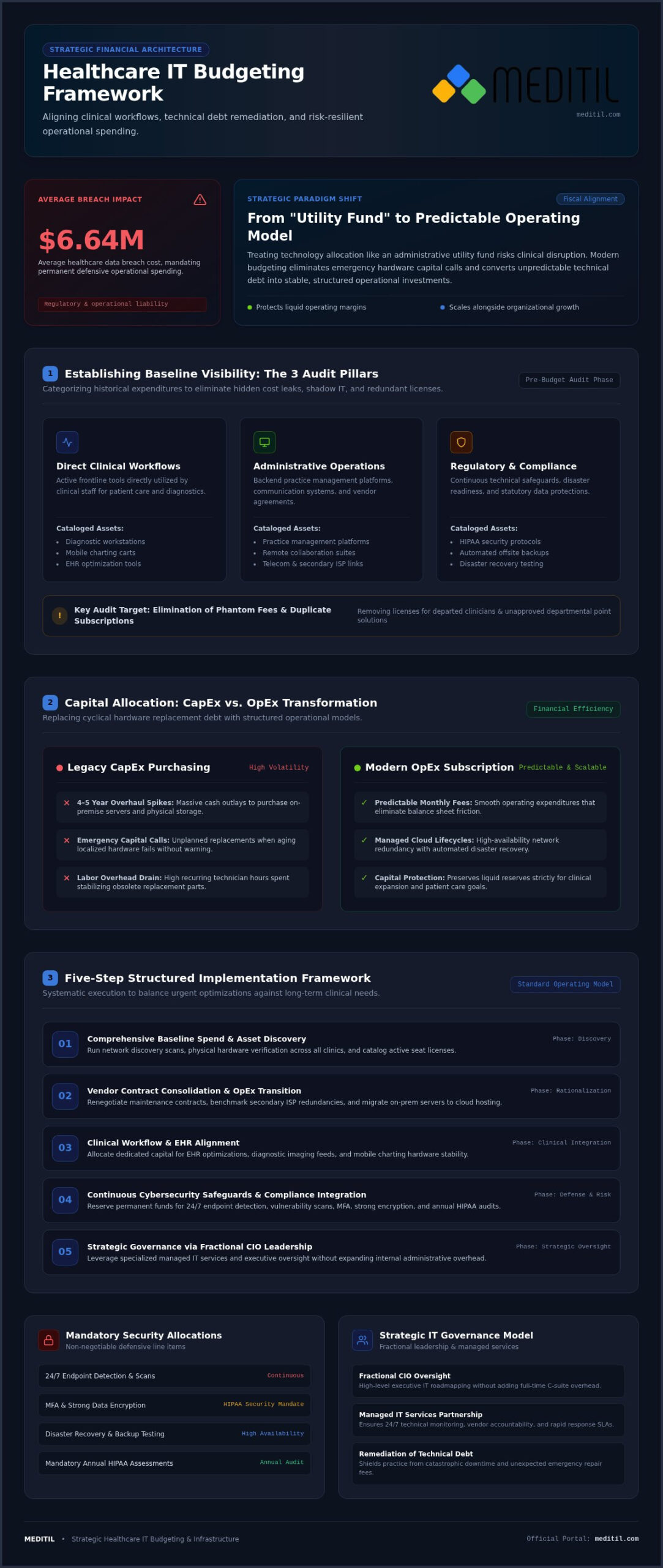
A reliable fiscal forecast requires complete clarity regarding current assets and ongoing commitments. Establishing a baseline audit serves as the bedrock of financial planning, revealing where organizational capital genuinely flows versus where leadership assumes it goes. In modern clinical environments, a complex health information technology (HIT) ecosystem can easily become fragmented over time. Departmental silos frequently deploy unapproved point solutions, generating unauthorized shadow IT and redundant recurring software subscriptions. When creating a healthcare IT budget, leadership must categorize historical expenditures into three distinct pillars: direct clinical workflows, administrative backend operations, and regulatory compliance standards. This operational segmentation immediately exposes hidden cost leaks before forward-looking resource allocation begins.
Cataloging Hardware Assets, Network Endpoints, and Legacy Devices
Physical infrastructure reviews require comprehensive network discovery scans combined with physical verification across every clinic and administrative facility. IT teams must catalog all active endpoints, including diagnostic workstations, mobile charting carts, on-premise servers, and core network switches. Outdated switching hardware and end-of-life operating systems don’t just introduce critical security exposures; they silently inflate maintenance expenses through recurring emergency troubleshooting. Track the exact hours internal or external personnel spend nursing aging equipment. The recurring labor overhead and obsolete replacement parts needed to stabilize legacy servers often surpass the predictable operating costs of modern cloud infrastructure.
Evaluating Clinical Software Licensing and Vendor Service Agreements
Software and vendor contracts represent one of the fastest-growing operational commitments in outpatient and hospital settings alike. A structured contract audit must review active seat licenses across practice management platforms, remote collaboration suites, and patient communication tools. Medical groups routinely absorb monthly fees for departed clinicians or duplicate applications that perform identical tasks across separate departments. Consolidate these overlapping tools and renegotiate outdated software maintenance contracts. Additionally, benchmark existing telecom and secondary ISP redundancy agreements against competitive market standards. Eliminating these quiet drains ensures that creating a healthcare IT budget starts from an accurate, defensible baseline.
CapEx vs. OpEx Allocation: Structuring Modern Clinical Technology Investments
Healthcare organizations historically relied on Capital Expenditures (CapEx) to fund major technology overhauls, purchasing on-premise servers and storage systems every four to five years. This periodic purchasing model routinely caused volatile capital swings and balance sheet friction. When creating a healthcare IT budget today, shifting toward Operational Expenditures (OpEx) through cloud hosting and subscription frameworks transforms unpredictable cash demands into smooth, structured operational allocations. This transition protects operating margins while ensuring clinical systems scale alongside organizational growth.
Transitioning Legacy Infrastructure to Cloud-Based Operating Models
Replacing on-premise servers demands large upfront outlays that tie up liquid reserves needed for clinical expansion. In contrast, cloud environments convert server lifecycle costs into predictable monthly fees. Your operating budget must specifically reserve funds for automated offsite data backups, continuous disaster recovery testing, and high-availability network redundancy. Adopting managed infrastructure lifecycles shields practice leaders from emergency capital calls when localized hardware fails unexpectedly.
Budgeting for Ongoing Cybersecurity Defense and Regulatory Oversight
Treating cybersecurity as a periodic capital expense leaves clinical networks severely exposed. Defensive safeguards require permanent, dedicated operating allocations for 24/7 endpoint detection, continuous vulnerability scans, and mandatory annual HIPAA risk assessments. As proposed HIPAA Security Rule updates move toward mandating multi-factor authentication, strong encryption, and recurring audits, compliance spending can’t remain an afterthought. Engaging trusted specialists through managed IT and compliance services ensures consistent threat monitoring and regulatory readiness without expanding internal administrative headcount.
Allocating Resources for EMR Optimization and Interoperability
Electronic health record maintenance demands ongoing fiscal attention. Annual EHR upkeep typically consumes 18% to 25% of initial implementation costs, making it vital to separate day-to-day software patching from strategic enhancements. Providers must allocate capital for custom API integrations that share diagnostic data seamlessly across specialty systems. In addition, prioritizing investments in medical billing automation and revenue cycle integrations accelerates claim adjudication and preserves practice cash flow. Accounting for these interoperability requirements early removes friction when creating a healthcare IT budget aligned with modern compliance benchmarks.
How to Build a Healthcare IT Budget: A Five-Step Implementation Process
Executing an operational forecast requires a disciplined methodology designed around clinical continuity. Rather than copying previous years’ line items, practice administrators must build their financial blueprint from the ground up. Creating a healthcare IT budget through a structured five-step framework ensures every dollar spent actively protects patient care workflows, satisfies federal compliance mandates, and eliminates wasteful spending.
Step 1 & 2: Strategic Goal Alignment and Technical Debt Prioritization
Begin by interviewing clinical department chairs, nursing leads, and practice administrators to identify workflow bottlenecks. Aligning technology investments with patient care objectives ensures that new deployments directly support provider efficiency. Next, quantify your outstanding technical debt. Rank deferred network upgrades, legacy workstations, and outdated servers by clinical downtime risk. Establish a phased remediation schedule for systems nearing obsolescence. Tackling high-risk infrastructure early prevents localized failures from disrupting daily patient appointments.
Step 3 & 4: Regulatory Risk Management and Total Cost Modeling
The third phase focuses on regulatory compliance parameters. Allocate capital to satisfy federal standards, including the CMS Interoperability rules and updated patient privacy guidelines. Next, develop a total cost of ownership (TCO) model for every proposed initiative. Don’t look solely at purchase prices or software subscriptions. Factor in implementation services, continuous maintenance, cybersecurity defenses, and mandatory staff training hours. Medical groups should cross-reference their financial allocations against established benchmarks for it budgeting for medical practices to ensure their cost projections remain realistic and balanced.
Step 5: Establishing Contingency Reserves for Critical System Interruptions
The final step involves establishing a dedicated operational contingency fund. Healthcare environments cannot afford unbudgeted downtime. Unexpected cyber incidents, vendor service failures, or catastrophic switch collapses require immediate intervention. Model worst-case clinical disruption scenarios to determine an appropriate emergency buffer size. Define transparent governance protocols that dictate who can authorize the release of these emergency reserve funds. Clear spending thresholds prevent administrative delays when urgent repairs are essential to keep clinical workstations online.
Mitigating Financial Risk: Addressing Technical Debt and Cybersecurity Exposure
Deferring infrastructure refreshes to preserve short-term capital creates a false sense of fiscal discipline. In clinical environments, delaying upgrades transforms manageable maintenance into severe operational emergencies. Unaddressed technical debt leaves staff dependent on unstable systems, while unpatched vulnerabilities invite catastrophic regulatory penalties. Creating a healthcare IT budget that overlooks these compounding risks leaves healthcare organizations vulnerable to prolonged downtime and balance sheet disruption.
The True Cost of Unaddressed Healthcare Technical Debt
Legacy systems exact a continuous toll on daily productivity. When medical staff lose minutes during patient encounters waiting for sluggish workstations to respond, clinical labor waste surges. In diagnostic environments, out-of-warranty hardware elevates the risk of mid-procedure failures, compromising patient safety and scheduling integrity. Relying on ad-hoc, break-fix repair technicians generates volatile invoices that dwarf the cost of scheduled modernization. Industry analyses show healthcare facilities often spend 60% to 80% of their technology funds simply keeping obsolete platforms functioning. Dedicating 15% to 20% of your annual expenditure to retire outdated equipment halts this expensive cycle.
Preventing Catastrophic Fines Through Proactive Cybersecurity Funding
Underfunding network defense represents an existential operational risk. The mean lifecycle to identify and contain a healthcare data breach spans 279 days, with third-party vendors implicated in nearly a third of confirmed breaches. An Office for Civil Rights (OCR) investigation following a preventable incident can trigger Tier 4 HIPAA penalties of up to $73,011 per violation, reaching statutory annual caps of $2,190,294. Creating a healthcare IT budget must treat security as an indispensable operational safeguard. Prioritize resources for comprehensive healthcare cybersecurity services that deliver automated endpoint defense, continuous monitoring, and structured vulnerability patching. Maintaining verified defensive controls also yields direct balance sheet dividends by lowering annual cybersecurity insurance premiums. Partner with MEDITIL to secure your clinical infrastructure and eliminate preventable regulatory liabilities.
Strategic IT Governance: Optimizing Spend Through Fractional Leadership and Managed Services
Recruiting and sustaining an internal technical department places significant financial pressure on growing practices. Beyond base salaries, medical facilities face substantial recruiting costs, specialized benefits packages, and ongoing training requirements necessary to keep staff certified on modern security protocols. Independent clinics and mid-sized healthcare systems rarely need an army of full-time, in-house engineers. Instead, alternative operating models provide high-level technical expertise while keeping operational overhead tightly controlled. When creating a healthcare IT budget, leadership can replace fluctuating internal payroll with predictable, scalable service agreements that stabilize cash flow.
Evaluating Managed IT Services Against Internal IT Payroll Overhead
Maintaining a dedicated internal technical team often leads to coverage gaps during evening clinics or unexpected staff turnover. Partnering with specialists through comprehensive managed it services for healthcare delivers immediate access to multi-tiered engineering teams, infrastructure architects, and compliance specialists. This structure replaces variable emergency repair bills and unbudgeted recruiting expenditures with a single, predictable monthly operational cost. Specialized managed providers also leverage enterprise vendor relationships to audit software procurement, eliminating redundant licensing tiers that internal teams often overlook.
Steering Fiscal Allocations with Virtual and Fractional CIO Guidance
Digital transformation initiatives often suffer from expensive scope creep when technical leadership lacks high-level clinical governance. Engaging virtual cio services grants healthcare organizations executive-level technical guidance without the multi-hundred-thousand-dollar burden of a full-time executive compensation package. A fractional CIO bridges the communication divide between medical executives, practice managers, and technical specialists. They audit multi-year modernization initiatives to prevent vendor overpromising, align capital requests with long-term clinical targets, and verify that every expenditure directly improves provider efficiency. Creating a healthcare IT budget under experienced fractional guidance ensures technology functions as a predictable engine for clinical growth rather than an open-ended operational liability.
Executing a Predictable Financial Roadmap for Healthcare IT
A balanced technology strategy does far more than keep practice lights on; it directly safeguards patient care and protects long-term operating margins. Successfully creating a healthcare IT budget requires moving past reactive break-fix cycles and replacing volatile emergency outlays with structured, predictable operational allocations. By establishing complete baseline audit visibility, retiring costly technical debt systematically, and prioritizing continuous cybersecurity defense, administrative leaders build an infrastructure that actively supports provider efficiency.
Achieving this level of operational resilience doesn’t require ballooning internal administrative payroll. With healthcare-exclusive managed IT infrastructure delivering reliable clinical uptime alongside proven fractional CIO leadership tailored to regulatory compliance and budget stewardship, your organization can confidently navigate shifting industry standards. Align your clinical roadmap with strategic technology investments through MEDITIL, and ensure every dollar allocated today delivers measurable stability and growth for years to come.
Frequently Asked Questions
What percentage of overall revenue should a healthcare organization allocate to IT?
Healthcare organizations typically allocate between 6% and 9% of their annual revenue to information technology. This operating allocation covers core infrastructure maintenance, regulatory compliance audits, data security, and staff end-user support. Practices investing below this range frequently experience recurring downtime and higher incident remediation costs. Those prioritizing advanced interoperability, analytics, and workflow automation usually operate near the upper end of that benchmark to sustain operational stability.
What is the primary difference between CapEx and OpEx in a healthcare IT budget?
CapEx involves major upfront capital purchases, whereas OpEx covers recurring, ongoing subscription and service expenses. CapEx includes purchasing physical server racks, major network switches, or facility wiring that depreciates over several years. OpEx encompasses cloud hosting tiers, cybersecurity monitoring, managed IT agreements, and software licensing. Shifting from CapEx to OpEx helps administrators maintain predictable monthly cash flow and avoids disruptive capital calls when aging infrastructure reaches obsolescence.
How does technical debt negatively impact a medical practice’s annual operating budget?
Technical debt creates unbudgeted financial drag by inflating maintenance overhead, causing lost clinical billing hours, and elevating breach risks. Nursing legacy servers and obsolete workstations requires expensive ad-hoc troubleshooting and emergency repairs. Sluggish endpoints also slow provider documentation, reducing patient throughput. Delaying necessary modernizations forces practices to spend substantial operating funds on temporary fixes rather than strategic improvements that drive clinical efficiency.
Why is cybersecurity considered an operational expenditure rather than an annual capital cost?
Modern cyber threats evolve continuously, requiring 24/7 proactive defense, ongoing threat hunting, and frequent patching rather than one-time hardware purchases. Classifying security as a periodic capital expense leaves networks vulnerable between upgrade cycles. Treating endpoint detection, vulnerability management, and employee training as predictable monthly operational expenses ensures uninterrupted compliance with HIPAA mandates and significantly reduces the probability of multi-million dollar data breach penalties.
How does a fractional CIO help small to mid-sized healthcare practices optimize IT spend?
A fractional CIO provides executive-level technical leadership and vendor oversight without the multi-hundred-thousand-dollar expense of a full-time executive salary. When creating a healthcare IT budget, a fractional CIO audits existing software contracts, eliminates redundant licensing, and evaluates vendor agreements to prevent overspending. They ensure every dollar invested in infrastructure directly advances clinical workflows, keeps technical projects on schedule, and shields practices from expensive vendor lock-in.
What steps should a medical practice take to prevent EHR implementation cost overruns?
Practices must define detailed workflow requirements before procurement and budget comprehensively for third-party implementation, custom integrations, and clinical staff training. Unplanned costs usually stem from scope creep, unbudgeted data migration hurdles, and lost provider productivity during go-live phases. Partnering with experienced implementation consultants ensures integrations with billing systems proceed smoothly, keeping deployment phases on schedule and within projected operational budgets.
How frequently should a healthcare organization review and adjust its IT budget?
Healthcare leadership should review technology expenditures quarterly and conduct a comprehensive budget overhaul annually. Quarterly reviews allow administrators to evaluate license utilization, track hardware maintenance trends, and address emerging technical issues before they become emergency capital outlays. This regular cadence is vital when creating a healthcare IT budget that adapts to evolving federal interoperability deadlines, payer mandates, and clinical expansion goals throughout the fiscal year.