
Healthcare directors do not reject cybersecurity requests out of negligence; they reject them because proposals sound like expensive insurance rather than operational enablement. If you want to convince board to invest in IT security, you must replace technical vulnerability scores with clear metrics on patient safety, regulatory defensibility, and clinical continuity.
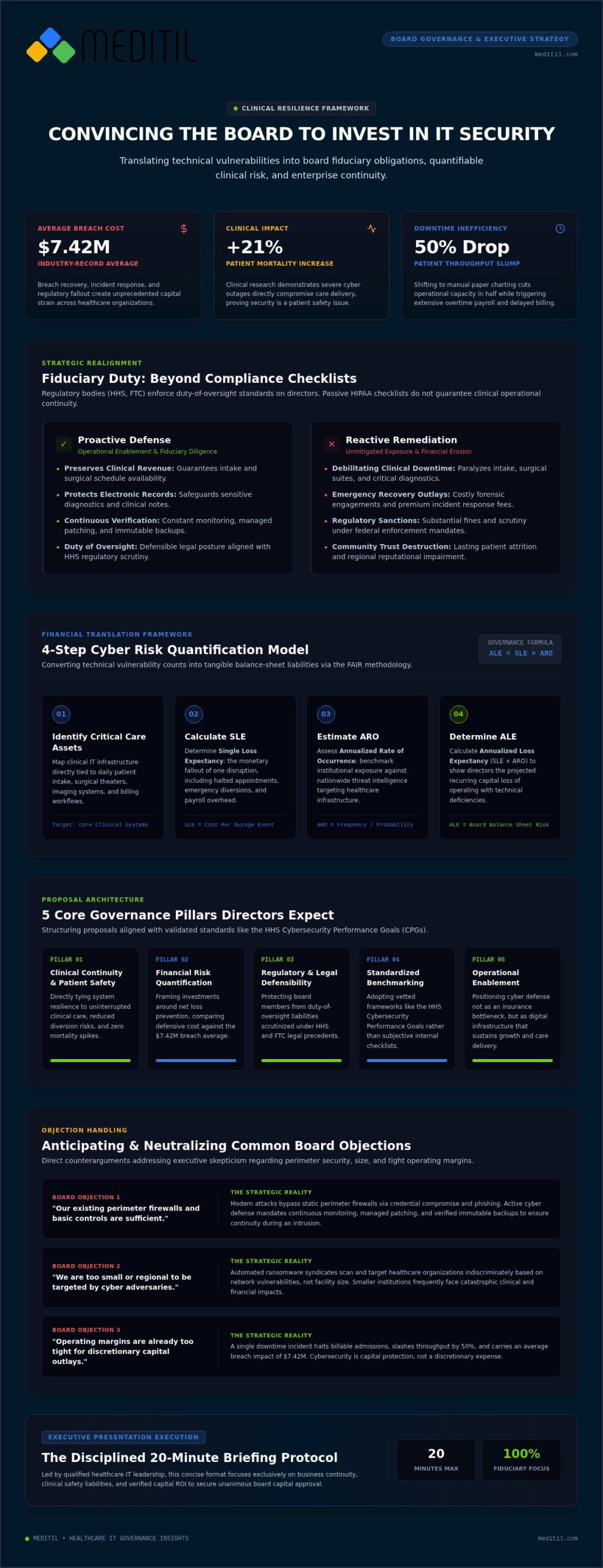
It is frustrating to watch vital defensive measures stall while operating margins tighten and healthcare breach costs reach an industry-record average of $7.42 million. You know that system downtime doesn’t just disrupt administrative workflows; clinical research demonstrates that severe outages correlate with up to a 21% increase in patient mortality.
Discover the step-by-step framework to translate clinical and technical cyber risks into executive business cases that secure board-level investment. We will examine how to benchmark against modern governance frameworks, calculate true financial downtime exposure, and build a persuasive presentation that earns unanimous executive approval.
Key Takeaways
- Reframe cybersecurity from a discretionary operational expense into a vital clinical safeguard that fulfills executive fiduciary obligations.
- Deploy a structured four-step financial model to convince board to invest in IT security by demonstrating the measurable operational costs of clinical downtime.
- Structure executive proposals around five core governance pillars aligned with validated standards like the HHS Cybersecurity Performance Goals.
- Anticipate and neutralize common board objections regarding perimeter defenses, organizational size, and constrained operational margins.
- Execute a disciplined, 20-minute briefing framework supported by qualified healthcare IT leadership to secure unanimous capital approval.
Reframing Healthcare IT Security: From Cost Center to Board Fiduciary Duty
Viewing cybersecurity as an isolated technical expense is a fundamental governance failure. In modern healthcare delivery, digital infrastructure forms the backbone of clinical operations. When medical records, diagnostic imaging, and connected infusion systems fail, patient care stops immediately. To convince board to invest in IT security, executive leadership must reframe defensive controls as critical instruments of patient safety and enterprise value preservation. Treating cyber defense as administrative overhead ignores the direct connection between network availability and patient outcomes.
Translating Cyber Risk into Corporate Governance
Regulatory bodies, including HHS and the FTC, increasingly scrutinize board-level oversight regarding health data protection. Directors now face expanding legal exposure under established duty-of-oversight standards when systematic security failures disrupt operations. Fiduciary responsibility requires directors to treat digital defense with the same diligence applied to clinical credentialing and financial audits. By applying quantitative models such as the Factor Analysis of Information Risk (FAIR) framework, security leaders can translate technical vulnerabilities into probable financial loss and operational exposure, giving board members the precise data required to uphold their governance duties.
Moving Beyond Compliance Checklists to Clinical Resilience
Checking compliance boxes does not prevent a modern ransomware attack. Standard HIPAA audits verify policy documentation, but they rarely test whether an organization can sustain clinical workflows during a network compromise. Passive regulatory alignment creates a false sense of security that crumbles under targeted intrusion.
True clinical resilience requires an active posture focused on maintaining care continuity during an incident. When you convince board to invest in IT security through the lens of operational resilience, the financial logic becomes straightforward:
- Proactive Defense: Preserves clinical revenue, secures patient records, and satisfies regulatory mandates through continuous monitoring, managed patching, and verified immutable backups.
- Reactive Remediation: Inflicts debilitating downtime, emergency breach recovery expenditures, regulatory penalties, and lasting reputational erosion across the community.
How to Quantify Healthcare Cyber Risk in Financial and Operational Metrics
Boardrooms evaluate strategic initiatives through financial risk and operational continuity. Presenting raw vulnerability counts or technical threat logs fails to register because directors require quantifiable business exposure. According to a Harvard Business Review analysis on boardroom cybersecurity discussions, executive committees struggle when conversations stall around technical controls rather than operational resilience. To successfully convince board to invest in IT security, leadership must translate cyber exposure into tangible balance-sheet liabilities using a disciplined four-step model:
- Identify Critical Care Assets: Map the clinical systems directly tied to daily patient intake, surgical execution, and billing workflows.
- Calculate Single Loss Expectancy (SLE): Determine the net monetary loss of a single operational disruption, factoring in halted appointments, emergency diversions, and payroll overhead.
- Estimate Annualized Rate of Occurrence (ARO): Benchmark institutional exposure against current threat intelligence targeting healthcare infrastructure nationwide.
- Determine Annualized Loss Expectancy (ALE): Multiply SLE by ARO to illustrate the projected capital loss of operating with unmitigated technical deficiencies.
Calculating the True Cost of Clinical Downtime
Operational downtime paralyzes clinical revenue immediately. When ransomware locks electronic health records, surgical suites stand idle, diagnostic clinics divert inbound patients, and billable services drop to zero. Secondary expenses compound rapidly; nursing staff shift to manual paper charting, which slashes patient throughput by half and triggers massive overtime payroll. Re-entering paper records into restored digital environments introduces billing delays, cash flow interruptions, and elevated denial rates. Incorporating these hidden operational expenses into a comprehensive plan for strategic IT budgeting for medical practices transforms technical defense into a clear financial justification.
Evaluating Cyber Insurance Gaps and Reputational Costs
Relying on cyber insurance as a standalone safety net is no longer a viable governance posture. Carriers have drastically restricted payouts, inflated deductibles, and introduced strict condition precedents. If an organization cannot prove enforced multifactor authentication across all access points, immutable offsite backups, and centralized audit logging, insurers will deny post-incident claims entirely.
Uninsured expenses quickly escalate. Federal regulatory penalties under HIPAA reach statutory caps exceeding $2.19 million annually for willful neglect violations, not counting mandatory state notifications, legal forensics, and severe patient attrition. Retaining specialized cybersecurity and compliance consulting enables clinical leaders to establish documented, defensible controls that protect institutional standing and maintain underwriting insurability.
Structuring the Board Proposal: The 5 Critical Pillars Directors Expect
Technical IT teams often fail to secure capital because their proposals focus on infrastructure specifications rather than strategic governance. Directors do not allocate capital based on firewall throughput, CVE scores, or software versioning; they approve initiatives that protect enterprise stability. To convince board to invest in IT security, leadership must translate technical requirements into five core executive pillars: strategic business alignment, quantifiable financial risk, framework benchmarking, targeted threat reduction, and milestone-driven accountability.
| Proposal Element | Standard Technical Proposal | Board-Ready Executive Proposal |
|---|---|---|
| Objective | Upgrade firewalls and deploy endpoint agents | Maintain clinical workflow continuity and eliminate ransomware vulnerabilities |
| Risk Justification | Lists unpatched common vulnerabilities and exposures (CVEs) | Quantifies hourly downtime exposure and patient safety liabilities |
| Success Metric | Percentage of network endpoints patched | Adherence to federal benchmarks and reduction in mean time to recover |
Aligning Proposals with Industry Frameworks
Healthcare boards look for objective, third-party validation to remove internal organizational skepticism. Rooting your proposal in recognized standards such as the NIST Cybersecurity Framework 2.0 and the CISA Cross-Sector Cybersecurity Performance Goals provides an undeniable baseline of due care. Combining these benchmarks with the voluntary HHS Healthcare Cybersecurity Performance Goals demonstrates that your strategy meets federally recognized standards of care, transforming cybersecurity into an audit-ready compliance defense.
Presenting Tiered Investment Options and Milestones
All-or-nothing budget requests invite immediate executive pushback. Presenting a phased, milestone-driven investment roadmap allows directors to direct capital toward immediate clinical exposures first while planning secondary optimizations over multi-year cycles. Engaging verified healthcare cybersecurity services gives organizations the external operational rigor required to execute these roadmaps reliably. Clear quarterly checkpoints ensure leadership can convince board to invest in IT security by demonstrating measurable reductions in attack surfaces and verifiable improvements in disaster recovery readiness.
Overcoming Common Board Objections to Healthcare Security Spending
Healthcare boards guard operating margins closely, especially when non-profit health systems often operate at margins between 1% and 3%. When directors push back against capital requests, they rarely do so out of disregard for safety; they simply require proof that requested allocations address verifiable exposures. Understanding how to convince board to invest in IT security means preparing precise, evidence-based rebuttals to predictable objections before entering the boardroom.
Refuting the ‘We Have Never Been Attacked’ Mindset
The belief that an organization is too small or has avoided scrutiny stems from a basic misunderstanding of modern cyber crime. Threat actors do not handcraft attacks against specific regional providers; automated scripts continuously scan external IP ranges across the country searching for known flaws. A quiet network doesn’t equal a secure one. In healthcare, the average breach lifecycle spans approximately 270 days to identify and contain. Intruders frequently dwell inside systems for months, silently mapping clinical databases and harvesting privileged credentials before deploying encryption payloads.
Perimeter defenses like basic network firewalls also fail to stop authorized credentials stolen through phishing or unpatched remote portals. When directors claim traditional controls are sufficient, remind them that modern intrusions exploit valid administrative accounts rather than breaking through network perimeters.
Justifying Continuous Operational Expenditure Over One-Off Fixes
Directors often ask why security cannot be solved with a single capital purchase. Static software installations degrade rapidly as clinical workflows shift and novel vulnerabilities emerge. Point-in-time assessments represent a snapshot of yesterday’s risks, whereas modern defense requires continuous monitoring, ongoing system patching, and active endpoint containment.
Demonstrating return on investment requires shifting the metric from revenue generation to loss prevention and operational stability. Recurring expenditures replace unpredictable disaster recovery costs with manageable, budgetable investments. Structuring ongoing protection through dedicated managed it services for healthcare establishes continuous threat visibility, guarantees regulatory record retention, and maintains underwriting standards required by cyber insurers.
If your organization struggles to reframe technical requirements into executive justifications, partner with specialized advisors. Speak with MEDITIL’s strategic healthcare IT consultants to prepare a comprehensive, defensible case that secures executive backing.
Executing the Presentation: Securing Approval with Strategic IT Leadership
Board agendas leave little room for ambiguity. Clinical IT leaders typically receive a tight 15 to 20-minute window to state their case, answer questions, and secure budgetary commitments. To convince board to invest in IT security, that brief window must be executed with disciplined precision. Presentations relying on panic or alarming headlines often backfire, prompting directors to seek second opinions or postpone decisions. Executive storytelling succeeds when it pairs realistic urgency with a composed, methodical remediation roadmap that instills confidence.
Delivering the Boardroom Presentation Effectively
Structure the briefing to prioritize governance and operational continuity rather than technical mechanics. Allocate five minutes to articulate clinical workflow and balance-sheet exposure, seven minutes to present the prioritized mitigation roadmap, and reserve the remaining time for open discussion. Slides should remain high-level, highlighting core exposure areas, target investment tiers, and milestone schedules. Move granular technical logs, port scan results, and tool configurations into an appendix to address specialized inquiries from audit or risk committees.
Leveraging Fractional Leadership for Executive Buy-In
Internal IT personnel sometimes face perceived bias when requesting expanded budgets, as directors may view them as simply expanding their own departments. Retaining experienced external leadership introduces the objective third-party credibility required to overcome skepticism.
Engaging specialized virtual cio services bridges the gap between engineering teams and executive directors. A seasoned advisor speaks the financial and regulatory language of the boardroom, translating complicated clinical IT risks into defensible governance strategies. This strategic leadership establishes structured reporting cadences, monitors key performance indicators, and reassures directors that allocated capital will be deployed responsibly.
Securing board consensus begins with objective insight. Initiating a comprehensive healthcare security readiness assessment provides the defensible documentation and roadmap needed to convince board to invest in IT security with complete confidence.
Securing Board Buy-In for Lasting Clinical Resilience
Gaining executive approval requires moving past technical jargon and alarming headlines. To convince board to invest in IT security, leadership must frame digital defense as an indispensable clinical safeguard, quantify risk through operational downtime exposure, and benchmark milestones against validated federal standards. When proposals directly protect patient care continuity and preserve operating margins, directors can confidently fulfill their fiduciary obligations.
You don’t have to navigate executive governance alone. MEDITIL delivers specialized healthcare IT leadership designed to bridge daily clinical workflows, engineering practices, and executive risk management. Delivering nationwide Fractional CIO advisory alongside comprehensive cybersecurity and compliance services, our seasoned team equips healthcare executives with the objective data and structured frameworks needed to earn unanimous board buy-in.
Take the decisive step toward defensible governance. Schedule a strategic consultation with MEDITIL to evaluate your current clinical readiness, refine your executive proposal, and protect your vital medical infrastructure.
Frequently Asked Questions
How do I convince our healthcare board to increase our IT security budget?
Reframe the discussion from technical tools to clinical continuity and operational revenue protection. Show how unmitigated cyber threats directly interrupt patient appointments, diagnostic services, and daily billing workflows. Use objective benchmarks like the NIST CSF or HHS Cybersecurity Performance Goals to illustrate institutional gaps. Demonstrating how planned safeguards eliminate operational vulnerabilities helps you convince board to invest in IT security while preserving operating margins.
What financial metrics resonate most when presenting cybersecurity to healthcare executives?
Healthcare directors respond best to Annualized Loss Expectancy, hourly clinical downtime costs, and Value at Risk. Rather than discussing raw vulnerability counts, present the single loss expectancy of an electronic health record disruption, factoring in delayed billing and idle surgical teams. Quantifying the daily margin impact against the proposed capital allocation allows directors to evaluate cyber defense like any traditional clinical capital expenditure.
Why is standard HIPAA compliance insufficient to satisfy the board’s fiduciary duties?
HIPAA compliance measures baseline administrative and technical documentation, not active operational resilience against targeted intrusions. An organization can pass an annual audit while harboring severe unpatched vulnerabilities or weak access controls. Courts and federal regulators increasingly expect active duty of care, holding boards accountable if systemic oversight failures lead to clinical paralysis or extensive data theft. Compliance fulfills legal baselines, but operational resilience protects patient care.
How can our medical organization calculate the true cost of clinical downtime?
Calculate true downtime by combining lost clinical billings, direct staff overhead, and delayed remediation costs. Multiply average hourly revenue across outpatient clinics and operating suites by expected outage hours. Add overtime payroll for manual charting catch-up, emergency forensic retainers, legal counsel expenses, and delayed claims reimbursements. Factoring in these secondary expenses quickly demonstrates that proactive defense costs far less than reactive crisis recovery.
What should be included in an executive board cybersecurity briefing slide deck?
A board-ready briefing deck should contain four to six high-level slides focusing strictly on governance and risk. Open with an executive summary connecting digital defense to clinical patient care. Follow with a quantitative risk overview, current regulatory alignment against HHS standards, a multi-year phased investment roadmap, and measurable operational milestones. Place granular firewall configurations, scan logs, and technical tool evaluations in an appendix for audit committees.
How can a Fractional or Virtual CIO assist in securing board approval for security?
A Fractional or Virtual CIO provides objective third-party authority that bridges the communication gap between technical teams and executive directors. Seasoned advisors translate technical vulnerabilities into executive risk metrics, establishing immediate credibility in the boardroom. Their specialized guidance helps clinical leaders convince board to invest in IT security by presenting phased, defensible budgets aligned with national standards, ensuring capital requests gain trust without internal departmental bias.