
Most healthcare organizations view an electronic medical record transition as a software upgrade, but this narrow perspective is why so many digital transformations fail before the first patient record is migrated. When leadership treats technology as a standalone tool rather than a foundational infrastructure project, they often encounter common EMR implementation mistakes that lead to physician burnout and fragmented workflows. You likely recognize the frustration of clinicians struggling with clunky interfaces or the sudden realization that hidden technical debt is draining your budget. It’s a high-stakes environment where a single oversight in data mapping can create silos that compromise interoperability for years.
This guide provides a professional framework designed to secure your clinical stability and protect data integrity throughout the transition. We’ll examine how to achieve a seamless migration without operational downtime while ensuring every step remains strictly HIPAA-compliant. By following this strategic checklist, you’ll learn to anticipate infrastructure needs and implement training protocols that drive high staff adoption rates. We’re moving beyond the software to build a resilient digital ecosystem that supports your providers and patients alike.
Key Takeaways
- Learn how to avoid common EMR implementation mistakes by shifting from a “plug-and-play” mindset to a strategy guided by clear clinical and operational KPIs.
- Evaluate your infrastructure readiness to ensure network bandwidth and N+1 redundancy can support life-critical systems without interruption.
- Develop a sustainable training model that moves beyond the “one-and-done” fallacy to maintain staff adoption and manage temporary volume fluctuations.
- Protect your data integrity by implementing strict migration protocols that prevent legacy errors from creating fragmented information silos.
- Use a strategic checklist and fractional CIO consultation to audit your hardware and systems integration before the transition begins.
The Strategic Vacuum: Why EMR Implementations Fail Before the First Login
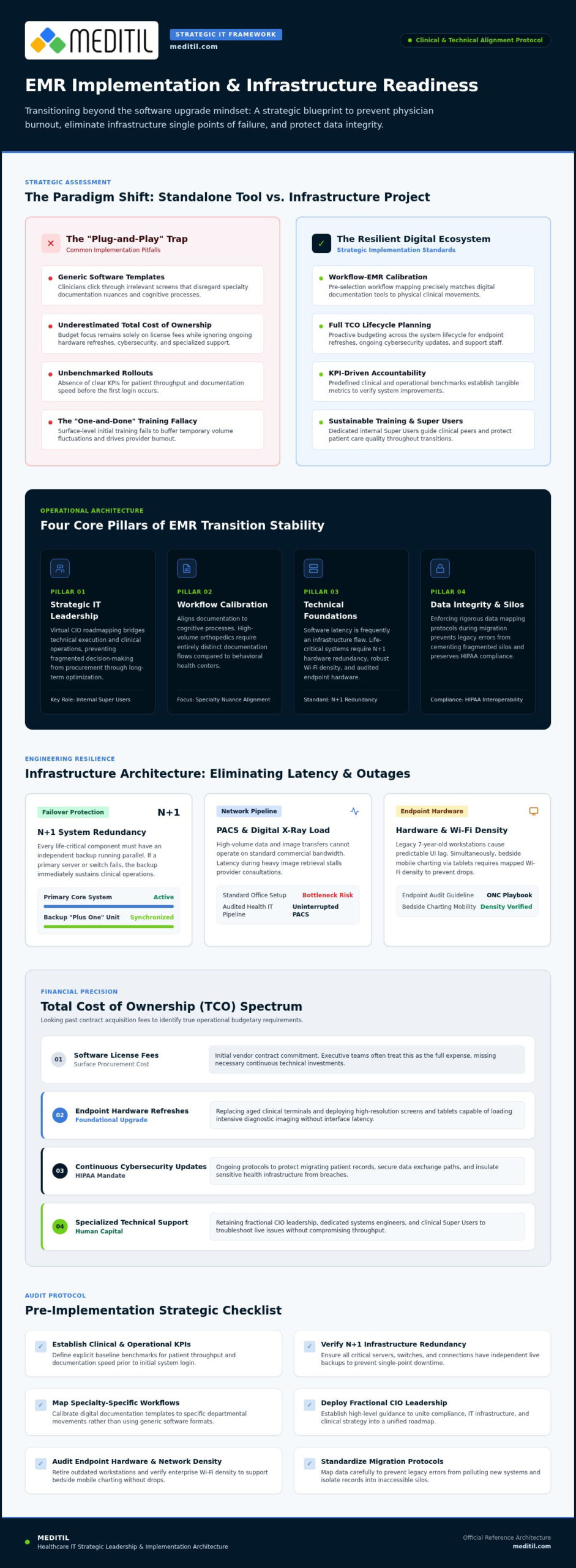
Success in digital transformation requires more than just a signed contract. Many healthcare leaders approach the deployment of electronic health record systems as a simple procurement task. However, treating a rollout as a plug-and-play solution is one of the most common EMR implementation mistakes. It creates a strategic vacuum where technology dictates clinical practice instead of supporting it. This lack of alignment often stems from failing to establish clear clinical and operational KPIs before the first login occurs. Without benchmarks for patient throughput or documentation speed, there’s no way to measure if the system is actually improving outcomes. Additionally, executive teams often underestimate the total cost of ownership (TCO). They focus on license fees while ignoring the ongoing costs of hardware refreshes, cybersecurity updates, and specialized support staff. Securing executive and clinical buy-in early isn’t just about approval; it’s about shared accountability for the system’s performance.
Misaligning Software with Clinical Workflow
Forcing a medical practice into a generic software template is a primary driver of physician burnout. When workflows aren’t mapped before a vendor is selected, clinicians are left clicking through irrelevant screens that don’t match their physical movements. Generic templates rarely account for the nuances of specific specialties. For example, a high-volume orthopedic clinic has drastically different documentation needs than a behavioral health center. Workflow-EMR alignment is the precise calibration of digital documentation tools to match the physical movements and cognitive processes of the clinical team. Securing clinical buy-in early ensures that the platform serves the provider, rather than the provider serving the platform.
The Absence of Strategic IT Leadership
Strategic IT leadership is the bridge between a technical tool and a functional clinic. Utilizing a virtual CIO prevents fragmented decision-making by creating a comprehensive roadmap. This high-level guidance helps avoid common EMR implementation mistakes by ensuring that infrastructure, compliance, and clinical needs are addressed in unison. This roadmap guides the organization from initial procurement through long-term optimization, ensuring the infrastructure scales with the practice. Within the clinic, the role of the ‘Super User’ is equally vital. These individuals act as internal consultants who understand both the IT requirements and the clinical realities. They help their peers adapt to the new system without losing focus on patient care, providing a steady hand during the transition’s most challenging phases.
Infrastructure and Security Oversights: The Technical Foundation Mistakes
An EMR platform is only as resilient as the hardware and network supporting it. Many organizations fail to realize that software latency is often an infrastructure issue rather than a coding error. Overlooking the technical foundation is one of the most common EMR implementation mistakes, leading to system crashes and provider frustration. A robust implementation requires N+1 redundancy, which means every critical system has at least one independent backup. If your primary server or network switch fails, the “plus one” ensures patient care continues without interruption. Without this safeguard, life-critical systems remain vulnerable to single points of failure. High-volume data and image transfers, such as PACS or digital X-rays, also require significant network bandwidth that standard office setups simply can’t provide.
Outdated endpoint hardware also contributes to poor performance. If a clinician is using a seven-year-old workstation to load high-resolution imaging, the resulting lag is predictable. The ONC Health IT Playbook provides extensive guidance on technical readiness, stressing that infrastructure must be audited before software deployment begins.
Network Readiness and Clinical Latency
Modern healthcare requires mobility. Assessing Wi-Fi density is vital for nurses and physicians using tablets for bedside charting. If signals drop between exam rooms, data synchronization fails. This sub-optimal network management directly impacts patient wait times, as staff spend more time troubleshooting connectivity than treating patients. For cloud-based systems, high availability is non-negotiable. You’ll need redundant internet service providers (ISPs) to ensure that a local outage doesn’t disconnect your clinic from its vital records. Investing in a managed network ensures that bandwidth is prioritized for clinical applications rather than guest Wi-Fi or background updates.
Cybersecurity and HIPAA Compliance Gaps
Security shouldn’t be a post-launch consideration. Professional healthcare cybersecurity services should be integrated into the initial rollout phase to avoid common EMR implementation mistakes like data leaks during migration. Migration is a particularly vulnerable time; legacy records often lack the encryption standards required today, creating breach points during the transfer. Role-based access control (RBAC) mistakes are another frequent point of failure. If permissions are too broad, the risk of an internal breach increases significantly, potentially leading to costly regulatory fines. Ensuring your infrastructure is secure and compliant from the start provides the stability your practice needs. If you’re planning a transition, a comprehensive network audit can prevent these technical hurdles before they impact your go-live date.
The Human Element: Training and Workflow Disruption Errors
Even the most advanced infrastructure can’t compensate for a workforce that feels abandoned during a digital transition. One of the most common EMR implementation mistakes is overlooking the psychological and operational impact on the people using the system daily. Leadership often expects immediate proficiency, yet failing to account for the temporary drop in patient volume during go-live is a recipe for operational chaos. It’s standard practice to plan for a temporary reduction in scheduled visits during the first two weeks to allow staff the cognitive space to learn. Ignoring the concerns of veteran staff who are accustomed to legacy processes can lead to quiet resistance, ultimately undermining the entire investment. Robust help desk support during the first 30 days is essential to maintain morale and ensure that technical hurdles don’t become permanent barriers to care.
Developing a Multi-Tiered Training Strategy
A “one-and-done” training session isn’t enough to build lasting competency across a diverse medical team. Administrative staff need to master scheduling and billing automation, while clinical roles must focus on charting efficiency and order entry. At-the-elbow support during the first week of go-live provides immediate resolution to real-world problems, preventing small frustrations from becoming permanent workarounds. Continuous education acts as a vital tool to combat technical debt. It ensures that staff utilize new features as they’re released rather than sticking to inefficient, outdated habits. This tiered approach builds a culture of technical proficiency that extends far beyond the initial launch date.
Managing Clinical Friction and Burnout
Physician burnout often starts when charting time bleeds into personal hours due to unfamiliar software interfaces. Setting realistic expectations for documentation speed in the early stages prevents morale from plummeting. Utilizing managed IT services for healthcare reduces the burden on clinical staff by ensuring that help desk support is responsive and technically proficient. When a provider encounters a software glitch mid-clinic, they need a solution, not just a ticket number. Identifying these friction points through active feedback loops allows you to address them before they become ingrained in the clinic’s culture. This proactive stance ensures that the human element remains a driver of success rather than a risk factor for another of the common EMR implementation mistakes.
Interoperability and Data Migration: Avoiding the Information Silo Trap
Migrating patient records is the most technically sensitive phase of a transition. Many leaders fall into the trap of dirty data migration, which involves carrying over inaccuracies from legacy paper or digital systems into the new platform. This oversight is among the most common EMR implementation mistakes because it compromises clinical decision support from day one. If the source data is flawed, the new system’s alerts and analytics will be equally unreliable. A successful migration requires rigorous data cleansing and mapping to ensure every field aligns with the new architecture. Without this precision, you risk creating a digital environment that clinicians don’t trust.
True connectivity requires planning for interoperability with external partners like labs, imaging centers, and pharmacies. Failing to anticipate these hurdles is another of the common EMR implementation mistakes that can derail a project’s ROI by forcing staff back into manual faxing and phone calls. You must also account for the Cures Act requirements regarding information blocking. Modern healthcare regulations demand that patient data remains accessible and shareable across different platforms. Ensuring your system is compliant isn’t just a technical preference; it’s a regulatory necessity to avoid significant penalties. Neglecting the integration of medical billing automation solutions during this phase can also lead to significant revenue cycle delays.
Data Integrity and Migration Standards
The “garbage in, garbage out” principle is the primary risk for any new system. Data cleansing involves identifying duplicate records, correcting formatting errors, and verifying historical medication lists before they enter the new database. This process ensures that the clinical team starts with a verified foundation. HL7 and FHIR are the standardized languages of modern interoperability that allow disparate systems to communicate patient data securely and accurately. By adhering to these standards, you ensure your practice can participate in the broader healthcare ecosystem without technical friction.
Closing the Loop with Billing and Analytics
Maintaining financial stability during a digital shift is critical, and Meridian RCM provides the specialized revenue cycle management services needed to ensure accurate reimbursement throughout the transition.
A high-performing EMR should act as the engine for your financial health. Clinical documentation must trigger accurate billing codes automatically to reduce manual entry errors and speed up reimbursement. When interoperability is neglected, data silos form, making it impossible to generate accurate financial reports or track key performance indicators. Preparing for strategic IT budgeting post-implementation is necessary to support these ongoing integrations. To secure your long-term revenue cycle, establishing a roadmap for strategic IT budgeting ensures your practice remains interoperable as standards evolve.
To further enhance your financial outcomes and data accuracy, you can discover FrontRunnerHC, Inc. and their specialized software solutions for optimizing healthcare data and reimbursement workflows.
The EMR Readiness Checklist: Auditing Your Implementation Strategy
A successful rollout isn’t a one-time event; it’s a series of verified milestones that ensure clinical and operational stability. To avoid common EMR implementation mistakes, leadership must adopt an audit-first mentality well before the go-live date. This process begins with pre-implementation alignment where a fractional CIO reviews the strategic roadmap to ensure technology serves your long-term goals. You must also finalize patient volume adjustments for the first 14 days. This temporary reduction gives your team the necessary bandwidth to adapt to new charting requirements without compromising patient safety or documentation quality. By verifying these strategic elements early, you build a foundation that supports rather than hinders your providers.
Step 1: The Strategic Infrastructure Audit
Before the software is deployed, the underlying hardware must be stress-tested to handle peak clinical loads. Verify that your N+1 redundancy is fully operational and that backup power systems can maintain life-critical functions during a sudden outage. A comprehensive cybersecurity risk assessment is also mandatory to ensure data encryption protocols meet modern 2026 interoperability and protection standards. You must confirm that every endpoint workstation and mobile device meets the vendor’s specifications to prevent the clinical latency issues that drive physician burnout. This audit serves as the final technical verification before the system becomes the primary record for patient care.
Step 2: Operational Readiness and Support
Operational success depends on the professional support structures surrounding your clinical team. Confirm that your technical help desk is fully staffed and capable of scaling for the inevitable surge in support tickets during the first 30 days. The ‘Super User’ training and delegation plan should be finalized, with these individuals clearly identified to the entire staff as the first line of assistance. Establishing a structured feedback loop for workflow optimization allows you to capture and resolve friction points before they become ingrained as inefficient habits. This proactive support model ensures that technical hurdles don’t disrupt the patient experience or provider morale.
The work doesn’t end once the system is live. Post-live optimization audits are necessary to refine documentation templates and billing automation based on real-world usage data. Scalability must be built into your help desk and infrastructure to accommodate future growth and evolving regulatory requirements. By following this structured checklist, you transform a high-risk transition into a controlled, professional evolution of your practice’s digital capabilities. This methodical approach is the most effective way to protect your investment and avoid the common EMR implementation mistakes that compromise healthcare delivery.
Securing Your Clinical Digital Infrastructure
Successfully navigating an EMR transition requires shifting your focus from software features to the underlying strategic infrastructure. By prioritizing technical readiness, clinical workflow mapping, and data integrity, you ensure your organization remains stable during and after go-live. Identifying and avoiding common EMR implementation mistakes is not just a technical challenge but a leadership responsibility that impacts patient safety and provider satisfaction. A resilient digital ecosystem relies on N+1 redundancy, HIPAA-aligned security protocols, and a commitment to continuous staff education.
Establishing this foundation protects your investment and secures your long-term operational efficiency. You don’t have to manage these complexities alone. Secure your EMR implementation with MEDITIL’s expert IT leadership. Our approach combines fractional CIO strategic guidance with comprehensive healthcare-managed IT and HIPAA-aligned security protocols to ensure every detail is handled with precision. Your commitment to a disciplined rollout today builds the high-performing clinical environment of tomorrow.
Frequently Asked Questions
What is the most common reason EMR implementations fail?
Treating a transition as a standalone software purchase is the most frequent cause of failure. It’s actually a strategic infrastructure project that requires deep clinical alignment. When leadership lacks clear clinical KPIs or fails to map workflows, the system becomes a burden. This is one of the most common EMR implementation mistakes. Success requires aligning the platform with the physical movements of the clinical team to ensure the technology supports care delivery.
How long does a typical EMR implementation take for a mid-sized practice?
A mid-sized practice implementation typically requires six to twelve months of planning and execution. This timeline accounts for strategic auditing, infrastructure upgrades, and comprehensive staff training. Rushing this process often leads to significant technical debt. A steady, methodical approach ensures that data migration is accurate and that all systems are stress-tested before the go-live date to prevent operational downtime and fragmented documentation.
Should we hire a consultant for our EMR implementation?
Hiring a strategic partner or a fractional CIO is highly recommended to oversee the technical complexities of the rollout. These experts provide the necessary oversight for infrastructure readiness and cybersecurity compliance. A consultant acts as a steady hand at the wheel, ensuring that your IT roadmap aligns with long-term clinical goals. They bridge the gap between software capabilities and the specific operational needs of your medical practice.
What is the hidden cost of a poor EMR rollout?
The most significant hidden costs include physician burnout and lost patient volume due to inefficient workflows. Technical debt also accumulates when shortcuts are taken during the network setup phase. These issues lead to long-term financial drains that far exceed the initial software license fees. Poorly integrated systems often result in billing delays and fragmented data silos that hinder interoperability and accurate financial reporting across the organization.
How can we prevent physician burnout during an EMR transition?
Reducing patient volume during the initial two weeks of go-live is a critical step in preventing burnout. It gives clinicians the cognitive space to master new charting habits without the pressure of a full schedule. Tiered training and at-the-elbow support also help mitigate frustration. When providers feel supported by a responsive help desk, they’re less likely to experience the technical friction that leads to professional exhaustion.
What infrastructure upgrades are usually required for a new EHR?
Most new systems require significant upgrades to network bandwidth and Wi-Fi density to support mobile charting. You’ll likely need to implement N+1 redundancy to ensure high availability for life-critical systems. Many organizations must also refresh their endpoint hardware, as outdated workstations can’t handle the processing demands of modern imaging. These technical foundations are essential to avoid common EMR implementation mistakes related to system latency and crashes.
Can an EMR implementation improve our billing cycle?
No software vendor can guarantee HIPAA compliance for your entire organization. While the software itself may have compliant features, your internal network, data migration processes, and endpoint management must also be secured. You’re responsible for role-based access controls and ensuring that all data transfers are encrypted. Professional cybersecurity services are necessary to audit your local infrastructure and verify that your implementation remains fully compliant with federal standards.