
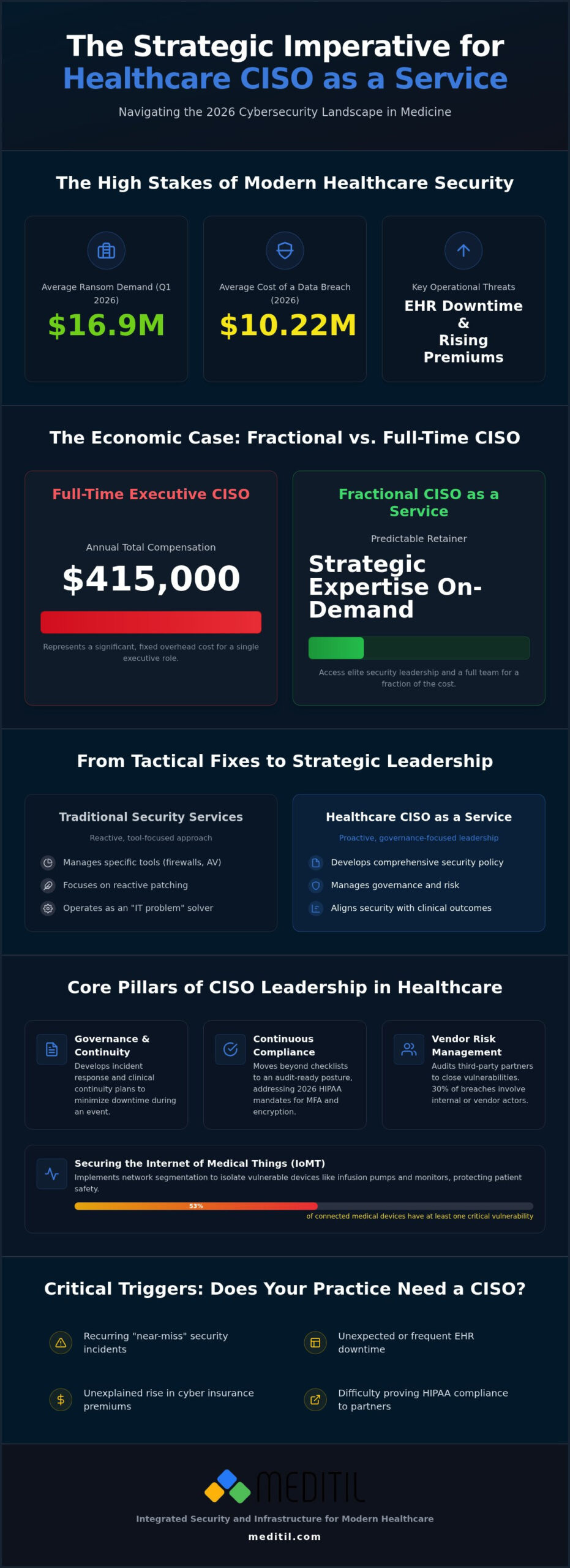
With the average healthcare ransom demand surging to $16.9 million in the first quarter of 2026, the question for medical practices is no longer if they can afford high-level security, but how they can survive without it. You’re likely feeling the weight of skyrocketing cyber insurance premiums and the complexity of the latest HIPAA Security Rule updates. It’s difficult to focus on patient outcomes when you’re constantly looking over your shoulder for the next data breach or compliance audit. You need stability. This is why healthcare ciso as a service has become a vital strategic asset for organizations that require elite protection without a full-time executive salary.
This article demonstrates how fractional security leadership provides the specific roadmap and audit-ready posture your practice needs to thrive. By utilizing specialized expertise, your organization gains a clear path toward compliance without the $415,000 annual compensation required for a full-time executive. We’ll examine how this model reduces operational risk and stabilizes your infrastructure through a predictable, managed approach that keeps your focus where it belongs: on the patients.
Key Takeaways
- Understand how healthcare ciso as a service provides strategic leadership to align security protocols with clinical outcomes and patient safety.
- Compare the financial advantages of a predictable monthly retainer against the high total compensation costs of a full-time security executive.
- Learn how to move beyond basic HIPAA checklists toward a continuous, audit-ready posture that anticipates 2026 regulatory updates.
- Identify the critical operational signs, such as recurring near-miss incidents or EHR downtime, that indicate your practice requires professional security governance.
- Explore the benefits of integrating fractional security leadership directly into your managed IT foundation for a more stable and resilient clinical environment.
What is Healthcare CISO as a Service (CISOaaS)?
Healthcare CISO as a Service (CISOaaS) represents a fundamental shift in how medical organizations manage digital protection. Instead of viewing security as a series of technical hurdles managed by a technician, this model provides fractional executive leadership focused on high-level strategy and regulatory alignment. In the 2026 environment, cybersecurity is no longer just an “IT problem” to be solved with software; it’s a core business risk that threatens the very stability of clinical operations. Organizations that adopt healthcare ciso as a service benefit from a proactive guide that understands the nuances of a regulated medical space.
The Difference Between vCISO and Traditional Security Services
Traditional security services often operate on a tactical level, focusing on the deployment of specific tools like firewalls or antivirus software. While these components are necessary, they lack the strategic oversight required to protect a modern medical practice. A Chief Information Security Officer (CISO) operating on a fractional basis bridges the gap between technical infrastructure and executive decision-making. Their focus remains on governance and risk management rather than just configuration.
A vCISO doesn’t just manage a firewall; they develop the comprehensive policies that dictate how data flows through your organization safely. This approach ensures that every security measure supports the broader objectives of the practice, providing a roadmap that aligns with both financial goals and patient safety requirements. It’s the difference between reactive patching and proactive strategic advancement.
Why Healthcare Requires a Specialized Security Leader
The healthcare sector remains a primary target for cybercriminals due to the immense value of Protected Health Information (PHI). General security consultants often lack the deep understanding of HIPAA and HITECH requirements necessary to maintain an audit-ready posture. With the average cost of a healthcare data breach reaching $10.22 million in 2026, the stakes for your practice are exceptionally high.
A specialized security leader understands that medical networks are life-critical systems. The current landscape involves managing millions of Internet of Medical Things (IoMT) devices, many of which contain unpatched vulnerabilities. A healthcare-focused CISO views their role as a “Clinical Continuity Officer.” They ensure that security measures don’t just protect data, but actively prevent the ransomware-driven downtime that can halt patient care. This level of specialization is essential for navigating the intersection of federal mandates and the immediate needs of a busy clinical environment.
Core Pillars of Security Leadership in Clinical Environments
Managing the Internet of Medical Things (IoMT)
With over 7 million IoMT devices deployed in smart hospitals by 2026, the attack surface has expanded significantly. Reports indicate that 53% of connected medical devices still harbor at least one unpatched critical vulnerability. A fractional CISO implements network segmentation to isolate these vulnerable devices, such as infusion pumps and heart monitors, without interrupting the flow of care. Securing the Internet of Medical Things (IoMT) is fundamentally a patient safety requirement.
Interoperability and Secure Data Exchange
Modern healthcare relies on the seamless exchange of data between EHRs, laboratories, and pharmacies. Leadership must balance this need for interoperability with strict “minimum necessary” disclosure rules. By integrating robust encryption and identity verification into these data flows, you protect sensitive information as it moves across the ecosystem. For those seeking to strengthen these defenses, exploring specialized Healthcare Cybersecurity Services provides a deeper look into protecting high-volume data exchanges.
Reducing Clinical Friction Through Smart Security
Security shouldn’t come at the cost of provider burnout. Strategic leaders focus on reducing clinical friction by consolidating redundant security tools and implementing streamlined identity management, such as Single Sign-On (SSO). This allows clinicians to access critical patient data faster while maintaining high standards of protection. When you have a steady hand at the wheel, security becomes an enabler of efficiency rather than a barrier to care.
The Economic Case: Fractional CISO vs. Full-Time Executive
The financial reality of securing a medical practice in 2026 requires a disciplined approach to resource allocation. A full-time Chief Information Security Officer now commands an average total compensation of approximately $415,000 annually. For many mid-market healthcare organizations, this expense creates a significant budgetary strain. Choosing healthcare ciso as a service provides a strategic alternative, replacing high executive salaries and equity packages with a predictable monthly retainer. This model allows practices to redirect capital toward clinical improvements while maintaining elite security standards.
A primary economic advantage is the “speed to value” factor. Recruiting a full-time executive can take months, leaving the organization vulnerable during the search. A fractional leader arrives with established frameworks and immediate expertise, accelerating the deployment of critical safeguards. They also play a vital role in reducing technical debt. By auditing existing infrastructure, a vCISO identifies and removes redundant or incompatible security tools that often bloat IT budgets without providing additional protection. This streamlined approach ensures that every dollar spent on technology directly supports the organization’s risk profile.
Strategic leadership also has a direct impact on cyber insurance. As of 2026, insurance providers increasingly require organizations to name a specific individual responsible for security governance as a condition for coverage. Having a designated CISO helps lower premiums and ensures eligibility for comprehensive policies. It signals to underwriters that the practice is managed by a “steady hand” capable of maintaining a mature security posture.
Calculating the ROI of Strategic Security
The cost of a data breach in the U.S. healthcare industry has reached an average of $10.22 million. When you compare this to the cost of proactive prevention, the return on investment is clear. Beyond avoiding breach-related expenses, standardized security policies lead to operational efficiency gains. A well-governed network experiences less downtime and fewer disruptions to patient care. Additionally, maintaining an “audit-ready” posture helps the practice avoid the heavy financial penalties associated with HIPAA and HITECH non-compliance.
Flexibility and Scalability for Growing Practices
Medical practices are rarely static. Whether you’re undergoing a merger, acquiring a new clinic, or expanding telehealth services, your security needs will fluctuate. Healthcare ciso as a service offers the scalability to adjust engagement levels based on your current risk profile or specific project demands. You gain access to a broad team of specialists through a single leader, ensuring that as your practice grows, your security infrastructure evolves in lockstep without the need for additional full-time hires.
Critical Triggers: When Does Your Practice Need a CISO?
Recognizing the moment a medical practice outgrows standard IT support is vital for long-term stability. While your internal team may handle daily tickets, they often lack the executive bandwidth to manage systemic risk. Several operational and compliance triggers indicate it’s time to implement healthcare ciso as a service to provide the necessary strategic oversight, often in partnership with specialized firms like M.I.S. Support, Inc. that bridge the gap between IT and security.
Operational triggers often manifest as recurring “near-miss” security incidents or prolonged EHR downtime that disrupts patient care. If your staff is constantly reacting to minor breaches or system instability, you’re likely missing a cohesive governance strategy. Compliance triggers are equally pressing. With over 650 data breaches reported in the healthcare sector during the first quarter of 2026, regulatory scrutiny is at an all-time high. Significant changes in your PHI volume or an upcoming audit require a dedicated leader to ensure your posture is defensible.
Growth and fiduciary responsibilities also drive the need for high-level security. Expanding telehealth services or integrating new EHR modules increases your attack surface. Investors and boards of directors now demand formal security governance to protect their assets. If you’re facing these challenges, you can contact our team for strategic advisory to stabilize your operations.
Post-Incident Recovery and Resilience
Hiring a CISO after a breach is a critical step in restoring trust with patients and partners. It signals a move from reactive firefighting to proactive risk management. A fractional leader establishes a long-term strategic roadmap that identifies the root causes of the incident and implements safeguards to prevent recurrence. This structured approach helps rebuild your reputation by demonstrating a commitment to professional security standards through precise, documented improvements.
Contractual and Insurance Requirements
Modern healthcare contracts, particularly those with major payers or pharmaceutical partners, often mandate a named security officer as a prerequisite for partnership. Meeting the rigorous requirements for 2026 cyber insurance renewals is another major trigger. Underwriters now look for evidence of security maturity, including universal encryption and mandatory Multi-Factor Authentication (MFA) as expected in the latest HIPAA Security Rule updates. A CISO provides the documentation and verification needed to prove your practice is a low-risk entity, ensuring you remain eligible for the best coverage terms.
The MEDITIL Approach: Integrated Security and Infrastructure
MEDITIL addresses the fragmentation often found in healthcare technology by providing a unified leadership structure. We combine fractional CIO and CISO roles to offer a “steady hand at the wheel” for medical practices. This approach ensures that security isn’t an afterthought but is integrated directly into the Managed IT Services foundation. By focusing on clinical stability and interoperability as the end goals, we ensure that every protection measure supports, rather than hinders, the delivery of care. Through healthcare ciso as a service, your organization receives a customized security roadmap designed to scale with your specific clinical volume and operational complexity. These roadmaps are dynamic frameworks that account for changes in patient volume, the introduction of new telehealth platforms, and shifts in federal privacy mandates.
Beyond Advisory: Operationalizing Your Security Strategy
MEDITIL moves beyond simple advisory by utilizing specialized engineering teams to implement vCISO recommendations. We understand that a strategy is only as effective as its execution. Our technical experts ensure seamless connectivity between sophisticated security layers and your core medical infrastructure, such as EMR systems and diagnostic equipment. This operational synergy is optimized when integrated with our Virtual CIO Services, providing a holistic executive presence that aligns technology with business objectives. We don’t just identify risks; we build the systems that mitigate them, ensuring that your infrastructure remains resilient against evolving 2026 threats.
Your Partner in Long-Term Clinical Resilience
Long-term clinical resilience is built on proactive monitoring and risk management tailored to the high-stakes environment of modern medicine. We prioritize data integrity and patient safety by maintaining a disciplined focus on infrastructure stability. Our team monitors for emerging threats and regulatory shifts, ensuring your practice remains ahead of compliance requirements without experiencing operational friction. We maintain a steady presence that suggests every detail of your network infrastructure is being handled with precision. This partnership provides the stability needed to navigate a complex digital landscape with confidence. Adopting healthcare ciso as a service empowers medical leaders to transfer the burden of security governance to trusted experts, allowing them to focus exclusively on patient care.
Securing the Future of Clinical Stability
The complexity of the 2026 healthcare landscape demands more than technical tools; it requires a disciplined governance strategy. By adopting healthcare ciso as a service, your practice gains the executive-level oversight necessary to navigate evolving HIPAA mandates and the rising costs of cyber insurance. This approach ensures that your security infrastructure isn’t just a defensive shield but a foundation for seamless clinical operations. You’ve seen how fractional leadership provides the strategic roadmap needed to protect patient data while maintaining the economic flexibility your organization requires.
MEDITIL serves as the steady hand at the wheel, combining expertise in healthcare-specific regulatory frameworks with a unique synergy between managed IT and security. We focus on delivering audit-ready compliance strategies that grow alongside your practice. It’s possible to achieve elite protection and clinical resilience without the burden of a full-time executive salary. Schedule a Strategic Security Consultation with MEDITIL to align your infrastructure with the highest standards of digital safety. Your focus belongs on patient care, and we’re here to ensure your technology supports that mission with precision and reliability.
Frequently Asked Questions
What is the difference between a vCISO and a security consultant?
A vCISO provides high-level strategic governance while a consultant typically focuses on tactical, project-specific tasks. While a consultant might install a firewall, a leader providing healthcare ciso as a service develops the policies and risk management frameworks that dictate how that technology is utilized. This role bridges the gap between technical operations and executive decision-making to ensure long-term clinical stability and regulatory alignment.
How many hours per month does a fractional healthcare CISO typically work?
The engagement level typically ranges from 10 to 40 hours per month depending on the size of the medical practice and its specific risk profile. For organizations with heavy compliance requirements or those undergoing significant infrastructure changes, the hours may scale upward. This flexibility allows practices to access executive-level expertise on a part-time basis while maintaining a predictable cost structure that aligns with their operational budget.
Can a CISO as a Service help my practice pass a HIPAA audit?
Yes, a fractional CISO ensures your organization maintains an audit-ready posture by aligning policies with current regulatory standards. This includes implementing the 2026 updates to the HIPAA Security Rule, such as mandatory multi-factor authentication and universal encryption for ePHI. By establishing continuous assurance rather than reactive compliance, the CISO provides the documentation and verification necessary to satisfy federal auditors and protect patient data integrity.
Is a fractional CISO responsible for fixing technical bugs?
A fractional CISO focuses on strategic leadership and governance rather than individual technical repairs or software debugging. Their role is to identify risks and create the roadmap for remediation. At MEDITIL, the actual technical fixes and infrastructure maintenance are handled by our dedicated engineering and Managed IT teams. This separation of duties ensures that the CISO remains focused on high-level protection and strategic advancement for the practice.
How does CISO as a Service affect our cyber insurance premiums?
Implementing healthcare ciso as a service often leads to lower insurance premiums by demonstrating a mature security posture to underwriters. As of 2026, many insurance providers require a named security officer and proof of advanced controls like EDR and MFA to grant coverage. Having a designated leader managing your risk signals that the practice is a low-risk entity, which simplifies the renewal process and ensures eligibility for comprehensive policies.
Can we use CISOaaS if we already have an internal IT team?
Yes, a fractional CISO is designed to lead and augment your existing IT department by providing the strategic oversight they may lack. Many internal teams are focused on daily help desk tasks and infrastructure maintenance. The CISO provides the steady hand that guides these teams toward better security outcomes, ensuring that tactical work aligns with broader compliance goals and long-term clinical resilience across the entire organization.
What is the first thing a vCISO does in the first 100 days?
The initial 100 days are focused on conducting a comprehensive risk assessment and gap analysis of your current infrastructure. This process establishes a baseline security posture and identifies immediate vulnerabilities that require attention. Once the assessment is complete, the vCISO develops a strategic roadmap that prioritizes remediation efforts based on clinical impact and regulatory requirements, ensuring that your organization has a clear, documented path toward stability.
Does CISO as a Service include incident response?
The service includes incident response governance and coordination to ensure a structured clinical response during a crisis. While the CISO leads the strategy and communication during a breach, the technical remediation is performed by the broader IT operations team. This ensures that if a ransomware event or data breach occurs, your practice follows a predefined plan to minimize downtime and restore clinical continuity as quickly as possible.