
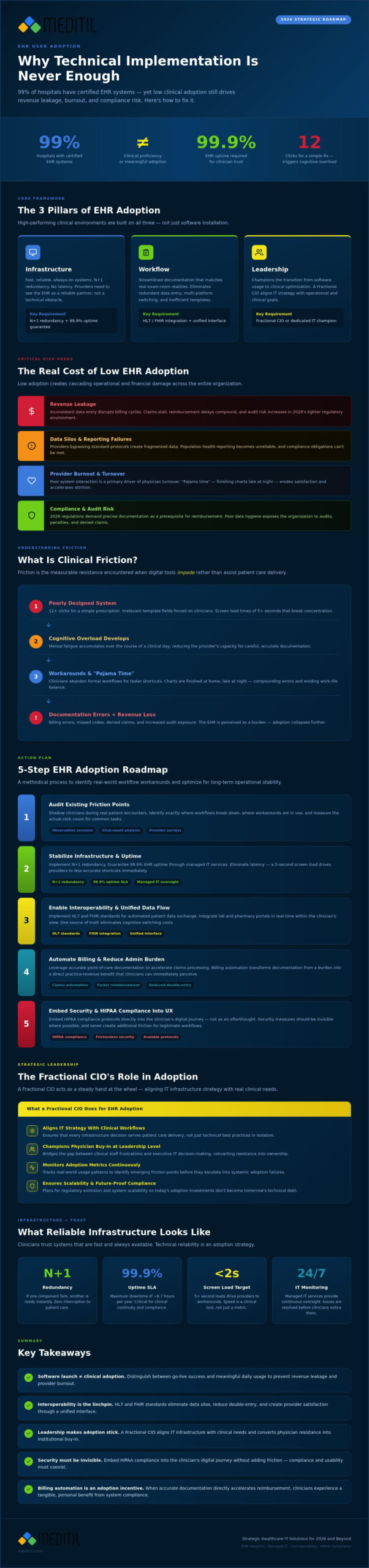
While 99% of non-federal acute care hospitals have technically adopted certified EHR systems, the presence of software rarely equates to clinical proficiency. For many providers, the digital transition has resulted in a documented rise in “pajama time” and fragmented workflows that hinder patient care. You understand that high-performance EHR user adoption strategies require more than a basic training manual. They demand a strategic alignment between technical infrastructure and the daily realities of the exam room.
We recognize the frustration of managing inconsistent data entry that complicates billing and reporting cycles. This article provides a 2026 strategic roadmap designed to transform physician resistance into operational stability. You’ll master the leadership frameworks and infrastructure tactics necessary to secure full clinical buy-in. We’ll explore how to streamline documentation workflows and build a reliable IT environment that supports provider satisfaction and long-term institutional growth.
Key Takeaways
- Learn to distinguish between a successful software launch and meaningful clinical adoption to prevent revenue leakage and provider burnout.
- Implement comprehensive EHR user adoption strategies that prioritize interoperability and reduce the administrative burden of redundant data entry.
- Discover how strategic leadership, such as a Fractional CIO, acts as a steady hand at the wheel to align IT infrastructure with clinical needs.
- Follow a methodical five-step roadmap to identify real-world workflow workarounds and optimize your system for long-term operational stability.
- Balance rigorous HIPAA compliance with user experience by embedding security protocols directly into the clinician’s digital journey.
The EHR Adoption Crisis: Why Technical Implementation Is Not Enough
Most clinical leaders have successfully crossed the “go-live” finish line. However, a functioning system doesn’t guarantee a functioning practice. While it’s helpful to understand what are electronic health records in a foundational sense, the gap between technical availability and meaningful clinical adoption remains a significant hurdle. Effective EHR user adoption strategies must address the psychological and operational barriers that cause clinicians to revert to paper or inefficient digital workarounds.
The cost of low adoption is quantifiable and severe. Revenue leakage occurs when inconsistent data entry disrupts billing cycles. Data silos emerge when providers bypass standard protocols, making population health reporting nearly impossible. Perhaps most critically, poor system interaction is a primary driver of physician turnover. As we move through 2026, regulatory requirements for data hygiene have intensified. Precise documentation is no longer just a best practice; it’s a prerequisite for compliance and reimbursement in an increasingly audited environment.
Identifying Clinical Friction Points
Clinical friction is the measurable resistance encountered by a provider when digital tools impede rather than assist the delivery of patient care. When a simple prescription requires twelve clicks, cognitive overload sets in. This mental fatigue leads to documentation errors and “pajama time,” where clinicians finish charts late at night. Poorly designed templates often force providers to enter irrelevant data, further eroding the perceived value of the system.
Infrastructure as a Foundation for Trust
You can’t expect clinicians to embrace EHR user adoption strategies if the underlying system is unreliable. System latency is a silent killer of digital protocols. If a screen takes five seconds to load, a provider will likely abandon the formal workflow for a faster, less accurate shortcut.
Maintaining clinician trust requires a robust technical foundation. Implementing N+1 redundancy ensures that if one component fails, another is ready to take its place without interrupting care. Professional managed it services for healthcare provide the specialized oversight needed to guarantee 99.9% EHR uptime. When the system is fast, responsive, and always available, providers view it as a reliable partner rather than a technical obstacle.
Defining EHR User Adoption Strategies for 2026
Successful EHR user adoption strategies in 2026 are built upon a comprehensive framework consisting of three essential pillars: infrastructure, workflow, and leadership. While infrastructure provides the technical foundation discussed previously, the workflow and leadership pillars ensure that the system actually serves the clinician. By integrating these elements, organizations move away from treating the EHR as a digital filing cabinet and toward utilizing it as a strategic clinical asset. Leadership, in particular, must champion the transition from mere software usage to high-performance clinical optimization.
High-performing clinical environments prioritize seamless connectivity to eliminate the data silos that often frustrate providers. Leveraging HL7 and FHIR standards allows for the automated exchange of patient data across disparate systems. This reduces the need for manual data retrieval and the high-friction task of double-entry. When integrated lab and pharmacy portals provide real-time updates directly within the clinician’s view, it establishes a single source of truth. This clarity eliminates clinical uncertainty and significantly increases user satisfaction. Providers spend less time hunting for information and more time engaging with patients.
Interoperability and Seamless Data Flow
Interoperability is the linchpin of modern provider satisfaction. By implementing robust systems integration, organizations can ensure that data flows effortlessly between the EHR and external diagnostic tools. This connectivity prevents the cognitive fatigue associated with switching between multiple platforms to piece together a patient’s history. A unified interface allows clinicians to maintain their focus on the patient encounter, reinforcing trust in the digital ecosystem as a tool for clinical excellence.
Billing Automation as an Adoption Incentive
One of the most effective incentives for adoption is the tangible reduction of administrative burden. The direct link between clinical documentation accuracy and billing speed cannot be overstated; precise data entry at the point of care ensures that claims move through the revenue cycle without rejection. Clinical leaders are increasingly turning to Medical Billing Automation Solutions to bridge the gap between patient encounters and financial reimbursement. This shift toward Documentation-to-Billing automation turns the EHR from a chore into a tool that accelerates the practice’s financial health.
Standardizing data entry isn’t just about compliance; it’s about business intelligence. When every provider uses the same protocols, the resulting data pool becomes a goldmine for analytics. This allows for proactive population health management and more informed executive decision-making. If your organization is struggling to align these technical workflows with clinical needs, exploring specialized billing automation and integration services can provide the strategic oversight necessary to stabilize your operations. Establishing these pathways early ensures your infrastructure remains scalable as your patient volume grows.
Strategic Oversight: The Fractional CIO’s Role in Adoption
True clinical transformation requires a steady hand at the wheel. While many organizations treat EHR user adoption strategies as a series of technical support tickets, high-performance practices recognize it as an executive leadership function. A Fractional CIO provides the strategic oversight necessary to move beyond reactive troubleshooting and into proactive system optimization. This role ensures that every IT investment directly supports the clinical mission rather than complicating it. It’s about outcomes, not just uptime.
Bridging the communication gap between clinical staff and technical IT teams is a primary responsibility of strategic leadership. Clinicians speak the language of patient care and efficiency, while IT teams often focus on network protocols and server stability. A Fractional CIO acts as a translator, ensuring that technical configurations actually solve clinical problems. This leadership also involves rigorous vendor management. By holding EHR providers accountable for usability and timely updates, the CIO ensures your software evolves alongside your practice’s needs.
A successful transition relies on a three-year strategic IT roadmap. This document prioritizes user experience by scheduling hardware refreshes, security patches, and workflow audits in a logical progression. It prevents the “technical debt” that often leads to system slowness and provider frustration. When clinicians see a clear plan for improvement, their trust in the system grows, facilitating deeper adoption across the entire organization.
Strategy vs. Support
There’s a fundamental difference between fixing a bug and optimizing a clinical workflow. Standard help desk support is reactive; it addresses immediate failures but rarely improves the provider’s daily experience. In contrast, virtual CIO services provide the high-level leadership required for sustainable practice growth. This strategic approach analyzes how data moves through the clinic, identifying opportunities to automate documentation and reduce manual entry. It’s the difference between keeping the lights on and illuminating a path toward operational excellence.
Governance and Feedback Loops
Governance structures turn passive users into active stakeholders. Establishing “Super User” programs is a proven method for driving peer-to-peer adoption. These clinical champions provide immediate, on-the-floor support and serve as a vital feedback loop for the IT department. Creating formal channels for clinicians to report workflow bottlenecks ensures that the system remains responsive to real-world challenges. Ultimately, the CIO’s role is to align IT budgets with provider satisfaction metrics, proving that technology is a servant to the clinical staff, not the other way around.
A 5-Step Roadmap for Increasing EHR User Adoption
Execution of high-performance EHR user adoption strategies requires a methodical sequence that prioritizes the clinician’s time. Moving from a state of resistance to operational stability is not achieved through a single software update. It involves a disciplined transition through these five critical phases:
- Step 1: Clinical Workflow Assessment. Observe providers in their natural environment to identify real-world workarounds and bottlenecks.
- Step 2: Technical Infrastructure Audit. Evaluate the security, network reliability, and cloud performance to ensure the foundation is stable.
- Step 3: Workflow Redesign. Reconfigure the interface and templates to prioritize clinical documentation speed and reduce redundant data entry.
- Step 4: Phased Specialty Training. Deliver instruction based on specialty-specific use cases rather than generic software features.
- Step 5: Business Intelligence Integration. Use data analytics to monitor adoption rates, time-per-encounter, and billing lag.
Conducting the Workflow Assessment
Shadowing providers is a delicate process. It requires passive observation techniques that allow you to see how clinicians actually interact with the system without disrupting patient care. During these sessions, you must look for “workarounds.” These are the manual spreadsheets, paper notes, or verbal relays that clinicians use to bypass the EHR. Every workaround is a signal of a system failure point. By identifying these gaps, you can prioritize technical debt reduction based on its direct clinical impact. This proactive approach builds trust by showing clinicians that the IT team is invested in their daily success.
Measuring Adoption Success
Data is the only objective way to verify the success of your EHR user adoption strategies. We focus on three primary metrics: time-per-encounter, documentation completion rates, and billing denial trends. If documentation completion is slow, it often indicates a user interface that is too complex. Conversely, high billing denial rates suggest that clinicians aren’t capturing the necessary data within the standard workflow.
Using this data allows leadership to justify the ROI of strategic IT budgeting for medical practices. It proves that technology is a driver of revenue rather than just an overhead expense. If your current system is failing to produce these insights, an expert EMR/EHR implementation and training audit can provide the clarity needed to stabilize your practice’s financial future.
Future-Proofing Adoption: Security, Compliance, and Scalability
Balancing rigorous HIPAA compliance with clinical ease-of-use is a cornerstone of sustainable EHR user adoption strategies. In many environments, intrusive security measures, such as repetitive password prompts or complex multi-factor authentication loops, act as primary friction points. When security protocols feel like an obstacle rather than a safeguard, clinicians often seek workarounds that compromise data integrity. We prioritize a methodology where cybersecurity is integrated directly into the clinician’s digital journey, ensuring that protection never comes at the expense of performance.
As we look toward the remainder of 2026, the scope of adoption is expanding beyond the four walls of the clinic. The integration of Telehealth and Remote Patient Monitoring (RPM) requires a system that is both secure and highly scalable. Preparing for this next wave requires an infrastructure that supports seamless data exchange from home-based devices directly into the patient record. This level of connectivity demands a proactive approach to system architecture, ensuring that new digital tools are welcomed by providers rather than viewed as additional administrative burdens.
Sustaining long-term adoption goals often requires more bandwidth than a standard internal IT department can provide. Augmented IT teams offer the specialized expertise needed to manage complex optimization projects without pulling your core staff away from daily support. This additional layer of professional oversight ensures that as your practice grows, your IT infrastructure evolves in lockstep with your clinical needs.
Seamless Cybersecurity
Implementing Single Sign-On (SSO) and biometric access is a critical step in reducing login fatigue. These technologies allow providers to move between workstations and applications with minimal interruption, maintaining the flow of patient care. It’s essential that your healthcare cybersecurity services are designed to support, rather than block, provider efficiency. By automating the verification process, you can maintain a high security posture while simultaneously improving the user experience.
Partnering for Long-Term Stability
A managed IT partner provides the proactive monitoring necessary for EHR success, identifying potential system latencies before they impact the clinician. Moving from a reactive “break-fix” model to a strategic operational partnership allows your leadership to focus on patient outcomes rather than technical failures. This steady hand at the wheel ensures that your EHR user adoption strategies remain effective even as regulatory requirements and technology standards change. To ensure your practice is positioned for growth, we recommend a comprehensive EHR workflow and adoption assessment to identify your specific opportunities for optimization.
Achieving Operational Stability in a Digital-First Environment
Transitioning from technical implementation to high-performance clinical adoption requires a shift in executive focus. You’ve seen how effective EHR user adoption strategies depend on a stable technical foundation and a deep alignment with clinical workflows. By addressing friction points like login fatigue and redundant data entry, you can rebuild provider trust and significantly reduce the administrative burden that leads to burnout. A successful roadmap isn’t just about software; it’s about creating a stable environment where technology serves the mission of patient care.
Sustaining this progress requires a strategic partner who understands the high-stakes nature of healthcare IT. MEDITIL offers the professional oversight and technical precision necessary to turn digital resistance into operational excellence. Our Fractional CIO leadership, HIPAA-compliant managed IT, and deep expertise in billing automation and interoperability provide the stable foundation your team deserves. Partner with MEDITIL for Strategic EHR Optimization to ensure your practice remains resilient, compliant, and efficient. We’re ready to help you navigate the complexities of 2026 with confidence and expert precision.
Frequently Asked Questions
What are the most effective EHR user adoption strategies for 2026?
The most effective EHR user adoption strategies for 2026 prioritize clinical workflow alignment over generic software training. Leaders should focus on reducing “pajama time” through specialized templates and automated documentation to billing pathways. Additionally, implementing interoperability standards like FHIR ensures that data flows seamlessly between systems, removing the friction of manual double entry. This comprehensive approach turns the digital record into a high performance clinical tool rather than an administrative burden.
How does a fractional CIO help with EHR user adoption?
A fractional CIO provides the strategic leadership required to align complex IT infrastructure with clinical objectives. This role acts as a bridge between technical teams and medical staff, ensuring that system configurations solve real world clinical problems. By developing a multi year IT roadmap and holding software vendors accountable for usability, a fractional CIO ensures that adoption remains a core executive priority rather than a reactive support task.
Can poor network infrastructure cause low EHR adoption rates?
Poor network infrastructure is a primary driver of provider frustration and system abandonment. If a clinician experiences frequent latency or downtime, they will likely revert to manual workarounds to ensure patient care continues. Maintaining high performance adoption requires a foundation of N+1 redundancy and 99.9% uptime. When the system is consistently fast and reliable, it builds the trust necessary for providers to fully commit to digital protocols.
What is the difference between EHR training and EHR optimization?
EHR training typically focuses on teaching staff how to use specific software features and buttons. In contrast, EHR optimization is a strategic process that redesigns clinical workflows to maximize efficiency and documentation speed. Optimization involves auditing the technical environment and clinical templates to ensure the system supports the provider’s natural movements. While training is a necessary starting point, optimization is what drives long term clinical satisfaction and operational stability.
How do I measure the success of an EHR adoption program?
Measuring success requires tracking objective data points that reflect both clinical efficiency and financial health. Key performance indicators include average time per encounter, documentation completion rates, and the frequency of billing denials related to data entry errors. Additionally, monitoring “pajama time” statistics provides insight into the cognitive load placed on clinicians. These metrics allow leadership to verify that their EHR user adoption strategies are delivering a measurable return on investment.
Does billing automation improve clinician engagement with the EHR?
Billing automation serves as a powerful incentive for clinician engagement by demonstrating the direct value of accurate documentation. When providers see that precise data entry leads to faster reimbursement and fewer administrative queries, they are more likely to follow digital protocols. By reducing the manual burden of the revenue cycle, automation allows clinicians to focus more on patient care and less on the financial mechanics of the practice.
How can we reduce physician burnout through better EHR workflows?
Reducing physician burnout requires an intentional effort to eliminate the technical friction that leads to administrative fatigue. This involves streamlining documentation workflows to minimize click counts and implementing single sign on (SSO) to reduce login interruptions. By automating routine tasks and ensuring the system is optimized for speed, organizations can return valuable time to their providers. This proactive approach helps to mitigate the technostress that often results from poorly managed systems; additionally, you can discover Maya AI to learn how emotionally intelligent AI companions are being used to support the mental wellbeing and focus of professionals in high-pressure environments.
Comprehensive managed IT services for healthcare should go beyond basic help desk support to include ongoing EHR optimization. At MEDITIL, we integrate application support with infrastructure management to ensure your digital tools remain aligned with your clinical goals. This includes regular workflow assessments, interoperability audits, and strategic leadership to sustain high performance adoption. This partnership ensures that your technical environment remains stable and scalable as your practice evolves.