What if your technical support team viewed a system delay not as a ticket number, but as a critical interruption to a patient’s treatment plan? Many providers currently struggle with physician burnout fueled by IT friction and EMR systems that fail to communicate. You likely recognize that a generic help desk often lacks the clinical urgency required in a medical environment. When support staff don’t understand the nuances of healthcare workflows, the result is often a compromise in care quality and a heightened fear of PHI breaches. Implementing specialized healthcare IT help desk solutions is no longer a luxury; it’s a fundamental requirement for maintaining clinical continuity.
You deserve a partner who acts as a steady hand at the wheel, managing the complexities of infrastructure and regulatory standards with precision. This article demonstrates how to eliminate technical debt and ensure your operations remain fully compliant with evolving HIPAA security rules, including mandatory multi-factor authentication and enhanced encryption protocols. We will examine how a clinical-first approach to support creates seamless interoperability between your EHR and secondary systems. By the end of this guide, you’ll understand how to transform your IT from a source of frustration into a strategic asset that lets your doctors focus entirely on their patients.
Key Takeaways
- Understand the fundamental gap between generic technical support and healthcare IT help desk solutions that prioritize clinical necessity and regulatory standards.
- Identify the essential components of a HIPAA-compliant support architecture, such as zero-trust access models and immutable audit trails for every interaction.
- Analyze the cost-benefit ratio of managed IT services versus in-house teams, focusing on predictable budgeting and access to specialized technical expertise.
- Apply a strategic framework to select IT partners capable of supporting advanced clinical workflows like telehealth and remote patient monitoring.
- Explore how a clinical-first approach to infrastructure and end-user support eliminates technical friction and allows providers to focus on patient outcomes.
The Critical Role of Healthcare IT Help Desk Solutions in 2026
In the high-stakes environment of modern medicine, the definition of technical support has undergone a fundamental shift. Specialized healthcare IT help desk solutions now serve as the backbone of clinical operations, aligning rapid technical resolution with the rigid demands of patient care and regulatory compliance. Unlike standard IT support, these solutions recognize that a system lag isn’t just a productivity hurdle; it’s a potential barrier to life-saving treatment. By integrating a deep understanding of Health information technology (HIT), these specialized desks bridge the gap between technical maintenance and clinical necessity.
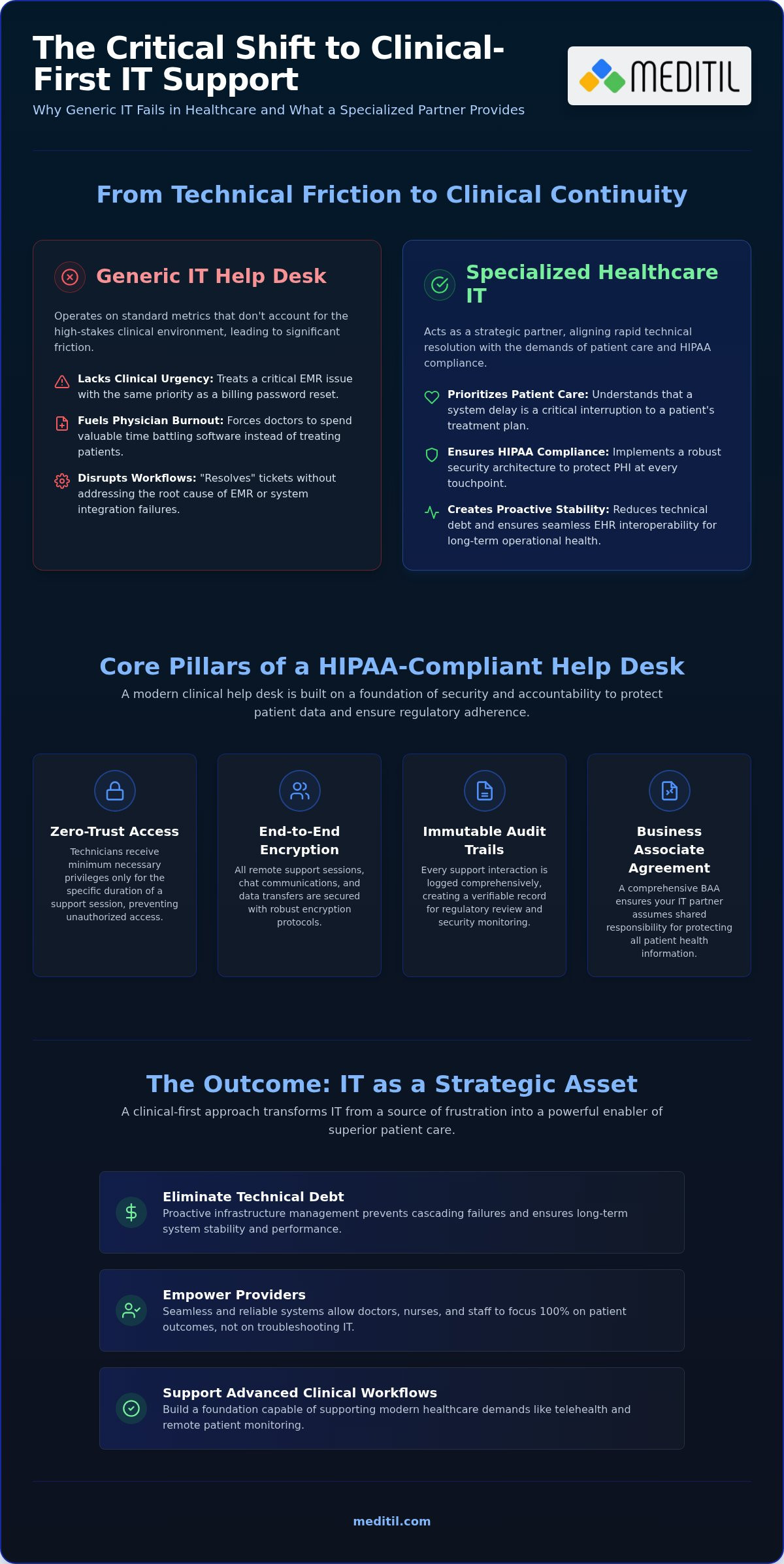
General IT help desks often fail in medical settings because they operate on standard response times that don’t account for clinical urgency. A technician might treat a login issue at a nursing station with the same priority as a password reset in the billing department. This lack of prioritization creates clinical friction, leading to significant provider burnout as physicians spend more time battling software than treating patients. Transitioning from reactive troubleshooting to proactive infrastructure stability is essential for maintaining a steady hand at the wheel of a growing practice.
Defining Clinical Urgency in IT Support
True clinical urgency prioritizes life-critical systems over administrative tasks. When a workstation in an emergency department fails, the impact on patient throughput and satisfaction is immediate and severe. A specialized help desk understands the mission-critical nature of healthcare networks. These teams ensure that diagnostic imaging tools and EMR interfaces remain accessible without interruption. Speed is measured not just in minutes, but in the preservation of the patient-provider relationship and the safety of the care environment.
Moving Beyond the Traditional Ticket System
Traditional metrics like “Time to Resolve” often fail to capture the full story in a medical context. A ticket might be closed technically while the clinical workflow remains disrupted due to poor integration. Specialized healthcare IT help desk solutions incorporate a thorough understanding of how doctors actually use technology during a shift. This expertise allows support teams to anticipate needs and resolve underlying issues before they escalate into systemic failures. By acting as a strategic partner, these specialists help reduce technical debt and stabilize the long-term IT roadmap for the entire organization.
Core Pillars of a HIPAA-Compliant Help Desk Architecture
A robust architecture for healthcare IT help desk solutions must prioritize security at every touchpoint. Traditional support models often rely on shared credentials or permissive remote access, which creates significant vulnerabilities. In contrast, a modern clinical help desk utilizes zero-trust access models. This approach ensures that technicians only have the minimum necessary access for the specific duration of the support session. Every interaction is documented through comprehensive logging and immutable audit trails, providing a verifiable record for regulatory review and continuous compliance monitoring.
Securing Protected Health Information (PHI) During Support
Maintaining the privacy and security of electronic health information requires more than just a password. As of February 16, 2026, new alignment between 42 CFR Part 2 and HIPAA necessitates even stricter handling of patient records across all digital touchpoints. Support sessions must use end-to-end encryption for both remote desktop controls and chat communications. Identity and Access Management (IAM) protocols ensure that only authorized personnel can initiate a support session. Crucially, a Business Associate Agreement (BAA) must cover every support activity to verify that the provider assumes shared responsibility for data protection. If you’re concerned about your current coverage, exploring expert compliance consulting can help identify hidden gaps in your support chain.
EMR/EHR Interoperability and Application Support
A common frustration in medical practices is the “finger-pointing” between software vendors and network providers. When an EMR system lags, the software company blames the network, while the generic IT team blames the application. Specialized healthcare IT help desk solutions eliminate this friction by maintaining deep application-level expertise. These teams understand the nuances of billing automation and integration, allowing them to troubleshoot the entire ecosystem rather than a single component. This holistic view is vital for maintaining clinical continuity during complex updates or system migrations.
For organizations seeking a more comprehensive approach to technology management, reviewing our Managed IT Services for Healthcare: The 2026 Definitive Strategic Guide provides a roadmap for aligning infrastructure with long-term clinical goals. Continuous compliance monitoring should be a standard function of your help desk, not a separate annual event. By integrating security into daily support, practices can focus on patient care with the confidence that their technical foundation is secure and reliable.
Comparing Support Models: In-House vs. Managed Healthcare IT
Deciding between an internal department and managed healthcare IT help desk solutions is a pivotal choice for organizational stability. Building an in-house team requires significant capital for competitive salaries, benefits, and the continuous training necessary to keep pace with evolving HIPAA standards. Beyond the financial investment, providing 24/7 coverage creates a heavy administrative burden that often leads to internal staff burnout. For many providers, the challenge lies in maintaining a full spectrum of expertise, from network security to EMR optimization, within a limited headcount.
Managed IT services offer a more predictable financial model and immediate access to a deep pool of specialists. Companies like Trinexta exemplify this model by providing unlimited support and proactive maintenance to ensure infrastructure stability. These providers act as a steady hand at the wheel, ensuring that your infrastructure remains resilient and compliant without the overhead of a large internal payroll. For organizations that prefer to keep a small internal staff, the “Augmented Team” model offers a sophisticated compromise. This hybrid approach allows external experts to manage complex backend infrastructure and compliance monitoring while your internal team focuses on high-touch clinical support.
Scalability remains a critical factor in this comparison. Healthcare organizations need elastic support that can expand instantly during a merger, a new clinic opening, or a sudden shift to remote patient monitoring. Managed solutions provide this flexibility, allowing you to scale up or down without the delays associated with recruiting and onboarding new employees. This ensures that technical support never becomes a bottleneck for clinical growth.
Strategic IT leadership doesn’t always require a full-time executive salary. A fractional CIO provides the high-level guidance needed to align your technical roadmap with long-term business goals. By utilizing Virtual CIO Services: Strategic IT Leadership for Healthcare in 2026, practices can leverage business intelligence and analytics to improve operational efficiency. This leadership ensures your help desk data isn’t just a log of issues, but a strategic tool for identifying systemic improvements in patient care workflows.
Evaluating Total Cost of Ownership (TCO)
The visible costs of IT support are often just the tip of the iceberg. Technical debt, caused by unpatched software or aging hardware, leads to catastrophic failures and expensive emergency repairs. Proactive management identifies these vulnerabilities before they disrupt clinical continuity. Reviewing our guide on Strategic IT Budgeting for Medical Practices: A 2026 Financial Roadmap helps administrators move from reactive spending to a value-based investment strategy. This approach reduces long-term costs while significantly improving system reliability and security across all support touchpoints.
Strategic Selection Framework for Healthcare IT Solutions
Selecting the right partner for healthcare IT help desk solutions requires a rigorous evaluation process that extends beyond basic technical proficiency. You must verify that a potential provider possesses healthcare-specific security certifications, such as SOC 2 Type II or HITRUST. These aren’t just badges; they represent a verified commitment to the high-stakes data protection your practice requires. With the proposed HIPAA Security Rule updates targeting a July 2027 release, ensuring your partner is already implementing mandatory multi-factor authentication and enhanced encryption is vital for future-proofing your operations.
Evaluation should also focus on the provider’s ability to support modern care delivery models. As telehealth and remote patient monitoring (RPM) become standard, your help desk must be equipped to troubleshoot patient-facing technology and home-based connectivity issues. This requires a level of patience and clarity that generic IT providers often lack. Testing for clinical workflow literacy is equally essential. Ask potential partners how they handle a system failure during a peak rounding period. Their response will reveal whether they understand the mission-critical nature of your daily schedule.
Verification and Audit: Don’t Trust, Confirm
A reliable partner should welcome transparency. Request recent audit logs and compliance reports to verify their internal security posture. It’s also necessary to check references specifically for EMR/EHR implementation and training success. Knowing they’ve successfully managed transitions for other medical practices provides much-needed security. Understanding their specific approach to cybersecurity and compliance ensures they can act as a proactive guide rather than a reactive service. If you’re ready to stabilize your technical environment, you can schedule a strategic consultation with our experts today to discuss your specific needs.
Infrastructure and Network Reliability Standards
Your network is the lifeblood of your practice. Evaluate the provider’s capabilities in managing N+1 redundancy to ensure that a single hardware failure doesn’t lead to a total clinical shutdown. This level of infrastructure management is critical for sustaining billing automation and integration within your support workflows. If these systems fail, your revenue cycle stalls immediately. For a deeper dive into protecting your patient data, review our Healthcare Cybersecurity Services: A Strategic Guide for 2026. Verifying disaster recovery and business continuity protocols completes the selection framework, ensuring your practice remains operational regardless of external technical challenges.
MEDITIL’s Clinical-First Approach to Help Desk Solutions
MEDITIL provides a specialized framework where technical support is fundamentally linked to patient outcomes. Our healthcare IT help desk solutions are designed to function as a clinical enabler rather than a reactive service department. We recognize that every minute a physician spends navigating technical friction is a minute lost to patient care. By creating customized IT roadmaps, we ensure your infrastructure remains stable and your staff remains focused. Our approach integrates infrastructure management, cybersecurity, and end-user support into a single, cohesive strategy that prioritizes the human element of medicine.
Proactive monitoring is a cornerstone of our methodology. We utilize sophisticated tools to identify clinical risks, such as database latency or network bottlenecks, before they manifest as service interruptions. This vigilance directly reduces physician burnout by ensuring that EMR interfaces and diagnostic tools are consistently available and performant. Ultimately, our partnership is built on the principle of improving patient safety through technical excellence and a deep understanding of the high-stakes environment in which you operate.
A Steady Hand at the Wheel: Fractional CIO Leadership
Our fractional CIOs provide the strategic oversight necessary to guide your organization through complex digital transitions. They ensure that daily help desk operations aren’t just isolated incidents, but valuable data points that inform your long-term IT strategy. By integrating business intelligence with support metrics, we help you identify specific opportunities for infrastructure modernization that reduce clinical friction. This leadership ensures that your technology investments are always aligned with your clinical objectives and long-term practice stability.
Ready for the Future of Healthcare IT
The landscape of care delivery is shifting toward decentralized models, including telehealth and remote patient monitoring. MEDITIL is equipped to support this next generation of healthcare technology, ensuring that your digital ecosystem remains interoperable and secure. We manage the complexities of systems integration so your providers can operate seamlessly across various platforms without technical interruption. Our team remains at the forefront of regulatory changes and technical advancements, providing you with a resilient foundation for future growth.
To begin stabilizing your practice’s technical environment and ensuring clinical continuity, contact MEDITIL to secure your strategic IT roadmap today. We are ready to serve as your dedicated partner in technical excellence and patient care.
Advancing Clinical Stability Through Strategic IT Partnership
Achieving seamless clinical continuity requires a departure from generic technical support. You’ve seen how specialized healthcare IT help desk solutions bridge the gap between technical resolution and clinical necessity. By prioritizing zero-trust architecture and deep EMR interoperability, your practice can eliminate the technical friction that often leads to physician burnout. These systems don’t just fix tickets; they protect your patient data and ensure that every digital touchpoint remains fully compliant with evolving HIPAA standards.
MEDITIL serves as a steady hand at the wheel, offering a team of specialized healthcare IT experts dedicated to your long-term success. We provide comprehensive HIPAA compliance management and clinical workflow-first support protocols designed to stabilize your infrastructure. This proactive approach allows your providers to return their full attention to patient care without the distraction of unreliable technology. It’s time to transform your IT department into a strategic asset that supports both organizational growth and patient safety.
Secure Your Strategic IT Roadmap with MEDITIL today. We’re ready to help you build a resilient technical foundation for the future of your practice.
Frequently Asked Questions
What is the difference between a general IT help desk and a healthcare IT help desk?
A healthcare IT help desk prioritizes clinical urgency and regulatory standards over standard technical metrics. While a general desk might treat all tickets equally, a healthcare-focused solution understands that a workstation failure in an exam room is more critical than a billing printer issue. These specialists possess deep knowledge of medical workflows and the specific interoperability requirements of clinical systems. This specialized expertise ensures that technical resolutions never compromise patient safety or clinical throughput.
How do healthcare IT help desk solutions ensure HIPAA compliance?
Specialized healthcare IT help desk solutions maintain HIPAA compliance through rigid technical and administrative safeguards. This includes utilizing zero-trust access models for remote support sessions and ensuring all technician activity is documented in immutable audit trails. Every support interaction is protected by a Business Associate Agreement (BAA). These protocols ensure that protected health information (PHI) remains secure during troubleshooting, meeting the latest federal standards for data encryption and identity management.
Can a managed IT service provider support our specific EMR or EHR software?
Managed IT partners provide extensive healthcare application support for various EMR and EHR systems. Although they don’t sell the software directly, they specialize in implementation, training, and optimizing interoperability within your existing infrastructure. This expertise helps resolve the “finger-pointing” between software vendors and network providers. By managing the integration of these systems, the help desk ensures that clinical data flows securely and efficiently across your entire digital ecosystem.
What is a fractional CIO, and do I need one for my medical practice?
A fractional CIO is a strategic leader who provides executive-level IT guidance on a contract basis. Your medical practice needs this role to align technical infrastructure with long-term business intelligence and clinical objectives. Instead of focusing solely on daily repairs, a fractional CIO acts as a steady hand at the wheel. They oversee strategic budgeting, compliance roadmaps, and the selection of advanced technologies like telehealth and remote monitoring solutions.
How does outsourced IT support handle emergency clinical downtime?
Outsourced support manages emergency downtime through proactive monitoring and established disaster recovery protocols. Specialized technicians identify potential hardware or network failures before they cause a clinical shutdown. If an outage occurs, the help desk prioritizes life-critical systems to restore clinical continuity immediately. This methodical approach reduces the risk of data loss and ensures that providers can return to patient care with minimal interruption to their daily workflows.
What are the benefits of an augmented IT team for mid-sized healthcare clinics?
An augmented IT team model allows mid-sized clinics to scale their technical capabilities without the overhead of hiring full-time specialists. This approach bridges the gap between your internal staff and external experts who manage complex backend infrastructure and cybersecurity. It provides access to a broader range of expertise, such as systems integration and billing automation. Your practice gains the elasticity needed for expansion while maintaining a high level of support for end-users.
How much do healthcare IT help desk solutions typically cost?
The investment for healthcare IT help desk solutions depends on the specific needs of your organization, including the volume of users and the complexity of your network. Most managed service providers offer predictable monthly budgeting models that replace the hidden costs of technical debt and emergency repairs. For example, nubivio.nl provides integrated IT and cybersecurity services at a fixed monthly rate, allowing practices to plan their financial roadmap with precision. It ensures that technical support remains a stable operational expense rather than a series of unpredictable costs.
Essential security protocols for remote support include mandatory multi-factor authentication and high-level data encryption. You should verify that the tool allows for granular access controls, ensuring technicians only see what is necessary for the specific support session. Additionally, the software must generate comprehensive logs that record every action taken during the session. These protocols are necessary to maintain a verifiable audit trail and protect the privacy of electronic health information.