
In the first half of 2026 alone, 281 healthcare data breaches have already compromised the records of nearly 12 million individuals. You likely recognize that a system failure is far more than a technical inconvenience; it’s a direct threat to patient safety and your organization’s regulatory standing. Developing a robust healthcare business continuity plan is no longer a secondary task for the IT department. It’s a fundamental requirement for clinical resilience in an increasingly volatile environment.
You’ve probably felt the weight of overwhelming HIPAA and CMS requirements or struggled to identify which systems are truly essential when every minute counts. We understand these pressures and the need for a steady hand to guide your strategic planning. This guide provides a professional roadmap designed to help you master these complexities and maintain clinical uptime during any disruption. We’ll explore a strategic IT framework that clarifies regulatory expectations, minimizes operational friction, and validates the stability of your current infrastructure for the year ahead.
Key Takeaways
- Distinguish between technical Disaster Recovery and a process-oriented healthcare business continuity plan to prioritize patient care over simple data restoration.
- Identify your organization’s “Critical Path” by conducting a modern Business Impact Analysis that maps essential clinical and administrative functions.
- Evaluate internal and external risks within the 2026 “Polycrisis” landscape, including regional infrastructure failures and evolving cybersecurity threats.
- Establish clear response strategies that define leadership succession and backup communication protocols to maintain stability when primary systems fail.
- Discover how Fractional CIO leadership provides the strategic oversight necessary to audit, test, and refine your organizational resilience framework.
Understanding the Healthcare Business Continuity Plan (BCP) vs. Disaster Recovery
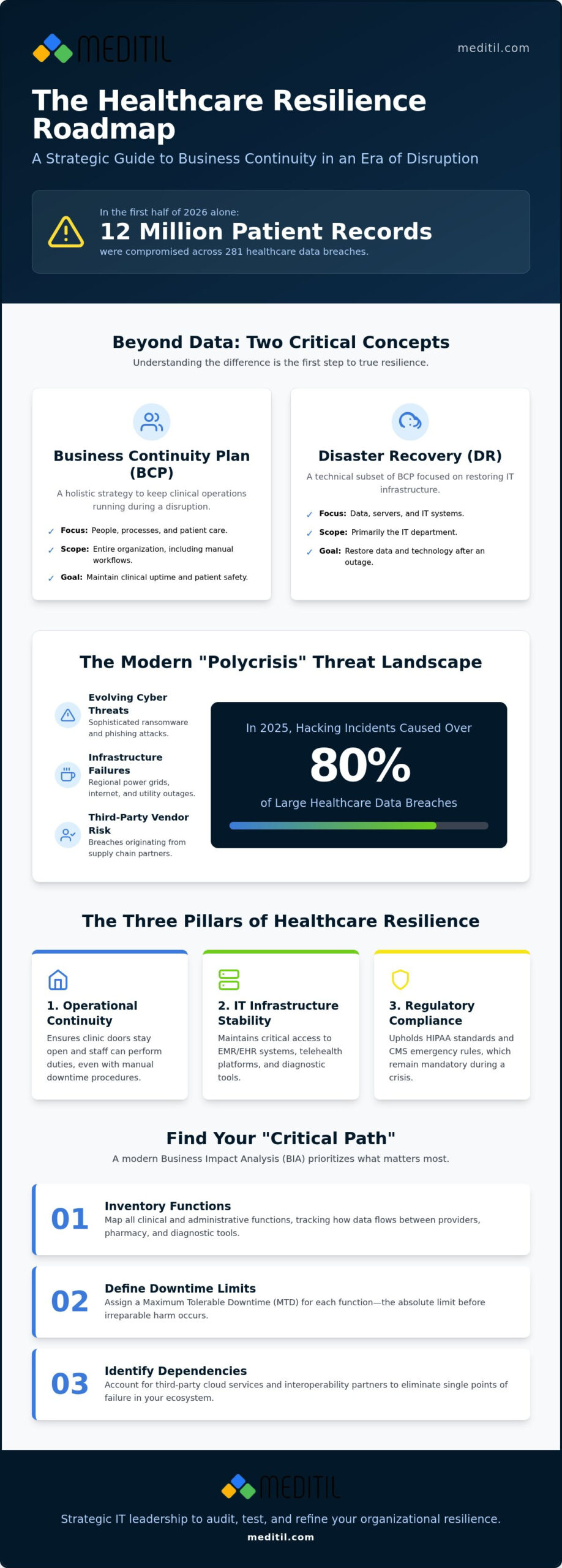
A healthcare business continuity plan serves as the tactical framework for maintaining clinical operations during any disruption, whether it’s a localized hardware failure or a regional disaster. While many administrators use the terms interchangeably, there’s a fundamental distinction between this plan and Disaster Recovery. Disaster recovery is a technical subset focused specifically on the restoration of data and IT systems. In contrast, business continuity encompasses the people, processes, and logistical workflows required to deliver patient care when those systems are unavailable.
For larger health systems and public health entities, this strategy often extends into Continuity of Operations (COOP). COOP focuses on the preservation of essential functions during large-scale emergencies, ensuring that the chain of command and critical service delivery remain intact. In the healthcare sector, these stakes are “life-critical.” Unlike a retail business that can pause transactions, a hospital must maintain clinical uptime to prevent patient harm. In 2025, hacking incidents accounted for over 80% of large healthcare data breaches, proving that the BCP is an essential component of patient safety. Technical outages often lead to delayed treatments or diagnostic errors, making proactive planning a moral and clinical imperative.
The Three Pillars of Healthcare Resilience
Effective resilience relies on three distinct but interconnected pillars. First, operational continuity ensures that clinic doors remain open and staff can perform their duties through manual downtime procedures. Second, IT infrastructure stability focuses on maintaining access to EMR/EHR systems and telehealth platforms. Third, regulatory compliance remains mandatory even during a crisis. Your organization must continue to uphold HIPAA standards and CMS emergency preparedness rules, regardless of the operational pressure. These pillars work together to create a stable environment where clinicians can focus on care rather than infrastructure failure.
Why Your Existing Backups Are Not a BCP
Relying solely on data backups is a common strategic error. While backups preserve information, they don’t provide a roadmap for staff coordination or clinical workflow transitions. Technical debt, the accumulated cost of choosing easy but short-term IT solutions, often acts as a silent barrier to resilience. Legacy systems create friction during recovery efforts, making it difficult to meet the 72-hour data restoration timelines proposed in recent regulatory updates. Establishing a foundation through managed it services for healthcare ensures that your infrastructure is designed for rapid restoration and seamless connectivity. A true healthcare business continuity plan addresses the human element, detailing exactly who makes decisions and how communication flows when primary channels fail.
Conducting a 2026 Healthcare Business Impact Analysis (BIA)
A successful healthcare business continuity plan relies on the accuracy of its Business Impact Analysis (BIA). This process identifies the “Critical Path” of patient care, determining which functions must remain active to prevent clinical harm. You can’t protect everything with equal intensity. The BIA provides the data needed to prioritize resources effectively, ensuring that the most vital operations receive the strongest safeguards.
The first step involves a comprehensive inventory of all clinical and administrative functions. This goes beyond simple department lists; it requires mapping how data flows between providers, pharmacy systems, and diagnostic tools. Once you’ve mapped these functions, you must assign a Maximum Tolerable Downtime (MTD) for each. This metric represents the absolute limit an organization can endure before the disruption causes irreparable harm to patients or the business itself. Finally, you must identify dependencies. In 2026, many breaches originate from third-party vendors. Your BIA must account for cloud services and interoperability partners to ensure no single point of failure exists within your ecosystem.
Identifying Critical Clinical Functions
Prioritizing clinical systems is the most sensitive aspect of the analysis. Access to the EMR, pharmacy dispensing systems, and diagnostic imaging represents the core of patient safety. Downtime in these areas creates immediate clinical friction, increasing the risk of medication errors or delayed interventions. You must establish a Recovery Time Objective (RTO) for these life-critical systems. While the 2026 proposed HIPAA updates suggest a 72-hour restoration window for data, clinical reality often demands an RTO of minutes rather than days. Evaluating these requirements helps you build an infrastructure that supports immediate care needs during a crisis.
Assessing Financial and Administrative Impact
Operational resilience also requires financial stability. Failures in billing automation or revenue cycle management can quickly lead to cash flow crises. Beyond lost revenue, the legal risks are substantial. In 2026, HIPAA violation penalties range from $145 to $73,011 per violation, with an annual cap exceeding $2.1 million. Prolonged unavailability of protected health information isn’t just an IT issue; it’s a significant legal liability. Within this context, MTD is the maximum duration a financial or administrative process can be suspended before the resulting losses threaten the organization’s viability. If you need help identifying these critical thresholds, our project-based IT consulting services can provide the strategic clarity required for a resilient framework.
The Healthcare Risk Assessment: Modern Threats to Continuity
A resilient healthcare business continuity plan must account for the current “Polycrisis” landscape, where natural disasters, sophisticated cyberattacks, and infrastructure failures often occur simultaneously. In 2025, the industry saw a record 772 large data breaches, proving that the threat environment is more volatile than ever. Assessing these risks requires a dual focus on internal and external vulnerabilities. External risks include regional power outages or supply chain disruptions affecting specialized medical equipment. Internal risks often involve staff shortages or the failure of aging on-site hardware. Managing these workforce challenges effectively, with support from experts like Altum HR, is crucial for maintaining operational stability during a crisis. By scoring these threats based on likelihood and potential impact, medical practices can prioritize their defensive investments where they’re most needed.
In 2026, AI-driven ransomware has fundamentally changed how organizations must respond to digital threats. Traditional recovery protocols from 2020 are often insufficient against modern attacks that target backup integrity and automate lateral movement. Utilizing professional healthcare cybersecurity services is a vital step in mitigating these triggers before they necessitate full BCP activation. Your breach protocols should allow for continued clinical operations even while an incident is being contained. This requires isolated network segments and verified manual downtime procedures that ensure patient care doesn’t stop when the network is compromised. Robust network security services act as the first line of defense, reducing the probability of a catastrophic system failure.
Physical and Infrastructure Redundancy
Physical stability remains a cornerstone of clinical uptime. Implementing N+1 redundancy in clinical hubs ensures that power, HVAC, and connectivity systems have at least one independent backup available at all times. Beyond the facility walls, you must evaluate supply chain vulnerabilities. A disruption at a single third-party billing company or EHR provider can have cascading effects on your operations. Telehealth serves as a powerful BCP strategy in this context. If a physical location is compromised by a natural disaster or utility failure, shifting to remote care allows for the continuation of essential services. This flexibility minimizes clinical friction and maintains patient safety when the traditional environment is no longer viable.
Developing Your Healthcare Response and Recovery Strategies
Establishing a response strategy is the operational core of your healthcare business continuity plan. It transforms theoretical risks into actionable steps for your staff. A dedicated Continuity Team must be formed with clearly defined roles and a robust succession plan. If a key decision-maker is unavailable, the chain of command must remain unambiguous to prevent delays in clinical care. This structure ensures that every department knows exactly who is authorized to activate downtime procedures.
Communication protocols are equally vital. You can’t rely on primary email or VOIP systems during a cyber incident or infrastructure failure. Alternative channels, such as encrypted messaging apps or satellite-based systems, should be established in advance. These tools allow you to notify staff, patients, and regulators without compromising security. Maintaining these secondary lines of communication is essential for managing clinical friction when your standard digital environment is compromised.
Staff must be trained on manual, paper-based workarounds to maintain patient care during a digital blackout. This includes physical charting, manual prescription writing, and offline patient tracking. Once the disruption ends, the “Return to Normal” phase begins. This involves safely reintegrating data into the EMR and verifying the integrity of restored records before resuming full digital operations. A methodical approach to data re-entry prevents synchronization errors that could lead to clinical mistakes later.
The Incident Command System (ICS) for Clinics
The Incident Command System provides a structured hierarchy for crisis management. While often used in large-scale emergencies, it’s highly effective when adapted for a private medical practice environment. The Incident Commander oversees the entire response, while the Safety Officer focuses on clinical risks and HIPAA compliance. Establishing a physical or virtual Command Center serves as the single source of truth, ensuring that all departments receive consistent updates and directives during the crisis.
Vendor and Interoperability Management
Managing third-party dependencies is a critical component of 2026 resilience. Maintain an Essential Vendor list with 24/7 contact information for all mission-critical partners, including cloud providers and billing services. When one system remains offline, interoperability solutions must be managed carefully to prevent data silos or synchronization errors. Every vendor contract should explicitly require N+1 redundancy to ensure their service stability matches your organizational needs. If you’re ready to strengthen your operational resilience, our managed IT services provide the expert guidance needed to build a comprehensive recovery strategy.
Fractional CIO Leadership: Orchestrating the Continuity Roadmap
A healthcare business continuity plan is only as effective as the leadership orchestrating its execution. Many organizations struggle when they treat resiliency as a static administrative checklist rather than a dynamic strategic asset. Without a dedicated leader to bridge the gap between clinical operations and technical capabilities, even the most detailed plans often fail during a crisis. Strategic oversight ensures that the BCP isn’t an isolated IT project; it’s a core component of your mission to provide uninterrupted patient care.
Professional virtual CIO services provide the expertise required to audit and test these complex frameworks. A vCIO acts as a strategic partner, ensuring that your continuity roadmap aligns with both your clinical goals and regulatory obligations. They move the organization beyond simple compliance by facilitating annual testing and tabletop exercises. These simulations transform a passive document into a living strategy, allowing your team to practice their response in a controlled environment before a real-world disruption occurs.
Budgetary alignment is another area where strategic leadership provides immense value. Integrating BCP requirements into the strategic IT budgeting process ensures that infrastructure upgrades and redundant systems are funded as essential clinical priorities. This proactive approach prevents the technical debt that often leads to BCP failure, providing the financial roadmap needed to maintain a high-performing and resilient environment.
The vCIO as a Continuity Architect
Fractional leadership serves as the architect of your organization’s resilience. By bridging the gap between clinical needs and IT infrastructure, a vCIO ensures that technical solutions actually support frontline providers during a blackout. They lead professional tabletop exercises to stress-test the BCP, identifying gaps in communication or succession planning. As your practice grows, the vCIO ensures the BCP evolves alongside new EMR implementations or system integrations, preventing your continuity strategy from becoming obsolete as your technology stack changes.
Managed IT: The Tactical Engine of Continuity
While the vCIO provides the strategy, ongoing managed IT services act as the tactical engine that keeps the plan operational. These services reduce the likelihood of BCP activation through proactive monitoring and infrastructure maintenance. During an incident, the help desk plays a critical role in executing the communication plan, serving as the frontline for staff support and status updates. This coordinated effort ensures that clinical friction is minimized and patient safety is preserved. Ensure your practice is resilient. Partner with MEDITIL for professional healthcare BCP guidance.
Strengthening Your Foundation for Clinical Resilience
Developing a comprehensive healthcare business continuity plan is a fundamental requirement for protecting patient safety and maintaining clinical uptime. We’ve established that true resilience extends beyond technical backups; it requires a deep understanding of your organization’s critical path and the people who navigate it. By prioritizing a strategic Business Impact Analysis and integrating fractional CIO leadership, you ensure your practice is prepared for the sophisticated threats of the 2026 landscape.
A proactive approach to infrastructure stability and HIPAA-compliant management provides the security your clinicians and patients rely on. At MEDITIL, we offer the mission-driven focus and technical expertise needed to orchestrate your continuity roadmap with precision. Our strategic consulting services help you bridge the gap between complex regulatory requirements and seamless operational execution.
Secure Your Clinical Operations with MEDITIL Strategic Consulting. You don’t have to manage these high-stakes challenges in isolation. With a steady partner at your side, you can build a stable, resilient future for your practice and the community you serve.
Frequently Asked Questions
What are the 4 elements of a healthcare business continuity plan?
A comprehensive plan consists of a risk assessment, a business impact analysis (BIA), recovery strategies, and ongoing plan maintenance through regular testing. The risk assessment identifies potential threats like cyberattacks or power outages. The BIA determines how downtime affects patient care. Recovery strategies provide the tactical workarounds for both technical and clinical staff. Finally, maintenance ensures the plan stays current as your IT infrastructure and regulatory requirements evolve.
Is a business continuity plan a HIPAA requirement?
Yes, a contingency plan is a mandatory standard under the HIPAA Security Rule. Covered entities must establish a data backup plan, a disaster recovery plan, and an emergency mode operation plan. Failing to maintain a robust healthcare business continuity plan can lead to significant legal consequences. In 2026, HIPAA violation penalties can reach $73,011 per violation, with an annual cap exceeding $2.1 million per provision for non-compliance.
How often should a medical practice test its business continuity plan?
Medical practices should conduct formal testing of their BCP at least once per year. Annual tabletop exercises or full-scale simulations help ensure that every staff member understands their specific role during a crisis. It’s also vital to review and update the plan whenever you make significant changes to your environment. This includes shifting to new cloud services, implementing a different EMR, or undergoing a major network infrastructure upgrade.
What is the difference between a BCP and a COOP in healthcare?
A BCP focuses on maintaining specific clinical and business processes, while a COOP (Continuity of Operations) focuses on preserving an organization’s essential leadership and mission-critical functions during a large-scale emergency. BCPs are tactical and process-oriented for daily resilience. COOPs are broader and typically used by government agencies or large health systems to ensure the chain of command remains intact during regional disasters or long-term disruptions.
What are considered essential functions in a clinical BIA?
Essential functions include any process that directly impacts patient safety, clinical decision-making, or legal compliance. Primary examples are EMR access, pharmacy dispensing systems, and diagnostic imaging results. While administrative tasks like billing automation are important for financial stability, life-critical systems always receive the highest priority. Identifying these functions during the BIA allows you to allocate resources effectively and set realistic recovery time objectives for your most vital operations.
How can a fractional CIO help with business continuity?
A fractional CIO provides the strategic leadership required to design and orchestrate a resilient IT framework. They bridge the gap between clinical needs and technical capabilities, ensuring that your continuity roadmap is both practical and effective. By integrating resiliency into your strategic IT budgeting, a fractional CIO ensures that necessary redundancies are funded. They also lead professional tabletop exercises that transform your static document into a living, tested strategy.
What happens if a healthcare provider does not have a BCP?
Providers without a BCP face increased risks of patient harm, prolonged clinical downtime, and severe financial losses. During a system failure, the absence of clear protocols creates operational friction and delays care delivery. Beyond clinical risks, organizations face massive regulatory penalties and potential lawsuits. Data from 2025 indicates the average cost of a healthcare data breach was $7.42 million, a figure that continues to rise for unprepared organizations.
How do you prioritize patient care during a total IT system failure?
Prioritization begins with the immediate activation of pre-defined manual downtime procedures for life-critical functions. Clinicians shift to paper-based charting and manual prescription writing while the Continuity Team manages the technical recovery process. By following the “Critical Path” established in your BIA, you ensure that systems impacting the most vulnerable patients are restored first. This methodical approach minimizes the impact of a digital blackout and maintains the highest standards of safety.