
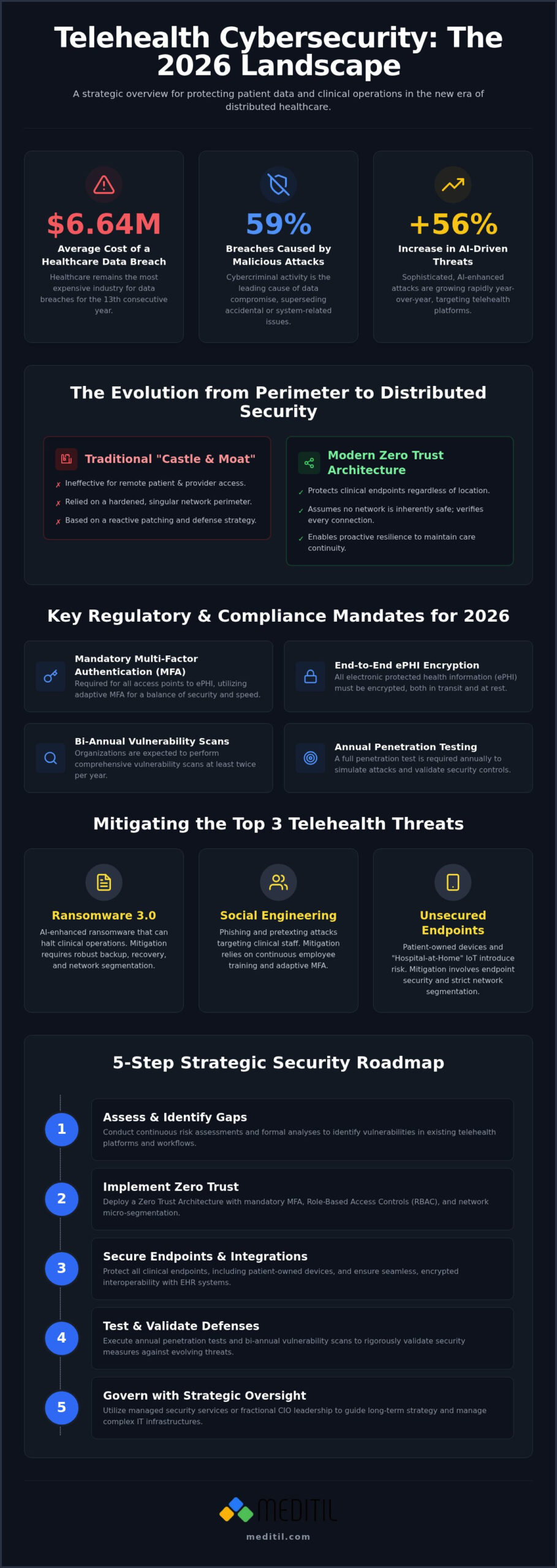
In 2026, the average cost of a healthcare data breach has reached $6.64 million, marking the thirteenth consecutive year that your industry has been the most expensive target for cybercriminals. This staggering figure highlights why implementing sophisticated telehealth cybersecurity solutions is no longer just a technical checkbox; it’s a fundamental requirement for patient safety and organizational stability. You’re likely managing the constant tension between expanding remote access and the terrifying prospect of a HIPAA violation or a ransomware attack that halts clinical operations.
We understand the complexity of securing patient-owned devices and the frustration of fragmented IT systems that refuse to communicate securely. This guide provides a clear, strategic roadmap to help you navigate the 2026 regulatory environment, including mandatory MFA and annual penetration testing requirements. You’ll discover how to build a resilient infrastructure that protects ePHI while maintaining seamless integration between your telehealth platforms and EHR systems. By the end of this article, you’ll have a professional framework to reduce risk and ensure your clinical team remains focused on care rather than connectivity gaps.
Key Takeaways
- Transition from traditional perimeter-based security to a distributed model that protects clinical endpoints regardless of their physical location.
- Modernize your telehealth cybersecurity solutions by integrating Zero Trust Architecture and mandatory multi-factor authentication to meet 2026 standards.
- Mitigate advanced “Ransomware 3.0” and social engineering threats through a formalized, five-step security roadmap and continuous risk assessments.
- Maintain HIPAA compliance and clinical efficiency by ensuring seamless, encrypted interoperability between remote care platforms and your existing EHR systems.
- Utilize fractional CIO leadership to provide the strategic oversight necessary for managing complex IT infrastructures and long-term security objectives.
The Evolution of Telehealth Cybersecurity Solutions in 2026
The clinical landscape has moved beyond the physical walls of the medical office. The Evolution of Telehealth has transitioned care delivery into the unpredictable digital infrastructure of patient homes. This shift has fundamentally altered the requirements for telehealth cybersecurity solutions. In 2026, malicious attacks cause 59% of healthcare data breaches, and AI-driven threats have increased by 56% year-over-year. These statistics prove that the modern attack surface is now as distributed as the patients you serve.
Traditional perimeter-based security models relied on a “castle and moat” strategy, which is ineffective when providers and patients connect through unmanaged networks. We’ve moved into an era where reactive patching is insufficient. Organizations now prioritize proactive clinical resilience, designing systems that anticipate failures to maintain care continuity. Telehealth cybersecurity is the integration of clinical workflow and data protection.
The Expanding Surface of Remote Care
Securing patient portals and mobile health (mHealth) applications requires more than just encrypted logins; it necessitates verifying the integrity of the device itself. Consumer-grade smart home devices, such as voice assistants, introduce significant privacy risks when integrated into clinical monitoring. This creates the “Hospital-at-Home” paradox. We’re delivering high-acuity care over infrastructure that lacks enterprise-grade protection. Every connected device in a patient’s living room is a potential entry point for lateral movement within your network if not properly segmented.
Regulatory Expectations for 2026
Compliance requirements have sharpened significantly this year. The 2026 HIPAA updates mandate encryption for all electronic protected health information (ePHI) and require multi-factor authentication for all access points. Adhering to the NIST Cybersecurity Framework 2.0 is the baseline for any organization deploying telehealth cybersecurity solutions. Current regulations expect vulnerability scans at least twice per year and full annual penetration testing. While these standards are rigorous, remember that compliance is the floor for operational stability, not the ceiling for patient safety. Relying solely on meeting the minimum legal requirements leaves your organization vulnerable to the sophisticated, AI-enhanced ransomware tactics prevalent today.
Core Components of a Robust Telehealth Security Architecture
A robust security posture for virtual care starts with the assumption that no network, internal or external, is inherently safe. This shift toward Zero Trust Architecture ensures that every clinical connection is verified through continuous authentication and granular authorization. Implementing these telehealth cybersecurity solutions requires a technical stack that supports end-to-end encryption for both real-time video consultations and asynchronous messaging. According to the NIST telehealth security framework, securing these pathways is vital as organizations integrate more IoT and smart home devices into their care models.
Strategic oversight is essential when protecting life-critical systems. Many organizations find that partnering for specialized healthcare cybersecurity services provides the technical depth needed to manage these complex environments. This partnership ensures that security protocols don’t hinder the speed of care. Our approach acts as a steady hand at the wheel, allowing your clinical teams to focus on patient outcomes while we manage the underlying infrastructure.
Identity and Access Management (IAM)
The “last mile” of the patient connection is often the most vulnerable segment of the telehealth ecosystem. Secure endpoint management involves deploying Mobile Device Management (MDM) for all provider tablets and smartphones. This allows IT teams to enforce security policies and perform remote wipes if a device is lost. Patching remote devices is a delicate operation; it must occur without interrupting active clinical sessions. In a “Hospital-at-Home” model, the security of the patient’s device is just as critical as the provider’s. Implementing light-weight, compliant agents on patient-facing apps can help verify the security health of the connection before data transmission begins. Organizations looking to stabilize these distributed environments often benefit from managed IT services to maintain continuous endpoint oversight.
Mitigating the Top 3 Threats to Telehealth Platforms
The threat landscape for 2026 has transitioned from broad, opportunistic attacks to highly targeted campaigns. As organizations evaluate HHS telehealth privacy and security risks, three distinct categories of threats emerge as primary concerns for 2026. Ransomware 3.0 represents a significant evolution where attackers don’t just encrypt data; they exfiltrate sensitive clinical databases to use as leverage for extortion. This double-extortion tactic directly targets the integrity of your telehealth cybersecurity solutions.
Sophisticated phishing remains the most common entry point. Attackers now use AI-generated social engineering to impersonate hospital leadership or vendors, tricking clinicians into bypassing security protocols. Additionally, insider threats pose a unique challenge in high-turnover environments. Managing data access for departing staff is critical to prevent unauthorized data removal. To counter these evolving risks, many organizations utilize managed it services for healthcare to provide the 24/7 monitoring required to catch threats before they impact clinical care.
Ransomware Prevention and Recovery
Effective defense against Ransomware 3.0 requires moving beyond simple backups. Immutable backups are now a clinical necessity. These backups cannot be altered or deleted by attackers, ensuring you can restore systems without paying a ransom. We also emphasize network segmentation. By isolating telehealth databases from the rest of the administrative network, you contain potential infections and prevent lateral movement. Every organization needs a formalized incident response plan specifically for telehealth outages. This plan should detail how to maintain care continuity if the primary virtual platform is compromised.
Advanced Threat Detection
Traditional signature-based antivirus is no longer sufficient. Modern telehealth cybersecurity solutions rely on AI and machine learning to identify abnormal traffic patterns that signal a breach in progress. Integrating a Security Information and Event Management (SIEM) system allows medical practices to aggregate logs from disparate systems into a single view. This visibility is essential for proactive vulnerability scanning of telehealth APIs. Because these APIs connect your telehealth platform to EHR systems, they are frequent targets for exploitation. Continuous scanning ensures that any new vulnerabilities are identified and remediated before they can be leveraged by external actors.
Implementing a 5-Step Telehealth Security Roadmap
Securing a virtual care environment requires a methodical progression from initial assessment to the establishment of a resilient security culture. In 2026, the complexity of remote care demands a structured approach that moves beyond basic compliance. Organizations must adopt telehealth cybersecurity solutions that protect patient data without hindering the provider’s ability to deliver timely care. This roadmap provides a disciplined framework for stabilizing your infrastructure and preparing for the stricter regulatory requirements of the current year.
Audit and Risk Assessment
Step 1 begins with a comprehensive, telehealth-specific risk assessment. This process identifies data silos that often create security blind spots, particularly where patient information is stored outside the primary EHR. You must evaluate the security protocols of every third-party vendor in your ecosystem. Documenting these findings is essential for 2026 HIPAA audits, which now emphasize the security of electronic protected health information (ePHI) across all transmission points. We recommend conducting vulnerability scans at least twice per year and full penetration testing annually to maintain a steady hand at the wheel of your security posture.
Workflow-Integrated Security
Step 2 involves formalizing security for remote clinical workflows, ensuring that protocols are embedded into the daily operations of your staff. Step 3 focuses on secure interoperability between telehealth platforms, EHR systems, and billing automation. While billing automation increases efficiency, it also expands your attack surface. Every connection point between these systems must be secured with hardened APIs to prevent unauthorized data exfiltration. Step 4 requires the deployment of continuous monitoring and endpoint protection to detect anomalies in real-time. Finally, Step 5 establishes an ongoing security culture through staff training. Providers must be proficient in secure remote care best practices, such as verifying patient identities and securing their home work environments.
As you refine your clinical workflows and patient intake processes, you might check out Meridu to explore how a customizable booking portal can serve as a professional and secure starting point for your telehealth services.
Automating security updates is a vital component of this roadmap. It minimizes the manual IT workload and ensures that patches are applied consistently across all distributed devices. By integrating these tools directly into clinical workflows, you reduce “clinical friction” and allow your team to focus on patient outcomes. If you are ready to modernize your infrastructure, we can help you implement a customized security framework tailored to your organization’s unique requirements. This proactive strategy ensures that your telehealth services remain both compliant and operationally resilient against evolving threats.
The Strategic Advantage of Managed Security and Fractional Leadership
Internal IT teams often find themselves overwhelmed by the rapid pace of virtual care innovation. While these teams are proficient at maintaining local networks, the distributed nature of modern telehealth cybersecurity solutions requires a level of specialized oversight that goes beyond daily maintenance. The capacity gap is real. Between managing EMR implementations and providing day-to-day support, internal staff rarely have the bandwidth to architect the complex, Zero Trust environments required in 2026. Augmenting your organization with healthcare-specific IT expertise ensures that your infrastructure remains resilient against the sophisticated, AI-driven threats we’ve analyzed.
Fractional CIO: Strategic Oversight
Integrating virtual cio services provides the high-level leadership necessary to secure your long-term IT roadmap. A fractional CIO doesn’t just manage hardware; they align your cybersecurity budget with clinical growth goals to ensure that every dollar spent on technology supports better patient outcomes. This role is vital for managing the complexity of multiple telehealth integrations. They ensure that every new platform or API connection adheres to your organization’s rigorous security standards. By acting as a steady hand at the wheel, a fractional CIO guides your organization through digital transformation while preventing the security gaps that often occur during rapid scaling.
Managed IT: Operational Excellence
Operational excellence is the backbone of patient trust and clinical efficiency. Managed IT services provide 24/7 help desk support, which is critical for remote providers who may encounter technical issues outside of standard office hours. This continuous availability ensures that technology remains an enabler of care rather than a barrier; you can learn more about managed IT support for small and medium-sized businesses to maintain this level of performance. Key benefits include:
- Seamless Network Management: Optimizing bandwidth for high-volume virtual care to prevent video latency or connectivity drops.
- Reducing Technical Debt: Proactively replacing legacy systems that are no longer patchable, which significantly improves overall system stability.
- Continuous Monitoring: Utilizing advanced threat detection to identify anomalies before they escalate into breaches.
Ultimately, positioning your organization’s commitment to security becomes a competitive advantage. Patients in 2026 are increasingly aware of data risks and the impact of breaches on their personal safety. When you can demonstrate that your virtual care infrastructure is managed by specialized experts, you build a level of trust that facilitates long-term patient retention. Cybersecurity isn’t just a technical requirement; it’s a foundational element of the patient-provider relationship.
Building Clinical Resilience Through Strategic Security
The transition to distributed care delivery requires a fundamental shift in how your organization approaches telehealth cybersecurity solutions. The move from perimeter-based defense to a Zero Trust model is no longer optional in 2026. By implementing a structured 5-step roadmap, you can protect sensitive ePHI while ensuring that security protocols don’t impede clinical efficiency. The complexity of these systems demands a steady hand at the wheel to navigate evolving ransomware tactics and stricter HIPAA requirements.
Strategic oversight is the differentiator between a reactive posture and true operational stability. MEDITIL offers a specialized healthcare IT focus that combines fractional CIO leadership with end-to-end managed security services. This partnership allows your internal team to focus on patient outcomes while we handle the technical intricacies of infrastructure protection and regulatory compliance. It’s time to transform your security posture from a technical obligation into a competitive advantage for patient trust.
Secure your telehealth roadmap with MEDITIL’s expert IT consulting and build a resilient foundation for the future of virtual care. Your commitment to robust security today ensures a safer, more stable environment for your providers and patients tomorrow.
Frequently Asked Questions
Is telehealth more vulnerable to cyberattacks than in-person care?
Telehealth expands your organization’s attack surface to unmanaged home networks and patient-owned devices, which naturally increases risk. While in-person care relies on a defined physical perimeter, telehealth depends on distributed endpoints that are often outside your direct control. Implementing robust telehealth cybersecurity solutions is essential to manage these remote connections. Because malicious attacks cause 59% of healthcare data breaches, specialized oversight is required to ensure remote care remains as secure as a traditional clinic visit.
What are the minimum HIPAA requirements for telehealth security in 2026?
In 2026, minimum requirements have become more stringent to counter evolving threats. Mandatory encryption for all ePHI and the implementation of multi-factor authentication (MFA) for all access points are now standard. Organizations must also conduct vulnerability scans at least twice per year and perform full penetration testing annually. Adhering to the NIST Cybersecurity Framework 2.0 provides the necessary governance baseline. It is vital to remember that compliance is the floor for patient safety, not the ceiling.
How can I secure patient-owned devices used for remote monitoring?
Securing patient-owned devices involves deploying lightweight, compliant agents or secure application wrappers that verify a device’s security health before data transmission occurs. We focus on securing the “last mile” by ensuring patient-facing applications utilize end-to-end encryption. While you cannot manage the patient’s physical hardware, you can enforce rigorous security policies within the clinical application itself. This prevents data leaks on unmanaged endpoints while maintaining a seamless user experience for the patient.
What is a Fractional CIO and how do they help with telehealth security?
A Fractional CIO is a strategic leader who provides high-level IT guidance on a part-time or project basis. They assist healthcare organizations by aligning technology budgets with clinical growth and managing the complexity of telehealth integrations. This role acts as a steady hand at the wheel, ensuring your security roadmap is proactive rather than reactive. They provide the expert oversight necessary to ensure that all infrastructure and network services meet the highest regulatory and security standards.
How does interoperability between telehealth and EHR impact cybersecurity?
Interoperability creates additional connection points, which can increase risk if those pathways are not properly managed. Every API that bridges your telehealth platform and EHR must be hardened and monitored to prevent unauthorized data exfiltration. However, seamless integration also improves data accuracy and care continuity. Balancing these factors requires specialized systems integration expertise. This ensures that interoperability enhances clinical workflows without compromising your organization’s overall security posture or the integrity of patient records.
What should be in a telehealth incident response plan?
A telehealth-specific incident response plan must include protocols for maintaining care continuity during a platform outage. Key components include:
- Defined roles and responsibilities for the incident response team.
- Specific timelines for system restoration and regulatory notification.
- Procedures for switching to secondary, secure communication channels.
- Steps for isolating affected network segments to prevent the lateral movement of threats like ransomware.
Regularly testing this plan ensures your team remains prepared for any disruption.
Can managed IT services help reduce our cybersecurity insurance premiums?
Yes, insurers often offer more favorable rates to organizations that demonstrate a high level of security maturity. By utilizing managed IT services, you provide evidence of 24/7 monitoring, regular vulnerability scanning, and formalized incident response plans. These proactive measures significantly reduce the insurer’s risk. Implementing comprehensive telehealth cybersecurity solutions demonstrates that your organization is a stable, well-managed entity. This professional approach to risk management is a key factor insurers consider when determining your coverage premiums.
How do we balance provider speed with strict security protocols?
We achieve this balance through adaptive security measures such as Single Sign-On (SSO) and context-aware MFA. These tools assess risk in real-time, allowing providers to log in quickly on trusted devices while requiring stricter verification only when a high-risk connection is detected. Automating security updates and optimizing network performance also reduces clinical friction. This ensures that security remains an invisible enabler of care rather than a technical barrier that slows down your clinical team.