
What if the persistent friction in your clinical workflows isn’t a software failure, but an infrastructure oversight? Many healthcare leaders treat communication tools as siloed applications, yet the reality is that clinical communication and collaboration platforms support must be managed as a core strategic asset. You likely recognize the frustration of fragmented messaging and the high technical debt that legacy systems leave behind. It’s a common struggle to bridge the gap between mobile tools and the EMR while maintaining full HIPAA compliance and protecting sensitive data.
This 2026 guide provides a roadmap to move beyond basic troubleshooting toward a high-performance, secure ecosystem. We’ll explore how to achieve seamless care coordination and reduce alarm fatigue through intentional system integration and expert oversight. You’ll discover the methods for stabilizing your infrastructure, ensuring predictable IT costs, and building a communication framework that acts as a steady foundation for life-critical systems. We’ll examine the strategic shift from reactive maintenance to proactive clinical connectivity, ensuring your organization remains resilient in a complex regulatory environment.
Key Takeaways
- Learn to transition from reactive software troubleshooting to a holistic management strategy that encompasses hardware, software, and network layers.
- Understand the critical role of interoperability and proactive cybersecurity monitoring in maintaining a secure, EHR-integrated communication environment.
- Evaluate the long-term cost benefits of specialized clinical communication and collaboration platforms support compared to the limitations of standard vendor “break-fix” models.
- Discover a step-by-step roadmap for auditing current friction points and aligning your technical infrastructure with clinical outcome objectives.
- Explore how Fractional CIO leadership can stabilize your IT operations and provide a steady hand for managing complex, multi-layered communication systems.
Understanding the Scope of Clinical Communication and Collaboration Platforms Support
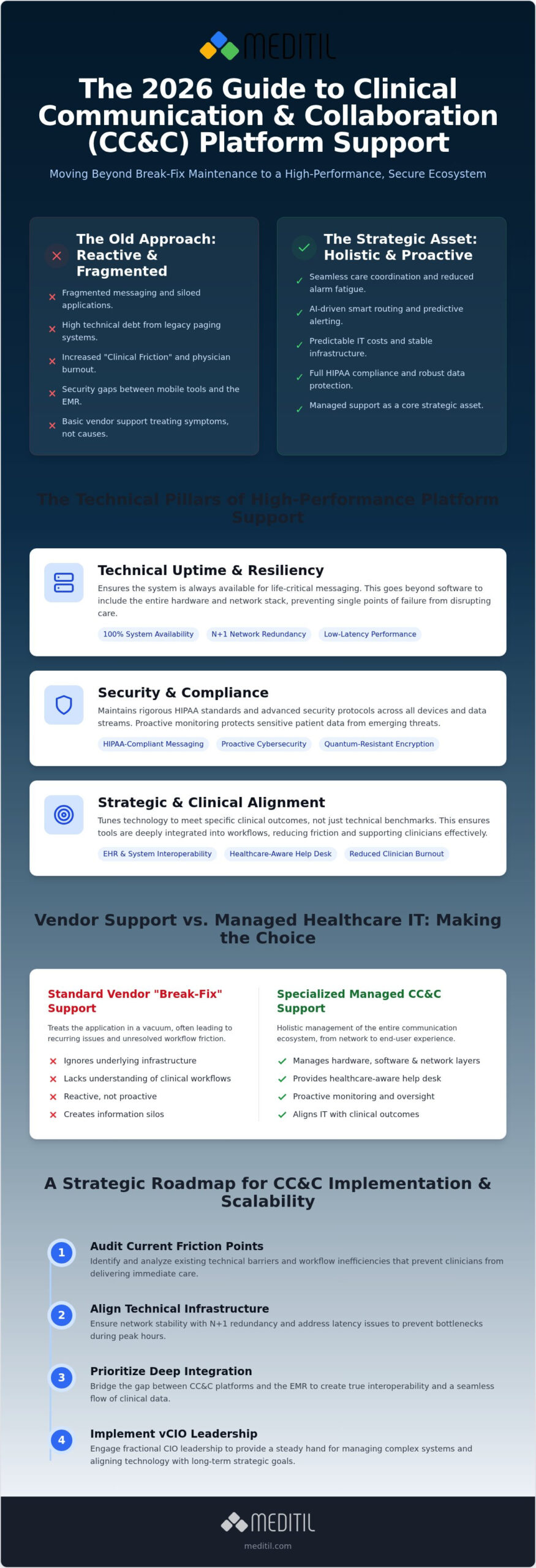
Effective Clinical Collaboration requires more than a functioning application; it demands a resilient and integrated ecosystem. In 2026, clinical communication and collaboration platforms support has evolved from simple software maintenance into the holistic management of hardware, software, and network layers. Basic vendor support is frequently insufficient because it treats the application in a vacuum. It often ignores the complex clinical workflows and the underlying infrastructure that must sustain them. True support ensures that every message reaches its destination, every alert is actionable, and every user feels confident in the system’s reliability.
The healthcare industry has moved decisively away from legacy paging systems toward AI-driven care activation. This shift means that the support layer must now manage smart routing and predictive alerting that can save lives. High-performance clinical communication and collaboration platforms support stands on three specific pillars. First, technical uptime ensures the system is available 100% of the time. Second, security compliance maintains rigorous HIPAA standards across all mobile devices. Third, strategic alignment tunes the technology to meet specific clinical outcomes rather than just technical benchmarks.
The Critical Role of Network Infrastructure in CC&C
Network stability is the silent partner of clinical messaging. For life-critical systems, N+1 redundancy is a non-negotiable standard. If a single router or switch fails, the communication flow must remain uninterrupted. Latency is another silent killer. Even a few seconds of delay in a clinical alert or consult connection can compromise patient safety. Organizations need stable network management for healthcare to ensure that their communication platforms don’t become bottlenecks during peak hours. A steady hand at the wheel of your infrastructure prevents these technical gaps from impacting care delivery.
Bridging the Gap Between IT Teams and Clinicians
Managed support acts as a vital buffer that reduces friction during platform adoption. When IT support is poor or slow to respond, the resulting technical hurdles contribute directly to physician burnout. Clinicians need tools that work without manual intervention or constant troubleshooting. Clinical Friction is the accumulation of technical barriers and workflow inefficiencies that prevent a provider from delivering immediate patient care. By providing proactive oversight, managed services ensure that the technology serves the clinician, rather than the clinician serving the technology. This alignment is essential for long-term platform stability and staff retention.
The Technical Pillars of High-Performance Platform Support
A reliable architecture is the backbone of any successful clinical messaging strategy. It isn’t enough for an application to simply remain active; it must be deeply integrated into the clinical environment to provide real value. A comprehensive Framework for Clinical Communication suggests that data must flow securely and fluently across the entire care continuum. Achieving this state requires specialized clinical communication and collaboration platforms support that prioritizes interoperability over basic connectivity. When your communication tools speak the same language as your EHR, clinicians spend less time hunting for information and more time at the bedside.
Managing the flow of life-critical signals involves more than just message delivery. It requires a sophisticated data management strategy that prevents information silos from forming between departments. If a critical lab result triggers an alert, that signal must reach the correct clinician without manual intervention. This level of precision depends on a healthcare-aware help desk. Unlike generic IT support, these professionals understand clinical urgency. They recognize that a login failure in an acute care setting isn’t just a technical ticket; it’s a potential barrier to immediate patient care.
Securing the Communication Ecosystem
In 2026, security standards have evolved to include quantum-resistant encryption protocols for all clinical messaging. Protecting protected health information (PHI) on mobile devices requires proactive monitoring through SOC-as-a-Service. This model provides continuous oversight of communication traffic to identify potential HIPAA violations before they escalate into data breaches. Implementing specialized healthcare cybersecurity services ensures that your mobile workforce remains compliant while maintaining the speed required for emergency coordination.
Interoperability and EHR Integration Support
Integrating modern CC&C platforms with legacy medical billing systems remains a significant hurdle for many healthcare organizations. Fragmented data architectures often prevent financial and clinical systems from syncing effectively. Supporting medical billing automation solutions within your communication ecosystem allows for real-time charge captures and streamlined administrative alerts. This integration reduces the technical debt associated with manual data entry and improves the overall financial health of the facility. Maintaining a steady hand over these complex integrations is essential for long-term operational stability. You can rely on expert consulting to ensure these systems remain synchronized and efficient.
Vendor Support vs. Managed Healthcare IT: Making the Choice
Selecting the right model for clinical communication and collaboration platforms support requires a clear understanding of where a software vendor’s responsibility ends. Most vendors operate on a reactive, break-fix mentality. They focus exclusively on the performance of their specific application, often ignoring the local network environment or third-party hardware interactions. This creates a dangerous gap in life-critical settings where communication failure isn’t just a technical glitch but a barrier to patient care. A managed IT partner acts as a strategic consultant, providing a steady hand that oversees the entire communication ecosystem from the server room to the clinician’s mobile device.
Relying solely on vendor updates often leads to significant technical debt. While the software may stay current, the underlying infrastructure frequently stagnates. This mismatch leads to security vulnerabilities and interoperability failures that standard vendor support isn’t equipped to handle. Specialized managed support brings deep knowledge of healthcare regulations, including the 2026 landscape of the HIPAA Security Rule. This expertise ensures that your communication traffic remains secure and compliant within a highly regulated framework. An augmented IT team provides the specialized oversight necessary to manage these complexities without overextending your internal resources.
When is Vendor Support Enough?
Small practices with basic communication needs might find standard vendor support sufficient for initial, standalone deployments. However, these organizations often hit a support ceiling as they grow. This ceiling occurs when the vendor fails to address infrastructure issues, such as Wi-Fi dead zones or network latency, that impact real-time alerts. Without a partner to manage these layers, data silos emerge. The communication platform becomes an island, unable to share data effectively with other clinical tools or legacy systems. This lack of integration eventually creates the clinical friction that hinders long-term adoption.
The Managed IT Advantage for High-Volume Practices
High-volume facilities require a proactive strategy to maintain stability while scaling operations. Managed services provide a disciplined approach to IT oversight, ensuring that every component of the communication chain is verified and optimized. This model allows for predictable financial planning. Ongoing service agreements prevent the sudden, high costs associated with emergency repairs and unplanned downtime. For a detailed roadmap on managing these expenses, organizations should consult our guide on strategic IT budgeting for medical practices. By stabilizing the infrastructure, managed IT partners ensure that your communication platform remains a high-performing asset that supports life-critical workflows.
A Strategic Roadmap for CC&C Implementation and Scalability
Successful deployment of a communication ecosystem requires a disciplined, multi-phase strategy. Organizations often fail when they treat implementation as a one-time technical installation rather than a continuous operational evolution. Robust clinical communication and collaboration platforms support begins with a comprehensive audit of existing friction points. This initial step involves identifying exactly where messaging delays or alert fatigue disrupt patient care. By pinpointing these gaps, leadership can move to step two: aligning the IT roadmap with specific patient safety and clinical outcome goals. Technology should never exist for its own sake; it must serve a measurable medical purpose.
The third step focuses on establishing a secure and redundant network foundation. As discussed earlier, a life-critical system cannot tolerate single points of failure. Step four involves implementing continuous training and augmented support for clinical staff. This ensures that as the platform evolves, the users remain proficient and supported by a healthcare-aware help desk. Finally, step five requires a regular review of the interoperability architecture. This prevents the formation of data silos and ensures that the platform continues to speak fluently with the EMR as both systems receive updates. You can consult with our experts to begin your comprehensive infrastructure audit today.
Scaling Support for Multi-Facility Organizations
Future-Proofing with AI and Care Activation
The integration of AI assistants in 2026 has introduced new requirements for specialized technical support. These systems don’t just route messages; they interpret clinical data to prioritize care activation. Supporting FDA 510(k)-cleared alarm management systems requires a deep understanding of both medical regulations and network performance. Maintaining compliance while adopting these emerging collaboration technologies is a complex task. It requires a steady hand to verify that AI-driven insights remain accurate and that the underlying infrastructure can handle the increased data load without compromising security or speed.
Optimizing Strategy with MEDITIL’s vCIO and Managed Services
A high-performance communication ecosystem requires more than just a software license; it needs professional leadership and disciplined management. MEDITIL positions itself as the steady hand at the wheel, providing the comprehensive clinical communication and collaboration platforms support necessary to sustain life-critical systems. By managing entire IT teams, we ensure that your platform operations remain seamless and resilient. This professional oversight allows clinicians to move away from being “middleware”—human bridges struggling to connect fragmented data—and return to being care-focused professionals who can rely on their tools.
We treat IT as a strategic partner rather than a simple service provider. Our approach integrates infrastructure management, cybersecurity, and strategic consulting into a single, cohesive framework. This ensures that every detail, from network latency to HIPAA compliance, is handled with precision. When your support layer is proactive, technical debt is minimized, and your communication tools become a stable foundation for clinical excellence. This shift in perspective turns a complex technical burden into a predictable, high-performing asset.
The Power of a Fractional CIO for CC&C
A Fractional CIO acts as the architect of your clinical communication strategy. This leader aligns your technical budgets with clinical safety metrics, ensuring that every investment drives better patient outcomes. Through virtual CIO services for healthcare, organizations gain access to high-level strategic advisory without the cost of a full-time executive. This role is crucial for managing the complexities of interoperability and system integration, providing a clear roadmap for your organization’s technical evolution in 2026. A vCIO ensures that your communication strategy is never reactive, but always aligned with long-term operational goals.
Managed Infrastructure: The Foundation of Life-Critical Systems
Infrastructure management is the ultimate form of clinical communication and collaboration platforms support. Without a verified and stable network, even the most advanced messaging software will fail during critical moments. MEDITIL’s approach focuses on protecting life-critical systems through continuous, proactive monitoring. We identify potential bottlenecks and vulnerabilities before they impact care delivery. We invite you to explore a partnership that views IT as a strategic asset rather than a cost center. By securing your infrastructure, we provide the stability your clinicians need to perform at their best. Let us manage the complexities of your technical environment so you can focus on the mission of care.
Securing the Future of Clinical Connectivity
Building a high-performance communication ecosystem in 2026 requires a shift from reactive troubleshooting to holistic infrastructure management. You’ve seen that the most effective strategies prioritize seamless interoperability and proactive security monitoring to protect life-critical systems. By aligning your technical roadmap with clinical safety goals, you eliminate the friction that often hinders patient care and leads to provider burnout. This methodical approach ensures that your technology serves as a reliable asset rather than a constant source of technical debt.
Securing professional clinical communication and collaboration platforms support is the strategic anchor your organization needs to maintain stability in a regulated environment. Our team brings national healthcare IT expertise and a focus on HIPAA-compliant infrastructure management to every partnership. You can Partner with MEDITIL for tailored Healthcare IT solutions to benefit from our Fractional CIO strategic leadership. We provide the steady hand at the wheel, allowing you to focus on the mission of care while we manage the technical complexities. Let’s work together to build a resilient foundation for your facility’s long-term success.
Frequently Asked Questions
What is the difference between CC&C platform support and standard IT help desk services?
Clinical communication and collaboration platforms support differs from a standard help desk by focusing on the clinical context and urgency of life-critical signals. While a standard desk might handle password resets, CC&C support manages the entire infrastructure chain from network latency to EMR integration. This specialized oversight ensures that communication tools remain stable and synchronized with medical workflows, preventing the technical gaps that often disrupt patient care in high-pressure environments.
How does a clinical communication platform improve patient safety in 2026?
In 2026, these platforms improve safety by utilizing AI-driven care activation to route critical alerts to the correct provider without delay. This proactive approach reduces alarm fatigue by filtering non-urgent notifications and ensuring that life-critical data, such as emergency lab results, is prioritized. By stabilizing the underlying network, managed support ensures these alerts reach mobile devices instantly, allowing for faster intervention and better clinical outcomes during time-sensitive medical events.
Why is interoperability the biggest challenge in supporting collaboration platforms?
Interoperability remains a significant hurdle because it requires modern messaging tools to sync fluently with legacy systems and diverse EMR architectures. Without expert clinical communication and collaboration platforms support, these systems often operate in silos, creating fragmented data that delays care. Effective support involves managing the integration layer to ensure that patient information flows securely and accurately across all departments, which is essential for maintaining a unified and efficient care environment.
Can a managed IT partner support multiple different communication vendors?
A managed IT partner like MEDITIL focuses on the infrastructure and strategic management layer rather than a single software product. This allows them to support multiple communication vendors simultaneously by optimizing the underlying network and ensuring secure connectivity across different platforms. Their role is to act as a steady hand at the wheel, managing the technical complexities and integrations that allow various tools to function together as a cohesive ecosystem.
How does CC&C support help reduce physician and nurse burnout?
Managed support reduces burnout by eliminating the technical barriers that create clinical friction for physicians and nurses. When communication tools work reliably and integrate seamlessly with the EMR, staff spend less time troubleshooting software and more time with patients. By providing a healthcare-aware help desk that understands clinical urgency, a managed partner ensures that technical issues are resolved quickly, reducing the daily frustrations that contribute to provider exhaustion and turnover.
What security standards are required for clinical communication platforms in 2026?
By 2026, platforms must adhere to the latest HIPAA Security Rule standards, which include quantum-resistant encryption and proactive monitoring of all mobile traffic. Security isn’t just about the software; it requires a robust network infrastructure and SOC-as-a-Service to identify potential vulnerabilities in real time. Managed partners ensure that every message remains protected and that the organization stays compliant with evolving regulatory requirements, providing a secure environment for sensitive patient data.
How much does managed support for clinical communication platforms typically cost?
The cost of managed support is typically structured through ongoing service agreements that provide predictable budgeting for healthcare organizations. These fees depend on the complexity of your infrastructure, the number of users, and the specific level of strategic oversight required, such as fractional CIO leadership. Because every clinical environment has unique needs, it’s best to consult with a specialist to receive a customized proposal that aligns with your practice’s operational goals and budget.
What role does a Virtual CIO play in clinical communication implementation?
A Virtual CIO serves as the strategic architect of your clinical communication ecosystem, ensuring that technical investments align with clinical safety metrics. They provide the leadership necessary to manage complex integrations and long-term IT roadmaps, moving beyond simple maintenance to strategic advancement. By acting as a consultant and partner, the vCIO helps healthcare leaders make informed decisions that improve operational stability and ensure that the communication platform supports the organization’s mission of care.