
Can your current infrastructure survive the next 24 months of expansion without causing a total clinician revolt? Many leaders find that scaling a healthcare IT department often feels like trying to repair an airplane while it’s in flight. You’re likely already managing the friction of physician burnout caused by clunky systems, the rising costs of full-time technical hires, and the constant threat of security vulnerabilities during rapid growth. It’s a delicate balance to maintain stability while pushing for progress.
You recognize that your organization’s success depends on more than just adding servers; it requires a disciplined approach to clinical alignment and data integrity. This guide provides the framework you need to master the complexities of expanding your healthcare IT infrastructure and operations without compromising patient care or security. We’ll explore how to transition from reactive troubleshooting to proactive governance. You’ll gain a strategic roadmap for 2026 that prioritizes a stable, high-performing environment, reduced administrative burdens through automation, and predictable IT costs that support long-term growth.
Key Takeaways
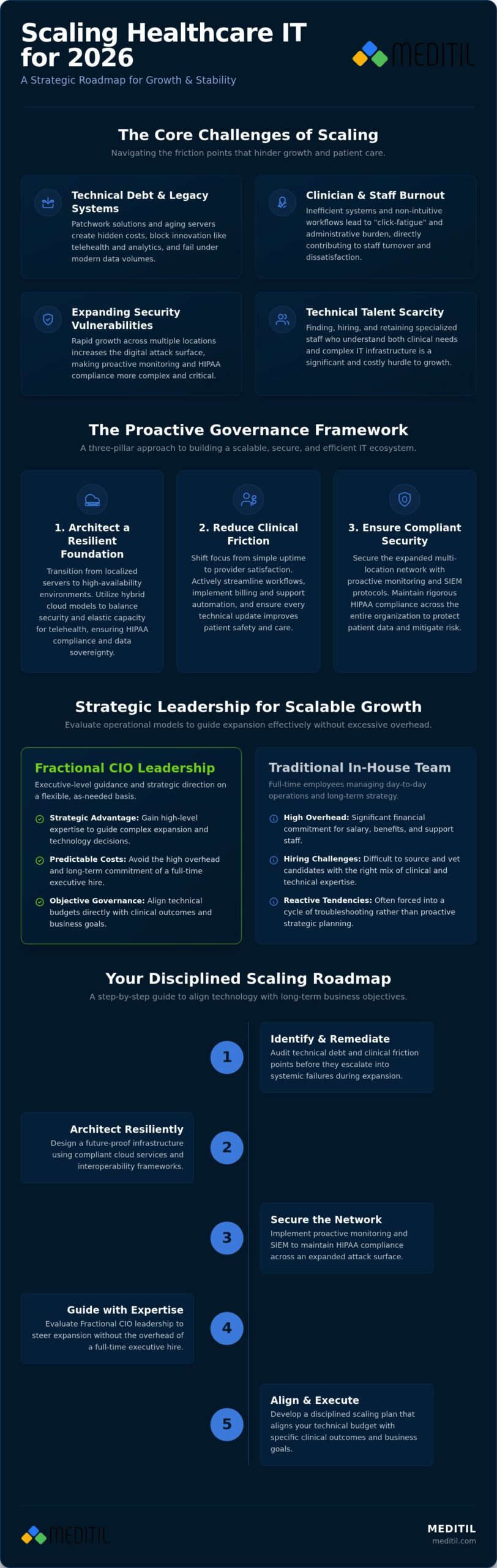
- Identify and remediate the technical debt and clinical friction points that hinder organizational growth before they escalate into systemic failures.
- Architect a resilient infrastructure by transitioning to healthcare-compliant cloud services and interoperability frameworks when scaling a healthcare IT department.
- Evaluate the financial and strategic advantages of utilizing Fractional CIO leadership to guide your expansion without the overhead of a full-time executive hire.
- Secure a multi-location network by implementing proactive monitoring and SIEM protocols to maintain HIPAA compliance across an expanded attack surface.
- Develop a disciplined scaling roadmap that aligns your technical budget with specific clinical outcomes and long-term business objectives.
The Core Challenges of Scaling Healthcare IT Departments in 2026
Scaling a healthcare IT department requires more than increasing headcount or server capacity. It involves confronting the structural weaknesses that often go ignored during periods of moderate growth. As organizations expand across state lines, the friction between legacy infrastructure and modern patient demand becomes a critical bottleneck. Leaders must address data silos that prevent seamless interoperability across national networks. Without a unified data strategy, patient records become fragmented, which increases the risk of medical errors and operational delays. Balancing high patient demand with limited technical resource availability is no longer just a budget issue; it’s a strategic imperative.
Overcoming Technical Debt and Legacy Systems
Technical debt in a clinical environment refers to the long-term costs incurred by prioritizing speed over sustainable architecture. It often manifests as patchwork IT solutions, where temporary fixes are layered on top of aging servers to meet immediate needs. These legacy systems frequently fail under the weight of modern patient data volumes and the high-velocity exchange required for Health Information Technology (HIT) in 2026. The hidden costs are substantial. You aren’t just paying for maintenance. You’re losing the ability to implement advanced analytics, automated billing, or telehealth services that modern patients expect. Failing to modernize your core infrastructure makes it impossible to scale securely or efficiently.
Addressing the Human Element: Clinician and Staff Burnout
Technology should be an enabler, yet inefficient systems are a primary driver of administrative burden. Clinicians frequently report click-fatigue when forced to navigate non-intuitive workflows that haven’t been optimized for high-volume environments. When scaling a healthcare IT department, the goal must shift from simple uptime to clinical friction reduction. If your technical expansion adds three minutes of documentation to every patient encounter, you’re actively contributing to staff turnover.
To mitigate burnout during rapid growth, organizations should focus on several key areas:
- Workflow Streamlining: You should audit current processes to reduce the number of manual entries required for routine documentation.
- Administrative Automation: Utilizing billing and support automation frees up staff time for higher-value clinical tasks.
- Clinical Alignment: It’s vital to ensure every technical update serves the ultimate goal of patient safety and provider satisfaction.
Technical talent is also increasingly scarce. Finding specialized staff who understand both regulatory compliance and infrastructure management is a significant hurdle. This scarcity often forces organizations into a reactive cycle, where they only address problems after they impact patient care. Moving toward a proactive model is the only way to sustain growth while keeping your team intact. A steady hand at the wheel ensures technical growth doesn’t come at the expense of your most valuable asset: your people.
Architecting a Scalable Healthcare IT Infrastructure
Transitioning from a single-location setup to an enterprise-grade network requires a fundamental shift in how your organization handles data. When scaling a healthcare IT department, you can no longer rely on localized server rooms that lack the redundancy required for 24/7 clinical operations. True growth necessitates a transition to high-availability environments that protect both patient outcomes and the revenue cycle. Successfully scaling a healthcare IT department requires a move toward infrastructure that expands dynamically with your patient census.
Cloud vs. On-Premise: Finding the Scalable Middle Ground
Hybrid cloud models offer a balanced approach for national healthcare organizations. This architecture allows you to maintain sensitive data on-premise where strictly necessary while leveraging the elastic capacity of the cloud for telehealth and remote monitoring. Ensuring data sovereignty and compliance is paramount; your cloud strategy must align with the technical safeguards outlined in the HIPAA Security Rule to prevent unauthorized access during transit. Scalable healthcare infrastructure is a modular framework that utilizes standardized data exchange protocols to ensure clinical systems remain responsive and secure as patient volumes grow.
Interoperability and Data Management Strategies
Data silos are the enemy of expansion. As you add new locations or specialty practices, the ability to share information between disparate systems becomes essential. Implementing healthcare interoperability frameworks ensures that clinician workflows remain seamless across the entire network. Utilizing HL7 and FHIR standards allows for the secure exchange of health information, which reduces the need for manual data reentry and minimizes clinical errors. A steady hand at the wheel helps you navigate these technical standards without disrupting daily care.
Growth also places immense pressure on administrative functions. Billing automation is a critical component of a scalable architecture, as it supports revenue cycle management by reducing the latency between care delivery and reimbursement. To maintain this pace, your network must feature built-in redundancy. High availability for life-critical systems ensures that even during a hardware failure, patient care remains uninterrupted. If you’re looking to modernize your foundation, a comprehensive systems integration and interoperability assessment can reveal the most efficient path forward for your organization.
Operational Models for Growth: Fractional CIO vs. In-House Teams
Selecting the appropriate leadership structure is a defining moment when scaling a healthcare IT department. Organizations often face a choice between the stability of an in-house team and the specialized agility of external partners. While an in-house department provides direct control, the true cost of full-time C-suite IT leadership includes significant recruitment time and high benefit overhead. Project-based consulting can solve immediate technical hurdles, but it often lacks the continuity required for long-term clinical alignment. Managed IT services bridge this gap by providing consistent, high-level oversight that adapts to your organization’s evolving needs.
The Role of the Fractional CIO in Strategic Scaling
A Fractional CIO serves as the essential bridge between clinical requirements and technical execution. These experts don’t just manage hardware; they align your technology budget with your business growth objectives. By utilizing virtual CIO services, you gain access to a professional who has navigated the complexities of national expansion many times before. This leader develops a three-year IT roadmap designed to survive the pressures of rapid expansion, ensuring that your systems remain compliant and performant as you enter new markets. This strategic oversight is vital for maintaining a disciplined approach to infrastructure governance.
Augmenting Your Internal IT Workforce
Scaling help desk and end-user support shouldn’t require a proportional increase in fixed overhead. An augmented IT team allows you to scale your support capabilities on-demand, providing your staff with consistent technical assistance without the complexities of internal hiring. This model is particularly effective for accessing specialized expertise in cybersecurity and regulatory compliance when scaling a healthcare IT department. MEDITIL manages entire IT operations for national entities, acting as a disciplined partner that maintains a steady hand at the wheel. Whether you require project-based support for a specific migration or comprehensive management of IT teams, the right operational model provides the flexibility to grow without compromising clinical stability.
Maintaining Cybersecurity and HIPAA Compliance During Expansion
Rapid growth significantly expands the digital perimeter of any clinical organization. When scaling a healthcare IT department, the transition from a localized network to a national infrastructure introduces a multitude of new endpoints, cloud integrations, and third-party access points. Each new location or remote monitoring device represents a potential vulnerability if not managed with precision. Relying on perimeter-based security is no longer sufficient; you must adopt a zero-trust architecture that verifies every request, regardless of its origin within the expanded network.
Centralized visibility is the only way to manage this complexity. Implementing a Security Information and Event Management (SIEM) system allows your team to aggregate logs from multi-location practices into a single, authoritative dashboard. This provides the real-time oversight necessary to identify anomalies before they escalate into full-scale breaches. Regular risk assessments must become a standard part of your growth cadence, ensuring that every new asset is vetted against rigorous HIPAA standards before it goes live.
Proactive Security for Life-Critical Systems
Reactive patching schedules are inadequate for the high-stakes environment of 2026. You need to move toward proactive threat hunting to identify latent risks within your infrastructure. This is especially critical for telehealth and remote patient monitoring access points, which often reside outside the traditional clinical firewall. Securing these remote connections requires advanced encryption and multi-factor authentication to protect patient data in transit. For organizations seeking a steady hand to manage these risks, specialized healthcare cybersecurity services provide the continuous monitoring and expert intervention required to maintain clinical uptime.
Compliance as a Scalable Framework
Maintaining HIPAA compliance across diverse digital platforms shouldn’t depend on manual spreadsheets. As you grow, you should implement automated compliance audits that reduce the administrative strain on your core team. These systems provide continuous verification of your security posture, making it easier to demonstrate regulatory adherence during national expansion. Training is equally vital; any augmented staff or new hires must be thoroughly onboarded into your specific regulatory standards to prevent human error.
Security must also extend to your financial operations. Ensuring that your billing automation remains secure and compliant is essential for protecting the integrity of the revenue cycle. A disciplined approach to cybersecurity ensures that your expansion doesn’t compromise the trust patients place in your care. If you’re concerned about vulnerabilities in your current roadmap, you can schedule a comprehensive cybersecurity and compliance audit to identify and remediate risks before they impact your operations.
Executing the Scaling Roadmap with MEDITIL
Successful expansion is never the result of chance; it is the product of a disciplined and well-documented strategy. When scaling a healthcare IT department, the first essential step is a comprehensive audit of your existing infrastructure and security posture. This baseline assessment identifies the technical debt and legacy bottlenecks that could impede your growth. Once these vulnerabilities are remediated, you can begin the process of aligning your technical investments with your specific clinical and business objectives. This ensures that every dollar spent supports the ultimate goal of stable, high-performing patient care.
Developing Your 2026 Strategic IT Roadmap
A strategic roadmap serves as your organization’s technical compass for the next 36 months. You should prioritize projects based on their potential for clinical impact and return on investment. For example, integrating billing automation and streamlining EHR workflows can yield immediate gains in administrative efficiency and revenue cycle stability. This phased approach allows you to scale your operations without overwhelming your staff or your budget. Planning for these expenses is a core component of sustainable growth. You can find detailed guidance on aligning your financial resources in our guide to it budgeting for medical practices. This financial foresight prevents the “patchwork” spending that often leads to technical debt in the first place.
Why a Healthcare-Specific Partner Matters
Generalist IT providers often lack the deep industry knowledge required to manage medical environments. They may understand networking, but they frequently struggle with the granular requirements of HIPAA compliance, clinical workflows, and interoperability standards. In a regulated environment, these gaps are more than just inconveniences; they are significant liabilities. Scaling a healthcare IT department requires a partner who understands the high-stakes nature of life-critical systems. Generalists might overlook the specific safeguards needed for telehealth access points or the nuances of medical data sovereignty.
MEDITIL serves as a steady hand at the wheel for growing national organizations. Our approach is characterized by a mission-driven focus on stability and improvement. We don’t just provide services; we act as strategic consultants invested in your long-term outcomes. By reducing clinical friction through professional management and seamless networking, we allow your clinicians to focus on patients rather than clunky systems. Whether you require a Fractional CIO to lead your strategy or an augmented IT team to support your daily operations, we provide the technical confidence you need to expand with precision. Are you ready to secure your organization’s future? Contact us today for a strategic consultation to begin your scaling journey.
Securing Your Organization’s Technical Future
The transition from a growing practice to a national healthcare entity requires a shift from reactive troubleshooting to disciplined infrastructure governance. Success depends on more than just adding software; it requires architecting a resilient, interoperable foundation that supports both clinicians and patients. By addressing technical debt and prioritizing clinical alignment, you can eliminate the friction that often leads to staff burnout. Successfully scaling a healthcare IT department in 2026 demands a strategic roadmap that balances rapid expansion with unwavering data security and HIPAA compliance.
You don’t have to navigate these regulatory and technical complexities alone. MEDITIL provides the steady hand at the wheel that your organization needs to thrive. With our specialized healthcare IT experts, Fractional CIO leadership, and national managed infrastructure support, we ensure your technical growth is both stable and predictable. We’re here to help you turn your IT department into a high-performing asset that drives clinical excellence and operational efficiency. Take the next step toward a more secure and scalable future today. Schedule a Strategic Consultation with MEDITIL and let’s build your 2026 roadmap together.
Frequently Asked Questions
What are the first steps in scaling a healthcare IT department?
The first steps in scaling a healthcare IT department involve conducting a thorough infrastructure and security audit to identify existing technical debt. You must understand your current baseline before adding new systems or locations. Following the audit, you should align your IT budget with specific clinical and business growth objectives. This disciplined approach ensures that technical expansion begins with a stable foundation rather than building on top of fragile, legacy systems.
Is a Fractional CIO better than a full-time CIO for a growing practice?
A Fractional CIO is often superior for growing organizations because it provides strategic leadership without the high salary and benefit overhead of a full-time executive. This model allows you to access specialized expertise in regulatory standards and long-term roadmap development on an as-needed basis. While a full-time CIO offers a dedicated presence, the fractional model provides the agility required during rapid expansion phases. It ensures your strategy remains sophisticated yet cost-effective.
How does scaling IT impact HIPAA compliance?
Scaling significantly increases your organization’s attack surface by introducing new endpoints, cloud services, and remote access points. Each expansion phase requires a fresh risk assessment to ensure that HIPAA compliance is maintained across the entire network. You must implement centralized monitoring and automated audits to manage this increased complexity. Without these safeguards, rapid growth can lead to fragmented security protocols and potential regulatory violations that compromise the integrity of your sensitive patient data.
What is the cost difference between managed IT and in-house IT during growth?
Managed IT services typically offer more predictable costs when scaling a healthcare IT department compared to the escalating expenses of an in-house team. Building an internal department involves significant recruitment fees, training costs, and fixed payroll overhead that remains even during slow periods. Conversely, managed services provide a scalable cost structure that adjusts to your current volume. This financial flexibility allows you to reallocate capital toward clinical improvements while maintaining access to specialized technical talent.
How can we scale IT without disrupting current clinical workflows?
You can scale without disruption by implementing technical changes in phases and prioritizing user acceptance testing. It’s essential to align IT updates with clinical schedules to minimize downtime during patient care hours. Providing thorough training for augmented staff and clinicians on new workflows ensures a smooth transition. By focusing on reducing clinical friction through intuitive systems, you can improve infrastructure performance without negatively impacting the daily routines or the productivity of your medical providers.
What infrastructure is required for national healthcare interoperability?
National interoperability requires an infrastructure built on standardized data exchange protocols like HL7 and FHIR. You must utilize healthcare-compliant cloud services and robust APIs that allow disparate systems to communicate securely. This architecture eliminates data silos and ensures that patient records are accessible across your entire network. A steady hand at the wheel is necessary to manage these integrations, ensuring that connectivity doesn’t come at the expense of data security or system performance.
How do I know if my healthcare IT department is ready to scale?
Your department is ready to scale when current systems can no longer support your patient volume without frequent downtime or manual workarounds. Signs of readiness include an increasing administrative burden on clinicians, unresolved security vulnerabilities, and an inability to integrate new specialty applications. If your IT team is constantly in reactive firefighting mode, it’s a clear indicator that you need a more robust framework to support your organization’s expanding national footprint and clinical demands.
Can managed IT services help reduce physician burnout?
Managed IT services directly reduce physician burnout by streamlining workflows and automating repetitive administrative tasks. When you optimize systems for high-performing clinical environments, you reduce the click-fatigue that often plagues medical staff. Reliable help desk support ensures that technical issues are resolved quickly, allowing clinicians to focus on patient care rather than troubleshooting. Professional management of IT teams creates a more stable environment, leading to higher provider satisfaction and significantly better patient outcomes.