
For every dollar your practice spends on clinical software, you’ll likely spend another two to three dollars on the implementation and integration required to make it actually work. Most administrators feel the weight of this investment when staff are still manually re-entering patient data or when billing cycles stall due to missing clinical notes. It’s frustrating to manage sophisticated tools that refuse to speak to one another; it leads to burnout and fragmented records that compromise patient care. This friction is exactly why integrating practice management software with EHR has become the primary strategic objective for high-performing clinics in 2026.
You deserve a system where data flows naturally from the initial patient check-in to the final billing statement. This article provides a strategic roadmap to bridge the gap between your clinical data and administrative operations. You’ll discover how to eliminate operational silos, maintain compliance with evolving regulatory standards, and build a scalable infrastructure. We will explore the technical architecture needed for real-time data access and the expert oversight required to ensure your technology supports, rather than hinders, your long-term growth.
Key Takeaways
- Understand how disconnected clinical and administrative systems lead to physician burnout and how a unified data flow restores operational stability.
- Explore the technical evolution of interoperability in 2026, including the role of HL7 and modern messaging standards in healthcare data exchange.
- Learn to evaluate the trade-offs between “All-in-One” integrated suites and “Best-of-Breed” strategies to find the architecture that fits your specific clinical needs.
- Follow a phased roadmap for integrating practice management software with EHR that prioritizes data mapping, encryption, and HIPAA compliance during migration.
- Identify how fractional CIO leadership and managed IT services provide the technical oversight necessary to align software capabilities with long-term strategic goals.
The Critical Intersection of Clinical Care and Administrative Efficiency
2026 represents a pivotal shift for medical practices. The era of managing clinical and administrative data in separate, disconnected silos has ended. Regulatory updates, such as the shortened 15-day window for PHI access expected in August 2026, demand a unified infrastructure that can retrieve records instantly. Information blocking rules under the 21st Century Cures Act also mandate transparent data sharing and standardized API access. Strategic leaders recognize that “Unified Healthcare IT” isn’t a luxury; it’s a requirement for operational stability and a competitive advantage.
Practice Management vs. EHR: Distinct Roles, Shared Goals
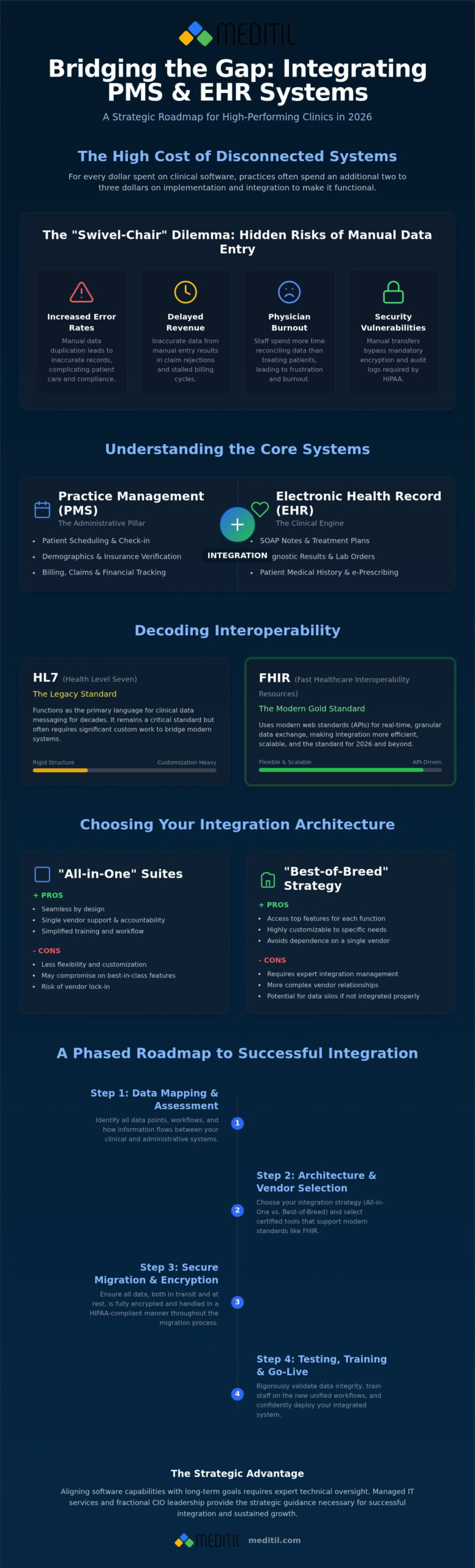
PMS systems serve as the administrative pillar. They handle scheduling, patient demographics, and financial tracking. In contrast, EHR systems are the clinical engine, housing SOAP notes, treatment plans, and diagnostic results. While Medical Practice Management Software focuses on the business of care, the EHR focuses on the care itself. Integrating practice management software with EHR bridges these two worlds. It ensures that every clinical action triggers a corresponding administrative event without manual intervention. This alignment is vital for maintaining a clean audit trail and ensuring that clinical providers aren’t burdened by administrative tasks.
The Hidden Risks of “Swivel-Chair” Data Entry
Manual data duplication, often called “swivel-chair” entry, introduces unacceptable risk. When staff must copy patient details from an EHR into a billing system, error rates climb. These gaps directly complicate medical billing automation solutions, as inaccurate data leads to claim rejections and delayed revenue. Beyond financial loss, disconnected systems create security vulnerabilities. Manually transferring data between unlinked platforms often bypasses the mandatory encryption and audit logs required by the latest HIPAA Security Rule updates. This fragmented approach fuels physician burnout, as providers spend more time reconciling data than treating patients.
A seamless data flow transforms the patient experience. It starts at intake, where digital forms populate clinical records immediately. It ends with accurate billing that reflects the exact services rendered. When you prioritize integrating practice management software with EHR, you eliminate the friction that fuels staff burnout. You create a practice that is agile, compliant, and ready for the technical demands of the coming year. This strategic alignment provides the steady hand needed to manage complex healthcare environments.
Decoding Interoperability: How PMS and EHR Systems Communicate
Interoperability is the foundational ability of disparate systems to work together without loss of data fidelity. In 2026, achieving this state isn’t just about moving files; it’s about creating a living ecosystem where data remains accurate and actionable across every platform. The technical backbone of this exchange has evolved from rigid, custom-coded interfaces to agile, API-driven frameworks. This shift ensures that patient information is not just transferred, but understood by both the clinical and administrative systems.
Standard Protocols: HL7 and FHIR Explained
For decades, HL7 (Health Level Seven) functioned as the primary language for clinical data transmission. It remains a critical standard for messaging, but it often requires significant customization to bridge modern systems. The industry is rapidly adopting FHIR (Fast Healthcare Interoperability Resources) as the gold standard for real-time data access. FHIR uses modern web standards to allow for more granular data exchange, making the process of integrating practice management software with EHR more efficient and scalable. When selecting vendors, consult the ONC Health IT Playbook to ensure your chosen tools meet the necessary certification standards for interoperability.
The Role of APIs in Modern Practice Integration
APIs (Application Programming Interfaces) act as the secure bridges between your administrative and clinical software. A unidirectional flow might send patient demographics from the front desk to the EHR, but it won’t sync billing data back. For a truly efficient practice, bidirectional data flow is essential. This ensures that when a clinician updates a treatment plan, the administrative staff sees the billing implications immediately. As you implement these connections, it’s vital that your healthcare cybersecurity services specifically address API endpoint protection to prevent unauthorized access. These endpoints are often targeted because they handle high volumes of sensitive patient data.
Managing these technical layers requires a steady hand and deep expertise in healthcare standards. Partnering with a fractional CIO ensures that these technical standards are implemented correctly to support your long-term operational goals. This strategic oversight prevents the common pitfalls of integrating practice management software with EHR, such as data fragmentation or compliance gaps. A disciplined approach to interoperability protects your infrastructure and ensures a seamless experience for both staff and patients.
Integrated Suites vs. Best-of-Breed: Choosing Your Integration Architecture
Selecting the right architecture is a strategic decision that dictates your practice’s operational rhythm for years. It’s not merely a software purchase; it’s a commitment to a specific workflow philosophy. In 2026, the choice typically falls between a unified, “All-in-One” suite or a “Best-of-Breed” configuration. Each path offers distinct advantages for clinical performance and administrative stability. Aligning this choice with your long-term it budgeting for medical practices ensures that your technology remains an asset rather than a growing liability.
The Pros and Cons of Unified Software Suites
Unified suites offer the appeal of simplicity. With a single vendor providing both the administrative and clinical modules, you benefit from a single point of contact for support and synchronized software updates. This approach often results in lower initial setup costs because the internal connections are pre-built by the vendor. However, the trade-off is frequently a lack of clinical specificity. Generalist suites may miss the niche templates or diagnostic tool integrations required by specialty clinics. While the administrative side might be robust, the clinical side can feel like an afterthought, leading to long-term workflow friction that impacts provider satisfaction.
Best-of-Breed: Customizing for Clinical Excellence
Specialty clinics often prefer a Best-of-Breed strategy, selecting the highest-performing PMS and EHR systems independently. This allows for deep clinical customization and superior performance in complex environments. The primary challenge here is integrating practice management software with EHR across different vendor platforms. This architecture requires a sophisticated technical bridge, often involving middleware to ensure legacy systems can communicate with modern web-based tools. An EHR workflow integration case study highlights how failing to manage these technical connections can disrupt clinical efficiency and data integrity.
Managing the “technical debt” of complex integrations is a significant undertaking. Without expert oversight, multi-vendor environments can become fragmented, leading to security gaps or data lag. This is where a strong managed it services for healthcare partner becomes essential. They act as the steady hand at the wheel, managing the technical complexity and ensuring that your chosen systems remain interoperable. By focusing on a disciplined integration roadmap, you can achieve clinical excellence without sacrificing administrative efficiency. The goal is a seamless flow of information that supports your providers and protects your practice’s financial health.
Overcoming Implementation Hurdles: A Phased Integration Strategy
Successful integration isn’t a single event; it’s a disciplined sequence of strategic actions. In 2026, the technical complexity of healthcare systems means that a rushed rollout often results in expensive downtime or compliance failures. A phased strategy allows for rigorous verification at every step, ensuring that the transition remains stable and predictable. This methodical approach protects your practice’s operational continuity while building a foundation for future growth.
Data Migration and Integrity Challenges
Moving data is the highest-risk activity during any system transition. If you migrate inaccurate patient records or mismatched demographics, you’re simply automating errors. We call this the “Garbage In, Garbage Out” risk, where poor data quality undermines the efficiency of your new architecture. To prevent this, data mapping is the essential alignment of fields between two distinct databases. This process ensures that a “First Name” field in your EHR perfectly matches the corresponding field in your PMS, eliminating the risk of fragmented or lost information. Cleaning your data before the move is a non-negotiable step for integrating practice management software with EHR effectively.
Security and Compliance During Integration
The regulatory landscape in 2026 is more demanding than ever. With the latest HIPAA Security Rule updates mandating multi-factor authentication (MFA) and encryption for all ePHI at rest and in transit, your migration must be hardened against external threats. During the integration process, maintaining a secure audit trail is mandatory to track every instance where Protected Health Information (PHI) is accessed or moved. You must also verify that formal Business Associate Agreements (BAAs) are in place for any third-party integration partners. Proactive risk management prevents data breaches during the vulnerable window of system downtime when standard protocols might be temporarily disrupted.
Once the technical foundation is secure, the focus shifts to clinical workflow validation. Pilot testing with a small group of providers allows you to identify friction points before a full-scale launch. The final phase involves comprehensive staff training and change management. Technology only delivers value if your team is proficient in its use. By following this roadmap, you ensure that integrating practice management software with EHR results in a seamless flow of data that supports both your clinicians and your administrative staff. If you’re ready to secure your practice’s digital future, our team provides the expert EMR/EHR implementation and training services needed to manage this complexity with precision.
The Strategic Advantage of Managed IT and Fractional CIO Leadership
Software vendors are experts at their own platforms, but they often lack visibility into your practice’s entire IT ecosystem. They don’t manage the complex handshakes between disparate tools or the long-term health of your local network. Relying solely on a vendor for integrating practice management software with EHR often leads to technical gaps that the vendor isn’t contractually obligated to fix. Independent strategic leadership is essential to ensure these systems function as a unified whole rather than a collection of expensive, isolated parts.
Fractional CIO: Strategic Oversight Without the Overhead
Our virtual cio services provide the high-level oversight required to align technology investments with clinical outcomes. A fractional CIO doesn’t just look at the software; they evaluate how that software impacts your revenue goals and operational efficiency. They act as your advocate during vendor selection and contract negotiations. This ensures that the service level agreements protect your practice, not just the software provider. This proactive guidance helps you develop an IT roadmap that accounts for future interoperability mandates, ensuring your infrastructure is ready for the technical demands of 2026.
Managed IT: Ensuring Continuous Interoperability
While the CIO handles the strategy, managed IT services provide the “steady hand” for daily operations. Interoperability isn’t a static achievement. APIs can fail. Software updates can break existing connections. Data flows can stall without warning. Proactive monitoring identifies these issues before they disrupt patient care or administrative workflows. Additionally, a managed help desk provides immediate support for clinicians who may struggle with new integrated workflows. As your practice scales, whether by adding new locations or specialties, your IT partner ensures your infrastructure grows without creating new data silos.
MEDITIL serves as the strategic partner that bridges the gap between clinical intent and administrative execution. We manage the technical complexity of integrating practice management software with EHR so your team can focus on patient outcomes. By providing both strategic consulting and ongoing technical support, we ensure your systems work in harmony. This disciplined approach protects your practice from the instability of unmanaged technology and provides a reliable foundation for long-term growth.
Securing Your Practice’s Digital Infrastructure for 2026
Achieving a unified data flow requires more than just purchasing software; it’s about intentional architectural alignment. integrating practice management software with EHR eliminates the operational silos that drive staff burnout and lead to costly administrative errors. By transitioning from manual data entry to automated interoperability, you ensure your practice remains compliant with the latest HIPAA security mandates and regulatory standards. Strategic oversight is the essential bridge between clinical intent and technical execution.
MEDITIL provides the specialized managed IT services and fractional CIO advisory needed to navigate this transition with precision. Our team focuses on comprehensive HIPAA compliance and cybersecurity oversight, offering you the reassurance of a steady hand at the wheel. We handle the technical complexity so you can focus on delivering exceptional patient care. Partner with MEDITIL for seamless system integration and strategic IT leadership. Your journey toward a more efficient, integrated future starts with a disciplined roadmap.
Frequently Asked Questions
What is the difference between an integrated EHR and an interface?
An integrated EHR shares a single, unified database with the PMS, while an interface uses a technical bridge to exchange data between separate databases. Integrated systems offer immediate data synchronization without the need for complex messaging protocols. Interfaces allow practices to choose specialized tools for clinical and administrative tasks but require robust standards like HL7 or FHIR to maintain data integrity. The choice depends on whether you prioritize simplicity or clinical specificity for your practice.
How long does it typically take to integrate a PMS with an EHR?
A standard integration project typically spans 3 to 6 months, depending on the complexity of the data mapping and the number of custom interfaces required. This timeline accounts for technical audits, data cleaning, and clinical workflow validation. Larger hospital systems with multiple legacy connections may require a longer duration. Working with an expert partner ensures the project remains on schedule while managing the technical hurdles of integrating practice management software with EHR.
Will integrating my systems help with HIPAA compliance?
Integration significantly strengthens HIPAA compliance by centralizing audit trails and ensuring data encryption during transmission. Disconnected systems often rely on manual data entry, which increases the risk of unauthorized access or exposure of protected health information. In 2026, integrated architectures facilitate mandatory multi-factor authentication and real-time security monitoring across both platforms. This unified approach reduces the likelihood of human error and ensures a more secure environment for sensitive patient data and administrative records.
Can I integrate an older PMS with a modern cloud-based EHR?
Integration between legacy on-premise systems and modern cloud-based EHRs is possible through the use of middleware or custom API bridges. These solutions translate data between different environments, allowing older databases to communicate with web-based platforms. However, this configuration often increases technical debt and requires proactive monitoring to prevent connectivity breaks. A strategic IT audit can determine if your legacy infrastructure supports the necessary encryption standards for integrating practice management software with EHR in a cloud environment.
Does integration require significant staff retraining?
Retraining should focus on the new, unified workflow rather than just software features. While fundamental tasks like scheduling and charting remain the same, staff must understand how data moves between systems to prevent duplicate entries. Training includes clinical workflow validation for providers and billing automation protocols for administrative staff. A phased approach ensures your team feels confident and maintains productivity. This disciplined training strategy is essential for realizing the full efficiency gains of an integrated system.
What are the most common points of failure in EHR-PMS integration?
The most common failures result from poor data mapping, lack of vendor cooperation, or inadequate pilot testing. If fields between databases are misaligned, data is often lost or misinterpreted. Strategic oversight from a fractional CIO helps mitigate these risks by verifying technical requirements before launch. This proactive approach prevents system breakages and ensures your data remains accurate across both clinical and administrative platforms, protecting your operational continuity and practice revenue.
How does integration affect the medical billing cycle?
Integration accelerates the billing cycle by ensuring clinical documentation and coding data flow instantly into the practice management system. This eliminates delays associated with manual claim creation and reduces the risk of denials caused by mismatched patient demographics. Real-time access to clinical notes allows billing staff to verify services rendered more accurately. The result is a more efficient revenue cycle with improved cash flow and fewer administrative hurdles for your financial team.