
What if your most critical life-saving equipment isn’t a ventilator or an imaging suite, but your ability to stabilize your digital environment in under sixty minutes? In an era where a single ransomware attack can halt clinical operations for weeks, the traditional IT recovery manual is no longer sufficient. You’re likely familiar with the fear of extended clinical downtime or the mounting pressure of conflicting reporting timelines that can lead to millions in penalties. It’s a high-stakes environment where the lack of internal forensic expertise can turn a manageable breach into a catastrophic event.
This guide serves as your authoritative resource for building a robust healthcare cybersecurity incident response plan tailored for the 2026 regulatory environment. We’ll show you how to activate a strategic response that protects patient safety, ensures HIPAA compliance, and maintains clinical continuity during a crisis. By following this roadmap, you’ll gain a clear protocol for the first hour of an incident, reducing your financial liability and ensuring that patient care never stops. We will examine essential system restoration benchmarks, forensic investigation steps, and the precise actions required to satisfy the latest oversight standards.
Key Takeaways
- Shift your perspective from standard technical recovery to patient-centric protocols that prioritize clinical continuity and life-critical operations over simple data restoration.
- Develop a comprehensive healthcare cybersecurity incident response plan that incorporates the six core phases of HIPAA compliance, from multidisciplinary preparation to post-incident analysis.
- Master the critical first 60 minutes of a security event by establishing clear verification and mobilization procedures to eliminate confusion and reduce clinical downtime.
- Navigate the complex 2026 regulatory landscape with a clear understanding of the evolving HIPAA Breach Notification Rule and the interplay between state and federal reporting timelines.
- Leverage Fractional CIO leadership to implement proactive testing and tabletop exercises that harden your infrastructure against sophisticated medical network threats.
Beyond IT: Why Healthcare Needs a Patient-Centric Incident Response Plan
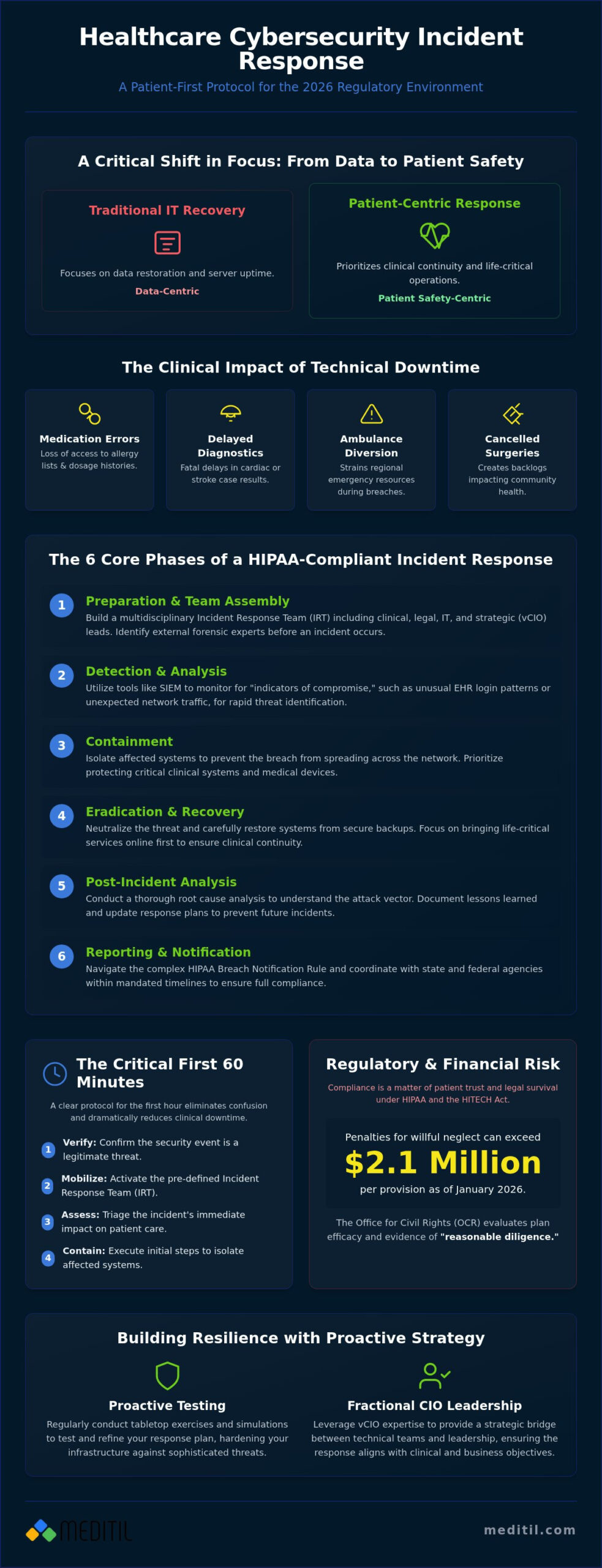
A healthcare cybersecurity incident response plan is a life-critical protocol. While a standard IT disaster recovery plan focuses on data restoration and server uptime, a healthcare-specific strategy prioritizes the person in the bed. In a clinical environment, a network failure isn’t just a business disruption; it’s a threat to patient safety. Generic plans often fail because they don’t account for the immediate needs of a trauma unit or the critical nature of real-time patient monitoring. Protecting data is secondary to ensuring that clinicians have the tools they need to save lives.
The 2026 threat landscape has grown increasingly complex. Ransomware attackers now frequently target IoT medical devices and EHR systems to force rapid payouts by compromising patient care. This shift requires a mission-driven approach to security. Your response strategy must be designed to maintain clinical operations even when the primary network is compromised.
The Clinical Impact of Technical Downtime
When systems go dark, the consequences are immediate and physical. EHR outages lead to medication errors because clinicians lose access to allergy lists and dosage histories. Diagnostic results are delayed, which can be fatal in cardiac or stroke cases. During major breaches, hospitals are often forced to divert ambulances to other facilities, stretching regional emergency resources thin. Elective surgeries are cancelled, creating a backlog that impacts community health for months. Clinical Continuity is the ability to provide care during a total network blackout.
Regulatory Foundations: HIPAA and the HITECH Act
Compliance is a matter of patient trust and legal survival. The HIPAA Security Rule and the HITECH Act establish the legal requirement for a formal, tested response plan. The Office for Civil Rights (OCR) evaluates plan efficacy following a breach, looking for evidence of “reasonable diligence.” In 2026, this requires more than just storing a PDF on a secure server. It demands a living document that is practiced and refined.
Effective plans integrate technical tools like Security Information and Event Management (SIEM) to provide real-time analysis of security alerts. This allows for faster detection and containment. Without a documented and regularly tested healthcare cybersecurity incident response plan, organizations face significant civil monetary penalties. For instance, willful neglect that remains uncorrected can lead to penalties exceeding $2.1 million per provision as of January 2026. A proactive approach ensures your organization is ready to act when every second counts.
The 6 Core Phases of a HIPAA-Compliant Incident Response
An effective healthcare cybersecurity incident response plan follows a structured lifecycle to ensure no detail is overlooked during a high-stress event. While many industries utilize general security frameworks, medical organizations must adapt these phases to account for patient safety and strict regulatory mandates. This structured approach transforms a chaotic technical failure into a controlled, clinical recovery process.
Phase 1: Assembling Your Incident Response Team (IRT)
Building a multidisciplinary team is the foundation of the preparation phase. Your IRT must include a clinical lead, such as a CMIO or Lead Physician, to evaluate how technical decisions impact patient care in real time. Legal counsel and IT specialists are essential, but the coordination often falls to virtual CIO services. A vCIO provides the strategic bridge between technical teams and the board, ensuring that the response aligns with both clinical needs and business objectives. If your internal team lacks specific forensic expertise, this is the time to identify a Managed Security Service Provider (MSSP) for immediate escalation.
Phase 2, Detection and Analysis, involves identifying “indicators of compromise” within complex medical networks. This includes monitoring for unusual EHR login patterns or unexpected lateral movement between medical imaging servers. Early detection is critical to preventing a widespread outage and minimizing the volume of compromised records.
Phase 3: Tactical Containment in a Medical Setting
Containment requires a surgical approach. In a standard business, you might shut down the entire network; in a hospital, that could be fatal. Short-term containment involves isolating affected VLANs to prevent the spread of ransomware while maintaining connectivity for life-support systems. Long-term containment may involve taking the EHR offline for a controlled period to perform deep forensic cleaning. Handling patient-connected devices requires extreme caution. These tools must be isolated through network segmentation rather than simple power-downs to ensure patient monitoring continues. Eradication in healthcare is the systematic removal of malicious components and the closing of security gaps to ensure the threat cannot re-emerge within the clinical environment.
Phase 4, Post-Incident Activity, focuses on recovery and the “Lessons Learned” session required by federal standards. This phase is not just about technical fixes; it’s about fulfilling the legal obligations outlined in the HIPAA Breach Notification Rule. Reviewing the efficacy of your healthcare cybersecurity incident response plan after an event is a mandatory step for demonstrating reasonable diligence to federal auditors. If you’re unsure if your current team is prepared for these complexities, consulting with a specialized healthcare IT partner can help bridge the gap in your strategy.
Activating the Plan: The First 60 Minutes of a Cybersecurity Event
The “Golden Hour” of a cyberattack determines whether an organization recovers in days or weeks. When an anomaly is detected, the first step is verification. You must quickly confirm the incident isn’t a false positive or unscheduled routine maintenance. Once a breach is verified, mobilization begins. This involves activating the physical or virtual ‘War Room’ and notifying the Incident Response Team (IRT) via pre-established channels. Speed is essential, but precision prevents the chaos that often follows a sudden system failure.
Simultaneously, the team must begin initial documentation. Every action taken from the moment of discovery must be recorded in an ‘Incident Log.’ This log is a critical piece of evidence for forensic investigators, legal counsel, and cyber insurance providers. Finally, communication shifts to ‘out-of-band’ methods. If your network is compromised, your internal email and VOIP systems are no longer secure. Teams should pivot to encrypted messaging apps or even physical runners to maintain operational control without alerting the adversary.
Initial Triage: Clinical vs. Administrative Systems
Rapid triage is the most important clinical task during the first hour. You need to determine the scope of the impact immediately. Is the outage limited to administrative billing, or has it reached the PACS system and EHR? A ‘Code Silver’ or similar emergency designation should be broadcast across the facility to alert staff that a cyber incident is in progress. Utilizing specialized healthcare cybersecurity services during this window allows for faster technical assessment. This helps leadership decide whether to pivot to paper charts or continue digital operations in a restricted mode.
The Communication Protocol: Who to Call First
Maintaining a ‘No-Fly’ list is a vital part of your healthcare cybersecurity incident response plan. This list identifies internal accounts that must not be used for communication during a breach, as they are likely monitored by the attacker. Before taking any forensic action that could alter evidence, you must engage your legal counsel and cyber insurance carrier. They provide the framework for what can be touched and what must be preserved. Internal messaging to staff should be direct and calm. Focus on instructing personnel to follow manual downtime procedures rather than speculating on the cause of the outage. This disciplined approach prevents panic and ensures that patient care remains the primary focus while technical teams work to contain the threat.
Post-Incident Strategy: Reporting, Legal Risk, and Root Cause Analysis
The period following containment is often the most legally perilous phase of a breach. Navigating the 2026 HIPAA Breach Notification Rule requirements demands a precise understanding of what constitutes a reportable event. While federal guidelines provide a baseline, you must also manage a patchwork of state-level reporting timelines that often conflict. Some jurisdictions require notification within days of discovery, leaving little room for error. Failure to meet these deadlines can result in significant civil monetary penalties, which were updated in January 2026 to reach over $2.1 million per provision for uncorrected willful neglect.
During this stage, evidence preservation is paramount. Forensic investigators require untouched hardware and log files to determine the full extent of the compromise. Your healthcare cybersecurity incident response plan should explicitly forbid internal IT staff from attempting deep forensic cleaning before external experts arrive. Any alteration of system data can jeopardize insurance claims and legal defenses. Maintaining a clear chain of custody for all affected equipment ensures that your organization remains compliant with both legal standards and insurance requirements.
Managing Regulatory and Patient Notifications
The “500+ Rule” remains a critical threshold for medical organizations. If an incident affects more than 500 individuals, it must be reported to the HHS Secretary and potentially local media, leading to a listing on the public HHS breach portal. Crafting patient notification letters requires a balance between technical transparency and maintaining trust. These communications must meet legal requirements without inadvertently expanding your liability. Managing the narrative in the local community is equally vital to prevent reputational damage that could outlast the technical recovery.
Turning Crisis into Strategy: The RCA
A Root Cause Analysis (RCA) is a mandatory step for long-term resilience. It identifies the specific technical or human gaps that allowed the breach to occur. This data is invaluable for it budgeting for medical practices, as it provides clear evidence for necessary infrastructure investments. For example, if an attack bypassed single-factor authentication, the RCA justifies the immediate implementation of Multi-Factor Authentication (MFA) and Zero Trust architectures. Using these findings to update your healthcare cybersecurity incident response plan ensures that the same vulnerability won’t be exploited twice.
Updating your annual Risk Assessment based on real-world data is a HIPAA requirement that demonstrates your commitment to improvement. By treating the RCA as a strategic roadmap rather than a post-mortem, you ensure that your organization emerges stronger and better protected. If you need assistance navigating the complex aftermath of a security event, partnering with a specialized healthcare IT consultant can provide the expert guidance necessary to mitigate long-term risk.
Building Resilience: How a Fractional CIO Hardens Your Response Strategy
Mid-sized healthcare organizations face a unique challenge. They operate with the same regulatory complexity as large health systems but often lack the budget for a full-time Chief Information Security Officer. This leadership gap is where a Fractional CIO provides immense value. By integrating strategic oversight into your healthcare cybersecurity incident response plan, a Fractional CIO ensures that security isn’t just a technical checkbox but a core business function. This expert leadership allows your organization to align its technical roadmap with evolving 2026 threats without the overhead of a permanent executive salary.
Tabletop Exercises: Testing the Plan Before the Crisis
A plan that remains untested is a liability, not an asset. Tabletop exercises are controlled simulations designed to stress-test your response protocols before a real crisis occurs. A vCIO-led exercise might simulate a sophisticated ransomware attack targeting your EHR’s availability. During these sessions, we often identify “Shadow IT” gaps, such as unauthorized cloud storage or unpatched medical devices that were missed in previous audits. These simulations force your team to practice communication protocols and manual downtime procedures, ensuring that the “first hour” actions discussed earlier become second nature. Regular testing transforms a static document into a dynamic, life-critical protocol.
MEDITIL: Your Steady Hand at the Wheel
MEDITIL serves as a proactive partner, offering the stability of an augmented IT team that understands the high-stakes nature of clinical environments. Our approach integrates security directly into the broader managed it services for healthcare framework. This ensures that your infrastructure is built for resilience from the ground up, rather than having security features bolted on as an afterthought. We take the technical burden off your clinical staff, allowing them to focus on patient care while we manage the complexities of forensic investigations and system restoration. Our experience in EMR implementation and interoperability ensures that your clinical continuity remains the top priority.
Moving from a reactive posture to a resilient one requires intentional, expert-led strategy. A healthcare cybersecurity incident response plan is only as strong as the leadership behind it. By choosing a partner who acts as a steady hand at the wheel, you gain the confidence that your practice can withstand the most sophisticated digital threats. Don’t wait for a breach to discover the holes in your strategy. Secure your practice’s future with a MEDITIL Cybersecurity Audit and transition toward a more stable, compliant, and secure clinical environment.
Securing Clinical Continuity in an Evolving Threat Landscape
Developing a resilient infrastructure requires moving beyond basic technical recovery. A successful healthcare cybersecurity incident response plan must prioritize clinical continuity and patient safety above all else. By mastering the first sixty minutes of an incident and adhering to a structured, HIPAA-compliant lifecycle, your organization can significantly mitigate both legal risk and operational downtime. We’ve explored how a patient-centric approach and rigorous post-incident analysis transform a crisis into a strategic opportunity for growth.
Maintaining this level of preparedness demands sophisticated, proactive leadership. MEDITIL provides the fractional CIO expertise and proactive risk management necessary to align your security roadmap with 2026 standards. Our specialists focus on HIPAA compliance and infrastructure stability, ensuring your practice remains a secure environment for care. You don’t have to face these high-stakes challenges alone. Schedule a Strategic Cybersecurity Consultation with MEDITIL to stabilize your digital future. Your patients depend on your readiness; let’s ensure your systems are as reliable as your clinical expertise.
Frequently Asked Questions
What are the 4 main steps of a healthcare incident response plan?
The four primary stages include Preparation, Detection and Analysis, Containment, Eradication, and Recovery, and Post-Incident Activity. Preparation involves establishing the team and tools before an event occurs. Detection identifies indicators of compromise within medical networks. Containment prevents the threat from spreading to life-critical systems. Finally, post-incident activity focuses on root cause analysis and fulfilling regulatory reporting requirements to ensure long-term resilience and compliance within your clinical environment.
How long do healthcare providers have to report a data breach in 2026?
Under current standards, you must notify affected individuals and the HHS without unreasonable delay, and no later than 60 days following discovery for breaches involving over 500 records. However, the 2026 regulatory environment shows a sharpened enforcement posture. Proposed updates to the HIPAA Security Rule anticipate much shorter windows, potentially requiring initial reports within 24 hours. Maintaining an updated healthcare cybersecurity incident response plan ensures you meet these evolving and strict timelines.
What is the difference between an incident response plan and a disaster recovery plan?
An incident response plan focuses on identifying, containing, and neutralizing a malicious security threat, such as a ransomware attack. In contrast, a disaster recovery plan is a broader strategy for restoring IT infrastructure and clinical data after any disruption, including hardware failure or natural disasters. While they overlap, the response plan is specifically designed to handle adversarial actions while maintaining patient safety and data integrity during an active security breach.
Does HIPAA require an incident response plan for small clinics?
Yes, HIPAA mandates that all covered entities, regardless of size, implement formal procedures for responding to security incidents. The HIPAA Security Rule requires administrative safeguards that include a contingency plan and specific response protocols. Small clinics aren’t exempt from these requirements and face the same Tier 4 penalties for willful neglect. These fines can reach over $2.1 million per provision as of January 2026, making a formal plan a legal necessity.
Who should be on the healthcare incident response team?
A robust team must be multidisciplinary to address technical, clinical, and legal risks simultaneously. It should include a Clinical Lead, such as a CMIO, to prioritize patient safety during digital downtime. You also need IT specialists, legal counsel, and a strategic leader like a Fractional CIO to coordinate the response. External partners, such as a Managed Security Service Provider, provide the specialized forensic expertise that many mid-sized medical groups don’t maintain in-house.
What should I do immediately if I suspect a ransomware attack in my clinic?
You should immediately isolate the suspected devices by disconnecting them from the network to prevent the ransomware from spreading laterally. Don’t shut down the computers, as this can destroy volatile evidence stored in the RAM that forensic investigators need. Notify your internal response team and legal counsel immediately. Following your healthcare cybersecurity incident response plan will guide you through the initial triage and mobilization steps without accidentally alerting the attacker.
How often should we update our healthcare cybersecurity incident response plan?
Your plan should be reviewed and updated at least annually to account for new threats and changes in your clinical environment. Significant triggers for an update include implementing a new EHR system, migrating to cloud services, or experiencing a security event. Regular tabletop exercises are also essential for identifying gaps in the protocol. This ensures the strategy remains a living document that evolves alongside sophisticated 2026 cybersecurity risks and regulatory changes.
Can cyber insurance help if we don’t have a formal incident response plan?
While cyber insurance provides financial protection, many carriers now require a formal, tested response plan as a condition of coverage. If you don’t have a plan in place, your insurer may deny your claim or significantly increase your premiums. Carriers often view the absence of a plan as a failure to exercise reasonable diligence. Having a documented strategy demonstrates a proactive security posture, making your organization more insurable and resilient during a crisis.