
In 2026, a healthcare facility’s IT infrastructure isn’t just a background utility; it’s the primary engine of clinical stability. When your healthcare network management services fail to keep pace with modern demands, the results are felt at the bedside through lagging EHRs and fractured patient workflows. You’ve likely experienced the frustration of clinical friction caused by slow systems or the persistent anxiety that follows an unexpected HIPAA audit. It’s difficult to reconcile the hidden costs of legacy hardware with the urgent need for a modern, integrated environment.
We understand that you’re seeking a way to modernize without disrupting the delicate balance of patient care. This strategic guide provides the clarity needed to master these complexities, ensuring your systems remain compliant and your data stays accessible. We’ll examine how to transition from reactive troubleshooting to a proactive, high-performance network model. By the end of this article, you’ll have a roadmap for seamless EHR integration and predictable technology spending that supports your mission rather than hindering it.
Key Takeaways
- Transition from reactive “break-fix” support to a proactive model that prioritizes clinical stability and patient safety.
- Implement high-performance healthcare network management services that utilize N+1 redundancy to ensure your critical systems never sleep.
- Resolve clinical friction and EHR lag by identifying the specific infrastructure bottlenecks that lead to physician burnout.
- Scale your technical operations efficiently by leveraging augmented IT teams and fractional CIO leadership for strategic guidance.
- Adopt a zero-trust cybersecurity framework to protect sensitive medical data from the evolving threats of the 2026 landscape.
Defining Healthcare IT Infrastructure Management for 2026
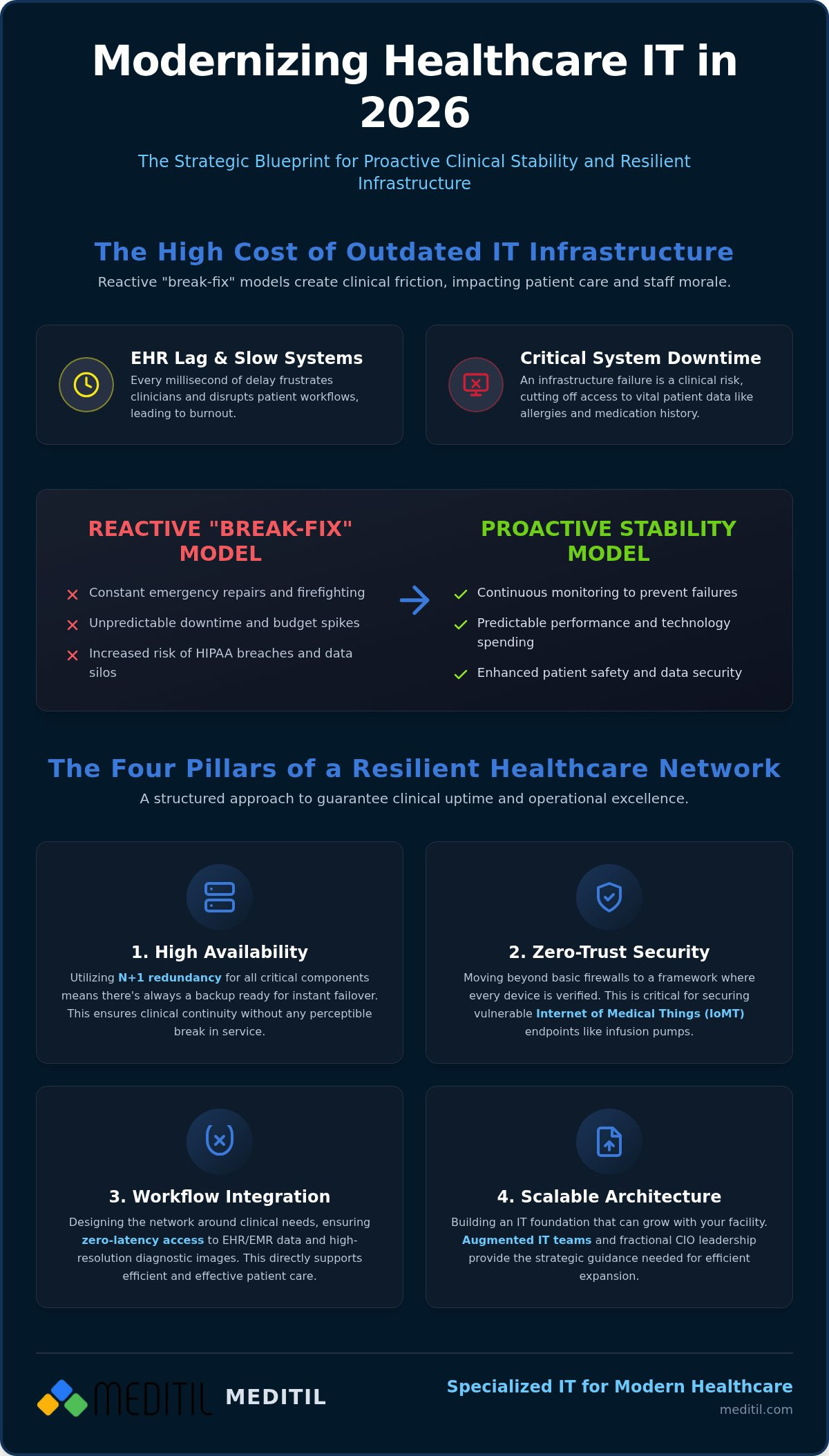
Healthcare IT infrastructure is the digital foundation of modern patient care. It represents the orchestration of hardware, software, and data protocols specifically tailored for clinical environments. Effective healthcare network management services ensure these components work in unison to prevent the system failures that lead to physician burnout and operational delays. In the past, IT was often viewed through a “break-fix” lens. If a workstation froze, a technician responded. By 2026, this reactive approach is no longer viable. Modern management focuses on proactive clinical stability, identifying potential failures before they ever impact a patient encounter.
System downtime isn’t merely an administrative inconvenience; it’s a direct clinical risk. When Health Information Technology (HIT) systems go offline, clinicians lose immediate access to allergy lists, medication histories, and real-time vitals. This loss of visibility can lead to medical errors and delayed treatments. For a medical facility, infrastructure stability is a prerequisite for patient safety.
The Scope of Modern Medical Infrastructure
Modern medical infrastructure extends far beyond physical servers in a back closet. It includes a complex web of endpoints, cloud environments, and Internet of Medical Things (IoMT) peripherals. High-availability networking is essential in high-volume settings to ensure zero-latency access to imaging and records. Data management must strike a precise balance. Clinicians require instant accessibility to make life-saving decisions, yet this data must remain shielded by rigorous privacy controls. Managing this ecosystem requires a steady hand and a deep understanding of how data flows through a clinical hub.
Why General Managed IT Fails Healthcare
Standard business IT providers often struggle with the 24/7/365 reality of clinical operations. A typical office can wait until Monday morning for a server reboot, but a trauma center or urgent care facility cannot. Generalists frequently lack the technical nuance required for managed it services for healthcare, particularly regarding EHR/EMR workflows and interoperability. Without industry-specific knowledge, these providers may inadvertently create data silos or security gaps that compromise HIPAA compliance. Specialized healthcare network management services understand that every millisecond of “EHR lag” translates into lost time for patient care. You need a partner who treats your network with the same urgency as a clinical procedure.
The Four Pillars of a Resilient Healthcare Network
A resilient network doesn’t happen by accident. It requires a structured approach that prioritizes clinical uptime over technical convenience. By 2026, the standard for excellence rests on four fundamental pillars: high availability, zero-trust security, workflow integration, and scalable architecture. These pillars form the bedrock of professional healthcare network management services, ensuring that your facility remains operational under any circumstances.
Network Redundancy and Clinical Continuity
Redundancy is the first pillar of resilience. In a medical environment, a single point of failure can halt an entire department. We implement N+1 redundancy for clinical hubs, which means every critical component has at least one backup ready to take over instantly. This architecture ensures that if a primary switch or server fails, the secondary system engages without a perceptible break in service. It’s the technical equivalent of a backup generator for your digital assets.
Reliable connectivity also demands low-latency paths for diagnostic imaging. When a radiologist pulls a high-resolution scan, the network must deliver that data without delay. Proactive monitoring plays a vital role here. By analyzing performance trends, we identify hardware that’s nearing its end of life before it actually breaks. This foresight prevents the emergency repairs that disrupt patient care and lead to unpredictable downtime.
Cybersecurity as an Infrastructure Foundation
Security is no longer a perimeter defense; it’s an internal foundation. Moving beyond basic firewalls is essential for protecting life-critical systems from evolving threats. Implementing comprehensive healthcare cybersecurity services ensures that every device on your network is verified and monitored. This zero-trust approach is particularly critical for the Internet of Medical Things (IoMT). Infusion pumps, heart monitors, and wearable sensors are often the weakest links in a network if not properly segmented.
Protecting these systems requires automated patch management. Manual updates are too slow for the 2026 threat environment. Automating the deployment of security patches for medical applications closes vulnerability windows before they can be exploited. It’s a disciplined way to maintain a steady hand at the wheel of your digital environment while keeping patient data shielded from unauthorized access.
Clinical Workflow and Scalable Architecture
The third pillar is Clinical Workflow Integration. Technology should be invisible to the physician. If a doctor has to fight the network to document a visit, the system has failed. Seamless integration means the infrastructure supports the clinician’s natural movement through the EHR. Finally, your data architecture must be scalable. With the explosion of telehealth data and remote monitoring, your storage and processing capabilities need to grow without requiring a total system overhaul. Building these pillars requires a partner who understands the high-stakes nature of medicine. If you’re ready to strengthen your foundation, consulting with a specialist can help you identify where your current network might be vulnerable.
Overcoming Interoperability and Clinical Friction Challenges
Interoperability is a strategic infrastructure goal, not a simple software feature. While many view it as a checkbox for their EHR, true connectivity requires a network capable of translating complex data streams across disparate systems. Clinical friction often manifests as slow EHR logins, fragmented patient data, and the burden of manual entry. These technical bottlenecks don’t just delay care; they actively contribute to physician burnout. When healthcare network management services are optimized, they solve the “EHR lag” that forces clinicians to spend more time with screens than with patients.
A unified patient record depends on seamless systems integration. This involves moving beyond siloed databases to an environment where information flows securely using HL7 and FHIR standards. By centralizing this flow, you eliminate the need for redundant data entry and ensure that every specialist has access to the same validated information. This technical precision creates a more composed and reliable environment for both staff and patients. It’s about building a steady hand at the wheel of your data exchange.
EHR/EMR Implementation and Optimization
Successful software deployment begins with an infrastructure readiness audit. Before a new clinical platform is launched, the underlying network must be verified for capacity and speed. We focus on optimizing end-user support so that technical hurdles never interfere with a patient encounter. This holistic approach includes integrating financial workflows directly into the clinical infrastructure. Utilizing medical billing automation solutions ensures that administrative tasks are handled with the same precision as clinical data, reducing the overhead of manual billing cycles and improving predictable spending.
Telehealth and Remote Monitoring Infrastructure
The expansion of telehealth has introduced significant bandwidth demands that standard networks aren’t always equipped to handle. High-definition video consultations require low-latency connections to maintain a professional and reassuring presence. Beyond the clinic walls, managing remote monitoring devices presents a unique security challenge. Every wearable sensor and home monitoring unit must be secured to prevent unauthorized access while ensuring the data it collects integrates seamlessly into the patient record. This level of connectivity requires a disciplined, proactive management strategy to ensure every detail is handled with precision. We treat your remote infrastructure with the same rigor as your local clinical hub.
Managed IT vs. In-House Infrastructure Management
Deciding between an internal IT department and specialized healthcare network management services is a strategic choice that impacts long-term clinical stability. While large health systems may maintain 24/7 internal teams, the overhead of full-time staffing is often prohibitive for mid-sized facilities. In-house departments frequently struggle with “tribal knowledge” risks, where critical system details exist only in the minds of a few individuals. If a key technician leaves, the facility faces a significant knowledge gap. Transitioning to a managed model provides a documented, disciplined approach that ensures continuity regardless of individual staff changes.
The “Augmented IT Team” model offers a balanced solution for organizations that wish to retain their local talent. In this scenario, we partner with your existing staff to handle high-level management and complex infrastructure tasks. This allows your internal team to shift from daily maintenance to clinical innovation. By offloading the burden of routine monitoring and updates, your staff can focus on projects that directly improve the patient experience. This strategic resource allocation transforms IT from a cost center into a driver of operational efficiency.
The Cost of Technical Debt in Healthcare
Technical debt occurs when aging infrastructure is left unaddressed, leading to increased operational costs and heightened security risks. Legacy hardware is more prone to failure and often lacks the performance required for modern EHR systems. Using it budgeting for medical practices allows you to plan multi-year upgrades that eliminate these vulnerabilities. Modernizing your network provides a clear ROI through reduced downtime and increased patient throughput. A steady hand at the wheel ensures that your technology investments are proactive rather than reactive.
Managed Compliance and Audit Readiness
Maintaining regulatory standards requires constant vigilance rather than a frantic scramble during annual HIPAA preparation. Professional healthcare network management services provide continuous monitoring as a standard operating procedure. This proactive stance ensures that your facility is always audit-ready. Automated reporting becomes a natural byproduct of well-managed infrastructure, providing the verification needed to satisfy regulators. As 2026 healthcare regulations continue to evolve, a managed partner acts as a seasoned guide, navigating the complexities of compliance so you can focus on patient care. If you’re ready to secure your facility’s future, our Managed IT Services provide the expert oversight your infrastructure requires.
Building a Strategic Roadmap with Fractional CIO Leadership
While technical support addresses immediate hardware failures, strategic leadership secures the long-term viability of your organization. Technicians focus on tactical fixes. A Chief Information Officer (CIO) provides the strategic vision required to align technology with clinical and financial objectives. For many mid-sized medical groups, a full-time executive salary is a significant hurdle. This is where virtual cio services bridge the gap. They provide high-level executive guidance without the overhead of a traditional full-time hire, ensuring your facility has a steady hand at the wheel.
Fractional CIO: The Strategic Missing Link
A fractional CIO acts as the strategic missing link for growing practices. They develop a 3-5 year IT roadmap that evolves alongside your clinical needs. This roadmap ensures that every infrastructure investment serves a specific purpose, whether that’s improving patient throughput or enhancing data security. These leaders also manage complex vendor relationships and contract negotiations. By centralizing these interactions, they reduce administrative overhead and ensure your healthcare network management services are delivered with precision and accountability. When it’s time for large-scale migrations, a fractional CIO leads the process to ensure minimal clinical disruption.
Business Intelligence and Analytics
Data shouldn’t just sit in a server; it should drive decision-making. Through integrated business intelligence and analytics, we turn infrastructure data into actionable clinical insights. You can monitor practice performance and patient outcomes in real-time through integrated data streams. This visibility allows for precise adjustments that drive operational efficiency and revenue growth. Using analytics to identify bottlenecks in patient flow or billing cycles moves your practice from a reactive state to a proactive one. It’s a disciplined approach to managing the health of your business alongside the health of your patients.
As we look toward the end of the decade, the role of AI and machine learning in medical infrastructure will only expand. Preparing your network for big data processing today ensures you won’t be left behind tomorrow. A strategic roadmap identifies the necessary steps to integrate these advanced tools while maintaining your healthcare network management services at peak performance. By aligning your infrastructure with future technical trends, you ensure your facility remains a high-performing specialist in an increasingly competitive landscape. This foresight is what separates a stable clinical environment from one that’s constantly struggling to catch up with the latest requirements.
Securing Your Clinical Future Through Strategic Infrastructure
The transition toward a proactive, high-performance digital environment is no longer optional for organizations aiming to thrive in 2026. By prioritizing high-availability networking and zero-trust security, you transform your technology from a potential point of failure into a silent partner in patient care. We’ve explored how addressing clinical friction and technical debt creates a more efficient workflow for your clinicians and a safer experience for your patients. Implementing professional healthcare network management services ensures that every technical detail is handled with precision, allowing your staff to focus on their primary mission.
Choosing the right partner provides you with the steady hand at the wheel needed to navigate evolving regulatory and technical landscapes. Whether you require fractional CIO strategic guidance, 24/7 clinical-grade support, or healthcare-exclusive expertise, we’re ready to assist you in building a resilient roadmap. It’s time to move beyond reactive troubleshooting and embrace a disciplined, forward-looking IT strategy. Secure Your Practice with MEDITIL’s Managed Infrastructure Solutions today and ensure your facility remains a leader in modern medical care. We look forward to supporting your long-term stability and growth.
Frequently Asked Questions
What is the difference between general IT and healthcare IT infrastructure management?
General IT focuses on standard business uptime, but healthcare IT infrastructure management prioritizes life-critical clinical stability. Healthcare environments require 24/7/365 availability and specialized knowledge of medical workflows. Standard providers often lack the technical nomenclature and regulatory expertise needed to manage complex EHR systems and HIPAA requirements. Choosing specialized healthcare network management services ensures your infrastructure is built to support the high-stakes demands of a clinical setting without the risk of generalist oversights.
How can managed infrastructure help my practice stay HIPAA compliant in 2026?
Managed infrastructure provides proactive HIPAA monitoring that far exceeds the traditional annual audit approach. By 2026, regulatory enforcement requires continuous verification of data encryption and access controls. A managed partner implements automated reporting and zero-trust security frameworks to ensure your practice remains compliant at all times. This steady hand at the wheel identifies potential vulnerabilities before they become breaches, protecting both your patient data and your organization’s professional reputation.
What are the biggest risks of using legacy IT infrastructure in a medical setting?
Legacy IT infrastructure introduces significant security vulnerabilities and contributes to clinical friction through slow system response times. Aging hardware is often incompatible with the latest EHR updates, leading to frequent lag that frustrates clinicians. Additionally, maintaining outdated systems is more expensive than modernizing due to higher failure rates and emergency repair costs. Upgrading your network eliminates these risks, ensuring your facility maintains high performance and predictable technology spending through a structured roadmap.
How does fractional CIO leadership differ from standard IT support?
Standard IT support is primarily tactical and reactive, while fractional CIO leadership provides the strategic vision needed for long-term growth. A fractional CIO develops 3-5 year roadmaps and aligns technology investments with your practice’s financial goals. While technicians fix immediate hardware issues, a CIO manages vendor relationships and leads large-scale migrations with minimal disruption. This executive-level guidance provides your organization with a seasoned expert who understands the intersection of technology and clinical administration.
Can managed IT services integrate with our existing EHR and billing software?
Yes, specialized healthcare network management services are designed specifically to integrate disparate systems like EHR platforms and billing software. We utilize industry standards such as HL7 and FHIR to ensure seamless data flow across your entire clinical hub. This interoperability reduces manual data entry and minimizes the risk of administrative errors. By creating a unified patient record, you improve both clinical outcomes and the efficiency of your billing automation processes through precise technical orchestration.
What is N+1 redundancy, and why is it critical for healthcare networks?
N+1 redundancy is a configuration where every critical component has at least one operational backup ready to take over in the event of a failure. In a clinical environment, this ensures that a single hardware malfunction won’t bring down your entire network. This architecture is essential for maintaining 24/7 uptime for EHR access and diagnostic imaging. Implementing this level of redundancy provides the clinical stability required to ensure patient care is never interrupted by technical issues.
How do I transition to managed infrastructure without disrupting patient care?
We utilize a phased approach that begins with a comprehensive infrastructure readiness audit to ensure a smooth transition. By using an augmented IT team model, we can work alongside your existing staff to implement upgrades without halting daily operations. This methodical process focuses on high-impact areas first, such as network stability and cybersecurity, before moving to deeper systems integration. Our goal is to enhance your technical capabilities while maintaining a steady, reliable presence for clinicians.
What are the costs associated with upgrading healthcare IT infrastructure?
Upgrading costs depend on your current technical debt and the scale of your clinical operations. Rather than viewing these as a single lump sum, we recommend strategic multi-year budgeting to spread the investment across several fiscal periods. This approach allows you to move from capital-intensive emergency repairs to predictable operational spending. Modernizing your infrastructure provides a significant ROI by reducing downtime and increasing patient throughput, ultimately lowering the total cost of ownership for your facility.