
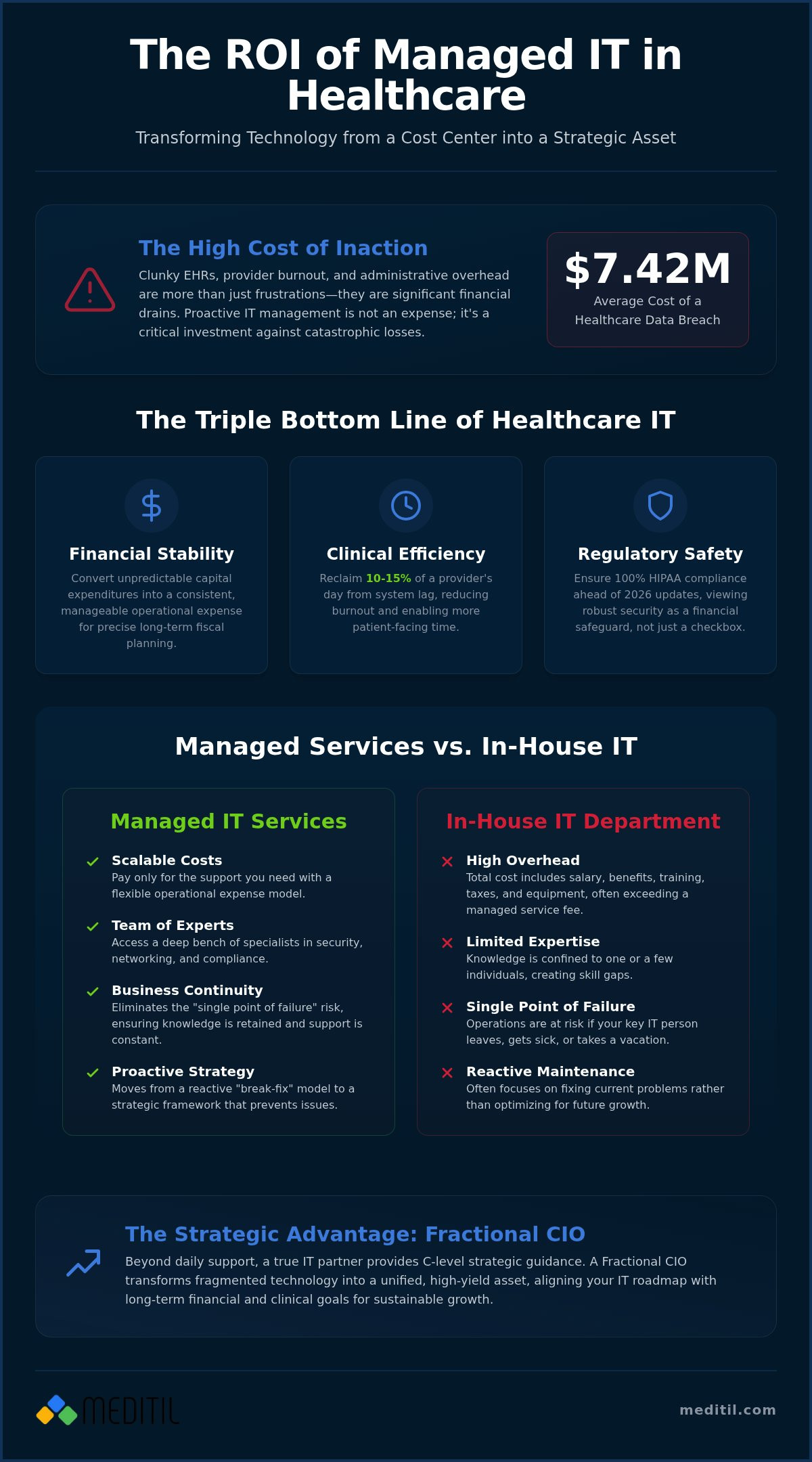
What if your IT infrastructure wasn’t a constant drain on shrinking Medicare reimbursements, but the very engine that recovered your lost revenue? It’s exhausting to watch administrative overhead climb while your providers struggle with clunky EHR workflows that lead to inevitable burnout. You likely feel that every dollar spent on technology is a necessary evil to stay ahead of the average $7.42 million cost of a healthcare data breach. However, the true roi of managed it services in healthcare is found when you stop viewing technology as an expense and start treating it as a strategic partner.
This analysis demonstrates that a high-performing digital ecosystem extends far beyond simple cost savings. It’s about a fundamental shift from reactive maintenance to proactive, strategic advancement. By the end of this guide, you’ll discover how fractional leadership and billing automation can eliminate technical debt and ensure 100% HIPAA compliance ahead of the 2026 regulatory updates. We’ll outline a roadmap to transform your digital infrastructure from a burdensome cost center into a high-yield asset that supports both your clinicians and your financial bottom line.
Key Takeaways
- Quantify clinical ROI by measuring how streamlined EHR workflows reduce physician burnout and reclaim valuable patient-facing time.
- Analyze the financial roi of managed it services in healthcare by comparing scalable external support models against the increasing overhead of in-house staffing.
- Explore how interoperability and billing automation accelerate the revenue cycle by minimizing denied claims and administrative friction.
- Evaluate the cost-benefit of proactive risk mitigation in response to the 2026 HIPAA Security Rule updates and evolving ransomware threats.
- Understand the role of a Fractional CIO in transforming fragmented technology into a unified, high-yield strategic asset.
Defining ROI in a Clinical Context: Beyond the Spreadsheet
Traditional return on investment metrics often fall short in medical environments because they fail to account for the human element of care. While a standard business might focus solely on hardware depreciation or software licensing costs, a clinical organization must prioritize “Clinical ROI.” This metric measures the direct correlation between technical stability and provider satisfaction. When systems function seamlessly, the primary roi of managed it services in healthcare manifests as reclaimed time; specifically, the minutes saved during each patient encounter that were previously lost to spinning icons or slow login sequences.
The “Friction Tax” is the daily drain on practice profitability caused by clunky, unoptimized systems. It’s the cumulative cost of a physician spending extra time on documentation because the EHR interface is unresponsive. This friction doesn’t just frustrate staff; it limits patient throughput and erodes the organization’s reputation. Moving from a reactive “break-fix” model to a proactive managed framework ensures that infrastructure remains a silent, reliable supporter of the clinical mission rather than a source of daily agitation.
The Triple Bottom Line of Healthcare IT
To accurately calculate the roi of managed it services in healthcare, leadership must look at three distinct pillars of value:
- Financial Stability: Managed services help stabilize the budget by converting unpredictable capital expenditures into consistent operational expenses. This allows for more precise long-term fiscal planning.
- Clinical Efficiency: Reclaiming 10-15% of a provider’s day from EHR lag or network latency directly impacts the bottom line. This time can be redirected toward additional patient appointments or essential administrative tasks, reducing the need for after-hours charting.
- Regulatory Safety: Compliance isn’t just a checkbox; it’s a financial safeguard. With the average cost of a healthcare data breach reaching $7.42 million in 2025, the cost of a robust managed security program is a fraction of the potential penalty for negligence.
Calculating the Cost of Technical Debt
Technical debt refers to the implied cost of additional rework caused by choosing an easy, short-term solution instead of a better approach that takes longer. In healthcare, this often looks like legacy servers that are no longer supported or “Shadow IT,” where staff use unauthorized personal applications to bypass slow corporate tools. These workarounds create fragmented data silos and significant security vulnerabilities. Technical debt acts like compounding interest; the longer these legacy issues persist, the more expensive they become to rectify. A strategic partner identifies these bottlenecks, providing a clear roadmap to modernize infrastructure and stop the drain on organizational resources.
Direct Cost Savings: Managed IT vs. In-House Departments
Comparing a monthly service fee to a single salary is a common oversight when evaluating the roi of managed it services in healthcare. By 2026, the total cost of ownership for a full-time, specialized healthcare IT employee includes much more than a base salary. You must account for payroll taxes, health benefits, retirement contributions, and the significant overhead of office space and equipment. When these factors are aggregated, the expense of maintaining an internal department often outweighs the cost of a comprehensive managed partnership.
Scalability remains a primary financial driver. In-house staffing is rigid; you pay for the same headcount whether your ticket volume is high or low. A managed model allows you to pay for the level of support you actually consume. This flexibility extends to hardware procurement. Strategic partners leverage vendor relationships to reduce lifecycle costs, ensuring you aren’t overpaying for infrastructure that will be obsolete in three years. Relying on a single IT manager also introduces a “single point of failure” risk. If that individual leaves or faces an emergency, your practice’s technical knowledge and security posture vanish instantly. A managed team provides continuity that a lone employee cannot match.
The Hidden Costs of In-House IT
Recruitment in the 2026 tech market is exceptionally competitive and expensive. Beyond the initial hire, the cost of continuous education is mandatory. With the U.S. Department of Health and Human Services (HHS) finalizing major updates to the HIPAA Security Rule in late 2026, your staff must undergo constant training to handle mandatory multi-factor authentication and vulnerability management. Licensing for sophisticated cybersecurity tools also adds a layer of overhead that is typically included in a managed service agreement, further improving the roi of managed it services in healthcare.
Predictable Budgeting with Managed Services
Shifting from unpredictable capital expenditures (CapEx) to stable operational expenses (OpEx) is essential for fiscal health. Large, unexpected outlays for server failures or emergency security patches can derail a practice’s financial goals. Implementing a disciplined approach to it budgeting for medical practices allows leadership to stabilize cash flow and allocate resources to clinical growth. A fixed-cost IT structure prevents “emergency budget” surprises by ensuring that infrastructure maintenance and security updates are baked into a predictable monthly fee. If you are ready to stabilize your technology spending, our team can help you transition to a more resilient managed infrastructure.
Revenue Acceleration through Interoperability and Automation
While previous sections focused on expense reduction, the most compelling roi of managed it services in healthcare stems from revenue acceleration. Technology shouldn’t just be a utility; it’s a vehicle for capturing lost revenue and expanding service reach. By prioritizing interoperability and automation, organizations can bridge the significant gap between clinical documentation and billing accuracy. This connectivity ensures that every billable event is captured, coded correctly, and submitted without the delays inherent in manual systems.
Managed infrastructure also supports the expansion of telehealth and remote monitoring capabilities. These services allow providers to maintain patient engagement outside the physical clinic, opening new revenue streams that were previously inaccessible due to geographic or logistical constraints. By 2026, these tools aren’t just optional features; they’re essential components of a competitive patient retention strategy that drives long-term financial growth.
Optimizing the Revenue Cycle
Integrating medical billing automation solutions directly with your EHR environment eliminates the manual “hand-off” where data entry errors often occur. These human errors are a primary driver of denied claims, which drain administrative resources and delay cash flow. Seamless connectivity ensures that clinical data flows directly into the billing system, allowing for real-time verification and cleaner claim submissions. This acceleration of the time-to-reimbursement cycle provides a measurable boost to liquidity. It allows practices to reinvest in clinical growth rather than chasing unpaid invoices through repetitive manual labor.
Reducing Clinical Friction
Revenue growth is fundamentally limited by patient volume and the speed of intake. Integrated digital platforms streamline the patient journey from the first appointment request to the final discharge. When specialty clinics and hospitals share data through advanced interoperability standards like FHIR APIs, clinicians spend less time hunting for records and more time treating patients. High-performing EHR systems don’t just reduce provider frustration; they directly correlate to higher patient volume. When the technology works at the speed of the clinician, the practice can see more patients without compromising the quality of care. This operational efficiency is a cornerstone of the roi of managed it services in healthcare in an era of tightening margins.
Risk Mitigation: The ROI of Cybersecurity and Compliance
Risk is a line item that many administrators ignore until it becomes a liability. In the current 2026 threat landscape, ransomware has evolved to target life-critical systems, making technical failure a direct threat to patient safety. Calculating the roi of managed it services in healthcare requires you to quantify the value of the breaches and system failures that never occur. A proactive security posture isn’t just an IT preference; it’s a financial necessity that protects the organization from catastrophic litigation and the total loss of operational capacity.
Compliance serves as the baseline for this organizational stability. With the U.S. Department of Health and Human Services (HHS) implementing a major overhaul of the HIPAA Security Rule in late 2026, formerly “addressable” safeguards like multi-factor authentication (MFA) and data encryption are now mandatory. Organizations that fail to meet these technical standards face significantly higher insurance premiums. Cyber liability carriers now demand documented proof of vulnerability scans and annual penetration tests before they will underwrite a policy. By maintaining these standards through a managed model, you ensure your practice remains insurable and legally protected.
The Cost of a Healthcare Data Breach
The financial impact of a security failure is staggering. According to 2025 industry data, the average cost of a healthcare data breach reached $7.42 million. These direct costs include HHS fines, legal fees, and the expensive process of patient notification. However, the indirect costs often prove more damaging over time. Patient trust is difficult to rebuild; a breach often leads to significant patient churn as individuals seek providers they perceive as more secure. When considering the roi of managed it services in healthcare, remember this: in 2026, the cumulative cost of clinical downtime and emergency remediation far exceeds the annual investment in a managed defense system.
Proactive Compliance Management
Relying on annual audits is no longer a viable strategy for modern clinics. The 2026 regulatory environment requires continuous monitoring to handle the shortened 15-day window for patient PHI access requests. Leveraging specialized healthcare cybersecurity services allows your organization to move from a reactive state to a proactive defense. This includes automated patching and endpoint protection that identifies threats before they can move laterally through your network. To ensure your clinic meets the new mandatory technical safeguards, you should consult with a compliance expert to review your current infrastructure.
The Fractional CIO: Strategic ROI for Long-Term Growth
Strategic leadership prevents the common pitfall of “vendor bloat.” Without expert vetting, practices often accumulate redundant software subscriptions and incompatible hardware that complicate workflows rather than simplifying them. An experienced consultant identifies these inefficiencies, streamlining your technical stack to ensure every tool serves a specific clinical or administrative purpose. This disciplined approach also future-proofs your practice. As AI governance and remote monitoring move from pilot programs to production in 2026, having a strategic roadmap ensures these innovations are integrated responsibly and effectively.
Strategic Roadmap Development
Success in a regulated environment requires a vision that extends beyond the current fiscal quarter. Utilizing virtual cio services allows your leadership to develop a 3-5 year growth plan that anticipates technological shifts and patient needs. These specialists prioritize IT investments based on their potential clinical impact, ensuring that your budget is allocated to the most critical infrastructure. They also bridge the communication gap between clinical staff and technical teams. By translating complex technical nomenclature into actionable business objectives, a Fractional CIO ensures that every stakeholder is aligned with the organization’s long-term trajectory.
Vendor and Project Management
Complex technical projects, such as EMR/EHR implementations or telehealth rollouts, frequently suffer from scope creep and budget overruns. A strategic partner manages these complexities, ensuring that vendors meet their contractual obligations and that timelines are strictly followed. This oversight is vital for maintaining the roi of managed it services in healthcare, as it prevents the hidden costs of failed integrations and clinical downtime. Efficient project management allows your staff to remain focused on patient engagement while the technical details are handled with precision. Discover how MEDITIL’s managed it services for healthcare can secure your practice’s financial future.
Securing a Sustainable Future for Your Clinical Infrastructure
The evolution of the healthcare landscape in 2026 requires a shift from reactive maintenance to strategic partnership. You’ve seen how the roi of managed it services in healthcare extends far beyond simple overhead reduction. It’s found in the minutes reclaimed by providers, the acceleration of the billing cycle through automation, and the protection of organizational reputation against evolving cyber threats. By integrating expert billing and EHR support with tailored healthcare-specific security frameworks, you build a foundation that supports both patient care and financial stability.
Fractional CIO leadership provides the steady hand at the wheel needed to navigate complex regulatory shifts and technical debt. This expert guidance ensures that every technology investment aligns with your long-term clinical goals. If you’re ready to transform your infrastructure into a high-yield asset, we invite you to Request a Strategic IT ROI Assessment for Your Practice. Proactive planning today ensures that your organization remains resilient, compliant, and focused on delivering exceptional care.
Frequently Asked Questions
How do you calculate the specific ROI of managed IT for a small clinic?
To calculate the roi of managed it services in healthcare for a small clinic, you must compare the total cost of ownership of your current system against the annual managed service fee. This includes tracking hours lost to system downtime, the cost of manual workarounds, and emergency repair bills. When you quantify these hidden expenses, the shift to a predictable monthly model typically reveals a net positive return within the first year.
Can managed IT services help reduce medical billing errors?
Managed IT directly reduces billing errors by implementing seamless systems integration between your clinical documentation and financial platforms. Automation ensures that data flows without manual intervention, which eliminates the primary source of coding mistakes and data entry discrepancies. This connectivity leads to higher first-pass claim rates and a significant reduction in the administrative labor required to appeal denied charges.
Is a Fractional CIO worth the investment for a mid-sized practice?
A Fractional CIO is a high-value investment for mid-sized practices that require executive-level strategy without the expense of a full-time officer. This role is essential for navigating complex vendor selections and ensuring that your technology roadmap supports clinical expansion. By preventing expensive procurement mistakes and vendor bloat, the strategic guidance provided often pays for itself through optimized resource allocation and improved system interoperability.
What is the average payback period for a healthcare IT infrastructure upgrade?
Most healthcare organizations realize a full return on infrastructure upgrades within 12 to 18 months. This payback period is driven by immediate gains in clinical throughput and the elimination of reactive repair costs. While initial outlays may seem high, the long-term stability and reduced energy requirements of modern cloud-integrated systems provide a consistent financial advantage that compounds over the lifecycle of the equipment.
How does managed IT impact physician burnout and clinical workflow?
Does outsourcing IT put our HIPAA compliance at higher risk?
Professional outsourcing actually strengthens your security posture by providing access to specialized compliance experts and 24/7 monitoring tools. Most small to mid-sized practices lack the internal resources to manage the mandatory technical safeguards required by the 2026 HIPAA updates. A dedicated partner ensures that encryption, multi-factor authentication, and vulnerability scans are handled with precision, significantly reducing the risk of a costly regulatory violation.
How much can a healthcare organization save by moving to managed cloud services?
Organizations typically see a 15% to 25% reduction in long-term IT spending by transitioning to managed cloud services. These savings result from the elimination of expensive on-site server maintenance and the ability to scale resources based on actual demand. Moving to a cloud-based model also enhances disaster recovery capabilities, ensuring that clinical operations can continue without interruption even in the event of local hardware failure or a regional emergency.
What happens to the ROI if we keep our current in-house IT person?
Retaining your in-house IT staff while partnering with a managed service provider creates an augmented IT model that maximizes your return. Your internal person can focus on immediate user support and clinical workflows while the managed team handles high-level security, compliance, and infrastructure stability. This collaborative approach ensures that your internal resources are utilized for high-value tasks rather than being overwhelmed by routine maintenance and complex cybersecurity requirements.