
In the current healthcare environment, an unmanaged IT vendor list isn’t just a budgetary leak; it’s a direct threat to patient safety and clinical continuity. You likely feel the weight of vendor bloat every time an interoperability gap delays a billing cycle or a third-party access point creates a security vulnerability. It’s frustrating to watch technology spend climb while your team struggles with technical debt and fragmented systems. You deserve a technology ecosystem that supports your mission rather than obstructing it.
This guide provides a strategic framework for healthcare IT vendor management designed for the complexities of 2026. We’ll show you how to consolidate your ecosystem to reduce clinical friction and ensure rigorous HIPAA compliance. By the end of this article, you’ll understand how to optimize your technology spend, close interoperability gaps between EMR and billing software, and transition from a reactive posture to a predictable, governed IT roadmap that stabilizes your entire organization. We will examine the specific steps required to transform your vendors from a collection of silos into a unified, high-performing infrastructure.
Key Takeaways
- Navigate the shift toward fragmented SaaS models by establishing a unified and governed technology ecosystem.
- Identify hidden HIPAA vulnerabilities created by unmanaged third-party access to your clinical and financial data.
- Evaluate potential partners using a four-pillar framework that prioritizes clinical outcomes and infrastructure stability.
- Implement professional healthcare IT vendor management to centralize your registry and eliminate technical debt through strategic consolidation.
- Discover how a Fractional CIO serves as a strategic buffer against aggressive sales teams to ensure neutral technology selection.
What is Healthcare IT Vendor Management in 2026?
In the high-stakes environment of modern medicine, healthcare IT vendor management has evolved far beyond the administrative task of processing invoices. It’s now a critical function of clinical safety and operational continuity. Effective management involves the systematic oversight of software, hardware, and service providers to ensure every digital tool contributes to, rather than detracts from, patient care. Healthcare IT vendor management is the strategic alignment of technology partners with clinical goals to ensure operational stability and patient safety.
By 2026, the industry has seen a massive shift toward fragmented SaaS models. While these cloud-based solutions offer flexibility, they often lead to “vendor sprawl,” where dozens of disconnected applications create silos. Managing these relationships requires a specialized approach to third-party management that prioritizes technical integrity over simple price points. Unlike general procurement, medical IT oversight must account for the life-or-death implications of system downtime and data breaches. It’s about ensuring that every link in your digital chain is resilient and compliant.
The Scope of Modern Medical IT Vendors
The modern medical technology stack is a complex web of interdependent services. To maintain a stable environment, administrators must oversee several key categories:
- EMR/EHR Providers: These are the foundation of your data ecosystem. Oversight focuses on data liquidity and ensuring that patient records move seamlessly between departments.
- Cloud Infrastructure: Whether you utilize AWS, Azure, or a private cloud, your hosting partners dictate the speed and reliability of your clinical applications.
- Cybersecurity and Compliance: Vendors providing SIEM or SOC-as-a-Service are your primary line of defense against evolving threats. Their performance is directly tied to your HIPAA standing.
- Medical Device and Equipment Procurement: In addition to software, managing clinical hardware through a B2B platform like GetMedicalDevice ensures that your physical assets meet the same high standards for quality and reliability as your digital infrastructure.
Why Traditional VMS Models Fail IT Teams
Generic Vendor Management Systems (VMS) often fail in a healthcare setting because they treat technology like a commodity. These models typically focus on “uptime” as the primary metric. However, a system can be “up” while still being functionally broken for a clinician. If a billing integration is slow or an EMR interface is clunky, it creates clinical friction that leads directly to physician burnout. You can’t measure the success of a medical tool by a server ping alone.
Traditional models also ignore technical debt. When software contracts are signed without a plan for long-term integration, the resulting patchwork of systems becomes increasingly expensive and difficult to maintain. A strategic approach ensures that every new vendor reduces, rather than increases, the complexity of your infrastructure. This shift from reactive purchasing to intentional partnership is the hallmark of a mature IT strategy. It’s how you move from a state of constant firefighting to a predictable, governed environment.
The Hidden Risks of Unmanaged Healthcare IT Ecosystems
Neglecting oversight of your digital partners creates systemic vulnerabilities that extend far beyond simple technical glitches. In the context of healthcare IT vendor management, the most dangerous risks are those that remain hidden until a crisis occurs. Compliance is a primary concern. Many practices assume that signing a Business Associate Agreement (BAA) shifts all liability to the vendor. This is a misconception. Under the shared responsibility model, you remain accountable for ensuring your partners maintain rigorous standards. Without active auditing, third party vendors can create significant HIPAA blind spots, especially when they access Protected Health Information (PHI) through unmonitored channels.
For a structured approach to managing these regulatory requirements, the HealthIT.gov Playbook provides essential guidance on contracting and vendor selection. Clinical friction is another invisible cost of unmanaged ecosystems. When billing and EMR systems are poorly integrated, staff must resort to manual data entry or workarounds that consume valuable time. This inefficiency doesn’t just slow down your revenue cycle; it contributes to physician burnout and increases the likelihood of medical errors. A fragmented IT environment forces your clinical team to act as the bridge between disconnected software, which is an expensive and risky use of their expertise.
Cybersecurity and Third-Party Access
Unmanaged remote access by software support teams often bypasses internal security protocols. Utilizing professional healthcare cybersecurity services is vital for auditing these entry points. By 2026, every vendor must meet strict encryption and multi-factor authentication (MFA) standards to prevent unauthorized lateral movement within your network. You need a clear record of who accessed your data, when they accessed it, and what changes were made. Without this oversight, a single compromised vendor account can jeopardize your entire practice.
Financial Leakage and Over-Provisioning
Redundant SaaS subscriptions often accumulate when different departments purchase software independently. Developing a comprehensive approach to it budgeting for medical practices helps reveal these hidden costs and identifies opportunities for consolidation. Beyond monthly fees, the lock-in effect of legacy contracts creates technical debt. This financial burden grows as data extraction fees and transition costs make it difficult to migrate to more efficient systems. A strategic partner can help you audit these relationships to ensure your technology stack remains lean and secure. Managing these costs effectively requires a proactive stance on contract renewals and service level agreements.
Strategic Framework for Evaluating Medical IT Partners
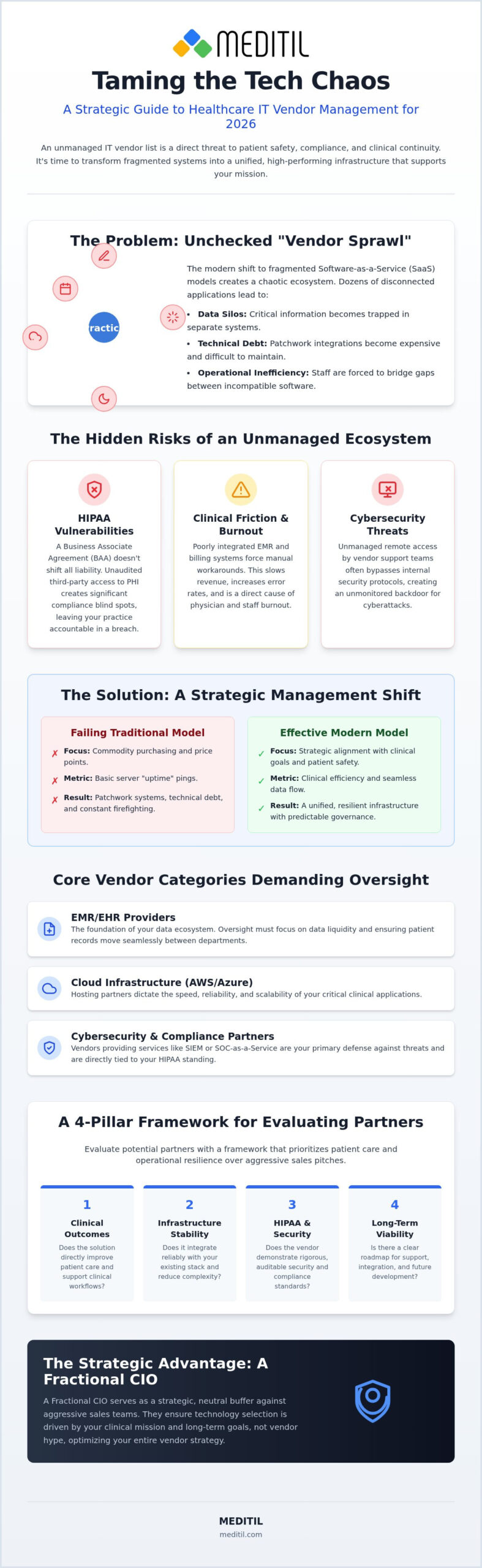
Moving beyond a simple procurement mindset is the first step in establishing a resilient technology ecosystem. While price is always a factor, evaluating vendors solely on cost is a dangerous strategy for life-critical systems. Effective healthcare IT vendor management requires a shift toward assessing partners based on clinical outcomes and long-term infrastructure stability. You need to know that a vendor’s roadmap aligns with your organization’s growth and that their financial health ensures they’ll be around to support you five years from now. A stable partner is one that views their role as an extension of your clinical team rather than just a software provider.
To achieve this, we utilize a four-pillar evaluation framework. This structured approach ensures every new addition to your stack is vetted for Compliance, Interoperability, Scalability, and Support. Compliance ensures the vendor meets all current HIPAA and 2026 regulatory standards. Scalability confirms the platform can handle increased patient volumes without performance degradation. Most importantly, you must define Service Level Agreements (SLAs) that reflect the realities of medical practice. A clinical-first SLA is a contractual commitment that prioritizes the availability and performance of patient-facing systems to prevent disruptions in care delivery. This ensures that technical issues don’t become clinical obstacles.
Interoperability and Data Liquidity
In 2026, data that can’t move is data that has no value. You must verify if potential vendors strictly adhere to HL7 FHIR standards to ensure seamless communication across your network. This is particularly vital when integrating medical billing automation solutions with your primary EMR. If data can’t flow automatically between clinical and financial platforms, your team is forced into manual reconciliations. Ask direct questions about API access and data ownership. You should never have to pay a “ransom” to extract your own patient data during a future transition.
Support and Response Protocols
There’s a significant difference between a standard help desk and specialized clinical workflow support. A general technician might understand how to reset a password, but they likely don’t understand how a system lag affects a physician in the middle of a patient encounter. Evaluate vendor response times specifically for life-critical system outages. In national healthcare contracts, it’s also important to distinguish between remote-only support and the ability to provide on-site assistance when infrastructure fails. Your vendors should provide a clear escalation path that leads to experts who understand the nuances of healthcare administration and clinical urgency. This level of precision is what separates a mere supplier from a strategic partner.
Best Practices for Vendor Consolidation and Oversight
Centralizing your vendor registry is the foundation of effective healthcare IT vendor management. It’s not enough to maintain a simple spreadsheet of contacts. You need a comprehensive database that details exactly which partners have access to your data and the specific functions they perform. This visibility allows you to implement the ‘Rule of One,’ where you aim for a single source of truth for clinical data across your entire organization. Fragmented data leads to clinical errors. By centralizing this information, you ensure that your clinical team isn’t hunting for records across multiple, disconnected platforms.
Operational excellence also requires automating contract renewals and compliance audits. Relying on manual tracking often leads to lapsed security certifications or unexpected price hikes that disrupt your budget. Establishing a regular Quarterly Business Review (QBR) with your primary IT partners keeps them accountable. These meetings shouldn’t just be about “uptime.” They should focus on how the vendor is helping you meet your strategic clinical goals and where their roadmap might create future friction.
Reducing Vendor Bloat
Conducting an annual IT audit is the most effective way to identify overlapping functionalities that drain your financial resources. Many practices find they’re paying for three different tools that all perform similar tasks. Transitioning from a patchwork of niche applications to comprehensive managed IT services for healthcare reduces complexity and eliminates technical debt. This consolidation also helps solve the “Shadow IT” problem, where individual departments purchase software without administrative oversight. When you provide a robust, integrated ecosystem, the temptation for departments to go rogue disappears.
The Vendor Onboarding Checklist
A disciplined onboarding process prevents future technical and regulatory friction. Every new partner must undergo a rigorous security assessment and BAA verification before they touch your network. You also need to perform a technical compatibility check with your existing EHR and network infrastructure to avoid integration failures. Finally, perform a workflow impact analysis. You must understand exactly how a new tool will change a physician’s daily routine. If a tool adds five clicks to a standard procedure, it’s a liability, not an asset. A steady hand at the wheel ensures that every new vendor adds value without increasing clinical burden.
If your current vendor list feels unmanageable, it’s time to regain control. You can streamline your technology stack with a partner who understands the nuances of medical operations and strategic consolidation.
How a Fractional CIO Optimizes Your Vendor Strategy
Leadership is the essential missing component in many healthcare technology stacks. While a management platform is a useful tool, it cannot replace the strategic oversight required to align technical choices with clinical objectives. This is where virtual cio services become a critical asset. A Fractional CIO provides neutral vendor selection, ensuring that your organization adopts software based on functional merit rather than the effectiveness of a vendor’s marketing department. By maintaining a high-level view of the market, they ensure that your healthcare IT vendor management strategy remains objective and results-oriented.
A Fractional CIO also acts as a vital buffer between your practice and aggressive vendor sales teams. These teams often push for upgrades or additional modules that your organization may not need. Your CIO evaluates these proposals against your five-year strategic goals, ensuring that every new expenditure has a clear purpose. They synchronize vendor roadmaps with your internal growth plans, preventing situations where a critical system becomes obsolete or unsupported just as your patient volume increases. This proactive alignment ensures that your infrastructure remains a stable foundation for care delivery.
Expert Negotiation and Contract Management
Securing a fair deal requires more than just comparing price quotes. A strategic partner leverages industry benchmarks to ensure your pricing for SaaS and hardware is consistent with current market standards. They focus on the technical fine print that administrators often overlook, such as:
- Exit Clauses: Ensuring you have a clear, cost-effective path to terminate a relationship if a vendor fails to meet performance standards.
- Data Portability: Mandating that your patient data remains accessible and exportable in standard formats at all times.
- Acquisition Protection: Managing the transition and risk assessment when one of your vendors is acquired by a larger entity.
MEDITIL: Your Partner in Strategic IT Management
At MEDITIL, we act as the steady hand at the wheel for your entire IT department. We don’t just advise; we execute. Our approach involves managing your entire vendor ecosystem, from initial vetting to day-to-day ticket resolution. By providing augmented IT teams, we take the burden of vendor communication off your internal staff. This allows your clinicians to focus on patients while we handle the technical coordination between your EMR, billing, and cybersecurity providers.
Our focus is on reducing technical debt through strategic consolidation and rigorous oversight. We have helped numerous organizations transform a cluttered list of providers into a streamlined, high-performing ecosystem. If your current vendor relationships feel fragmented or unmanageable, we are ready to assist. Contact us today for a comprehensive audit of your current healthcare IT vendor management practices and discover how we can stabilize your technology roadmap for 2026 and beyond.
Stabilizing Your Technology Ecosystem for 2026
Establishing a resilient healthcare IT vendor management strategy is no longer an optional administrative task; it’s a fundamental requirement for clinical safety and financial stability. By centralizing your vendor registry and prioritizing interoperability between EMR and billing systems, you eliminate the friction that leads to clinician burnout. Transitioning to a governed, consolidated infrastructure ensures that your technology serves your patients rather than complicating your operations. High-stakes environments require a steady hand to manage the complexities of modern medical software and cybersecurity standards.
MEDITIL provides the leadership necessary to navigate this landscape through our Fractional CIO services and national healthcare IT expertise. We specialize in resolving the integration gaps between EMR and billing platforms to ensure your data flows seamlessly. Our team acts as a proactive partner, managing your entire vendor lifecycle so you can focus on delivering care. You don’t have to manage these technical burdens alone.
Schedule a Strategic IT Vendor Audit with MEDITIL to identify hidden risks and optimize your technology spend. We are ready to help you build a more secure and predictable future for your practice.
Frequently Asked Questions
What is the most common mistake in healthcare IT vendor management?
The most frequent error is focusing exclusively on the initial purchase price while ignoring long-term technical debt and integration costs. Practices often acquire niche software that lacks the ability to communicate with other systems, which creates clinical silos. This oversight leads to higher operational expenses and increased physician burnout over time. A strategic approach prioritizes interoperability and the total cost of ownership over the lowest bid.
How do I ensure my IT vendors are truly HIPAA compliant in 2026?
You must move beyond the signed Business Associate Agreement and conduct active security audits of their data handling processes. Verify that they meet current 2026 encryption standards and strictly enforce multi-factor authentication for all remote access points. Compliance is a shared responsibility under the law. Regularly reviewing their SOC 2 reports or third-party audit certifications ensures they maintain the rigorous standards required to protect your patient data.
Should I use a different vendor for billing than my EMR provider?
This decision depends on whether a specialized billing platform offers superior automation features that your EMR lacks. While using a single vendor can simplify support, dedicated billing solutions often provide more robust revenue cycle management. If you choose separate vendors, ensuring seamless systems integration is vital. Without a reliable data bridge, your staff will waste hours on manual reconciliations and redundant data entry.
What is a Business Associate Agreement (BAA) and why is it critical?
A BAA is a legally binding contract that establishes exactly how a third-party vendor handles protected health information. It’s critical because it shifts a significant portion of the regulatory liability to the vendor. Without a valid BAA, your practice remains solely responsible for any data breaches caused by that partner. It ensures that your vendors are contractually obligated to follow HIPAA security and privacy rules at all times.
How can I reduce the number of IT vendors without losing functionality?
Conduct a comprehensive audit to identify overlapping software features and consolidate them into a unified managed IT service. Many modern platforms offer integrated modules that replace several legacy niche tools. By migrating to a single source of truth for clinical and administrative data, you reduce technical debt. This consolidation simplifies your healthcare IT vendor management by reducing the number of contracts and support channels you must oversee.
What role does interoperability play in choosing a new software vendor?
Interoperability is the most critical factor for ensuring data liquidity across your practice. You should prioritize vendors that strictly support HL7 FHIR standards to ensure your new software can communicate with existing EMR and billing systems. Choosing a closed system creates data silos that hinder clinical efficiency. High interoperability reduces the need for expensive custom coding and prevents long-term vendor lock-in that can trap your data.
How often should I audit my healthcare IT vendors for security?
You should perform a high-level security review annually, supplemented by more frequent Quarterly Business Reviews for your most critical partners. These audits should verify that vendors still comply with current cybersecurity protocols and that their access permissions are up to date. Regular oversight prevents compliance drift where security standards lapse over time. Routine checks are essential for maintaining a stable and protected clinical infrastructure.
Can a Fractional CIO help with vendor contract negotiations?
Yes, a Fractional CIO provides the technical expertise and industry benchmarks needed to negotiate favorable terms and fair pricing. They ensure that essential clauses like data portability and clear exit strategies are included in every agreement. By acting as a strategic buffer, they protect your practice from aggressive sales tactics. Their leadership ensures that healthcare IT vendor management is handled with professional precision and a long-term strategic vision.