
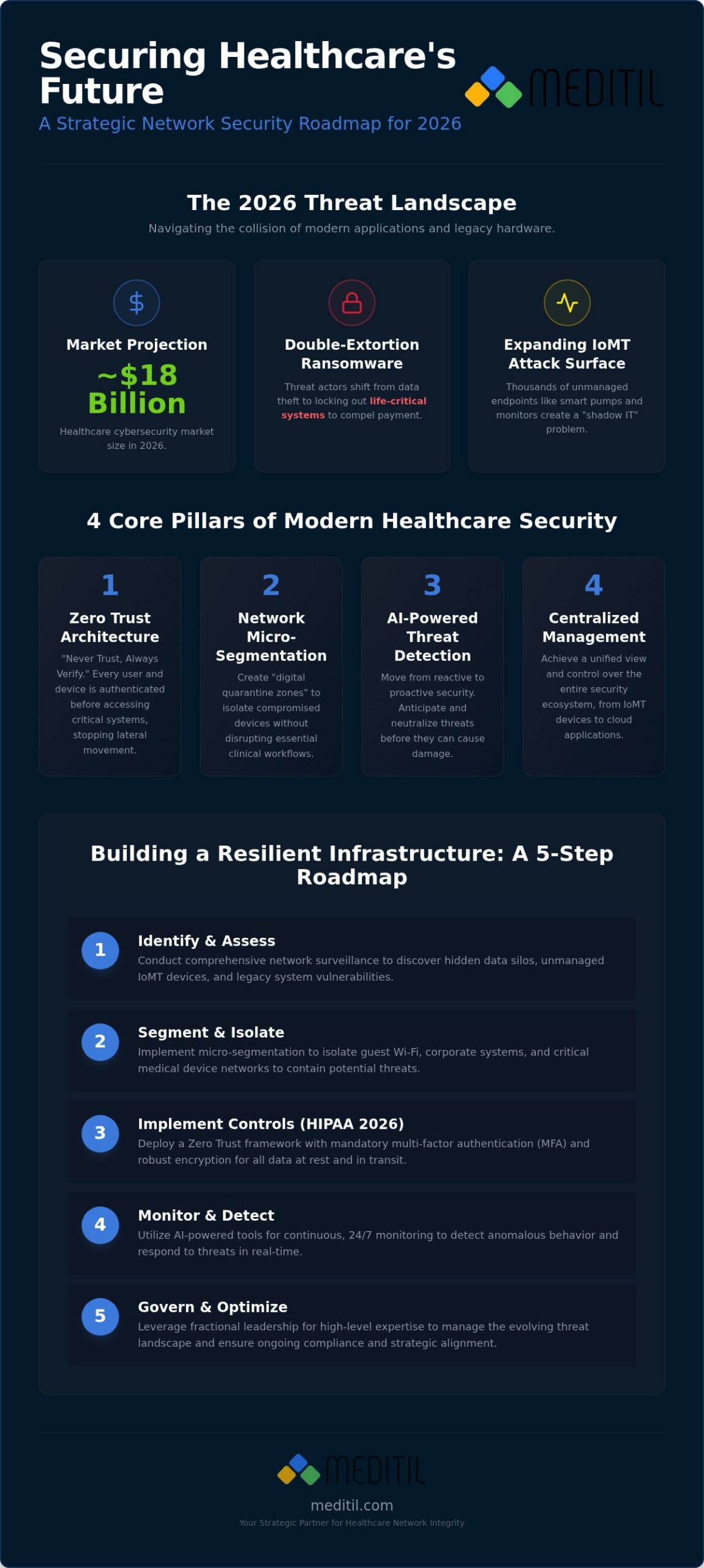
In 2026, a single network vulnerability is more than a technical failure; it’s a direct threat to patient care and clinical continuity. With the healthcare cybersecurity market projected to reach nearly $18 billion this year, the search for effective healthcare network security solutions has shifted from simple software procurement to a demand for comprehensive, managed resilience. You’re likely managing the fallout of the February 16, 2026, HIPAA compliance deadline for substance use disorder records while bracing for the next wave of double-extortion ransomware.
It’s exhausting to balance the strict requirements of the revived OCR audit program against the need for seamless clinical workflows. You want a network that’s always on and fully compliant, yet you can’t afford security protocols that create friction for your providers. This guide outlines how to protect your life-critical systems and patient data using a managed, zero-trust framework. We’ll examine the strategic roadmap for 2026, including IoMT device management and the role of fractional leadership in building a resilient, future-proof infrastructure.
Key Takeaways
- Implement a Zero Trust Architecture to move beyond perimeter-based security, ensuring every device and user is verified before accessing life-critical systems.
- Evaluate healthcare network security solutions that prioritize micro-segmentation to isolate compromised devices without disrupting essential clinical workflows.
- Align your technical safeguards with 2026 HIPAA standards by implementing mandatory multi-factor authentication and robust encryption for data at rest and in transit.
- Adopt a structured five-step roadmap to identify hidden data silos and modernize infrastructure for high-volume telehealth and interoperability needs.
- Leverage fractional leadership to oversee your security strategy, providing high-level expertise to manage the evolving threat landscape without the cost of a full-time executive.
The Healthcare Infrastructure Paradox: Security Challenges in 2026
Healthcare administrators in 2026 face a unique technical dilemma. This infrastructure paradox arises from the collision of modern cloud-based applications and legacy medical hardware. While your facility may utilize the latest AI-driven diagnostic tools, these systems often share a network with fifteen-year-old MRI scanners and legacy monitoring equipment. These older devices were never designed to withstand modern cyber threats, yet they remain essential for daily operations. Implementing effective healthcare network security solutions requires a strategy that protects this fragmented environment without compromising the functionality of either system.
The Rise of Sophisticated Medical Ransomware
Extortion tactics have shifted significantly. In previous years, cybercriminals focused primarily on data encryption and theft. Today, the focus has moved toward the lockout of life-critical systems. Cybercriminals recognize that health systems are more likely to pay when patient safety is immediately at risk. The financial cost of downtime is staggering, as disrupted services lead to diverted ambulances and cancelled surgeries. The current threat landscape for US healthcare networks in 2026 is defined by high-frequency, double-extortion attacks that weaponize patient safety to bypass traditional data recovery strategies.
IoMT and the Expanding Attack Surface
The Internet of Medical Things (IoMT) has introduced thousands of unmanaged endpoints into the clinical environment. Devices such as smart infusion pumps, cardiac monitors, and imaging systems often lack standard security features like native encryption or automated patching. This creates a massive “shadow IT” problem. Clinical departments frequently deploy new connected devices to improve care without involving the IT department. Comprehensive health network surveillance is necessary to identify these hidden risks before they become entry points for an attack.
General IT providers often fail to address these specific needs. They might treat a ventilator like a standard office laptop, applying aggressive scans that could cause the device to malfunction during a procedure. Specialized healthcare network security solutions must account for these operational sensitivities. Security protocols should be robust, yet they must not create clinical friction. If a nurse is forced to navigate multiple authentication screens during a critical event, the security measure itself becomes a risk to the patient. A balanced approach ensures that protection remains invisible to the provider while remaining impenetrable to the intruder.
Core Pillars of Modern Healthcare Network Security Solutions
Securing a medical facility in 2026 requires moving beyond the traditional firewall. As networks grow more complex, healthcare network security solutions must evolve from perimeter-based defense to a model of continuous verification. This shift is driven by the need to protect sensitive patient data while maintaining the high-speed access clinicians require for life-critical decisions. A robust security posture is built on four core pillars: Zero Trust Architecture, digital quarantine zones, AI-powered threat detection, and centralized management. These elements work together to create a resilient environment that anticipates threats rather than just reacting to them.
Implementing Zero Trust in a Clinical Setting
Zero Trust operates on the principle of “Never Trust, Always Verify.” In a clinical environment, this means identity-based access is required for every user and device, regardless of their location on the network. We implement this by utilizing adaptive multi-factor authentication (MFA) that recognizes clinician patterns. This approach ensures that EMR logins remain fast and intuitive while meeting the strict standards found in our Healthcare Cybersecurity Services: A Strategic Guide for 2026. By verifying the user’s identity and device health at every step, you significantly reduce the risk of lateral movement by unauthorized actors.
Network Segmentation and Digital Quarantine
Effective network segmentation involves creating logical or physical barriers between different types of traffic. It’s essential to isolate guest Wi-Fi and corporate systems from the medical device networks that handle ePHI. According to the HIPAA Security Rule guidance, technical safeguards must protect against unauthorized access to electronic health information. Digital quarantine zones take this a step further. If a smart infusion pump or a workstation shows signs of a ransomware infection, the network automatically isolates that specific device. This containment prevents a localized issue from becoming a facility-wide crisis, ensuring that other life-critical systems remain operational.
Automation plays a vital role in 2026. AI-powered threat detection acts as a digital security guard, monitoring network traffic 24/7 for anomalies that human teams might miss. These systems can identify a potential breach in milliseconds, triggering an immediate response. When combined with a “Single Pane of Glass” management view, your IT leadership gains total visibility across all clinical locations. You don’t have to check multiple systems to understand your risk profile; everything is visible in one centralized dashboard. This level of clarity is vital for maintaining uptime and compliance in a regulated industry. Partnering with an expert IT consultant can help you integrate these pillars into your existing infrastructure without creating operational friction.
Navigating HIPAA Compliance and Technical Safeguards
Navigating the regulatory landscape in 2026 requires a precise alignment between clinical operations and the HIPAA Security Rule. With the HHS Office for Civil Rights (OCR) actively conducting audits through its revived program, healthcare network security solutions must provide more than just protection; they must provide proof. The February 16, 2026, deadline for aligning Substance Use Disorder (SUD) record protections with the HIPAA Privacy Rule has further intensified the need for granular access controls and meticulous documentation across the entire infrastructure.
Technical safeguards form the backbone of this alignment. Encryption for data at rest and in transit is a fundamental requirement for protecting electronic protected health information (ePHI). High-performance encryption protocols must be integrated into every layer of the network, from the core database to the mobile clinician’s tablet. For organizations seeking a structured framework, the NIST Health Sector Cybersecurity Guidance offers a comprehensive set of standards that bridge the gap between abstract regulations and technical execution.
Physical security and the human factor remain equally critical. On-site servers and network access points in clinics must be secured against unauthorized physical entry to prevent hardware tampering or data theft. Simultaneously, clinical staff require ongoing training to recognize the sophisticated social engineering and phishing tactics that often bypass technical filters. A secure network is only as strong as the physical and human barriers protecting it.
Audit Controls and ePHI Security
In 2026, auditors look for comprehensive, immutable logs that detail every interaction with ePHI. It’s not enough to have security; you must be able to prove who accessed what data and when. Every access point, from remote telehealth portals to internal workstations, must be tracked and verifiable. Security Information and Event Management (SIEM) systems serve as the central repository for network event logs, providing the real-time visibility and historical record necessary for healthcare audit readiness.
Bridging the Gap Between Compliance and Security
It’s a dangerous misconception to believe that being HIPAA compliant is synonymous with being secure. Compliance is a baseline, a set of minimum standards that often lag behind the rapid evolution of cyber threats. Managing technical debt is essential to prevent security gaps, especially in older EHR implementations that may not support modern authentication. To address these complexities, many organizations look to Managed IT Services for Healthcare: The 2026 Definitive Strategic Guide to build a strategy that exceeds regulatory minimums and ensures true clinical resilience.
Building a Strategic Security Roadmap: A 5-Step Framework
- Step 1: Comprehensive Risk Assessment. Begin by identifying every endpoint and data silo across your organization. This includes unmanaged IoMT devices and legacy hardware that often bypass standard inventory checks.
- Step 3: Security Integration. Layer Zero Trust Architecture and AI-powered monitoring into your existing environment. This ensures continuous verification without requiring a total infrastructure overhaul.
- Step 4: Clinical Alignment. Review your security protocols from the perspective of the provider. If a security measure adds significant time to a patient encounter, it needs to be refined to prevent physician burnout.
- Step 5: Managed Governance. Establish a cycle of continuous monitoring, auditing, and strategic adjustment. Regulatory requirements and cyber threats change; your roadmap must be flexible enough to respond.
The Role of Strategic IT Budgeting
Effective cybersecurity requires a financial strategy that prioritizes long-term resilience over short-term fixes. You must align your technology spend with clinical outcomes to ensure every dollar invested improves patient safety or operational efficiency. Identifying technical debt early is vital. If you delay upgrading aging systems, they eventually become both a financial burden and a significant security liability. For a detailed look at managing these costs, refer to our guide on Strategic IT Budgeting for Medical Practices: A 2026 Financial Roadmap.
Operationalizing Security for High-Volume Practices
Scaling healthcare network security solutions for multi-location groups introduces unique challenges in connectivity and standardization. High-volume practices require N+1 redundancy to ensure that clinical operations remain always-on, even during a localized hardware failure. Your roadmap must also include a robust disaster recovery plan that defines clear recovery time objectives for your EHR and life-critical systems. If you’re ready to stabilize your infrastructure and protect your practice, contact us for Managed IT Services today.
MEDITIL: Your Strategic Partner for Healthcare Network Integrity
Many vendors offer fragmented healthcare network security solutions that focus solely on individual software licenses or hardware deployments. MEDITIL operates differently. We focus on clinical outcomes and long-term infrastructure stability. Our healthcare-exclusive focus means we understand that a network failure is not just an IT ticket; it is a direct disruption to patient care. We provide managed team support that transforms your environment from a reactive “break-fix” cycle to an always-secure, proactive state. This ensures your network remains resilient against the double-extortion ransomware and IoMT vulnerabilities discussed earlier in this guide.
Fractional CIO Leadership for Security Strategy
Strategic direction is often the missing link in medical IT. Our Fractional CIO services provide the high-level expertise needed to build and manage your security roadmap without the financial burden of a full-time executive salary. We serve as the steady hand at the wheel, ensuring your technical infrastructure supports your clinical objectives. This leadership is essential for bridging the gap between provider workflows and complex regulatory requirements, such as the 2026 updates to substance use disorder record protections. We help you navigate these transitions with technical confidence and precision. Explore how we guide long-term planning through our Virtual CIO Services: Strategic IT Leadership for Healthcare in 2026.
Augmented IT Teams and Managed Operations
Recruiting and retaining specialized cybersecurity talent is increasingly difficult for small-to-midsize clinics in 2026. The technical requirements for managing zero-trust frameworks and AI-powered monitoring demand a level of expertise that is often out of reach for independent facilities. MEDITIL solves this through our augmented IT teams. We don’t necessarily replace your existing staff. Instead, we provide the specialized oversight and technical resources they need to manage the sophisticated 2026 threat landscape effectively. MEDITIL’s approach to healthcare network security solutions integrates seamlessly with your current operations, providing a level of protection that software alone cannot achieve.
This partnership ensures that your internal team can focus on day-to-day user support while we handle the complex security and compliance monitoring. We bring the discipline of a seasoned specialist to your operations, allowing you to focus on your mission. Our goal is to provide a secure, always-on network that your clinicians can trust implicitly. Contact MEDITIL to secure your healthcare network today.
Securing the Future of Clinical Operations
The 2026 threat landscape demands a transition from traditional perimeter defense to a proactive, managed infrastructure. Successfully navigating the infrastructure paradox requires more than just software; it necessitates a strategic alignment between clinical efficiency and technical safeguards. By integrating Zero Trust principles and automated monitoring, you can protect life-critical systems without introducing friction for your providers. Staying ahead of evolving HIPAA requirements and OCR audits ensures your facility remains compliant while maintaining the highest standards of patient safety.
Building a resilient roadmap is a continuous process that benefits from specialized expertise and high-level advisory. As specialized healthcare IT experts, we provide the Fractional CIO strategic advisory and comprehensive HIPAA compliance management needed to stabilize your environment. Our team acts as a steady hand, ensuring your healthcare network security solutions are both effective and sustainable for the long term. Partner with MEDITIL for tailored healthcare network security solutions and gain the technical confidence your mission deserves. We’re ready to help you build a more secure, always-on future for your patients and your practice.
Frequently Asked Questions
What are the most common network security threats in healthcare for 2026?
The most prevalent threats in 2026 include double-extortion ransomware and attacks targeting the Internet of Medical Things (IoMT). Ransomware actors now weaponize patient safety by locking life-critical systems, while unmanaged medical devices provide easy entry points for lateral movement. Phishing remains a significant vector, often utilizing AI-generated social engineering to bypass traditional email filters. Effective healthcare network security solutions must address these evolving tactics through proactive monitoring and rapid response protocols.
How does Zero Trust architecture work in a hospital or clinic?
Zero Trust architecture functions by removing the concept of a “trusted” internal network. Every user, device, and application must be verified via identity-based access controls before accessing sensitive data or clinical systems. In a hospital, this means a clinician’s workstation is treated with the same level of scrutiny as an external portal. This “never trust, always verify” approach ensures that even if one device is compromised, the intruder cannot move laterally across the network.
What is the difference between HIPAA compliance and network security?
HIPAA compliance is a regulatory baseline that outlines administrative, physical, and technical standards for protecting ePHI. Network security is the actual technical implementation of those standards. While compliance ensures you meet legal requirements, true security involves proactive measures that exceed these minimums to defend against modern threats. It’s possible to be compliant on paper while remaining technically vulnerable, which is why a comprehensive strategy must address both regulatory alignment and technical resilience.
How can we secure medical devices (IoMT) that do not support modern security software?
Legacy medical devices that cannot support modern security agents are secured through network-level isolation and micro-segmentation. By placing these devices into “digital quarantine” or dedicated VLANs, you restrict their communication to only the specific servers they need to function. This prevents a vulnerability in an older imaging machine from exposing the entire EHR system. Implementing specialized healthcare network security solutions allows you to maintain these essential clinical tools while mitigating their inherent risks.
Is a Fractional CIO necessary for managing healthcare network security?
A Fractional CIO is essential for organizations that require high-level strategic leadership without the overhead of a full-time executive. This role focuses on building a long-term security roadmap, aligning IT budgets with clinical outcomes, and managing complex regulatory changes. They serve as a steady hand, ensuring that your technical infrastructure evolves alongside the threat landscape. This strategic oversight is vital for maintaining compliance and operational stability in a high-stakes medical environment.
How much does downtime from a network security breach cost a typical medical practice?
Downtime from a security breach causes immediate financial and operational distress. Beyond the potential for regulatory fines, a breach often leads to ambulance diversions, cancelled procedures, and significant reputational damage. While specific costs vary by facility size, healthcare organizations generally face higher recovery costs per record than other sectors. The true cost includes lost revenue, emergency remediation fees, and the long-term impact on patient trust and clinical outcomes.
Can managed IT services help our practice pass a HIPAA audit?
Managed IT services provide the continuous monitoring and immutable audit logs required to pass a HIPAA audit. These services ensure that every access point to ePHI is tracked and that technical safeguards, such as encryption and multi-factor authentication, are consistently applied. By shifting from a “break-fix” model to proactive management, your practice maintains a state of constant audit readiness. This comprehensive documentation serves as verifiable proof of your commitment to regulatory standards.
How do we balance network security with clinical workflow efficiency?
Balancing security with workflow efficiency requires a clinical-first approach to technical design. We implement adaptive authentication and single sign-on (SSO) solutions that minimize the time clinicians spend logging into systems. By using context-aware security, protocols become more or less restrictive based on the user’s location and device health. This ensures that protection remains robust without creating friction that leads to provider burnout or delayed patient care during critical medical events.