
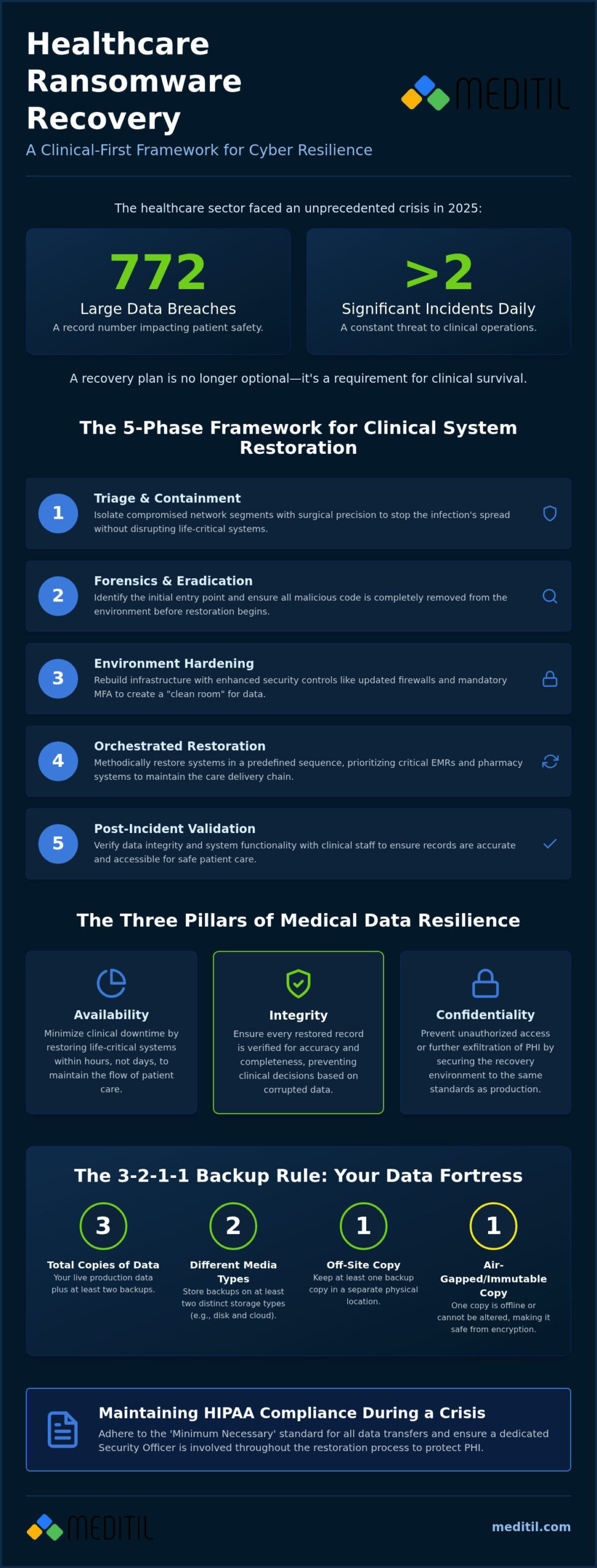
In 2025, the healthcare sector faced a record 772 large data breaches, which averages to more than two significant incidents every single day. This alarming frequency means a healthcare ransomware recovery plan is no longer just an IT backup policy; it’s a fundamental requirement for clinical survival. You’re likely feeling the pressure of hardening cyber insurance markets and the anxiety of extended clinical downtime that could jeopardize patient safety. Restoring interconnected EMR systems isn’t just about moving data. It’s about verifying clinical integrity and ensuring every patient record remains accurate and accessible.
This framework provides a clinical-first strategy to restore patient data, ensure HIPAA compliance, and maintain operational continuity during a cyber crisis. We’ll outline a roadmap to reduce your Recovery Time Objective (RTO) for critical systems and provide the technical confidence needed to manage data restoration post-incident. By aligning technical recovery with regulatory mandates, your practice can move from reactive panic to strategic resilience.
Key Takeaways
- Understand the critical distinction between generic IT restoration and a clinical-first healthcare ransomware recovery plan designed to prioritize patient safety and EMR integrity.
- Implement a structured five-phase framework that moves from rapid containment to full eradication without compromising life-critical systems.
- Maintain HIPAA compliance during a crisis by adhering to the ‘Minimum Necessary’ standard for data transfers and involving a dedicated Security Officer in the restoration process.
- Adopt the 3-2-1-1 backup strategy, utilizing immutable and air-gapped storage to ensure your recovery data remains untouched by sophisticated encryption.
- Transition from reactive firefighting to managed resilience by leveraging strategic leadership and proactive monitoring to ensure clinical continuity.
What is a Healthcare Ransomware Recovery Plan?
A healthcare ransomware recovery plan is a specialized response framework specifically engineered to restore clinical IT systems and patient data following an encryption event. Unlike standard disaster recovery, which might focus on general server uptime, this strategy prioritizes clinical continuity and patient safety. It serves as a tactical roadmap for healthcare organizations to resume operations without compromising the quality of care or the security of Protected Health Information (PHI). To fully understand the stakes of these incidents, it’s helpful to review the technical evolution of What is Ransomware? and how it has transitioned from a simple data threat into a direct risk to human life.
By 2026, the definition of a successful recovery has shifted. With the proliferation of telehealth and interconnected IoT medical devices, the tolerance for downtime has essentially vanished. A generic recovery might restore files over several days, but in a medical setting, that delay leads to diverted ambulances and canceled surgeries. A clinical-first healthcare ransomware recovery plan ensures that the most critical systems, such as EMRs and pharmacy dispensers, are restored in a precise, validated sequence that maintains the integrity of the entire care delivery chain.
The Three Pillars of Medical Data Resilience
A robust recovery strategy rests on three foundational principles that align with HIPAA standards and clinical requirements:
- Confidentiality: The restoration process must prevent unauthorized access or further exfiltration of sensitive records. It’s vital that the recovery environment is just as secure as the original production site to avoid secondary breaches.
- Integrity: Restoring data is useless if that data is corrupted or incomplete. Every record must be verified for accuracy to ensure physicians aren’t making decisions based on outdated or altered patient histories.
- Availability: This focuses on minimizing clinical downtime. A 2026 standard for recovery emphasizes getting life-critical systems back online within hours to maintain the steady flow of patient care.
Why ‘Backup’ is Not a Recovery Plan
Many organizations mistake having data backups for having a viable recovery plan. While backups are the raw material for restoration, they don’t account for the complex interdependencies of modern healthcare infrastructure. Simple data copies often fail during a crisis because they lack an orchestrated restoration sequence. If an EMR is restored without its associated database metadata or clinical imaging links, the system remains non-functional.
Modern resilience requires immutable, air-gapped backups that threat actors can’t encrypt. However, the plan itself must detail how these backups are re-integrated into the network. Without a predefined hierarchy of system restoration, IT teams often find themselves in a state of reactive firefighting rather than methodical, strategic recovery.
The 5-Phase Framework for Clinical System Restoration
Executing a healthcare ransomware recovery plan requires a methodical approach that balances technical urgency with clinical precision. The objective is to move from the initial chaos of an attack to a state of verified operational stability. This framework ensures that restoration isn’t just about data, but about the safe resumption of patient care.
Step 1: Triage and Containment. The first response must focus on stopping the spread of the infection. IT teams isolate compromised network segments to prevent lateral movement. In a healthcare setting, this requires surgical precision. You can’t simply shut down the entire network if life-critical systems like telemetry monitors or infusion pumps depend on those connections.
Step 2: Forensics and Eradication. Before any restoration begins, the threat must be fully understood. This involves identifying the initial entry point and ensuring no dormant malicious code remains. Adhering to the U.S. Joint Ransomware Task Force Guide provides a standardized methodology for clearing the environment of persistent threats.
Step 3: Environment Hardening. Restoring data to a compromised network is a recipe for re-infection. We rebuild the infrastructure with enhanced security controls, such as updated firewall rules and mandatory multi-factor authentication, to create a “clean room” for data recovery.
Step 4: Orchestrated Restoration. This phase involves the actual movement of data from backups. It’s not a bulk process but a prioritized sequence focused on the clinical application stack.
Step 5: Validation and Re-entry. The final step is verifying data integrity. Clinicians only return to the system after IT confirms that patient records are accurate and that all interconnected systems are synchronized correctly.
Prioritizing the Clinical Application Stack
Ranking systems is a clinical decision as much as a technical one. Life-safety systems and EMR/EHR databases take precedence over administrative or billing tools. A successful healthcare ransomware recovery plan ensures that EMR databases are synchronized with laboratory and PACS imaging systems during the restore. This prevents discrepancies in patient histories. Additionally, teams must plan for the “paper-to-digital” gap, establishing a process to ingest manual records created by staff during the downtime period.
Eradication: Ensuring the Malware is Gone
Recovery is only permanent if the threat is truly gone. We must scan all backups for latent “time-bomb” malware that could trigger a second wave of encryption after restoration. A complete reset of all administrative credentials across the healthcare network is mandatory. Engaging expert healthcare cybersecurity services can provide the 24/7 monitoring required to detect re-infection attempts during the sensitive restoration window. This proactive stance provides the “steady hand” needed to navigate the final stages of a crisis.
Protecting Patient Safety and HIPAA Compliance During Recovery
A healthcare ransomware recovery plan must address the dual challenge of restoring technical infrastructure while upholding stringent regulatory standards. During the high-pressure environment of a cyber crisis, it’s easy to prioritize speed over protocol. However, maintaining the ‘Minimum Necessary’ standard remains a legal requirement. Emergency data transfers must be strictly controlled to ensure that only the essential PHI required for immediate clinical care is accessible to authorized personnel. This prevents secondary data exposure during the restoration phase.
The role of the Security Officer is pivotal during this transition. They provide the necessary oversight to ensure that Protected Health Information (PHI) is restored into secure, validated environments. Every movement of data and every configuration change must be logged. Documentation isn’t just a best practice; it’s your primary defense during a future OCR audit. If the restoration process isn’t documented in real-time, proving HIPAA compliance after the fact becomes nearly impossible. Clear communication with patients is also essential. Organizations should provide transparent, reassuring updates about system availability without disclosing specific technical vulnerabilities that could be exploited by other threat actors.
Data Integrity: The Hidden Risk of Restoration
Restoring a database doesn’t automatically mean the data is clinically safe. Partial restores or synchronization errors can lead to missing allergy information, incorrect medication lists, or outdated lab results. These discrepancies create significant risks for patient safety. A successful healthcare ransomware recovery plan includes a formal data validation protocol. Clinical staff must verify a subset of records against paper charts or offline sources before the system is cleared for full use. Additionally, administrative systems like medical billing automation solutions must be re-synced carefully. Ensuring that clinical actions and billing records match is vital for both financial accuracy and the legal integrity of the patient record.
Regulatory Reporting and Breach Notification
Determining if a ransomware event constitutes a reportable breach is a complex legal and technical task. Under current HHS guidelines, any unauthorized access to PHI is presumed to be a breach unless a low probability of compromise can be demonstrated. The clock for notifying the Department of Health and Human Services (HHS) typically starts at the moment of discovery, not the moment the investigation concludes. Managing these timelines while simultaneously restoring clinical operations is a heavy burden. Many practices leverage a virtual CIO to manage this regulatory documentation. This strategic leadership ensures that all notification deadlines are met and that the narrative provided to regulators is accurate, thorough, and compliant with 2026 standards.
Validating Your Recovery Strategy: Drills and Air-Gapped Backups
By 2026, threat actors have refined their ability to locate and delete online backups before deploying encryption. This tactical shift makes a healthcare ransomware recovery plan entirely dependent on the integrity of your storage architecture. You can’t rely on simple synchronization. You need immutable, air-gapped copies that exist beyond the reach of compromised administrative accounts. Validation is the only way to prove your organization can actually meet its stated goals during a high-stakes clinical crisis.
Defining your Recovery Time Objective (RTO) and Recovery Point Objective (RPO) is a clinical necessity. RTO determines how long your staff can operate on paper before patient safety is compromised. RPO determines the maximum window of data loss your practice can tolerate. Testing these metrics ensures that your technical capabilities align with clinical expectations. The 3-2-1-1 backup rule provides a foundational standard for this: keep three copies of your data, on two different media types, with one copy stored offsite and one copy stored completely offline.
Infrastructure for Rapid Recovery
Resilience is built into the network through N+1 redundancy, ensuring that the failure of a single component doesn’t paralyze the entire clinical workflow. Cloud-native healthcare applications often speed up the recovery timeline because they offload the burden of infrastructure restoration to specialized providers. Air-Gapping is a physical or logical isolation of data from the main network. This isolation ensures that even if your primary environment is fully compromised, a “gold copy” of your patient records remains safe and ready for restoration.
Tabletop Exercises for Clinical Staff
A recovery plan shouldn’t live in a vacuum within the IT department. Effective validation requires conducting tabletop exercises that involve nurses, physicians, and department heads. These drills simulate a total system outage, forcing staff to practice “downtime procedures” such as manual charting and phone-based triage. Drills also help identify “Shadow IT,” which are unsanctioned applications staff might use to bypass technical hurdles. These hidden systems are often missed during standard recovery, creating dangerous gaps in the patient record. Evaluating the effectiveness of your managed it services for healthcare during these drills provides an objective look at your actual state of readiness. If your team can’t restore a test database within the required window during a drill, they won’t be able to do it during a live event. Contact our team today to schedule a strategic review of your disaster recovery infrastructure.
Strategic Resilience: Building a Managed Recovery Architecture
Building a sustainable healthcare ransomware recovery plan requires a fundamental shift from reactive “firefighting” to a model of proactive managed resilience. Many organizations view recovery as a one-time technical event. In reality, it’s a continuous operational state that demands 24/7 monitoring and rapid response capabilities. An augmented IT team provides the necessary scale to detect anomalies before they escalate into full-scale encryption events. This transition ensures that your clinical environment remains stable, even as threat actors evolve their methods throughout 2026. It’s about creating an infrastructure that doesn’t just survive an attack but resists it by design.
Strategic resilience also involves financial foresight. Recovery capabilities must be closely aligned with it budgeting for medical practices to ensure that infrastructure hardening isn’t an afterthought. Investing in immutable storage and network redundancy today is significantly more cost-effective than managing the catastrophic fallout of clinical downtime and regulatory penalties tomorrow. This alignment turns cybersecurity from a cost center into a foundational component of patient care stability. It allows leadership to view security investments as a direct contribution to clinical uptime and patient safety.
The Role of the Fractional CIO in Recovery
A Fractional CIO provides the high-level strategic oversight often missing in mid-sized healthcare organizations. They develop a multi-year roadmap for infrastructure hardening that addresses both current vulnerabilities and future risks. During a crisis, the Fractional CIO acts as the essential liaison between the technical response teams and the executive board. They translate technical data into actionable business intelligence, allowing leadership to make informed decisions about patient safety and operational continuity. Beyond the immediate recovery, they ensure that system interoperability remains intact after major rebuilds, preventing the “digital silos” that often occur when systems are restored in haste.
Partnering for Clinical Continuity
MEDITIL manages the entire IT lifecycle to identify and mitigate risks before ransomware can take hold. Our approach integrates proactive cybersecurity monitoring with a deep understanding of clinical workflows. We recognize that a server is only as valuable as the patient care it supports. By partnering with a specialist who understands both technical networking and the nuances of EMR synchronization, your practice gains a “steady hand at the wheel.” This collaboration ensures your healthcare ransomware recovery plan is more than a document; it’s a functional guarantee of resilience. Contact MEDITIL for a comprehensive healthcare IT risk assessment.
Securing the Future of Clinical Continuity
The landscape of 2026 requires more than simple data preservation. A successful healthcare ransomware recovery plan must prioritize clinical integrity and patient safety above all else. By implementing a structured five-phase framework and enforcing the 3-2-1-1 backup rule with air-gapped storage, your practice ensures that patient care remains uninterrupted even during a crisis. Strategic leadership through a Fractional CIO further bridges the gap between technical response and executive decision-making, ensuring that every restoration step remains compliant and clinically sound.
You don’t have to manage these high-stakes complexities alone. Secure your practice with MEDITIL’s healthcare-specific managed IT and security services. Our team provides the expertise in HIPAA-compliant infrastructure, Fractional CIO strategic leadership, and proactive 24/7 clinical system monitoring needed to maintain operational stability. We offer the steady hand at the wheel that your organization requires for long-term resilience and peace of mind. With the right partner and a validated strategy, you can face the evolving threat landscape with absolute confidence.
Frequently Asked Questions
Is a ransomware attack considered a HIPAA breach?
HHS generally presumes that a ransomware attack constitutes a reportable breach under HIPAA. This is because encryption usually implies that an unauthorized individual has taken control of Protected Health Information (PHI). To avoid notification requirements, you must perform a formal risk assessment demonstrating a low probability that the data was compromised. Most organizations find this difficult to prove, making breach notification the standard response for these incidents.
How often should a medical practice test its ransomware recovery plan?
Medical practices should test their healthcare ransomware recovery plan at least every six months. Annual testing is no longer adequate given the speed of modern infrastructure updates. These sessions should involve both technical restoration of EMR databases and clinical tabletop exercises. Regular testing ensures that your staff remains proficient in downtime procedures and that your immutable backups are actually functional when they are needed most.
What is the difference between RTO and RPO in a clinical setting?
RTO represents the maximum allowable time to restore a system before clinical operations are dangerously impacted. RPO defines the maximum amount of data loss, measured in time, that the practice can tolerate. In a medical setting, a four-hour RTO might be necessary for the EMR, while a fifteen-minute RPO ensures that very few patient vitals or medication entries are lost. These values drive your infrastructure investment.
Can we recover patient data if our backups are also encrypted?
Data recovery is extremely difficult if your backups are also encrypted by the threat actor. In this scenario, your only options are to pay the ransom or locate an older, offline copy that was not connected to the network. This highlights the absolute necessity of air-gapped or immutable cloud storage. Without a clean, unencrypted source of data, the restoration process cannot begin, leading to permanent patient record loss.
How long does it typically take to recover from a healthcare ransomware attack?
Full restoration can take weeks, but critical systems should be online within hours if you have a mature healthcare ransomware recovery plan. While the average breach lifecycle in the healthcare sector is 279 days, the initial clinical restoration phase is much shorter. The total timeline depends on the complexity of your EMR interdependencies and the thoroughness of your forensic eradication process. Proper planning is the only way to minimize this downtime.
What are downtime procedures, and why do clinicians need them?
Downtime procedures are manual workflows that allow physicians and nurses to provide care when IT systems are offline. These include paper charting, manual medication reconciliation, and phone-based triage protocols. Clinicians need these procedures because even the best recovery plans involve a period of system unavailability. Without practiced manual workflows, patient safety is immediately at risk when the digital infrastructure fails during a cyber event or system outage.
Does cyber insurance cover the cost of a ransomware recovery plan?
Most cyber insurance policies cover the forensic and restoration costs following an attack, but they don’t pay for the development of the plan itself. In 2026, insurers often mandate a tested recovery strategy as a requirement for insurability. If you don’t maintain a documented plan, your carrier may have the legal right to deny your claim entirely. Investing in a plan is a prerequisite for financial protection.
What is the role of a vCIO during a ransomware recovery process?
A vCIO provides the strategic leadership needed to manage the technical, legal, and clinical aspects of a recovery. They serve as the primary liaison between your IT team and the executive board. By coordinating with insurance providers and ensuring HIPAA documentation is complete, the vCIO allows clinical staff to focus on patient care. Their role is to ensure the restoration is methodical, compliant, and aligned with long-term practice goals.