Is your remote monitoring program actually improving patient outcomes, or is it simply generating more digital noise for an already exhausted clinical team? Most healthcare leaders recognize that the true barrier to expansion isn’t the medical device itself. It’s the fragmented infrastructure behind it. You likely feel the daily pressure of managing disconnected data silos and the persistent anxiety of maintaining HIPAA compliance across remote networks. Implementing scalable remote patient monitoring IT solutions requires more than just buying hardware; it demands a disciplined, expert approach to system interoperability.
We understand the need for a steady hand to manage these complex technical backends. This 2026 strategy guide provides a professional roadmap to help you build a secure, FHIR R4-compliant foundation that eliminates clinical friction. You’ll discover how to streamline data flow from patient devices to provider dashboards while adhering to the latest regulatory standards. We will explore how to align your infrastructure with current CMS reimbursement structures and the $535 Stark Law non-monetary compensation cap. This overview ensures you can transition from disconnected pilots to a high-performing, scalable ecosystem that grows with your practice.
Key Takeaways
- Shift from episodic care to a continuous data transmission ecosystem by implementing a network architecture with N+1 redundancy for constant availability.
- Protect your organization from the 2026 threat landscape by deploying remote patient monitoring IT solutions that prioritize end-to-end encryption and rigorous HIPAA compliance.
- Resolve the interoperability gap by integrating RPM data directly into your clinical workflow using modern HL7 and FHIR standards to achieve a “single pane of glass” view.
- Leverage fractional CIO leadership to create a scalable IT roadmap that reduces clinical friction and ensures long-term operational stability for your practice.
Defining Remote Patient Monitoring (RPM) IT Ecosystems in 2026
The landscape of Remote Patient Monitoring (RPM) has evolved beyond simple peripheral devices. In earlier iterations, RPM was often viewed as a collection of standalone gadgets like blood pressure cuffs or pulse oximeters. By 2026, the industry has shifted toward a holistic ecosystem model where the device is merely the point of origin. The true value lies in the continuous, secure transmission of data from the patient’s home to the clinical dashboard. This shift from episodic, office-based care to real-time clinical monitoring requires a robust technical foundation that most internal IT departments aren’t equipped to manage. We define remote patient monitoring IT solutions as the integrated framework of networks, security protocols, and software interfaces that facilitate this high-stakes data exchange.
The “IT backbone” is frequently the most critical failure point in modern RPM programs. When a network connection drops or a data silo prevents an EHR from updating, the clinical team loses visibility. This isn’t just a technical inconvenience; it’s a break in the chain of care. To ensure scalability, practices must move away from ad-hoc setups and toward a standardized, engineering-first approach that treats RPM as a mission-critical infrastructure project.
The Components of a Modern RPM IT Stack
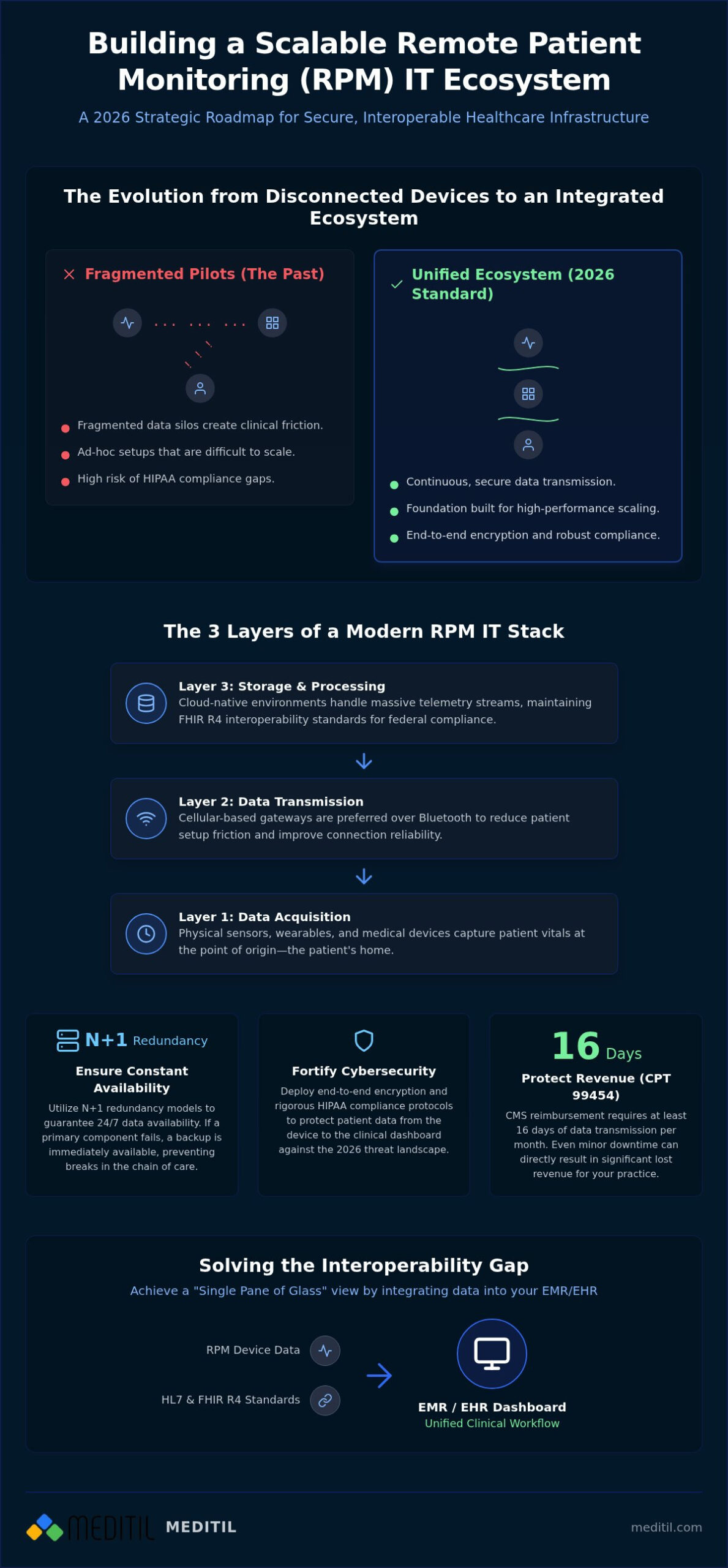
A functional RPM environment requires three distinct layers to operate at scale. First, the data acquisition layer includes the physical sensors and wearables that capture patient vitals; innovators like Cura+ are demonstrating how these devices can evolve into predictive health intelligence tools by 2027. Second, the data transmission layer has moved toward cellular-based gateways. These are preferred over traditional Bluetooth pairing because they reduce patient setup friction and improve connection reliability. Finally, the storage and processing layer utilizes cloud-native healthcare environments. These systems must be capable of handling massive telemetry streams while maintaining the FHIR R4 interoperability standards mandated for federal compliance.
Why Standard IT Support Often Fails RPM Programs
General office IT support is designed for printers and email servers, not life-critical clinical data. In a standard office setting, a thirty-minute server delay is a nuisance. In a remote monitoring environment, that same latency could mean a critical cardiac alert doesn’t reach a provider in time. The high cost of downtime makes generalized support a liability. Specialized managed it services for healthcare are required to manage these complexities. These specialists understand the nuances of HIPAA-compliant encryption and the specific requirements of 2026 CMS reimbursement codes. They provide the steady hand needed to ensure that data flows without interruption, allowing clinicians to focus on patients rather than troubleshooting connectivity issues.
Engineering Infrastructure for High-Volume RPM Data Traffic
Building a scalable RPM program requires an infrastructure capable of sustaining continuous, high-volume data streams. Unlike traditional patient portals that handle intermittent logins, remote patient monitoring IT solutions must manage real-time telemetry from hundreds or thousands of concurrent endpoints. This puts significant strain on clinical networks. Assessing bandwidth isn’t just about total capacity; it’s about the ability to handle bursts of data without packet loss. If your network isn’t engineered for this traffic, you risk clinical alerts being delayed or lost entirely.
Redundancy is the cornerstone of a stable environment. We utilize N+1 redundancy models to ensure that if a primary component fails, a backup is immediately available. This architecture guarantees 24/7 data availability, which is essential for programs monitoring chronic conditions like heart failure or COPD. Because CMS 2026 reimbursement for CPT Code 99454 requires at least 16 days of data transmission per month, even minor downtime can result in lost revenue. When selecting a hosting model, the industry has largely shifted toward cloud-native solutions. While on-premise servers offer control, they often lack the elasticity needed to scale as patient enrollment grows. A hybrid approach or a fully managed cloud environment typically provides the best balance of security and agility.
Optimizing Network Reliability and Latency
Network congestion can delay life-critical alerts. Implementing Quality of Service (QoS) protocols allows your routers to prioritize medical data over non-essential traffic like guest Wi-Fi. Managing the “last mile” connection, which is the path from the patient’s home device to your database, is equally vital. This requires a focus on Cybersecurity and Compliance for RPM to protect data in transit. Strategic network management ensures that clinical hubs remain responsive even under heavy load. If you’re unsure if your current setup can handle 2026 data demands, consulting with an infrastructure expert can reveal hidden bottlenecks.
Cloud Infrastructure and Data Management
Modern RPM programs thrive in HIPAA-compliant cloud environments such as AWS HealthLake or Azure for Health. These platforms offer pre-configured security controls and native support for FHIR R4 data structures. By adopting a data lakehouse architecture, practices can perform advanced analytics on vital sign trends without compromising the performance of the primary patient dashboard. Unlike traditional databases, a lakehouse supports both structured clinical data and unstructured telemetry logs. Scaling remote patient monitoring IT solutions in the cloud provides the necessary agility for modern practices. This setup allows for seamless scaling during seasonal patient volume fluctuations, such as respiratory surges in winter. It ensures that your IT foundation grows alongside your clinical ambitions without requiring a complete system overhaul.
Securing the Remote Frontier: Cybersecurity and Compliance
The 2026 threat landscape presents specific challenges for healthcare providers as cybercriminals increasingly target decentralized endpoints. Ransomware groups prioritize RPM devices because these tools often lack the sophisticated security layers found in on-premise hospital hardware. Protecting these systems requires a comprehensive security posture that extends far beyond the physical clinic. End-to-end encryption is the primary defense, ensuring that patient telemetry remains unreadable from the bedside to the database. Implementing secure remote patient monitoring IT solutions demands that data stays protected during every stage of transmission. Without this level of verification, data in transit is vulnerable to interception or unauthorized manipulation.
Identity and Access Management (IAM) serves as the gatekeeper for your clinical data. It’s essential to implement multi-factor authentication and role-based access controls for all remote clinical staff. These measures prevent unauthorized users from gaining access to sensitive patient information if a staff member’s credentials are compromised. MEDITIL’s healthcare cybersecurity services provide the specialized oversight required to mitigate remote monitoring risks by securing every node in the transmission chain.
HIPAA Compliance in a Decentralized Environment
Maintaining HIPAA compliance is significantly more complex when data is generated outside your facility. You must manage rigorous Business Associate Agreements (BAAs) with every vendor in your remote patient monitoring IT solutions stack. These agreements must clearly define data protection responsibilities and liability. Beyond that, comprehensive audit trails are necessary. You need to log every instance of remote data access to satisfy regulatory requirements and simplify forensic investigations. Conducting proactive risk assessments for home-based monitoring devices allows you to identify hardware or software vulnerabilities before they result in a costly compliance failure.
Advanced Threat Detection for RPM Networks
Modern security requires more than passive monitoring. Implementing a Security Information and Event Management (SIEM) system is critical for aggregating and analyzing logs from thousands of remote devices. This allows for the detection of anomalous patterns that might indicate a coordinated attack. We recommend a zero-trust architecture for all remote device authentication. In this model, no device is trusted by default. Every connection request must be verified regardless of its location or previous status. Finally, your organization needs rapid response protocols. If a potential breach occurs, your team must be able to isolate affected segments immediately to prevent lateral movement through the network and protect the broader clinical infrastructure.
Solving the Interoperability Gap: Integrating RPM with EMR/EHR
The clinical success of any remote monitoring program depends on achieving a “Single Pane of Glass” workflow. If your physicians must log into a separate portal to view vital signs, the program creates clinical friction rather than resolving it. Integrating remote patient monitoring IT solutions directly into your existing EMR or EHR system ensures that data is actionable and visible within the standard patient chart. This level of connectivity transforms RPM from a siloed initiative into a core component of your care delivery model. It allows providers to make informed decisions based on real-time data without leaving their primary clinical environment.
Modern medical data exchange relies on HL7 and FHIR R4 standards. These protocols serve as the universal language that allows disparate systems to communicate effectively. By utilizing FHIR-based APIs, we can create secure, standardized pathways for data to move from a patient’s home device to your clinical database. This automation is also essential for preventing alert fatigue. Rather than overwhelming staff with every single data point, integrated systems can use intelligent thresholds to trigger alerts only when a patient’s vitals fall outside of pre-defined clinical parameters. This ensures that your team focuses their energy on the patients who need immediate intervention.
Interoperability also has a direct impact on your practice’s financial health. To capture revenue accurately, your IT systems must document the time spent on interactive communication and the number of days data was transmitted. Utilizing specialized medical billing automation solutions ensures that these data points are captured and coded correctly according to 2026 CMS requirements. If your practice is struggling with fragmented data, consult with our interoperability experts to bridge the gap between your RPM platform and your EHR.
The IT Process for Seamless Integration
Achieving deep integration requires a methodical three-step engineering process. First, we perform API mapping to align the data fields between the RPM platform and the EHR. Second, data normalization is performed to ensure that vitals are recorded in the correct units and formats to maintain clinical accuracy. Finally, we establish bi-directional synchronization. This ensures that patient demographics and insurance information are updated in the RPM system whenever they change in the EHR, preventing duplicate entries and administrative errors.
Reducing Clinical Friction through Interoperability
The primary goal of interoperability is to return time to your clinical staff. By automating the flow of vital signs directly into the patient chart, you eliminate the need for nursing staff to perform manual data entry. This reduction in administrative burden directly combats clinical burnout and minimizes the risk of human error. Furthermore, a well-integrated system ensures data integrity across all disparate IT systems. When every member of the care team sees the same validated data in real-time, the quality of care improves and the risk of conflicting treatment plans is significantly reduced.
Strategic Implementation: The Role of a Fractional CIO
Many healthcare organizations treat RPM as a procurement task rather than a strategic shift in their delivery model. Without executive-level IT oversight, even the most advanced remote patient monitoring IT solutions eventually succumb to technical debt or operational silos. Strategic leadership is necessary to align technology with your organization’s long-term financial and clinical objectives. A Fractional CIO provides the steady hand needed to ensure your IT infrastructure doesn’t just function today but scales for the next decade of remote care expansion. This leadership ensures that every technical decision supports the overarching mission of improving patient stability and practice efficiency.
For many mid-sized practices, the cost of a full-time executive is prohibitive. The virtual CIO services model offers a sophisticated alternative. This approach provides expert guidance on systems integration and cybersecurity without the burden of a permanent executive salary. Your virtual CIO builds a multi-year IT roadmap that anticipates shifts in CMS reimbursement and technical standards. This proactive planning transforms a pilot program into a permanent, revenue-generating service line that remains resilient against regulatory changes and emerging security threats.
Budgeting and ROI for RPM IT Solutions
Calculating the true value of an RPM program requires looking beyond the initial device purchase. You must account for the Total Cost of Ownership (TCO), which includes network upgrades, ongoing cybersecurity monitoring, and staff training. Leveraging strategic IT budgeting for medical practices allows you to fund these foundational costs predictably. When the IT foundation is sound, the ROI becomes evident through tangible outcomes. These include reduced hospital readmissions and improved patient adherence. These metrics are critical for demonstrating value in a value-based care environment where clinical outcomes directly impact reimbursement levels.
Vendor Selection and Management
Vetting vendors is a technical exercise as much as a clinical one. You must evaluate hardware for its compatibility with your existing network infrastructure and security protocols. A strategic leader ensures that Service Level Agreements (SLAs) are robust enough to support 24/7 clinical monitoring. It isn’t enough for a device to work; it must have a clear roadmap for long-term support and frequent software updates. Managing these relationships ensures your remote patient monitoring IT solutions remain secure and operational as the 2026 threat landscape continues to evolve. This disciplined approach to vendor management prevents the common pitfall of being locked into a system that cannot adapt to future clinical needs.
Securing the Future of Connected Care
As a specialized healthcare IT authority, MEDITIL provides the fractional CIO strategic guidance needed to navigate this complex landscape. We specialize in HIPAA-first infrastructure design that reduces clinical friction and ensures your organization remains compliant with 2026 standards. By aligning your technology with a multi-year roadmap, you can transition from fragmented pilots to a high-performing ecosystem. Secure your RPM roadmap with MEDITIL’s strategic IT consulting today. With the right technical partnership, your organization can lead the shift toward continuous, data-driven patient care with confidence.
Frequently Asked Questions
What are the core IT requirements for remote patient monitoring?
Core IT requirements include high-bandwidth network connectivity, secure data gateways, and FHIR R4-compliant storage environments. Your infrastructure must also support N+1 redundancy to maintain 24/7 availability for life-critical telemetry. These components form the foundation of effective remote patient monitoring IT solutions by ensuring that vitals move seamlessly from the patient to the provider dashboard without interruption or data loss.
How do I ensure RPM data is HIPAA compliant during transmission?
You ensure HIPAA compliance by implementing end-to-end encryption for data both at rest and in transit. This involves using secure transport protocols like TLS 1.3 and ensuring all remote devices utilize multi-factor authentication. Regular audits and automated logging are also necessary to track who accesses patient data and when, satisfying the technical safeguards required by the Department of Health and Human Services.
Can RPM devices integrate with my existing EMR/EHR system?
Yes, most modern RPM devices can integrate with your existing EHR through standardized HL7 or FHIR APIs. This integration allows vital signs to flow directly into the patient chart, eliminating manual data entry for your clinical staff. Successful integration depends on proper API mapping and data normalization to ensure that the information remains accurate and actionable within your primary clinical workflow.
What is the difference between RPM software and RPM IT infrastructure?
RPM software refers to the user interface and dashboard where clinicians view patient data. In contrast, RPM IT infrastructure is the underlying backbone, including the servers, networks, and security protocols that facilitate data movement. While software provides the visibility, the infrastructure ensures the reliability, security, and scalability of your remote patient monitoring IT solutions across a decentralized network.
How does a fractional CIO help with remote patient monitoring implementation?
A fractional CIO provides executive-level IT leadership to align your RPM technology with long-term financial and clinical goals. They manage complex vendor relationships, oversee cybersecurity posture, and build a multi-year IT roadmap. This model offers the strategic guidance of a seasoned expert without the full-time executive salary, ensuring your program remains resilient as regulatory requirements and reimbursement codes evolve.
What happens to the RPM program if our practice network goes down?
If your practice network goes down, you lose real-time visibility into patient vitals, which can delay critical clinical interventions. Additionally, persistent downtime may jeopardize your ability to meet CMS requirements for the 16 days of data transmission needed for reimbursement under CPT Code 99454. Implementing redundant network connections and cloud-based failovers is essential to mitigate these operational and financial risks effectively.
Are there specific cybersecurity threats unique to remote patient monitoring?
Unique threats include distributed attacks targeting thousands of home-based endpoints and ransomware that exploits vulnerabilities in unmanaged remote hardware. Unlike office-based computers, RPM devices often lack sophisticated local security, making them prime targets for intercepting sensitive data. Protecting these networks requires a zero-trust architecture where every device is verified before it can transmit data to your core clinical systems.
How much does it cost to set up the IT backend for an RPM program?
The cost of setting up an RPM IT backend depends on patient volume and the complexity of your existing infrastructure. Expenses typically include cloud hosting fees, cybersecurity monitoring services, and the cost of API integration with your EHR. It’s important to calculate the Total Cost of Ownership (TCO) rather than just the initial device price to ensure your program is financially sustainable over time.