
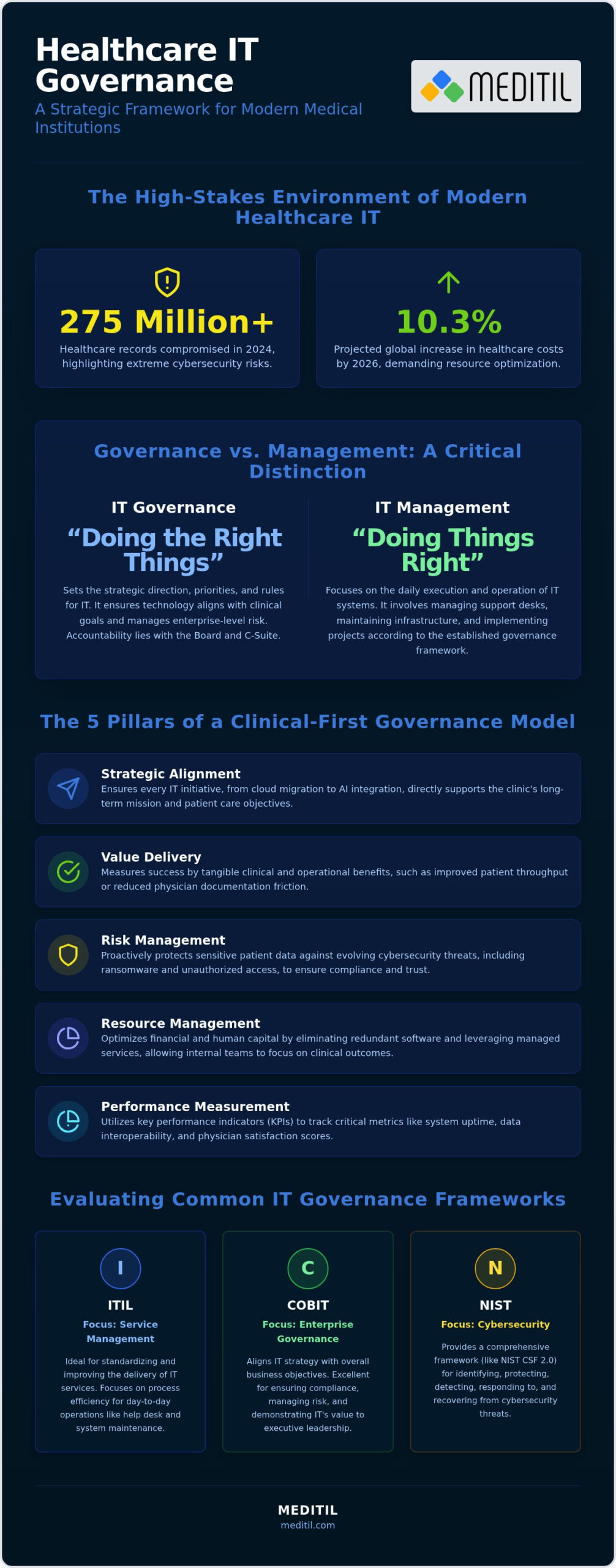
In 2024, over 275 million healthcare records were compromised, a statistic that highlights the escalating risks facing modern medical institutions. As global care costs are projected to climb by 10.3% in 2026, the necessity for a rigorous healthcare IT governance framework has transitioned from a compliance requirement to a strategic imperative. Organizations can no longer afford the luxury of fragmented systems or misaligned technology goals that fail to serve the clinical mission.
You’re likely familiar with the strain of siloed data and the anxiety that accompanies shifting HIPAA regulations. It’s difficult to maintain physician satisfaction when technical requirements feel like an obstacle rather than a tool for improvement. This guide provides a structured approach to aligning your technology investments with clinical excellence. We’ll explore how to reduce cybersecurity risk through standardized controls and establish a clear roadmap for decision-making that delivers a measurable return on investment.
Key Takeaways
- Learn how to transition IT from a traditional cost center into a strategic asset that directly supports your clinic’s long-term objectives.
- Compare the specific benefits of COBIT, ITIL, and NIST to identify the ideal healthcare IT governance framework for securing your infrastructure and ensuring compliance.
- Discover a structured implementation roadmap that integrates governance into daily workflows through cross-functional committees and rigorous system audits.
- Master the calculation of Clinical Value of Investment (CVI) to move beyond hardware costs and measure the true impact of technology on patient outcomes.
- Understand how fractional CIO leadership provides the specialized expertise necessary to eliminate redundant software subscriptions and prevent “Shadow IT” risks.
Defining the Healthcare IT Governance Framework in 2026
Effective IT governance is the structural alignment of technology with clinical and business goals. It’s the mechanism that ensures an organization’s IT investments directly support its mission of patient care. In 2026, the industry has undergone a fundamental shift. Technology is no longer viewed as a back-office cost center. Instead, it’s recognized as a primary strategic asset. Implementing a robust healthcare IT governance framework allows leadership to move beyond reactive troubleshooting toward proactive, value-driven decision-making.
A successful framework focuses on three core objectives. First is value delivery, which ensures that every project provides tangible clinical or operational benefits. Second is risk management, which addresses the increasingly sophisticated threats to patient data. Third is resource optimization, which prevents the waste of human and financial capital on redundant systems. General IT frameworks often fail in this sector because they lack clinical context. A hospital isn’t a standard enterprise; a system failure doesn’t just impact productivity, it impacts patient safety. Therefore, governance must be built around the unique requirements of the medical environment.
Why 2026 Demands a New Governance Approach
The rapid integration of AI-driven diagnostics has created new challenges for data integrity. Governance must now address “model drift” and data poisoning to ensure clinical decisions remain accurate. Additionally, the rise of remote patient monitoring (RPM) has expanded the network perimeter far beyond the hospital walls. This creates massive infrastructure demands and complicates the delivery of healthcare cybersecurity services. With healthcare costs projected to increase by 10.3% globally this year, organizations need disciplined oversight to manage these complexities without compromising care quality.
The Difference Between IT Management and IT Governance
It’s vital to distinguish between management and governance. Management focuses on “doing things right,” which involves the daily operation of systems and support desks. Governance is about “doing the right things.” It sets the rules of engagement for clinical IT teams and establishes the criteria for project prioritization. The adoption of a healthcare IT governance framework shifts accountability to the Board and C-suite. Under standards like NIST CSF 2.0, cybersecurity and IT strategy are no longer just technical issues. They’re core enterprise risks that require high-level oversight to ensure long-term stability and clinical alignment.
The 5 Essential Pillars of a Clinical-First Governance Model
A robust healthcare IT governance framework rests on five foundational pillars. These pillars provide the architecture necessary to transform technical debt into clinical value. By establishing a structured approach, leadership ensures that technology serves as a catalyst for care rather than an administrative burden. It’s about creating a steady environment where every digital investment is justified by its contribution to the organization’s mission.
- Strategic Alignment: Every digital initiative, from cloud migration to AI integration, must support the clinic’s long-term roadmap.
- Value Delivery: Success is measured by tangible clinical and operational benefits. Projects must justify their presence through improved patient throughput or reduced documentation friction.
- Risk Management: Central to this is healthcare cybersecurity. Protecting patient data requires a proactive stance against evolving ransomware threats and unauthorized access.
- Resource Management: Leaders must optimize spend and personnel. Utilizing managed IT services for healthcare allows internal teams to focus on patient outcomes while experts handle the underlying infrastructure.
- Performance Measurement: Organizations use specific KPIs to track system uptime, interoperability across disparate platforms, and physician satisfaction scores.
Clinical Alignment: Putting Patient Outcomes at the Center
Technology shouldn’t impede the provider. Governance ensures EHR workflows are optimized to reduce physician burnout by eliminating redundant data entry and unnecessary clicks. By prioritizing projects that directly impact patient safety and care quality, organizations build trust with their medical staff. Clinical-First Governance is the integration of medical ethics with technical standards. Organizations seeking to refine these priorities often find that a managed IT partnership provides the expert guidance needed to bridge the gap between clinical needs and technical capability.
Compliance and Security as a Continuous Process
In 2026, the regulatory environment has moved beyond static, annual HIPAA audits. The National Health Systems Resource Centre emphasizes that governance must facilitate continuous oversight to remain effective. This requires integrating compliance into the entire software procurement lifecycle from day one. Real-time security monitoring is now a mandatory standard. Proposed 2026 HIPAA changes make multi-factor authentication and encryption at rest non-negotiable requirements for all entities. Billing automation also plays a critical role here. By standardizing financial data flows, organizations reduce the risk of audit failures while maintaining steady revenue cycles through seamless connectivity and verified data integrity.
Evaluating Governance Frameworks: ITIL, COBIT, and NIST for Healthcare
While the previous sections established the pillars of a clinical-first model, selecting the right methodology is the next logical step. A tailored healthcare IT governance framework typically integrates the strengths of several established models to address the unique complexities of medicine. COBIT acts as the high-level umbrella, providing control objectives that align technical goals with the organization’s business requirements. It’s particularly effective for executive oversight, ensuring the Board remains informed about systemic risks. In contrast, ITIL 4 focuses on the operational side of service delivery. In 2026, 78% of enterprises have transitioned to ITIL 4 to leverage its value-centric approach. For those prioritizing a robust security posture, the NIST Cybersecurity Framework 2.0 provides the essential foundation. Its “Govern” function explicitly links technical safeguards to leadership accountability. Most modern practices find that a hybrid framework is the most effective solution, as it combines strategic depth with technical rigor.
ITIL in the Clinic: Improving Service and Support
COBIT for Compliance and Executive Oversight
COBIT bridges the communication gap between technical teams and clinical leadership. It translates technical metrics into the language of risk and value, which is essential for meeting HIPAA and HITECH requirements. By mapping COBIT controls to specific regulatory standards, organizations can establish clear accountability for data integrity. This framework ensures that interoperability goals aren’t just technical aspirations but are tracked as strategic milestones. It provides the steady hand needed to manage digital transformation while keeping the organization’s financial and legal obligations in sharp focus.
Implementation Roadmap: Integrating Governance into Daily Workflows
Transitioning from theoretical frameworks to operational reality requires a methodical, step-by-step approach. Implementing a healthcare IT governance framework isn’t a one-time event; it’s a continuous integration into the clinic’s lifecycle. This roadmap ensures that technology remains a servant to clinical outcomes rather than a source of frustration. Efficiency in a medical environment is never an accident. It’s the result of disciplined planning and expert execution.
- Step 1: Current State Assessment. Audit your existing infrastructure and security protocols. This phase must include a comprehensive review of it budgeting for medical practices to identify where capital is being underutilized or misallocated.
- Step 2: Establish a Governance Committee. Form a multi-disciplinary group including clinical, administrative, and IT stakeholders. This ensures that technical decisions aren’t made in a vacuum and reflect the needs of those providing care.
- Step 3: Define Policy and Standards. Create a clear playbook for procurement and security. This document sets the “rules of engagement” for how new technology enters the organization and how it’s maintained.
- Step 4: Tooling and Automation. Deploy the necessary technical architecture, such as SIEM for security monitoring and billing automation tools for financial integrity.
- Step 5: Iterative Review. Use established KPIs to measure performance. Adjust your strategy based on system uptime, user satisfaction scores, and clinical throughput.
If your organization lacks the internal bandwidth to manage this complex transition, our Managed IT Services provide the steady hand at the wheel needed for long-term stability.
Overcoming Resistance to Change
Resistance is natural when introducing new oversight. To ensure buy-in, leadership must clearly communicate the “Why” behind the governance shift. Focus on demonstrating quick wins, such as improved system speeds or reduced log-in friction, which provide immediate relief to clinical staff. Identifying “Clinical Champions” is also vital. These are respected physicians or nurses who lead the transition, showing their peers how the framework protects their time and patient safety. When staff see that governance reduces administrative burdens, adoption becomes a shared mission rather than a top-down mandate.
The Role of Automation in Governance
Automation is the engine that drives modern governance. By utilizing medical billing automation solutions, practices significantly reduce human error and audit risks. These tools ensure that financial data flows are standardized and compliant without requiring constant manual oversight. Automation acts as the enforcement layer of a governance framework, ensuring that policies are applied consistently across all systems. Additionally, automating compliance reporting provides executives with real-time visibility into the organization’s risk profile, allowing for faster, more informed decision-making.
Maximizing IT ROI Through Strategic Governance and Fractional Leadership
Calculating the return on investment for technology in a medical setting requires a shift in perspective. While traditional metrics focus on hardware costs and licensing fees, a mature healthcare IT governance framework introduces the concept of Clinical Value of Investment (CVI). This metric evaluates how technology impacts patient safety, provider satisfaction, and care outcomes. With global healthcare costs projected to increase by 10.3% in 2026, organizations must ensure every dollar spent contributes to both financial stability and clinical excellence. Governance serves as a financial safeguard; it prevents the proliferation of “Shadow IT,” which occurs when departments purchase unauthorized software that creates security gaps and redundant costs.
The financial impact of avoiding a single HIPAA breach or system downtime event is staggering. Considering that over 275 million healthcare records were compromised in 2024, the cost of a failed security posture can negate years of operational savings. By centralizing procurement and security through a standardized framework, leadership can eliminate duplicate software subscriptions that often drain significant portions of an IT budget without adding value. Positioning virtual CIO services as the architect of this framework is a strategic move for organizations looking to optimize their leadership spend while gaining expert-level oversight.
The Fractional CIO: Expert Governance Without the Full-Time Salary
A vCIO provides the objective oversight needed for successful governance without the overhead of a full-time executive salary. These specialists bridge the gap between medical boardrooms and technical server rooms, translating complex infrastructure needs into strategic business cases. They’re uniquely positioned to build a three-year strategic IT roadmap that aligns with the clinic’s growth targets. This proactive leadership ensures that your healthcare IT governance framework remains agile, adapting to regulatory changes and emerging technologies like AI-driven diagnostics before they become liabilities.
Measuring Success: KPIs for Healthcare IT ROI
Measuring success requires tracking specific KPIs that reflect the clinic’s daily reality. One vital metric is “Time to Care,” which measures how much time a well-governed IT environment saves clinicians daily by reducing documentation friction. Additionally, organizations should track billing cycle improvements through automated integration, as standardized data flows lead to faster reimbursements. Evaluating system interoperability scores is another essential metric for long-term health; it ensures that data moves seamlessly between systems, reducing the risk of clinical errors. When these KPIs are consistently met, IT transforms from a necessary expense into a primary driver of organizational growth.
Securing Your Clinical Future Through Strategic Oversight
Adopting a clinical-first healthcare IT governance framework is the most effective way to ensure your technology supports your mission rather than hindering it. By aligning digital investments with patient outcomes, you protect both your revenue and your reputation. This guide has detailed how structured pillars and hybrid frameworks provide the stability needed to navigate 2026’s shifting HIPAA mandates. Real-time monitoring and billing automation are now foundational components of a resilient, high-performing practice.
Implementing these changes requires a steady hand and deep industry expertise. You don’t have to manage this complex evolution alone. Our team provides HIPAA-compliant infrastructure management and 24/7 monitoring to ensure your data remains secure. We offer expert guidance on interoperability and billing automation to streamline your operations and maximize your Clinical Value of Investment. Secure your strategic roadmap with MEDITIL’s Fractional CIO services.
Your journey toward a more stable and efficient technical environment starts with a single strategic decision. We’re ready to partner with you to build a legacy of clinical excellence and operational stability.
Frequently Asked Questions
What is a healthcare IT governance framework and why is it necessary?
A healthcare IT governance framework is a formal structure used to ensure that technology investments support clinical objectives and regulatory requirements. It’s necessary because it provides the steady hand at the wheel needed to manage complex interoperability and cybersecurity risks. Without this structure, organizations often face fragmented data and inefficient workflows that compromise patient care and organizational stability.
How does IT governance differ from regular IT management in a medical setting?
IT management focuses on the daily operations and maintenance of technical systems. In contrast, governance establishes the strategic direction and accountability for those systems. While management ensures your EHR is running, governance ensures that the EHR implementation actually improves clinical outcomes and meets long-term financial goals. It’s the difference between tactical execution and strategic leadership.
Which framework is better for healthcare: COBIT or ITIL?
Most modern medical organizations find that a hybrid approach is superior to choosing just one. COBIT serves as an excellent umbrella framework for executive oversight and compliance mapping. ITIL 4 is better suited for managing service delivery and help desk efficiency. Combining these allows a clinic to maintain high-level strategic control while ensuring daily technical support remains responsive to physician needs.
Can a small medical practice afford to implement a formal governance framework?
Small practices can absolutely implement formal governance by leveraging scalable solutions like fractional CIO services. You don’t need a full-time executive to establish a healthcare IT governance framework. In fact, smaller clinics often have more to lose from a single HIPAA breach or system outage. For those who also manage government contracts, you can discover FeDril to see how compliance-readiness software helps smaller teams stay audit-ready. Investing in structured oversight early prevents the wasteful spending that often cripples growing practices.
What are the biggest risks of not having an IT governance framework?
The primary risks include catastrophic data breaches, non-compliance with evolving 2026 HIPAA standards, and significant financial waste. Without governance, IT projects frequently suffer from budget overruns and poor clinical adoption. You also risk creating data silos that prevent the interoperability required by the 21st Century Cures Act. This lack of structure eventually leads to physician burnout and compromised patient safety.
How do I calculate the ROI of a healthcare IT governance project?
You calculate ROI by looking at Clinical Value of Investment (CVI) rather than just hardware costs. Measure improvements in billing cycles through automated integration and track the time saved for clinicians daily. Reductions in cybersecurity insurance premiums and the avoidance of HIPAA settlement costs also contribute to the total return. These tangible metrics prove that governance is a primary driver of organizational stability.
Who should lead the IT governance committee in a healthcare organization?
The committee should be led by a strategic IT leader, such as a CIO or a fractional CIO, who understands both technology and healthcare administration. However, it must include representatives from clinical staff, finance, and operations. This multi-disciplinary approach ensures that technical policies reflect the actual workflows of physicians and nurses. Leadership by a strategic partner helps maintain the balance between technical rigor and clinical excellence.
How often should our healthcare IT governance framework be reviewed?
Your healthcare IT governance framework should undergo a comprehensive review at least once per year. However, with the rapid introduction of AI-driven diagnostics and new CMS interoperability rules, many organizations now conduct quarterly assessments. These frequent check-ins allow you to adjust your roadmap in response to emerging cybersecurity threats and regulatory updates. Continuous review ensures your infrastructure remains both compliant and high-performing.