
Did you know that despite federal mandates for FHIR R4, approximately 95% of U.S. hospitals still rely on HL7 v2 for their internal operational messaging? This persistent reliance on legacy standards often leaves critical patient information trapped in proprietary EHR silos, creating a fragmented landscape that hinders clinical decision-making. You’ve likely realized that building a clinical data warehouse is no longer just a technical project; it’s a strategic necessity to eliminate the high cost of technical debt and ensure long-term stability.
We understand the pressure of maintaining security while transitioning to the cloud, especially with the 2026 HIPAA Security Rule updates mandating stricter encryption and multi-factor authentication. This guide will help you master the architectural and regulatory steps required to consolidate your data into a high-performance system. You’ll learn how to create a single source of truth that supports predictive analytics and scales with your organization’s growth. We’ll examine the specific requirements for modern interoperability, including the latest LOINC and SNOMED CT standards, to provide a clear roadmap for your digital infrastructure.
Key Takeaways
- Identify the critical distinctions between a Clinical Data Warehouse and standard EHR reporting to unlock advanced business intelligence and billing automation.
- Master the structured architectural layers, including ingestion, staging, and transformation, necessary for building a clinical data warehouse that ensures a single source of truth.
- Address the 2026 HIPAA Security Rule updates by implementing universal encryption and proactive cybersecurity monitoring within your cloud-based data infrastructure.
- Establish a cross-functional governance committee to align technical data consolidation with specific clinical use cases and patient safety objectives.
- Utilize strategic IT leadership, such as a Virtual CIO, to bridge the gap between complex systems integration and long-term organizational stability.
Defining the 2026 Clinical Data Warehouse (CDW) Framework
In the 2026 healthcare environment, a Clinical Data Warehouse is no longer just a digital filing cabinet. It’s a sophisticated, consolidated repository designed specifically for decision support, advanced analytics, and strategic reporting. While traditional EHR tools are excellent for documenting individual patient encounters, they often fail to provide the aggregate visibility required for population health management or complex billing automation. A Clinical Data Repository (CDR) or Clinical Data Warehouse (CDW) serves as the essential single source of truth, aligning clinical findings with financial performance metrics to create a comprehensive view of organizational health.
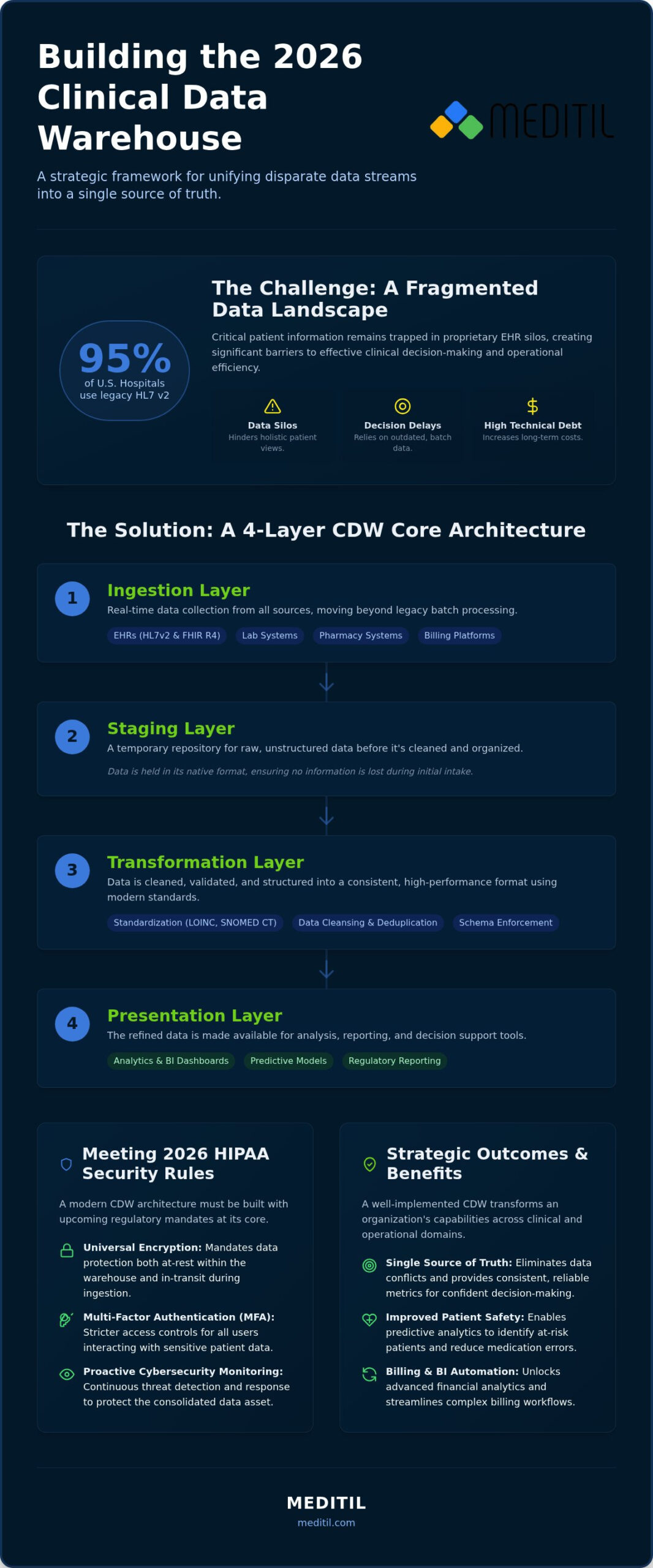
Building a clinical data warehouse in 2026 necessitates a shift from legacy batch processing to real-time data ingestion. The days of waiting 24 hours for a data refresh are over. Modern clinical workflows and predictive safety models require immediate access to information as it’s generated at the point of care. This transition ensures that leadership teams aren’t making decisions based on yesterday’s numbers, but on the live pulse of the facility. By consolidating fragmented data from disparate EHRs, labs, and pharmacy systems, the CDW provides the reliable infrastructure needed for long-term stability and growth.
CDW vs. Data Lakes: Choosing the Right Repository
Understanding the distinction between a CDW and a data lake is critical for effective data management. Data lakes typically store vast amounts of raw, unstructured data in its native format. While these lakes are valuable for exploratory research, they often lack the rigorous schema and data quality controls required for immediate clinical action. A CDW provides a structured hybrid approach. It organizes data into a refined format that supports high-performance querying and reporting. For clinical use cases like population health, the structured nature of a CDW ensures that metrics are consistent, verified, and ready for regulatory submission.
The Impact of CDWs on Patient Outcomes and Safety
Centralizing data directly influences patient safety by eliminating the friction of data silos. When information is trapped in proprietary systems, clinicians lose the holistic view of the patient journey, increasing the risk of missed diagnoses or medication errors. A well-implemented CDW enables advanced predictive analytics that can identify at-risk patients before adverse events occur. Establishing this level of precision requires a foundation of robust managed it services for healthcare to handle the underlying infrastructure, security protocols, and connectivity. This stability allows medical teams to focus on data insights rather than technical troubleshooting, ultimately leading to improved patient care and reduced clinical friction.
Core Architecture: Integrating Disparate Healthcare Data Streams
The architecture of a modern CDW must handle massive volumes of data without compromising speed or security. Building a clinical data warehouse requires a methodical approach to infrastructure that many organizations overlook, particularly regarding high-performance networking. This journey involves creating a structured path for data to travel from the point of care to the final analytics dashboard. This process typically utilizes four distinct layers: ingestion, staging, transformation, and presentation. By organizing data this way, you ensure that information remains clean, accessible, and ready for high-level analysis.
High-volume processing requires specialized infrastructure. Organizations often underestimate the network bandwidth and low-latency connections needed for real-time integration. Without a high-performance network foundation, the warehouse becomes a bottleneck rather than an asset. Metadata management is also critical. It ensures that once data enters the warehouse, it remains discoverable and usable. For instance, OUHSC’s Clinical Research Data Warehouse provides a clear example of how to structure the data lifecycle from EMR ingestion to research-ready datasets. If your team needs assistance with this technical heavy lifting, our systems integration and interoperability services can provide the necessary expertise.
Interoperability Standards: FHIR, HL7, and Beyond
FHIR R4 is the 2026 baseline for healthcare interoperability. However, building a clinical data warehouse effectively means accounting for legacy systems. Approximately 95% of U.S. hospitals still rely on HL7 v2 for internal operational messaging. Your architecture must bridge the gap between these legacy messages and modern FHIR APIs. Ensuring semantic interoperability is the next step. This involves using standardized terminologies like SNOMED CT and ICD-10-CM. When every system speaks the same clinical language, you reduce errors and improve the accuracy of your predictive safety models.
ETL vs. ELT: Modern Data Transformation Strategies
Traditional Extract-Transform-Load (ETL) processes often struggle with the scale of modern health data. Many organizations are moving toward Extract-Load-Transform (ELT) strategies. ELT allows you to load raw clinical data into the warehouse immediately, which is invaluable for future retrospective studies where the original data context is required. This approach leverages the massive compute power of cloud environments to handle transformations on demand. ELT allows healthcare organizations to store raw clinical data immediately while deferring complex transformations to the high-performance cloud compute layer.
Overcoming Technical and Regulatory Implementation Barriers
Organizations often hesitate when building a clinical data warehouse due to the perceived vulnerability of cloud environments. This concern is valid. The 2026 updates to the HIPAA Security Rule represent the most significant regulatory shift in over a decade, mandating stricter cybersecurity measures for electronic protected health information (ePHI). Beyond security, the persistent challenge of technical debt from legacy systems complicates the consolidation process. Integrating these older platforms without degrading the performance of your modern infrastructure requires a disciplined, strategic approach to data architecture.
Data quality remains a primary hurdle. Normalizing disparate EHR formats into a unified nomenclature is not merely a technical task; it is a clinical necessity. When data is inconsistent, the risk of clinical friction increases, potentially compromising patient safety. Many internal IT teams struggle with these builds because they lack the specific expertise in healthcare interoperability required to navigate these complexities. This resource gap often leads to project delays and cost overruns that can exceed initial projections by 20% or more.
HIPAA Compliance and Life-Critical Cybersecurity
The 2026 regulatory landscape requires a shift toward zero-trust architecture for all data warehouse access points. This means implementing universal encryption for data both at rest and in transit, alongside mandatory multi-factor authentication. Regular vulnerability scans and penetration testing are no longer optional best practices; they are now defined regulatory requirements. To ensure your warehouse meets these rigorous standards, it is essential to integrate advanced healthcare cybersecurity services into your foundational design. This proactive stance protects sensitive patient data while maintaining the integrity of your clinical insights.
The Build vs. Buy vs. Managed Service Dilemma
When building a clinical data warehouse, leadership must evaluate the total cost of ownership (TCO) across different implementation models. A custom-built warehouse offers maximum flexibility but comes with high development costs, often ranging from $50,000 to over $800,000 depending on complexity. Conversely, off-the-shelf analytics platforms may offer faster deployment but often lack the deep customization needed for unique clinical workflows.
The “Managed Implementation” model provides a strategic middle ground. By leveraging expert partners to manage the infrastructure, organizations can focus their internal resources on clinical data insights rather than pipeline maintenance. Consider that the average annual cost for data pipeline maintenance is approximately $520,000. A managed approach reduces this operational burden, providing a scalable infrastructure that supports future growth without the need for a massive, permanent internal data team. This model ensures stability and precision, allowing your organization to remain agile as the healthcare landscape evolves.
A Step-by-Step Roadmap for Building Your Clinical Data Warehouse
Building a clinical data warehouse begins with strategic alignment, not technical architecture. Many organizations make the mistake of starting with server specifications, only to find that the final product doesn’t meet the needs of the medical staff. To avoid this, your implementation should follow a methodical, phased progression that prioritizes high-value outcomes and stakeholder buy-in. This structured approach ensures that the repository remains a stable asset rather than an expensive technical burden.
- Step 1: Define specific clinical and business use cases to drive the project.
- Step 2: Establish a data governance committee with clinical and IT stakeholders.
- Step 3: Select the infrastructure stack (Cloud, On-prem, or Hybrid).
- Step 4: Execute a pilot integration with a single high-value data source, such as Billing.
- Step 5: Scale horizontally by adding clinical, lab, and imaging data streams.
This phased approach to building a clinical data warehouse reduces organizational risk by validating the data flow at every stage. It allows your team to address integration challenges in a controlled environment before expanding to more complex, life-critical clinical data streams.
Phase 1: Strategic Alignment and Governance
The success of a warehouse project depends heavily on identifying a ‘Clinical Champion’. This is typically a physician leader who understands the value of data and can advocate for the project among the medical staff. Their role is to ensure that the technical team isn’t just moving data, but is creating insights that actually improve patient care. Before the first line of code is written, the governance committee must define clear data ownership and access policies. Aligning the CDW roadmap with it budgeting for medical practices ensures that the project remains financially viable and avoids the pitfalls of underfunded infrastructure.
Phase 2: Technical Execution and Validation
Once governance is established, the focus shifts to setting up a staging environment. This is a critical isolation layer where you can test ingestion pipelines without impacting your live EHR systems. Validation protocols are essential during this phase; you must prove that the data stored in the warehouse perfectly matches the source EHR records. Automated data quality checks have become the essential defense against the ‘garbage in, garbage out’ syndrome that can plague high-speed clinical data streams in 2026. These checks verify the integrity of every record in real-time, ensuring that your predictive analytics are based on flawless information.
If your organization is ready to move beyond fragmented data silos, our Project-Based IT Consulting team can provide the technical roadmap and strategic leadership required for a successful implementation.
Strategic IT Leadership: Navigating the CDW Journey with a vCIO
Building a clinical data warehouse is a fundamental business transformation rather than a simple IT task. When organizations treat this project as a mere software implementation, they often fail to achieve the cross-departmental alignment necessary for success. This journey requires a “steady hand at the wheel” to navigate the complexities of data stewardship, clinical workflows, and technical architecture. Strategic leadership ensures that the warehouse doesn’t just collect data, but actively drives improvement in patient safety and operational efficiency.
A major challenge in this process is managing the vendor landscape. Without proactive oversight, healthcare facilities often find themselves locked into proprietary data formats that limit future flexibility. Disciplined leadership prevents this by prioritizing open standards and ensuring that the data remains the property of the organization, not the software provider. This strategic advancement allows for a scalable infrastructure that can support future growth and emerging technologies without requiring a complete system overhaul every few years.
Fractional CIO Services for Data Strategy
For many healthcare organizations, the cost of a full-time executive leader is a significant barrier. Utilizing virtual cio services provides the necessary strategic oversight without the burden of a permanent executive salary. A vCIO bridges the gap between clinical needs and technical execution, translating medical requirements into a precise technical roadmap. This partnership is essential for building a multi-year plan for data maturity, ensuring that the organization is prepared for the next wave of AI-driven diagnostics and predictive modeling. By focusing on long-term outcomes, a vCIO helps the organization avoid the technical debt associated with short-term fixes.
Leveraging Managed Infrastructure for CDW Performance
The performance of a data warehouse is only as reliable as the underlying network. Real-time clinical analytics require high-availability networking and low-latency connections to ensure that insights are available exactly when they are needed at the point of care. Outsourcing infrastructure management to a healthcare specialist provides a sense of security and stability that internal teams may struggle to maintain alone. At MEDITIL, we support large-scale clinical data initiatives through our augmented IT teams, providing the technical depth required for complex integrations. This managed approach allows your clinicians to focus on extracting meaningful insights from the data while we handle the precision and protection of the infrastructure layer. Our role is to act as a seasoned expert, ensuring that every detail of your data environment is handled with professional care and technical confidence.
Securing Your Organizational Future Through Data Consolidation
Transitioning from fragmented silos to a unified repository is a critical shift for 2026. Success relies on more than server specifications; it requires a precise alignment between clinical objectives and technical execution. By prioritizing real-time interoperability and establishing a disciplined governance framework, your organization can transform raw data into a high-performance asset that improves patient safety and stabilizes operational costs.
Building a clinical data warehouse is a sophisticated journey that demands expert guidance. Our team provides the specialized healthcare infrastructure and deep EMR/EHR interoperability expertise required to navigate this regulatory landscape safely. We offer fractional CIO leadership to oversee your strategic roadmap, ensuring your data environment remains scalable and compliant with 2026 standards.
If you’re ready to eliminate technical debt and secure a single source of truth for your facility, let’s discuss your vision. Schedule a Strategic Consultation for Your Clinical Data Project today. We’re committed to ensuring your transition to a consolidated data framework is methodical, secure, and built for long-term stability.
Frequently Asked Questions
What is the difference between a clinical data warehouse and an EHR?
An EHR is a tool for documenting real-time patient encounters, while a Clinical Data Warehouse is a consolidated repository designed for aggregate analysis and decision support. EHRs focus on immediate documentation and individual care. In contrast, CDWs integrate data from multiple disparate sources, such as labs and pharmacy systems, to provide a holistic organizational view. This distinction is critical for leaders who need business intelligence beyond simple record-keeping.
How much does it cost to build a clinical data warehouse in 2026?
The total investment for a data platform depends heavily on complexity, data volume, and the number of system integrations. Regulatory requirements alone can add up to 25% to the total cost of a data platform due to the need for advanced security measures. Organizations must also plan for the ongoing annual maintenance of data pipelines to ensure the system remains reliable. Strategic leadership helps justify these costs by driving long-term clinical and financial improvements.
Is a clinical data warehouse HIPAA compliant by design?
A Clinical Data Warehouse isn’t HIPAA compliant by default; compliance depends on the underlying infrastructure, security protocols, and administrative governance. With the 2026 HIPAA Security Rule updates, organizations must implement universal encryption for data at rest and in transit. Universal multi-factor authentication and regular vulnerability scans are also mandatory to maintain a secure environment for electronic protected health information. Compliance is a continuous process of verification and protection.
How long does a typical clinical data warehouse implementation take?
A typical implementation occurs in phases, often starting with a three to six month pilot focused on a high-value data source like billing. Full-scale horizontal integration of clinical, lab, and imaging data streams may take twelve to twenty-four months to achieve complete maturity. Building a clinical data warehouse is a phased journey that requires steady progress through ingestion and validation layers to ensure the final system provides long-term stability.
Can a clinical data warehouse help with medical billing automation?
Yes, a CDW serves as the foundation for billing automation by aligning clinical documentation with financial data streams. By normalizing disparate data formats, the warehouse ensures that billing codes accurately reflect the services provided. This integration reduces clinical friction and minimizes claim denials, allowing for more efficient revenue cycle management. It provides the financial transparency needed to identify gaps in reimbursement and improve the overall stability of the organization.
What are the most common reasons clinical data warehouse projects fail?
Projects often fail due to a lack of clear clinical use cases or insufficient data governance. When organizations prioritize server specifications over stakeholder buy-in, they often create systems that clinicians find difficult to use. Another common pitfall is failing to identify a Clinical Champion to bridge the gap between the technical team and the medical staff. Without this strategic leadership, the warehouse risks becoming an expensive repository of unused data.
Do we need a full-time CIO to manage a clinical data warehouse project?
You don’t need a full-time executive to lead this initiative; a Virtual CIO (vCIO) can provide the necessary strategic oversight. A vCIO manages the vendor landscape and ensures the project aligns with long-term organizational goals without the expense of a permanent salary. This fractional leadership model is particularly effective for building a clinical data warehouse while maintaining lean operational costs. It provides a steady hand at the wheel during complex digital transformations.