
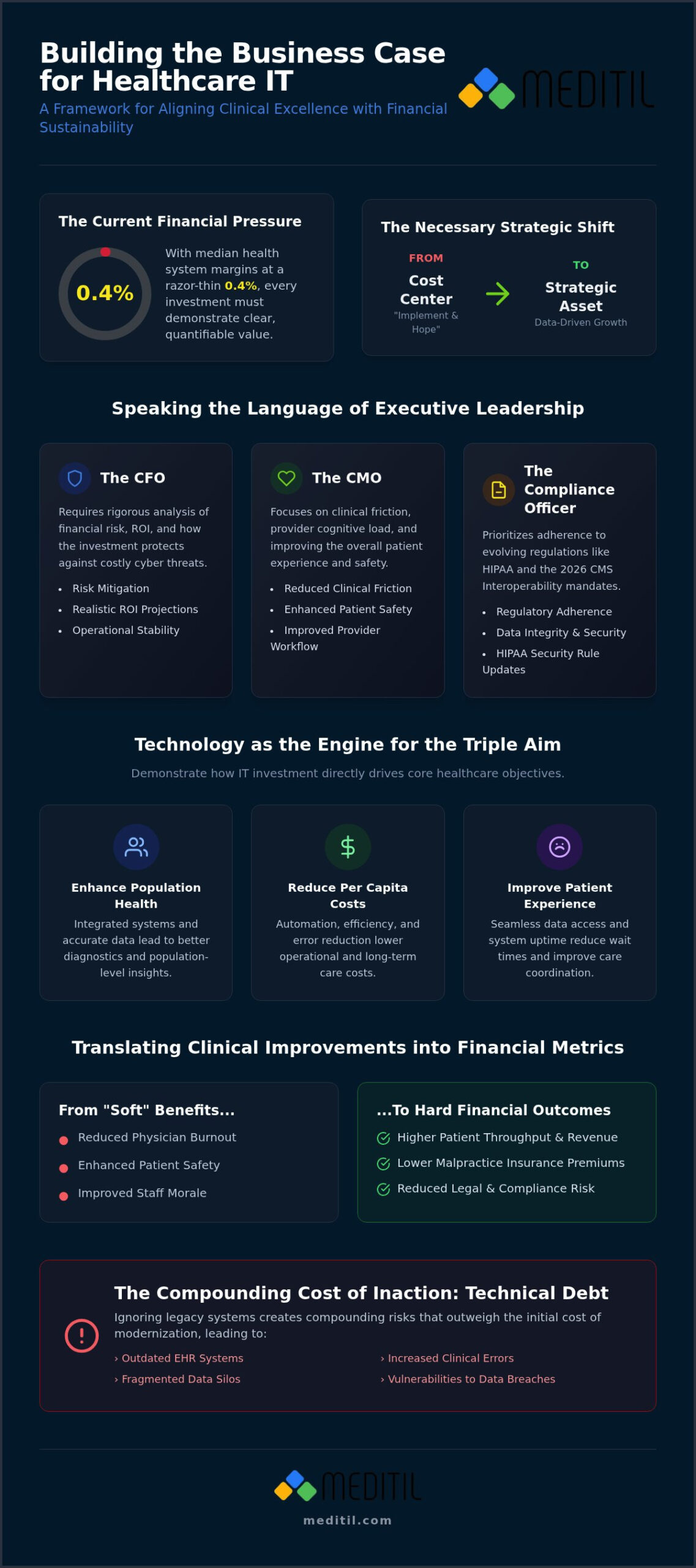
With median health system margins hovering at a mere 0.4% in early 2026, the era of “implement and hope” for technology has ended. You’ve likely experienced the frustration of watching a vital clinical tool stall because the C-suite views it as a cost center rather than a strategic asset. It’s difficult to quantify the “soft” benefits of reduced physician burnout or improved patient safety into the hard financial data that a CFO respects, particularly when legacy EHR implementations failed to deliver a clear ROI. Successfully building a business case for IT investment in healthcare now requires a shift from technical specifications to a language of financial risk and operational stability.
We’ll show you how to bridge this gap and master the framework for securing executive buy-in by aligning clinical excellence with financial sustainability. This guide provides a structured roadmap for your next proposal, including the specific metrics that command respect in the boardroom and strategies to meet the latest CMS interoperability standards. You’ll learn how to transform IT from an expense into a reliable engine for long-term growth through a methodical, data-driven approach.
Key Takeaways
- Learn how to translate clinical improvements into precise financial metrics that align with C-suite strategic priorities.
- Discover a methodology for quantifying “soft” benefits, such as reduced physician burnout and enhanced patient safety, to strengthen your ROI model.
- Master a structured framework for building a business case for IT investment in healthcare that addresses both infrastructure gaps and 2026 regulatory mandates.
- Understand the strategic role of a Virtual CIO in facilitating communication between technical departments and administrative leadership.
- Identify high-impact opportunities, such as billing automation, that provide measurable returns despite tightening health system margins.
Defining the Foundation of Your Healthcare IT Business Case
A healthcare IT business case isn’t a mere procurement request. It’s a strategic bridge that connects clinical imperatives with the organization’s financial reality. When building a business case for IT investment in healthcare, you must first identify the primary catalyst for the expenditure. Is the initiative driven by regulatory compliance, such as the 2026 CMS Interoperability and Prior Authorization mandates? Is it focused on operational efficiency or long-term revenue growth? Without a clearly defined driver, the proposal lacks the focus necessary to survive executive scrutiny in an environment where capital investments are increasingly restricted.
General IT business cases often fail in a medical environment because they ignore the unique complexities of health informatics and stringent regulatory standards. In a standard corporate setting, system downtime might result in lost productivity or delayed communication. In a clinical setting, however, system failure can lead to compromised patient safety and disrupted care delivery. This high-stakes environment requires a highly specialized approach that prioritizes system stability, data integrity, and seamless interoperability over simple feature sets or aesthetic upgrades.
The Cost of Inaction: Technical Debt in Healthcare
Technical debt refers to the long-term costs and risks incurred by choosing easy, legacy solutions over more robust, modern alternatives. In many practices, this manifests as outdated EHR systems, fragmented data silos, or unpatched network infrastructure. These systems don’t just slow down workflows; they increase the probability of clinical errors and create vulnerabilities for data breaches. Addressing these systemic weaknesses is a central component of Strategic IT Budgeting for Medical Practices: A 2026 Financial Roadmap. Ignoring technical debt creates a compounding risk that eventually outweighs the initial cost of modernization.
Identifying Your Stakeholders: Beyond the IT Department
A successful proposal speaks to multiple audiences simultaneously, recognizing that technology purchasing decisions are now consolidated at the executive level. The CFO requires a rigorous analysis of risk mitigation and a realistic projection of ROI. They need to see how the investment protects the organization’s financial health against the rising costs of cyber threats. Conversely, the CMO is primarily concerned with clinical friction. They want to know how the technology will reduce the cognitive load on providers and improve the patient experience. Finally, the compliance officer focuses on how the investment ensures adherence to evolving HIPAA Security Rule updates. By addressing these diverse perspectives, you build a coalition of support that transcends basic technical requirements.
Aligning Clinical Outcomes with Financial Performance
The success of any medical organization rests on the “Triple Aim” framework: improving the patient experience, enhancing population health, and reducing per capita costs. When building a business case for IT investment in healthcare, you must demonstrate how technology serves as the engine for all three. Clinical excellence and financial sustainability are not opposing forces. Instead, they are deeply interdependent. By reducing clinical friction, organizations can simultaneously improve care quality and protect their bottom line.
Quantifying Patient Safety as a Financial Asset
Patient safety is often categorized as a “soft” benefit, but it carries significant financial weight. Data accuracy within an integrated system reduces the likelihood of adverse drug events and diagnostic errors. These improvements lead to tangible reductions in malpractice insurance premiums and legal risk. For a structured approach to these justifications, the AMA’s guide to digital health business cases offers a reliable path for aligning digital solutions with organizational goals. In 2026, safety-driven ROI is defined by the precision of real-time data verification that prevents costly clinical oversights before they occur.
Operational Efficiency and Staff Retention
Physician burnout is a major driver of turnover costs, which can reach hundreds of thousands of dollars per clinician. “Click fatigue” and administrative burdens from poorly optimized EHRs are primary contributors to this crisis. By investing in automated workflows, practices can alleviate this cognitive load. This transition is especially effective when implementing Medical Billing Automation Solutions: A Strategic Guide for Healthcare Leaders in 2026. Automation allows staff to focus on high-value clinical tasks rather than manual data entry. If your organization is struggling to quantify these efficiencies, our consultants at MEDITIL can help you map out the specific labor savings and retention benefits of a modernized IT roadmap. Building a business case for IT investment in healthcare becomes far more persuasive when you can show a CFO exactly how technology stabilizes the workforce.
Quantifying ROI and Risk Mitigation in Medical IT
CFOs often view technology as a recurring expense rather than a value driver. When building a business case for IT investment in healthcare, you must shift the narrative from procurement costs to the mitigation of existential financial risks. This requires a clear distinction between Hard ROI and Soft ROI. Hard ROI involves tangible cash savings, such as reduced labor hours from billing automation or lower supply costs through better inventory management. Soft ROI covers critical but less direct benefits, including enhanced brand reputation, patient trust, and the prevention of clinical errors. While harder to track, these factors often determine the long-term stability of a medical practice.
One of the most effective ways to counter the “IT is a black hole” objection is to frame infrastructure as a foundation for interoperability and resilience. This isn’t just about spending money; it’s about protecting the organization’s ability to generate revenue. Efficient systems reduce administrative waste by automating the data exchange required for prior authorizations and claims processing. When systems work together seamlessly, the organization can focus on patient volume rather than technical troubleshooting.
The Cybersecurity ROI: Avoiding the Multi-Million Dollar Breach
Cybersecurity should be presented as a strategic insurance model. As of mid-2026, regulatory scrutiny has intensified, with proposed updates to the HIPAA Security Rule mandating multi-factor authentication (MFA) and encryption for ePHI both at rest and in transit. The financial impact of a breach now far exceeds the cost of proactive defense. For instance, the national average for healthcare data breach costs remains at record levels, often including legal fees, patient notification costs, and heavy regulatory fines. Utilizing Healthcare Cybersecurity Services: A Strategic Guide for 2026 can help you align your security spend with recognized risk frameworks. Investing in protection is a disciplined financial decision that prevents catastrophic capital loss.
Interoperability: The Revenue Generator
Interoperability is no longer just a compliance requirement under the CMS-0057-F rule; it’s a revenue generator. Effective data exchange allows for faster prior authorization decisions, which the latest regulations now require within 7 days for standard requests and 72 hours for expedited ones. These shortened timelines improve patient retention and referral management by ensuring care isn’t delayed by administrative bottlenecks. By facilitating real-time data exchange, interoperability reduces the cost per patient encounter by eliminating manual record retrieval and redundant diagnostic procedures. It’s a clear path to improving the bottom line while meeting the USCDI v3 standards that became mandatory in January 2026.
Step-by-Step: Drafting Your Healthcare IT Investment Proposal
Drafting a successful proposal is an exercise in strategic precision. It requires moving beyond technical specifications to present a narrative of organizational improvement. When building a business case for IT investment in healthcare, your document must follow a logical progression that addresses the specific concerns of every C-suite executive. This process begins with an honest look at your current limitations and ends with a compelling vision of a modernized, stable environment. By following a structured five-step approach, you can transform a complex technical request into a disciplined financial and clinical roadmap.
- Step 1: Current State Assessment. Perform a comprehensive audit of existing infrastructure to identify specific pain points and performance bottlenecks.
- Step 2: Solution Mapping. Align your proposed IT solutions directly to the clinical gaps identified during the assessment phase.
- Step 3: Financial Modeling. Build a detailed forecast that includes the Total Cost of Ownership (TCO) and a realistic ROI projection.
- Step 4: Risk Analysis. Proactively identify potential implementation risks and outline clear mitigation strategies.
- Step 5: Executive Summary. Craft a concise “elevator pitch” that highlights the strategic value of the investment for the board.
Conducting a Readiness Audit
Before investing in new capabilities, you must evaluate your network stability and cloud readiness. Many proposals fail because they ignore the underlying infrastructure required to support new systems. This phase should also include a “Shadow IT” discovery to identify unauthorized applications that may be creating security vulnerabilities or data silos. Utilizing Managed IT Services for Healthcare: The 2026 Definitive Strategic Guide provides a reliable baseline for the standards your infrastructure should meet before expansion begins. A thorough audit ensures that your investment rests on a stable foundation.
Building the Financial Forecast
A credible financial model accounts for more than just the initial purchase. You must include implementation costs, staff training, and ongoing managed service fees to present a true TCO. Projecting the “Breakeven Point” is essential for gaining CFO approval, as it demonstrates when the efficiency gains will begin to outweigh the capital expenditure. While Hard ROI is easier to calculate, you should also present intangible benefits, such as improved clinician morale, in a way that leadership can value. If you need expert assistance in developing these complex financial models, our vCIO consulting services can guide you through every stage of the proposal process. Building a business case for IT investment in healthcare is significantly more effective when backed by professional strategic leadership.
Navigating Executive Approval with Strategic Leadership
Securing the final signature on a proposal is often the most challenging phase of building a business case for IT investment in healthcare. Even the most data-rich document can stall without a dedicated “champion” in both the clinical and administrative offices. A dual-advocacy approach ensures that the project isn’t perceived as a siloed IT initiative but as a mission-critical upgrade for the entire organization. When a Chief Medical Officer and a Chief Financial Officer both vouch for a project’s necessity, it signals to the board that the investment is balanced, addressing both patient care standards and fiscal responsibility.
Board members frequently raise objections regarding implementation timelines and potential disruptions to clinical workflows. You must be prepared to position technology as a long-term strategic asset rather than a one-time project. This involves explaining how phased rollouts and robust testing protocols mitigate risk. By demonstrating a disciplined approach to deployment, you reassure leadership that the organization’s stability remains the priority throughout the transition. Professional guidance during these presentations can make the difference between a deferred project and a funded mandate.
Leveraging vCIO Expertise for Board Presentations
A Virtual CIO (vCIO) provides the authoritative presence needed to justify significant capital expenditures. These fractional leaders act as a bridge, translating complex technical nomenclature into strategic business outcomes that resonate with a non-technical board. By utilizing Virtual CIO Services: Strategic IT Leadership for Healthcare in 2026, practices gain access to seasoned experts who have navigated similar regulatory and financial hurdles. A vCIO ensures that the technical roadmap is not just feasible but optimized for the practice’s specific growth objectives, providing a “steady hand at the wheel” during high-stakes decision-making sessions.
Post-Approval: Ensuring the Business Case Holds True
The work doesn’t end once the board grants approval. To maintain trust, you must establish Key Performance Indicators (KPIs) that track the realized ROI against your initial forecasts. This might include monitoring reductions in claim denial rates, improvements in patient portal engagement, or a decrease in system-related clinical delays. Ongoing managed services are essential during this phase to protect the infrastructure and ensure that technical debt doesn’t begin to accumulate again. Building a business case for IT investment in healthcare is a continuous cycle of verification and improvement. When you are ready to secure your organization’s future, partner with MEDITIL to build your strategic IT roadmap and ensure every investment delivers measurable clinical and financial value.
Securing a Resilient Future for Your Medical Practice
The operational landscape of 2026 demands a departure from reactive technology spending. Success now hinges on your ability to demonstrate how modern infrastructure directly supports clinical outcomes and financial health. By addressing technical debt and quantifying the ROI of interoperability, you move beyond simple procurement to strategic advancement. Successfully building a business case for IT investment in healthcare requires a disciplined framework that speaks to the CFO’s focus on risk and the CMO’s commitment to patient safety. This alignment ensures that every dollar spent is a step toward greater institutional stability.
As a partner specialized in HIPAA-compliant infrastructure and expert vCIO strategic guidance, MEDITIL is trusted by national healthcare organizations to navigate these complex decisions. We provide the technical confidence and mission-driven focus needed to transform IT into a reliable engine for growth. To begin formalizing your next proposal with precision, Download our Strategic IT Budgeting Template for Healthcare Leaders. Taking the first step toward a modernized roadmap ensures your practice remains stable and competitive in an increasingly regulated environment. We look forward to helping you achieve lasting clinical and financial excellence.
Frequently Asked Questions
What are the most important metrics in a healthcare IT business case?
The most important metrics include Total Cost of Ownership (TCO), clinical throughput, and the projected breakeven point. You should also track claim denial rates and patient acquisition costs. These figures help the board understand both the initial capital outlay and the long-term operational impact on the organization’s financial health.
How do you calculate the ROI of improved patient safety?
Calculating the ROI of patient safety involves quantifying the reduction in malpractice insurance premiums and the avoidance of adverse drug events. By integrating data-driven IT systems, practices can lower legal risks and prevent the costs associated with diagnostic errors. This shift transforms safety from a qualitative goal into a measurable financial asset.
Why do many IT business cases in healthcare get rejected by the board?
Many proposals are rejected because they fail to translate technical features into strategic business outcomes or lack a clear ROI forecast. Boards often view IT as a standalone expense rather than a foundation for growth. If a proposal doesn’t address financial risk or regulatory compliance directly, it’s unlikely to secure approval in a high-scrutiny environment.
Is it better to focus on cost savings or revenue generation in a proposal?
A successful proposal should emphasize both, but focusing on revenue generation through improved patient throughput often carries more weight with 2026 boards. While cost savings from automation are vital, demonstrating how technology expands your capacity to see patients provides a more aggressive growth narrative. This balance is critical when building a business case for IT investment in healthcare.
How does a vCIO help in building a business case for IT investment?
A Virtual CIO acts as a strategic partner who translates technical requirements into the language of risk and financial performance. They provide the authoritative leadership needed to justify large-scale investments during board presentations. By leveraging a vCIO, practices can ensure their technical roadmap aligns perfectly with long-term administrative and clinical objectives.
What is the role of HIPAA compliance in justifying IT spend?
HIPAA compliance serves as a primary justification for cybersecurity spend by framing it as essential risk mitigation against multi-million dollar data breaches. With proposed 2026 updates mandating multi-factor authentication and encryption, non-compliance represents a significant financial and reputational liability. Investing in security is effectively a form of institutional insurance that protects the organization’s capital.
How long does it typically take to see a return on healthcare IT investments?
Most healthcare organizations begin to see a measurable return on IT investments within 12 to 24 months, depending on the project’s scope. Infrastructure upgrades may take longer to realize full value, while specific solutions like billing automation can deliver faster results. It’s important to set realistic expectations for the breakeven point to maintain executive trust.
Should we include the cost of staff training in our business case?
You must include the cost of staff training to provide an accurate Total Cost of Ownership and ensure successful system adoption. Omitting these costs leads to “click fatigue” and high turnover, which eventually erodes the ROI of the new technology. Comprehensive training is a prerequisite for achieving the operational efficiencies promised in your building a business case for IT investment in healthcare.