
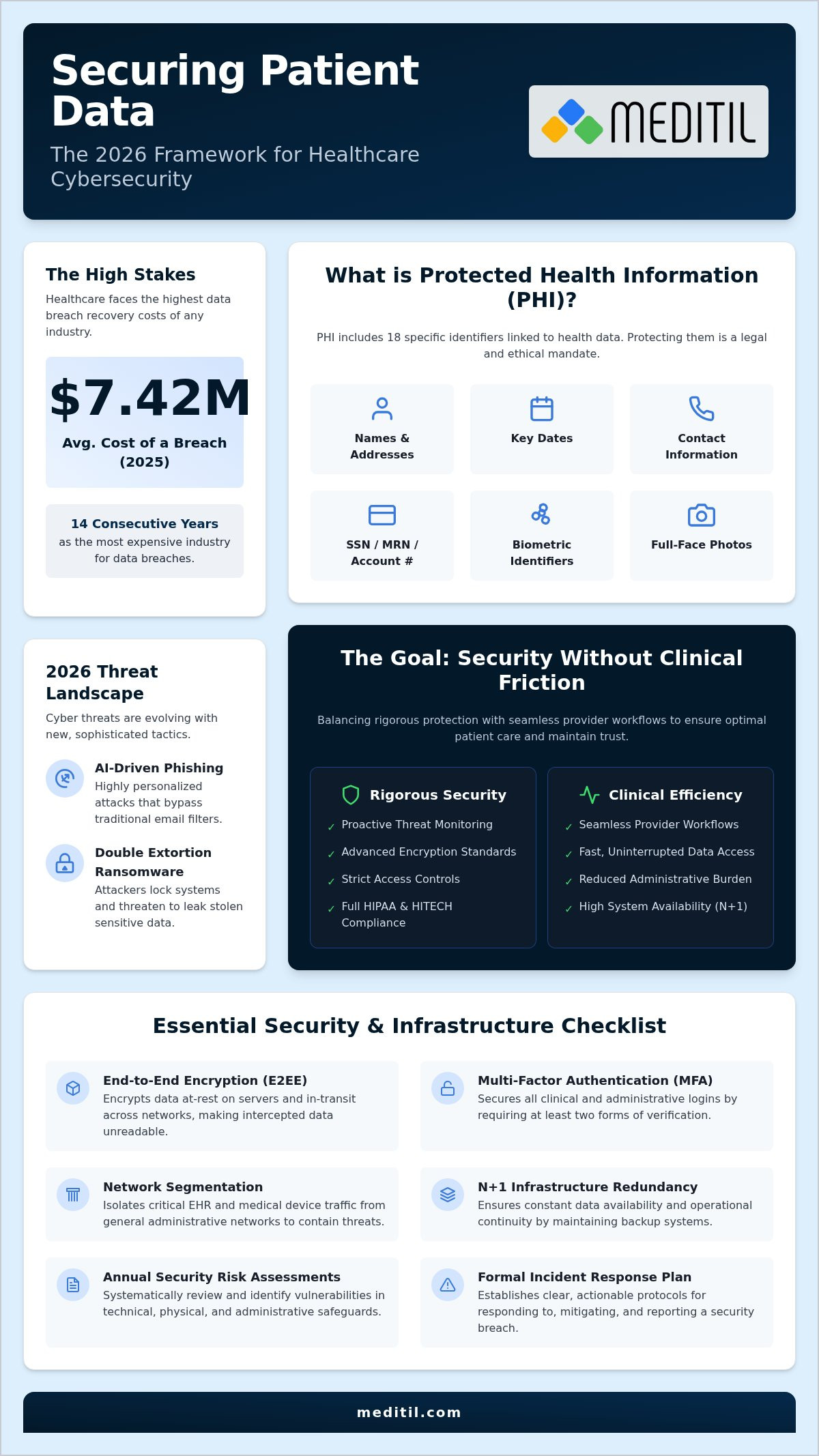
In 2025, the average cost of a healthcare data breach climbed to $7.42 million, marking fourteen consecutive years that this industry has faced the highest recovery expenses of any sector. You likely recognize that protecting protected health information is no longer just a regulatory hurdle. It’s a foundational requirement for maintaining patient trust and operational stability. However, managing the complexity of cloud-based EHRs and mobile data often leads to clinical friction, where security measures inadvertently slow down the very providers they’re meant to support.
This article provides a structured operational framework for implementing the best practices for securing patient data in a modern threat environment. By aligning your strategy with the 2026 HIPAA Security Rule overhaul and the latest ITIL v5 standards, you can move toward a zero-breach environment while maintaining seamless provider workflows. We’ll preview the essential 2026 checklist, covering everything from the February 16 deadline for 42 CFR Part 2 compliance to the strategic use of fractional CIO oversight to stabilize your infrastructure and ensure predictable security costs.
Key Takeaways
- Analyze the 2026 threat landscape to effectively distinguish between general administrative information and high-risk Protected Health Information.
- Adopt technical safeguards like end-to-end encryption and multi-factor authentication as core best practices for securing patient data.
- Fortify infrastructure using network segmentation and N+1 redundancy to isolate EHR traffic and ensure constant data availability.
- Maintain regulatory compliance through annual security risk assessments and formal incident response plans tailored to clinical protocols.
- Optimize clinical efficiency by partnering with specialists who implement rigorous security frameworks without disrupting essential provider workflows.
Defining the 2026 Patient Data Security Landscape
Healthcare organizations remain the primary target for data exfiltration because medical records offer a high-yield return for cybercriminals. Unlike credit card numbers, which are easily cancelled, a patient’s medical history, Social Security number, and insurance details are permanent. This longevity makes them highly valuable for long-term identity theft and insurance fraud. In 2026, the threat environment has shifted toward AI-driven phishing, where bad actors use large language models to create highly personalized, error-free communications that bypass traditional email filters. Ransomware has also evolved into “double extortion” models, where attackers not only lock systems but also threaten to leak sensitive data if their demands aren’t met.
Successfully implementing best practices for securing patient data requires a clear understanding of the regulatory framework. While the HIPAA Privacy Rule focuses on the legal rights of patients and the permissible uses of their information, the Security Rule specifically governs the technical and physical safeguards required to protect electronic PHI. In a modern digital context, the Security Rule is no longer a static checklist but a dynamic mandate for continuous monitoring and rapid response.
The Definition of PHI in a Connected Ecosystem
The push for interoperability has significantly expanded the footprint of sensitive data. As information flows between EHRs, billing platforms, and telehealth apps, the risk of exposure increases. Understanding What is Protected Health Information (PHI)? is the first step toward building a compliant infrastructure. Under U.S. law, PHI includes 18 specific identifiers when they’re linked to health data:
- Names and all geographic subdivisions smaller than a state
- All elements of dates (except year) related to an individual
- Telephone numbers, fax numbers, and email addresses
- Social Security numbers and Medical Record Numbers (MRN)
- Health plan beneficiary numbers and account numbers
- Certificate or license numbers
- Vehicle identifiers and serial numbers, including license plate numbers
- Device identifiers and serial numbers
- Web Universal Resource Locators (URLs) and IP addresses
- Biometric identifiers, including finger and voice prints
- Full-face photographic images and any comparable images
- Any other unique identifying number, characteristic, or code
In 2026, PHI encompasses any health-related data coupled with identifying markers that exist within a provider’s digital ecosystem, from cloud storage to remote monitoring devices.
Why General IT Security Fails Healthcare Organizations
General business IT strategies often prioritize uptime and return on investment over the life-critical requirements of medical data. In a clinical setting, a security delay isn’t just an inconvenience; it can directly impact patient outcomes. Many organizations struggle with technical debt, where aging legacy systems lack the modern encryption capabilities required to thwart advanced threats. This gap creates a dangerous vulnerability that general-purpose IT teams may not be equipped to manage. Transitioning to specialized healthcare cybersecurity services is essential for organizations that need to balance rigorous protection with the high-speed demands of a modern clinical environment. Specialized teams understand that best practices for securing patient data must be integrated into the provider’s workflow, not layered on top of it as a barrier.
Technical Safeguards: The Essential Security Checklist
Transitioning from strategic definitions to operational reality requires a robust suite of technical controls. Implementing best practices for securing patient data involves more than just software installation; it requires a layered defense strategy that addresses vulnerabilities at the device, user, and network levels. In accordance with updated HIPAA Security Rule requirements, organizations must now prioritize automated safeguards that reduce the likelihood of human error or oversight.
The core of this defense rests on five critical pillars:
- End-to-End Encryption (E2EE): Data must be encrypted at rest on servers and in transit across networks. This ensures that even if a packet is intercepted, the information remains unreadable.
- Multi-Factor Authentication (MFA): Every clinical and administrative login should require at least two forms of verification to prevent unauthorized access from stolen credentials.
- Role-Based Access Control (RBAC): Access should be strictly limited to the minimum necessary information required for a specific job function, following the principle of least privilege.
- Automated Patch Management: Connected medical devices and workstations need immediate updates to close security gaps as soon as vendors release them.
- Endpoint Detection and Response (EDR): Advanced tools monitor devices in real-time to identify, block, and isolate malicious activity before it spreads through the network.
Encryption and Identity Management
As clinical rounds increasingly rely on mobile devices and tablets, these endpoints represent a significant risk surface. Securing these devices requires remote wipe capabilities and mandatory biometrics. We’ve seen a shift away from traditional passwords toward hardware tokens and biometric MFA, which provide a more secure and frictionless experience for providers. When managing temporary access for visiting specialists or auditors, utilize “just-in-time” provisioning. This grants time-limited permissions that automatically expire, preventing “privilege creep” where accounts retain access long after a project concludes.
Logging and Continuous Auditing
Immutable audit logs are non-negotiable for 2026 compliance. These logs must track every PHI access event, including the user identity, timestamp, and specific data viewed. Maintaining these best practices for securing patient data through automated logging supports faster post-incident forensic analysis, allowing your team to pinpoint the entry point within minutes rather than days. Maintaining this level of audit readiness can be resource-intensive for internal teams. Many organizations find that leveraging managed it services for healthcare provides the necessary oversight to ensure logs are properly captured and stored. If you’re concerned about your current audit posture, our team can help you design a more resilient logging architecture.
Infrastructure Fortification: Securing the Network Core
While technical safeguards protect individual users and devices, the underlying network architecture determines the ultimate resilience of your organization. A secure network core acts as a fail-safe against both external breaches and internal system failures. Designing for resilience starts with N+1 redundancy. This principle ensures that for every critical system component, at least one independent backup is ready to take over the load. In a clinical environment, this means duplicating hardware and data pathways so that a single equipment failure never interrupts access to life-critical records.
Real-time visibility is equally essential. Implementing Security Information and Event Management (SIEM) allows your IT team to aggregate data from across the entire network. This centralized view enables the detection of anomalous patterns that might indicate a sophisticated, slow-moving threat. By applying best practices for securing patient data at the infrastructure level, you transition from reactive troubleshooting to proactive threat hunting. This high-level oversight ensures that your network remains a stable foundation for clinical operations.
Network Segmentation and IoMT Security
The proliferation of the Internet of Medical Things (IoMT) introduces unique vulnerabilities. Many legacy medical devices, such as older infusion pumps or imaging systems, cannot support modern encryption or frequent patching. To protect these assets, guest Wi-Fi and medical equipment must never share a network segment. Segmenting your network into dedicated VLANs isolates sensitive EHR traffic from general office activity and public access points. This isolation is a primary defense against lateral movement. If a guest’s laptop is compromised, the attacker remains trapped within the public segment, unable to reach the clinical core where PHI resides. Utilizing proactive network security services helps manage these complex configurations, ensuring that connectivity never comes at the expense of safety.
Backup and Disaster Recovery (BDR)
Ransomware remains a persistent threat to clinical continuity, making a robust Backup and Disaster Recovery (BDR) strategy mandatory. We recommend the 3-2-1 backup rule: maintain three copies of your data, stored on two different types of media, with at least one copy kept off-site. In 2026, the most effective best practices for securing patient data include air-gapped backups. These are copies of your data that are physically or logically disconnected from the primary network, making them immune to ransomware that spreads through connected systems. However, a backup is only as good as its recovery speed. Regularly testing recovery times ensures that if a system failure occurs, your clinical team can resume patient care within minutes. This disciplined approach to data preservation protects your organization from the catastrophic costs of permanent data loss or prolonged downtime.
Operational Governance and Regulatory Compliance
Governance serves as the essential framework that ensures technical and infrastructure controls remain effective over time. Without a disciplined administrative approach, even the most advanced encryption can be undermined by inconsistent policies or human error. Annual Security Risk Assessments (SRAs) are mandatory for identifying how best practices for securing patient data must evolve to meet new external threats. A formal Incident Response Plan (IRP) is equally vital. This plan must go beyond IT recovery steps to include specific clinical and legal protocols, ensuring that providers can maintain patient care while leadership manages regulatory notifications and forensic investigations.
The Role of Strategic IT Leadership
Strategic leadership is often the missing link in healthcare security. Many organizations find that virtual cio services bridge the gap between high-level compliance requirements and day-to-day clinical operations. By aligning it budgeting for medical practices with long-term security goals, a vCIO ensures that protection isn’t a one-time expense but a sustainable operational cost. This specialized leadership is also essential for navigating the growing complexity of state-specific data privacy laws. These local regulations often impose stricter requirements than federal HIPAA standards, requiring a nuanced approach to data residency and patient consent.
Managing Third-Party Risk
Third-party vendors are frequently the weakest link in the healthcare security chain. Vetting cloud service providers and EHR vendors requires a disciplined review of their encryption standards, uptime history, and audit capabilities. Billing automation partners must also be scrutinized to ensure they don’t introduce vulnerabilities during the exchange of financial and medical data. A Business Associate Agreement (BAA) remains the cornerstone of vendor management in 2026, serving as a legally binding assurance that third-party partners uphold the same rigorous security standards as the covered entity itself. Without an executed BAA, your organization remains fully liable for any breach occurring within a vendor’s system.
Technical defenses are only as strong as the people who use them. Ongoing staff training is the primary defense against social engineering and AI-enhanced phishing attacks that bypass traditional filters. Regular, low-stakes simulations help clinical and administrative teams recognize sophisticated lures, turning your workforce into a human firewall. By integrating these best practices for securing patient data into your culture, you reduce the likelihood of a catastrophic breach caused by a simple credential theft. If your organization requires a strategic partner to manage these complex regulatory requirements, consult with MEDITIL to evaluate our cybersecurity and compliance services.
MEDITIL: Implementing Security Without Clinical Friction
Security protocols often create barriers between doctors and their patients. When technical safeguards are poorly implemented, they lead to clinical friction, causing providers to seek workarounds that inadvertently compromise data integrity. MEDITIL functions as a strategic partner that understands the nuances of the clinical environment. Our approach ensures that best practices for securing patient data are woven into the fabric of the daily workflow, rather than being layered on top as an administrative hurdle. We prioritize the stability of your infrastructure, allowing medical staff to focus on care delivery while we manage the underlying complexities of cybersecurity and compliance.
Our augmented IT team model provides the specialized expertise necessary to manage complex healthcare networks without the overhead of a full-time internal security department. We integrate protection into every stage of the technology lifecycle, from initial EHR implementation and training to ongoing proactive monitoring. By providing dedicated help desk support tailored specifically for medical staff, we resolve technical issues before they impact patient throughput. This steady hand at the wheel ensures that your organization remains resilient against evolving 2026 threats while maintaining the high-speed requirements of a modern practice.
Reducing the Administrative Burden of Security
Efficiency and security must coexist to be effective. Implementing Single Sign-On (SSO) is a primary example of how we improve the provider experience. SSO reduces the time spent on repetitive logins while simultaneously enforcing the rigorous multi-factor authentication standards required by the 2026 HIPAA Security Rule overhaul. We also focus on streamlining medical billing automation solutions through secure, interoperable integrations. By managing your entire IT team, we ensure that every technician and consultant operates with precision, maintaining a unified defense that protects your revenue cycle and your patients. Our goal is to create a seamless connectivity environment where data flows securely and providers work without interruption.
Getting Started with a Security Audit
Transitioning from a reactive posture to proactive data protection begins with a comprehensive assessment of your current environment. MEDITIL identifies hidden HIPAA gaps, such as unencrypted legacy devices or incomplete business associate agreements, before they escalate into costly breaches or civil monetary penalties. These penalties can now reach $2,190,294 per violation category, making early detection a financial necessity. Our audit process provides a clear roadmap for implementing best practices for securing patient data, tailored to your specific clinical needs and budget. If you’re ready to stabilize your infrastructure and ensure full regulatory compliance, contact us today for a strategic IT consultation. We’ll help you align your technology investments with the long-term security outcomes your patients deserve.
Advancing Toward a Resilient Healthcare Infrastructure
Securing PHI in 2026 requires a shift from static compliance checklists to a dynamic, managed infrastructure. By integrating technical safeguards with robust network segmentation and air-gapped backups, organizations can significantly reduce the risk of catastrophic data exfiltration. Operational governance, led by strategic IT leadership, ensures these best practices for securing patient data remain effective without disrupting the clinical workflow. It’s no longer sufficient to simply install software; you must cultivate a culture of continuous monitoring and rapid response.
MEDITIL serves as a specialized partner, providing Managed IT & Infrastructure Services alongside expert Healthcare IT Consulting. Our Cybersecurity & Compliance Specialists act as a fractional CIO to align your security outcomes with your operational budget. We understand that clinical efficiency is just as important as data protection, and our team is dedicated to maintaining that balance through precise, proactive oversight.
Request a Strategic IT Consultation with MEDITIL to stabilize your clinical environment and protect your organization’s future. Building a secure foundation today ensures your team can focus on what matters most: delivering exceptional patient care.
Frequently Asked Questions
What is the most common cause of patient data breaches in 2026?
Credential theft through sophisticated, AI-enhanced phishing attacks is the most frequent cause of breaches. Attackers use these tools to bypass standard filters and trick staff into revealing login details. Implementing best practices for securing patient data must include regular social engineering simulations to keep your workforce vigilant against these evolving lures.
How often should a medical practice conduct a HIPAA Security Risk Assessment?
You should conduct a formal Security Risk Assessment (SRA) at least once every calendar year to remain compliant. However, federal guidelines also require a new assessment whenever you implement major technology changes or move to a different facility. This proactive approach ensures your safeguards evolve alongside your infrastructure and the current threat environment.
Is cloud storage safer than on-premise servers for patient data?
Cloud storage is generally more secure for most practices because enterprise-level providers maintain physical security and redundancy that on-premise servers often lack. While the cloud offers superior protection against hardware failure, you still remain responsible for securing user access. You must ensure the provider has signed a Business Associate Agreement and uses end-to-end encryption.
What are the penalties for a HIPAA violation in 2026?
As of January 28, 2026, the maximum civil monetary penalty for HIPAA violations is $2,190,294 per violation category, per calendar year. These fines scale based on the level of perceived negligence found by the Office for Civil Rights. Proactive compliance and documented security protocols are the only reliable ways to avoid these catastrophic financial liabilities.
How can I secure patient data when using telehealth or remote monitoring?
Securing telehealth requires the use of platforms that offer end-to-end encryption and a signed BAA. You must also ensure that all remote monitoring devices are managed through a centralized system that enforces best practices for securing patient data, such as remote wipe capabilities and mandatory biometrics. This prevents data exposure if a device is lost or stolen.
Does my EHR provider take full responsibility for data security?
What should be included in a healthcare incident response plan?
A healthcare incident response plan needs to include clear communication protocols for legal teams, clinical staff, and regulatory bodies. It should also detail the technical steps for isolating compromised systems and the specific procedures for restoring data from air-gapped backups. This ensures patient care continues without interruption while the IT team manages the forensic investigation.
How does network segmentation help protect PHI?
Network segmentation creates logical barriers that isolate clinical traffic from general business operations or guest Wi-Fi access. If an attacker gains access to a low-security device, such as a smart thermostat or a guest’s laptop, segmentation prevents them from moving laterally into the core network. This isolation keeps sensitive patient records trapped in a high-security zone that’s unreachable from other segments.