
Most healthcare leaders believe that choosing the right software is the most critical decision in a digital transition, but the reality is that even the most advanced platform will fail without a resilient infrastructure and a clear strategic roadmap. You’ve likely felt the pressure to deliver a seamless upgrade while facing concerns about physician resistance, data loss, and unexpected costs from technical debt. Successfully avoiding EMR implementation pitfalls requires more than just a software vendor; it demands a disciplined approach to the underlying technology and clinical workflows that drive your organization.
We understand that you’re looking for stability and a system that finally delivers on the promise of reduced administrative burden. This guide will help you master the complexities of adoption by identifying and mitigating the hidden technical, clinical, and strategic risks that lead to implementation failure. We’ll explore how to improve interoperability across your billing and clinical systems while ensuring your infrastructure is prepared for a transition with minimal downtime.
Key Takeaways
- View EMR adoption as a comprehensive clinical transformation to safeguard your revenue cycle and minimize physician burnout.
- Address critical infrastructure requirements, such as network redundancy and latency management, to ensure uninterrupted access to life-critical data.
- Master the art of avoiding EMR implementation pitfalls by balancing practice-specific customization with long-term system stability and intuitive workflow design.
- Prioritize data quality and seamless interoperability to prevent information silos between your clinical, laboratory, and billing systems.
- Secure a steady hand at the wheel by leveraging specialized strategic oversight and augmented IT teams to manage the complexities of the implementation roadmap.
The Strategic Framework for Avoiding EMR Implementation Pitfalls
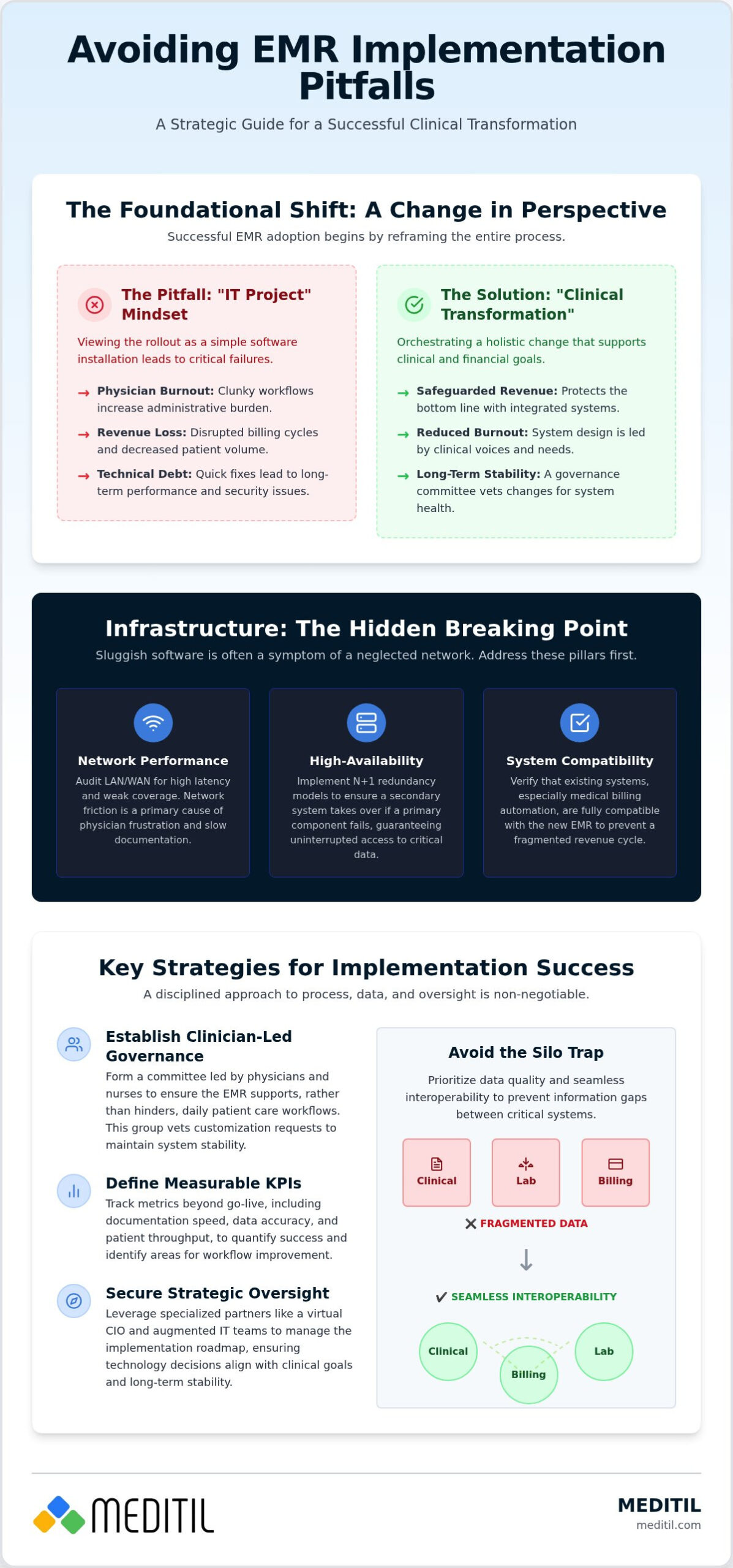
Viewing an Electronic Medical Record (EMR) rollout as a simple IT project is perhaps the most common mistake leadership can make. True success requires a shift in perspective. You aren’t just installing software; you’re orchestrating a clinical transformation. This shift is the first step in avoiding EMR implementation pitfalls that often lead to physician burnout and significant revenue loss. When technical decisions are made in a vacuum, the resulting system often feels like a burden rather than a tool for improvement.
The financial stakes of a failed rollout are high. Implementation failure isn’t just a technical setback; it’s a direct threat to your bottom line. Quantifying the cost of physician burnout and the subsequent loss of productivity is vital for understanding the true impact. High turnover rates and decreased patient volume during a rocky transition can cripple a practice’s finances for years. To prevent this, establishing a governance committee is essential. This group should be led by clinical voices, including physicians and nurses who understand the daily realities of patient care. Their input ensures that the system supports rather than hinders the medical team.
A governance committee also acts as a buffer against technical debt. It ensures that every customization request is vetted for its impact on system performance and security. To maintain this alignment, many organizations leverage virtual CIO services. A strategic partner provides the high-level oversight needed to ensure the IT roadmap remains focused on clinical goals and long-term stability. This leadership ensures that the technical infrastructure evolves alongside the needs of the providers.
Shifting from Software Install to Clinical Transformation
The belief that an EMR is “plug-and-play” frequently results in catastrophic workflow disruptions. Every practice has unique nuances that a standard installation cannot account for. Leadership must define measurable KPIs that extend beyond the go-live date. These metrics should track documentation speed, data accuracy, and patient throughput. Communicating a clear vision to your staff is equally important. When employees understand how the new system improves patient outcomes or reduces their administrative load, they’re more likely to embrace the change and mitigate resistance early.
Auditing Your Infrastructure Readiness
Strategic success rests on a foundation of reliable hardware. Before the first screen is configured, perform a comprehensive gap analysis of your current network. Latency issues or weak wireless coverage will quickly alienate users and compromise patient safety. You should also assess the digital literacy of your staff to determine the most effective training model. Finally, verify that your existing medical billing automation solutions are fully compatible with the new platform. A failure to integrate these systems can lead to a fragmented revenue cycle and delayed reimbursements.
Infrastructure Pitfalls: Why Your Network is the Hidden Breaking Point
Software performance is often the first thing criticized when a new system feels sluggish, but the true culprit is frequently a neglected network infrastructure. High latency creates a friction that leads directly to physician frustration and documentation backlogs. Avoiding EMR implementation pitfalls requires a rigorous audit of your local area network (LAN) and wide area network (WAN) capabilities. If your network can’t handle the increased traffic of a modern EMR, even the most advanced software on the market will feel like a failure to your clinical team.
Clinical data access is life-critical. Implementing an N+1 redundancy model ensures that if a primary network component fails, a secondary system is ready to take the load without interrupting patient care. This level of stability is rarely provided by general IT firms that lack experience in medical environments. Medical-grade networks require a deep understanding of high-availability architectures and the specific demands of clinical software. Securing your environment through specialized healthcare cybersecurity services ensures that your clinical speed remains high while your data remains protected.
The Critical Need for Network Management
Calculating bandwidth requirements is a technical necessity that goes beyond simple internet speeds. High-volume imaging, such as DICOM files, and high-definition telehealth streams place immense strain on existing pipes. You need a system that prioritizes clinical traffic over non-essential data. Proactive monitoring is the only way to identify these bottlenecks before they cause catastrophic downtime during your transition phase. It’s about maintaining a steady, reliable connection that staff can trust during every patient encounter.
Cybersecurity and Compliance During Migration
System transitions are high-risk periods for data breaches and accidental loss. You need established risk assessment protocols for legacy data extraction and cloud uploading to ensure no information is compromised in transit. Maintaining HIPAA compliance during vendor-led migrations is a shared responsibility that requires constant verification of encryption standards. Protecting the integrity of your data during this vulnerable window is paramount for long-term trust.
- Perform deep-packet inspection to ensure security protocols aren’t slowing down EMR traffic.
- Secure all end-user devices, including tablets and mobile workstations, before they’re deployed for staff training.
- Encrypt all data at rest and in transit using industry-standard protocols to prevent unauthorized access.
- Establish clear access controls to limit data exposure to only necessary personnel during the migration phase.
Operational Pitfalls: Navigating Workflow Disruption and Staff Burnout
Operational success relies heavily on the human element of your practice. While technical stability is the foundation, the way your staff interacts with the system determines its long-term viability. Avoiding EMR implementation pitfalls requires a delicate balance between technical requirements and the daily realities of patient care. When clinicians feel the system was built for administrators rather than providers, the resulting friction leads to documentation fatigue and a decline in patient satisfaction. We focus on ensuring the system serves the user, rather than the user serving the system.
The “Big Bang” approach, where every feature is launched simultaneously, is a common strategy that frequently backfires. It overwhelms the staff and creates a surge in support requests that internal teams often cannot handle alone. Successful organizations utilize an augmented IT team to provide high-touch, on-site support during the critical go-live window. This presence ensures that technical issues are resolved in real-time. It prevents minor glitches from turning into widespread clinical frustration that can take months to rectify. Having a steady hand at the wheel during this phase is vital for maintaining staff morale.
Customization vs. Standardization Dilemma
Practices often fall into the customization trap by trying to replicate every manual process in the digital environment. This leads to system bloat and makes future upgrades difficult to manage. To avoid this, use business intelligence tools to map clinical workflows before the build phase begins. You must distinguish between “must-have” features that protect patient safety and “nice-to-have” requests that might hinder system performance. Templates should be designed to support the patient-provider interaction, ensuring that documentation remains a secondary task to clinical care.
Mitigating Physician and Staff Resistance
Resistance is a natural response to significant change, but it can be managed through structured support and clear communication. Implementing a “Super User” program provides a reliable resource for clinicians on the floor. These peer experts can troubleshoot common issues without needing to escalate every ticket to the help desk. It’s also vital to schedule protected time for training. Expecting providers to master a new system while maintaining a full patient load is a recipe for burnout. Finally, establish a clear feedback loop. Staff are more likely to support the transition if they know their operational concerns are being heard and addressed in post-implementation adjustments. Avoiding EMR implementation pitfalls is a continuous process of refinement and listening to those who use the system most.
Data and Interoperability: Avoiding the Silo Trap
Data is the lifeblood of your practice, but it often becomes a significant liability during a transition if not handled with precision. Many organizations fall into the trap of migrating every byte of legacy information, regardless of its accuracy or relevance. Avoiding EMR implementation pitfalls requires a strategic approach to data that prioritizes quality over raw volume. Migrating corrupted or incomplete records only replicates old problems in a new environment, leading to clinical errors and administrative frustration. It’s vital to cleanse your data before the migration begins to ensure the new system remains efficient and reliable from day one.
Strategies for Secure Data Migration
Before the first data packet is moved, you must establish clear data retention policies that align with current HIPAA standards. Validating data integrity is a complex technical challenge that demands rigorous verification protocols. It’s not enough to move the data; you must ensure it remains actionable and secure throughout the process. Selecting a managed it services for healthcare partner ensures that your migration is overseen by experts who understand the high-stakes nature of clinical data protection. They provide the steady hand needed to navigate legacy extractions without compromising patient privacy.
Achieving True Interoperability
Modern healthcare demands adherence to FHIR and HL7 standards to facilitate seamless external data exchange. These protocols allow different software applications to speak the same language, which is vital for connecting clinical documentation to billing automation. Middleware often serves as the necessary bridge between disparate applications, ensuring that information flows where it’s needed most. When your systems are truly interoperable, you reduce the administrative burden on your staff and improve the accuracy of your financial reporting. If you’re ready to break down your data silos and unify your clinical environment, consult with our systems integration specialists to secure your clinical roadmap.
The Implementation Roadmap: Securing a Steady Hand at the Wheel
The final phase of avoiding EMR implementation pitfalls isn’t a technical task; it’s a leadership challenge. While software vendors focus on their product’s features, a Fractional CIO focuses on your organization’s business health. This objective advisory service is a critical defense against the inherent biases of vendor-led transitions. Software providers are naturally incentivized to prioritize their own ecosystem, but a strategic partner manages these relationships to ensure accountability and performance. By overseeing the technical roadmap, they prevent the accumulation of technical debt that often cripples a practice’s agility long after the software is installed.
Managing the temporary surge in workload during a rollout requires more than your existing staff can provide. Building an augmented IT team ensures that daily operations continue without interruption while the transition team focuses on the migration. This approach allows for a specialized focus on workflow optimization and system integration without sacrificing help desk responsiveness. Financial success during this period depends on integrating it budgeting for medical practices into your broader implementation plan. A well-constructed budget accounts for the hidden costs of training, hardware upgrades, and potential downtime, ensuring that the project remains financially viable through every stage of adoption.
The Strategic Advantage of Fractional Leadership
Leadership at this level provides a steady hand at the wheel. They navigate the complexities of a regulated environment with a focus on long-term outcomes rather than just getting the system live. This role involves verifying that every technical decision aligns with clinical objectives, offering a layer of protection that internal teams or software providers rarely offer. It’s about proactive guidance that anticipates challenges before they become roadblocks. Avoiding EMR implementation pitfalls means having someone who can speak both the language of technology and the language of clinical operations.
Long-term Stability and Optimization
The work doesn’t end at launch; in many ways, it’s just beginning. Post-go-live optimization is where the real value of the EMR is realized. Launch is not the finish line, but the starting point for refinement. Establishing a help desk that understands clinical urgency ensures that staff feel supported during the most stressful weeks of adoption. Regular system audits are necessary to verify continued compliance and to monitor performance. As your practice grows, your infrastructure must scale accordingly. This methodical approach to maintenance ensures that your investment continues to deliver improved interoperability and reduced administrative burden for years to come.
- Establish a post-go-live committee to review workflow efficiency every 30 days.
- Monitor network performance metrics to identify latency issues before they impact patient care.
- Schedule quarterly compliance audits to ensure data security remains intact as new users are added.
- Utilize business intelligence to track the ROI of your billing automation and clinical documentation.
Securing Your Practice’s Clinical and Financial Future
Successful EMR adoption isn’t defined by the software itself, but by the strategic framework and technical infrastructure that support it. By prioritizing network redundancy, clinical workflow mapping, and data integrity, your organization can move beyond the common friction points of digital transformation. Focusing on these foundational elements is the most effective method for avoiding EMR implementation pitfalls that lead to physician fatigue and significant revenue loss. This methodical approach ensures that your technology remains an asset rather than a liability.
Achieving this level of precision requires a partner who understands the high-stakes nature of the healthcare environment. MEDITIL provides the Specialized Healthcare IT Expertise and Fractional CIO Leadership needed to navigate these complex transitions with confidence. We provide the Managed Clinical Infrastructure required to maintain stability through every phase of your roadmap. Partner with MEDITIL for a Strategic EMR Implementation to ensure your next transition is seamless, secure, and built for long-term growth. Your clinical future is more stable when you have a steady hand at the wheel.
Frequently Asked Questions
How long does a typical EMR implementation take for a mid-sized practice?
A typical EMR implementation for a mid-sized practice generally spans six to twelve months. This timeline accounts for the initial infrastructure audit, clinical workflow mapping, staff training, and the actual data migration process. Rushing this schedule often leads to technical debt and staff burnout, so a methodical approach is essential for long-term stability and system performance.
What is the most common reason EMR implementations fail?
The most common reason for failure is viewing the project as a simple software installation rather than a clinical transformation. When technical decisions are made without provider input, the resulting system often disrupts workflows and increases administrative burden. Successfully avoiding EMR implementation pitfalls requires aligning the technology with the daily realities of patient care and securing physician buy-in early.
Should we migrate all our legacy data or start fresh with the new system?
You should prioritize data quality over raw quantity by migrating only essential, verified clinical information into the new system. Migrating corrupted or redundant legacy records creates immediate inefficiency and potential safety risks in the new environment. Most organizations find success by defining strict retention policies and maintaining a secure, read-only archive for historical records that aren’t needed for daily operations.
How can we minimize lost revenue during the EMR go-live period?
What is the role of an augmented IT team during an EMR transition?
An augmented IT team provides high-touch, on-site support to manage the temporary surge in technical demands during the transition window. While your internal team maintains daily operations, these specialists focus on real-time troubleshooting and peer-to-peer training for clinicians. This presence ensures that minor technical glitches don’t escalate into widespread clinical frustration or significant downtime during the critical go-live phase.
How do we ensure our new EMR system is fully HIPAA compliant?
Ensuring HIPAA compliance involves performing a comprehensive risk assessment of the new environment, focusing on data encryption both at rest and in transit. You must also establish granular access controls to ensure that only authorized personnel can view protected health information. Regular audits and a secure infrastructure foundation are necessary to maintain these standards as your practice scales and evolves.
Can we integrate our existing medical billing software with a new EMR?
Integration is possible through industry-standard protocols such as HL7 or FHIR, or by utilizing specialized middleware to bridge the gap between disparate systems. Seamless connectivity between your EMR and billing software is vital for protecting your revenue cycle and reducing manual entry errors. This interoperability ensures that clinical documentation flows directly into your financial workflows without requiring redundant administrative tasks.
Is a Fractional CIO necessary if we already have an internal IT manager?
A Fractional CIO complements your internal IT manager by providing high-level strategic oversight and objective vendor management. While an IT manager focuses on daily operational tasks, the Fractional CIO ensures the long-term technology roadmap aligns with your clinical and financial goals. This leadership is a critical safeguard for avoiding EMR implementation pitfalls and managing the complex strategic risks associated with large-scale digital transitions.