
In 2026, a patient journey map is no longer just a clinical diagram; it’s a technical systems architecture. Most healthcare leaders agree that while the vision of a seamless patient experience is clear, the technical reality is often fragmented by legacy EHR systems and persistent data silos. You’ve likely felt the frustration of high patient drop-off rates during digital touchpoints or the administrative strain caused by inconsistent data across platforms. Effective patient journey mapping in healthcare IT requires moving beyond the “what” of patient care to the “how” of technical execution.
This guide provides a methodical framework to transform those high level clinical diagrams into robust technical blueprints. We’ll show you how to leverage interoperable IT infrastructure and automation to eliminate friction from the first digital click to the final bill. You’ll learn to build a scalable architecture that maintains data integrity across the entire care continuum while significantly reducing the administrative burden on your team. We’ll explore the strategic integration of systems that turn a disjointed series of events into a unified, secure, and highly efficient patient experience.
Key Takeaways
- Understand why patient journey mapping has evolved from a marketing visualization into a critical technical requirement for the modern CIO.
- Identify the core infrastructure components, including HL7 FHIR and API-first architectures, that facilitate seamless data exchange.
- Apply a systematic roadmap for patient journey mapping in healthcare IT to convert clinical diagrams into functional technical blueprints.
- Evaluate the operational advantages of specialized automation tools compared to native EHR modules within your digital ecosystem.
- Recognize the role of vCIO oversight and managed IT services in bridging the implementation gap left by software vendors.
The Strategic Evolution of Patient Journey Mapping in 2026
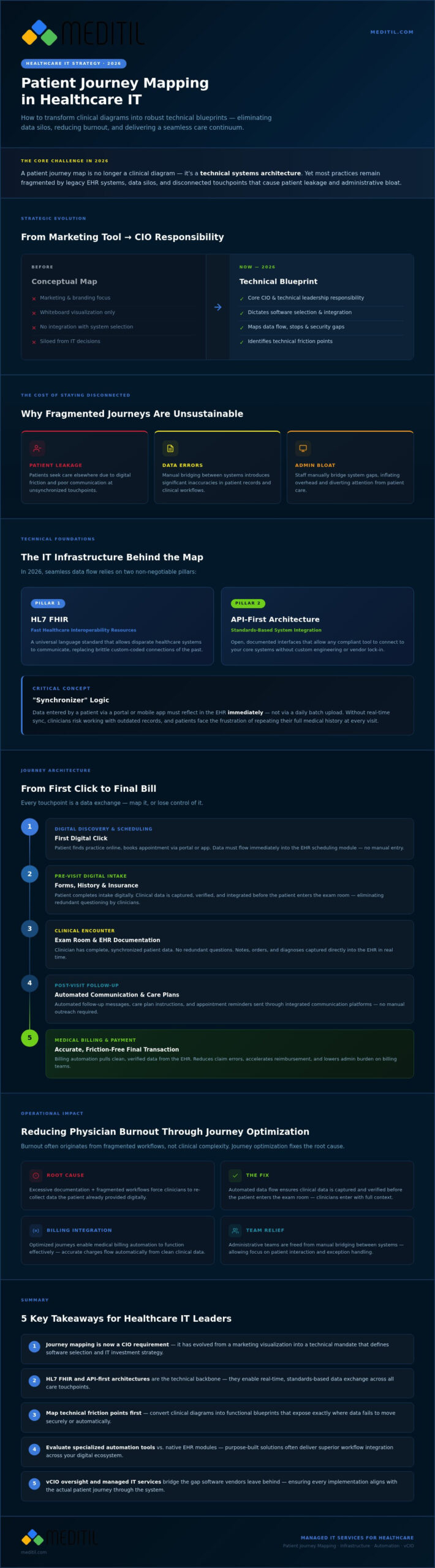
Patient journey mapping in healthcare IT has undergone a fundamental transformation over the last decade. Historically, these maps were conceptual tools used by marketing departments to improve the patient experience in healthcare through better communication and branding. By 2026, the focus has shifted entirely. It’s now a core responsibility of the CIO and the technical leadership team. We define patient journey mapping as the strategic visualization of every digital and physical touchpoint a patient has with a practice. It’s the process of identifying how data moves, where it stops, and how it’s protected at every stage of the care cycle.
The cost of maintaining disconnected journeys is no longer sustainable for modern practices. When touchpoints don’t synchronize, the result is patient leakage, where individuals seek care elsewhere due to digital friction or poor communication. Beyond patient retention, these gaps lead to significant data errors and administrative bloat as staff members manually bridge the divide between systems. By prioritizing patient journey mapping in healthcare IT, organizations can identify exactly where these silos exist. This mapping serves as the essential technical blueprint for managed IT services for healthcare, ensuring that every technological investment aligns with the actual path a patient takes through the system.
From Clinical Diagrams to Technical Blueprints
Reducing Physician Burnout Through Journey Optimization
Physician burnout often stems from excessive documentation and fragmented workflows. Strategic mapping reduces this burden by ensuring clinical data is captured, verified, and integrated before the patient ever enters the exam room. Automated data flow eliminates the need for clinicians to ask redundant questions that the patient has already answered during digital intake. By optimizing these flows, practices can also integrate medical billing automation solutions more effectively. This ensures that the journey ends with an accurate, friction-free financial transaction, reducing the administrative load on both the clinical and billing teams.
Technical Foundations: The IT Infrastructure Behind the Map
Success in patient journey mapping in healthcare IT depends entirely on the underlying infrastructure’s ability to move data without interruption. In 2026, this capability is defined by the adoption of HL7 FHIR (Fast Healthcare Interoperability Resources) and API-first architectures. These standards allow disparate systems to communicate in a common language, replacing the brittle, custom-coded connections of the past. Organizations that rely on legacy infrastructure often find that high-volume patient journeys fail when real-time data flow is required. Interoperability serves as the technical backbone of any successful journey mapping project because it ensures data fluidity across every digital and physical touchpoint.
Central to this infrastructure is the “Synchronizer” logic. This technical framework ensures that data provided by a patient via a portal or mobile app reflects in the EHR immediately. It’s not enough to have a daily batch upload; the modern patient expects real-time confirmation of their information. Without this logic, clinicians face the risk of working with outdated records, and patients experience the frustration of repeating their medical history. Maintaining this level of synchronization requires robust network stability and high-performance bandwidth. If your network isn’t optimized for these constant, high-stakes data exchanges, the entire patient journey will suffer from latency and errors.
In addition to software and connectivity, the physical hardware used to interpret clinical data must be equally reliable. For critical departments, Synergy Medical Inc. provides high-performance visualization and video integration technology that supports the technical integrity of the patient journey in radiology, mammography, and surgical settings.
Bridging the Gap Between Legacy EHRs and Modern Tools
Many practices still operate on legacy EHR systems that weren’t designed for open connectivity. Integrating modern patient engagement applications with these “closed” environments requires a strategic approach. We often utilize middleware and custom-developed APIs to create a unified patient record that spans both old and new systems. This layer acts as a translator, ensuring that modern tools can pull from and push to legacy databases without compromising system stability. It’s also vital to ensure that any third-party journey mapping software adheres strictly to HIPAA standards, protecting the integrity of the data as it moves through the technical stack.
Cybersecurity and Data Integrity in the Care Continuum
As a patient moves through different clinical departments, their Protected Health Information (PHI) must be shielded by end-to-end encryption. Security isn’t a static checkpoint; it’s a continuous requirement that follows the patient along their journey. Effective mapping must include detailed access controls, ensuring that only authorized personnel can view specific segments of the patient record at the appropriate time. For a deeper look at protecting these data pathways, consult our Healthcare Cybersecurity Services guide. Managing these complex security protocols while maintaining a smooth user experience is a delicate balance that requires expert systems integration and interoperability services to execute correctly.
Evaluating Solutions: Automation Tools vs. Unified IT Platforms
Selecting the right technology to support patient journey mapping in healthcare IT requires a strategic choice between specialized point solutions and native EHR modules. Point solutions are often considered “best-of-breed” tools because they focus on perfecting a specific touchpoint, such as automated intake or patient self-scheduling. These tools typically offer a more polished user interface and advanced features that general EHR platforms struggle to match. However, the primary risk with these tools is the creation of new data silos. If a point solution doesn’t integrate perfectly with your central record, it can actually increase the administrative burden by requiring manual data reconciliation.
Native EHR modules offer the advantage of a unified ecosystem where data stays within a single database. This approach simplifies security and reduces the need for complex middleware. The trade-off is often functionality; native modules may lack the sophisticated automation or AI-driven features found in specialized software. When evaluating these options, you must consider the “hidden costs” that go beyond the subscription price. These include API licensing fees for data exchange, the extensive time required for implementation, and the productivity loss during staff retraining. To prevent app fatigue, every addition to your technical stack must provide a clear, frictionless benefit that justifies its presence in the workflow.
Automating the First Touchpoint: Digital Intake
The transition from paper-based systems to digital intake delivers a measurable return on investment by enhancing data accuracy and accelerating the check-in process. Effective digital intake tools do more than just digitize forms; they pre-populate clinical notes directly within the EHR. This functionality is a key factor in reducing “pajama time,” the hours clinicians spend on documentation after their shift ends. When selecting an intake solution, ensure it includes a checklist of essential features: AI-driven triage to prioritize urgent cases, real-time insurance verification to prevent billing delays, and multilingual support to accommodate a diverse patient population.
The Role of Systems Integration and vCIO Oversight
Many practices discover that “out of the box” integrations rarely function as promised without significant custom configuration. These standard connections often fail to account for the unique clinical workflows of a specialty practice. This is where Virtual CIO oversight is invaluable. A vCIO doesn’t just look at software features; they evaluate vendors based on technical stability, long-term scalability, and the ability to maintain data integrity. By aligning your software acquisitions with strategic IT budgeting, you ensure that every dollar spent contributes to a more efficient, interoperable patient journey rather than just adding another layer of complexity to your infrastructure.
A Step-by-Step Roadmap for Implementing Your IT Journey Map
Transitioning from a visual concept to a functional, automated system requires a disciplined execution strategy. Patient journey mapping in healthcare IT serves as the foundation, but the implementation phase is where clinical efficiency is actually realized. We follow a methodical five-step roadmap to ensure your digital transformation is both stable and scalable.
- Step 1: Audit existing clinical workflows. Identify every point where staff manually enters data that already exists in another system. These manual entry points are primary targets for automation.
- Step 2: Map patient touchpoints to IT systems. Align every stage of the patient path with specific data fields in your EHR. This ensures that information flows directly into the correct clinical records without human intervention.
- Step 3: Conduct a security and interoperability review. Verify that all third-party integrations meet current encryption standards and utilize stable API connections. This step prevents data leaks and system crashes during high-volume periods.
- Step 4: Pilot the automated journey. Launch the new workflow within a single specialty department or with one provider. This allows you to resolve technical glitches in a controlled environment before a full-scale rollout.
- Step 5: Establish a continuous monitoring schedule. Implement tools to track system uptime and data flow integrity. Constant oversight ensures that the “pipes” moving patient data remain clear and functional.
Workflow Mapping and Field Optimization
Effective mapping requires more than just connecting software; it involves optimizing the data itself. We use conditional logic in patient forms to eliminate redundant questions. If a patient indicates no history of a specific condition, the system should automatically bypass related inquiries. This precision ensures that structured data correctly populates the EMR, providing clinicians with a clean, actionable record. Involving your clinical staff in this mapping process is essential. Their direct experience helps identify operational gaps that technical teams might overlook, ensuring the system supports the actual reality of patient care.
Staff Training and Change Management
Technical success depends on staff adoption. We overcome resistance by demonstrating exactly how the new system reduces the administrative load on front-desk and clinical teams. Training should focus on practical troubleshooting, such as how to identify and report sync errors between the portal and the EHR. While we aim for total digital reliability, developing “analog” backups is a critical component of risk management. Having a clear protocol for system outages ensures that patient flow continues even during unexpected downtime. To ensure your infrastructure is ready for this level of automation, consider a consultation regarding your healthcare IT strategy.
The Strategic Advantage of Managed IT and vCIO Oversight
Implementing a sophisticated patient journey mapping in healthcare IT strategy requires more than just high-quality software. While vendors are experts in their specific platforms, they rarely possess the comprehensive infrastructure knowledge required to integrate those tools into a complex clinical environment. This gap in expertise often leads to “orphaned” systems that don’t communicate effectively with the rest of your technical stack. Managed IT services provide the essential oversight needed to maintain the “pipes” that move patient data securely from one touchpoint to the next. By focusing on the underlying network and integration layers, we ensure that your technology supports the patient journey rather than obstructing it.
A Fractional or Virtual CIO acts as a strategic architect, aligning your journey technology with specific clinical outcomes and financial ROI. These leaders help practices avoid the trap of accumulating technical debt by selecting interoperable, scalable solutions from the very beginning. Instead of reacting to system failures, a vCIO proactively maps out a multi-year IT roadmap that anticipates growth and regulatory changes. This disciplined approach ensures that every technological investment is verified for its ability to enhance the patient experience and reduce administrative friction over the long term.
Ongoing Support and System Maintenance
The reliability of your digital patient journey depends on continuous system maintenance and proactive monitoring. Front-desk staff require immediate assistance during peak hours to resolve technical hurdles that could otherwise cause patient delays. We provide the help desk support necessary to keep these essential operations running without interruption. Additionally, our team manages the constant stream of software updates and API changes that can often break data syncs between your portal and EHR. By maintaining a 99.9% uptime for your patient-facing systems, we help you build a reputation for reliability and professional excellence.
Aligning Technology with Strategic Practice Growth
Strategic growth requires a clear understanding of how patients move through your practice. By analyzing journey data, we help you identify specific bottlenecks in patient throughput that may be limiting your revenue potential. These insights allow you to scale your systems across multiple locations without the need to reinvent your IT infrastructure each time. A standardized, interoperable framework makes expansion predictable and manageable. Contact MEDITIL to discuss how our Virtual CIO services can secure your IT roadmap and provide the steady hand your practice needs for long-term success.
Building a Resilient Digital Care Continuum
The transition toward a fully digitized patient experience requires a shift from conceptual mapping to technical execution. By treating patient journey mapping in healthcare IT as a systems architecture project rather than a clinical diagram, your practice can eliminate the data silos that lead to patient leakage and administrative burnout. Success in 2026 relies on a foundation of interoperable standards and a network capable of supporting real-time data exchanges. This methodical approach ensures that every digital touchpoint serves both the patient’s needs and the practice’s operational goals.
Navigating this complex landscape of EHR integrations and cybersecurity requirements is best achieved with a strategic partner. MEDITIL provides specialized healthcare IT managed services and strategic vCIO guidance to help you manage the technical complexities of digital transformation. Our expertise in EHR interoperability and clinical workflows ensures that your infrastructure remains stable as you scale. Secure your clinical workflow with MEDITIL’s strategic IT leadership. We’re ready to help you build a more connected and efficient future for your practice.
Frequently Asked Questions
What is patient journey mapping in healthcare IT?
Patient journey mapping in healthcare IT is the strategic process of documenting every digital and physical interaction a patient has with your practice and aligning those touchpoints with your technical infrastructure. It moves beyond simple clinical diagrams to create a functional blueprint for interoperable data exchange. This mapping identifies exactly where information is captured, how it’s securely stored, and where manual data entry can be replaced by automation.
How much does it cost to implement patient journey automation?
The financial investment required for automation depends on the complexity of your current IT environment and the number of systems that need to be integrated. Primary cost factors include software licensing, custom API development for legacy systems, and the time allocated for staff training. Practices should also account for ongoing managed IT support to ensure the system remains secure and functional as regulatory standards evolve.
Is patient journey mapping software HIPAA compliant?
Compliance depends on both the software’s capabilities and how it’s integrated into your network. To meet HIPAA standards, any tool used for patient journey mapping in healthcare IT must utilize end-to-end encryption for Protected Health Information (PHI). It’s also essential to have a signed Business Associate Agreement (BAA) with the vendor and to ensure that access controls are strictly managed as data moves between platforms.
Will journey mapping tools integrate with my existing EHR system?
Integration success depends on the interoperability of your current EHR and its support for HL7 FHIR or RESTful APIs. While modern, cloud-based systems often feature native integration capabilities, legacy “closed” systems may require specialized middleware or custom-developed connectors. A technical audit of your existing infrastructure is the first step in determining the feasibility of connecting new engagement tools to your primary database.
How does patient journey mapping reduce physician burnout?
Mapping reduces burnout by identifying and eliminating the administrative friction that forces clinicians to spend excessive time on documentation. When patient data flows automatically from digital intake forms into the clinical record, it removes the need for redundant data entry. This optimization allows doctors to focus on patient care rather than paperwork, significantly reducing the “pajama time” spent charting after regular clinic hours.
Do I need a dedicated IT person to manage journey mapping software?
You don’t necessarily need a full-time, on-site employee, but professional oversight is critical for maintaining system stability. Many practices rely on Managed IT services or Virtual CIO leadership to manage the technical complexities of journey mapping software. This provides access to specialized expertise for handling software updates, security patches, and API configurations without the overhead of a dedicated internal department.
How long does it take to implement a digital patient journey?
A typical implementation timeline ranges from three to six months, depending on the scale of the project and the number of integrations required. This period includes the initial workflow audit, technical configuration, a pilot phase in a single department, and comprehensive staff training. A phased approach is generally more successful than a sudden rollout, as it allows for the identification and resolution of technical glitches in a controlled environment.
What are the common failures in healthcare IT journey mapping?
Common failures often stem from neglecting the limitations of legacy infrastructure or failing to involve clinical staff in the design phase. If the technical blueprint doesn’t align with actual clinical workflows, the system will likely create more administrative work rather than reducing it. Additionally, inadequate network stability can lead to data sync errors and system latency, which ultimately erodes patient trust and staff adoption of the new technology.