
Most healthcare leaders treat technology as a series of software purchases, but for an Accountable Care Organization, success is actually an infrastructure and strategic alignment challenge. You likely recognize the frustration of managing data silos between participating providers or the ballooning costs of maintaining disparate EHR systems that refuse to talk to one another. It’s exhausting to worry about cybersecurity risks during inter-provider data exchange when your primary goal is simply improving patient outcomes. Inconsistent reporting often leads to inaccurate quality metrics, which directly impacts your ability to secure shared savings.
Securing specialized accountable care organization IT support is the most effective way to bridge these gaps and regain control of your technical environment. This guide outlines how strategic leadership and a robust technical foundation empower your network to excel in value-based care and care coordination. We’ll examine the path toward seamless interoperability across your provider network, the implementation of cybersecurity that ensures HIPAA compliance, and the use of actionable population health data to optimize your financial results through better reporting. By the end of this article, you’ll understand how to transform your IT from a cost center into a strategic asset for 2026.
Key Takeaways
- Learn how to dismantle data silos across diverse provider networks by leveraging modern interoperability standards and Health Information Exchanges.
- Discover a proactive approach to accountable care organization IT support that secures data in motion between multiple legal entities while maintaining strict HIPAA compliance.
- Understand the impact of Fractional CIO leadership in bridging the gap between clinical objectives and technical execution for long-term stability.
- Explore the benefits of an augmented IT team model to scale your infrastructure rapidly without the overhead of expanding internal departments.
- Identify how optimized reporting and billing automation directly influence your ability to capture shared savings in value-based care models.
Navigating the IT Demands of Accountable Care Organizations (ACOs) in 2026
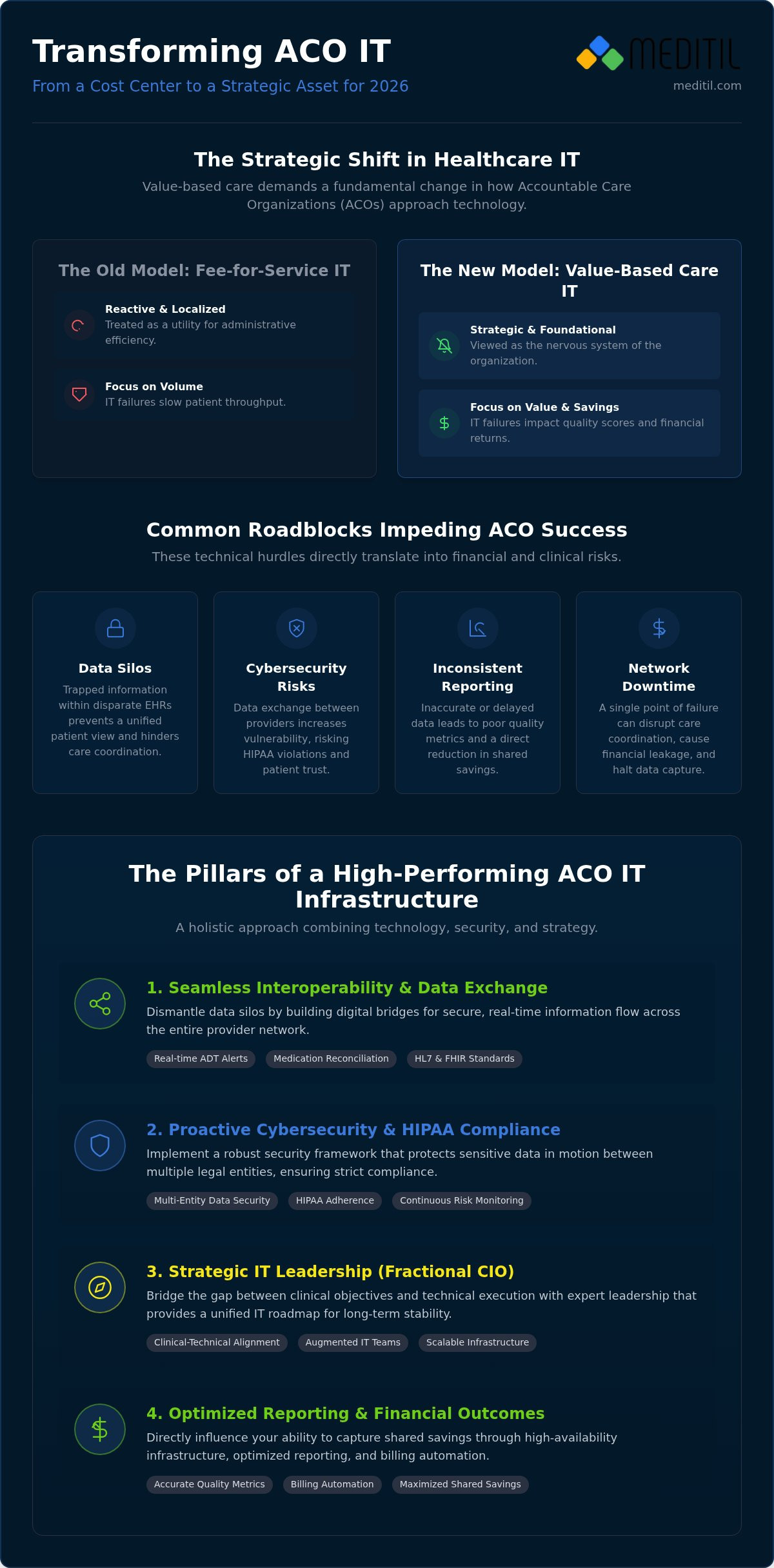
Effective Accountable Care Organization (ACO) IT support involves much more than reactive help desk tickets. It represents the strategic management of infrastructure, cybersecurity, and seamless data exchange across a diverse network of independent providers. In the current environment, technology must act as the nervous system of the organization, ensuring that every participant is aligned with both clinical and financial objectives. This requires a shift in perspective where IT is viewed as a foundational pillar of care delivery rather than a peripheral utility.
Traditional fee-for-service models often treat IT as a localized tool for administrative efficiency. However, value-based care models demand significantly higher levels of IT reliability and sophistication. If a system fails in a volume-based clinic, patient throughput slows down. If it fails within an ACO, the resulting data gaps can compromise quality reporting and lead to missed shared savings opportunities. By 2026, standards have shifted entirely from simple data collection to active data utilization. It’s no longer enough to store patient records; you must be able to analyze and act upon that data in real time to drive measurable improvements in patient health.
The Transition to Value-Based Care Technology
Shared Savings and IT Reliability
Network downtime is a luxury your organization cannot afford. In an integrated environment, a single point of failure can cause significant financial leakage by disrupting care coordination and preventing real-time data capture. High-availability infrastructure is essential for maintaining care continuity across multiple settings, from primary care offices to post-acute facilities. Additionally, billing automation plays a critical role in tracking value-based incentives. It ensures that every action taken toward quality improvement is documented and reflected in your final shared savings calculations. A unified IT roadmap isn’t just a technical document; it’s a financial necessity for long-term sustainability.
Bridging the Gap: Interoperability and Secure Data Exchange
Data silos represent the single greatest technical hurdle for integrated networks. When information is trapped within a single clinic’s EHR, the entire care team loses the ability to make informed decisions. According to the Centers for Medicare & Medicaid Services, effective care coordination is the cornerstone of the ACO model. It remains difficult to achieve when provider systems don’t communicate. Strategic accountable care organization IT support focuses on building the digital bridges necessary to move patient data securely across these boundaries.
Real-time Admission, Discharge, and Transfer (ADT) alerts are a critical component of this infrastructure. These notifications allow primary care providers to intervene immediately when a patient is hospitalized. This proactive step significantly reduces the likelihood of avoidable readmissions. Without a managed data pipeline, these alerts often arrive too late or fail to reach the correct clinician. Accurate data reconciliation is equally vital. Ensuring that medication lists are consistent across the care continuum prevents dangerous drug interactions and improves overall patient safety.
Implementing HL7 and FHIR Standards
By 2026, the Fast Healthcare Interoperability Resources (FHIR) standard has become the benchmark for modern data exchange. Unlike older HL7 versions, FHIR allows for more granular data access. It enables applications to pull specific pieces of information rather than entire documents. This precision is essential for data normalization. It ensures that quality reporting remains consistent even when providers use different software versions. Effective management involves integrating these disparate EHR systems without forcing every participant onto a single platform. This preserves the autonomy of individual practices while maintaining a unified data stream for the entire organization.
Breaking Down Clinical Data Silos
Sharing patient records securely between independent clinics and hospitals reduces clinical friction. It also eliminates the need for duplicate testing. When a specialist can instantly view the results of a primary care physician’s lab work, the patient experiences a more cohesive journey. This level of connectivity requires a sophisticated approach to Managed IT Services for Healthcare to ensure that security protocols remain robust during every exchange. If your organization is struggling with fragmented data, you might consider a strategic IT review to identify and close these gaps. Reliable accountable care organization IT support ensures that these connections aren’t just established but actively monitored for performance and accuracy.
Cybersecurity and HIPAA Compliance Across Distributed Networks
ACOs operate as a complex web of independent providers, each with their own local networks and security protocols. This distributed nature introduces significant risks, particularly regarding data in motion between multiple legal entities. When patient information leaves one clinic to reach another, it enters a transitional space where vulnerabilities are most likely to be exploited. A “Steady Hand” approach to proactive threat monitoring and risk management is necessary to ensure that these exchange points remain impenetrable. This strategy focuses on continuous verification and strategic advancement rather than simple reactive maintenance. You don’t want to wait for a breach to realize your network’s vulnerabilities.
The National Academy of Medicine emphasizes that IT interoperability and cybersecurity are inseparable in a modern healthcare environment. Without a unified security policy that governs every participating provider, the organization remains exposed. Accountability in 2026 requires more than just local firewalls; it demands a collective defense strategy where every node in the network adheres to the same rigorous standards. Effective accountable care organization IT support must bridge the gap between individual practice autonomy and the collective need for data protection.
Securing Data in Motion and at Rest
Protecting sensitive data requires advanced encryption standards for all exchange pipelines. By 2026, healthcare organizations have largely moved toward zero-trust architecture, where no user or device is trusted by default. Implementing multi-factor authentication (MFA) across all clinical environments is a non-negotiable requirement for HIPAA compliance. These technical layers ensure that even if one credential is compromised, the broader network remains secure. For a deeper analysis of these technical frameworks, you can review our guide on Healthcare Cybersecurity Services.
Managing Third-Party Vendor Risk
Every practice that joins your network brings its own set of technical debts and vulnerabilities. You must vet the security posture of every participant with the same scrutiny you’d apply to a primary software vendor. Business Associate Agreements (BAAs) are essential for 2026 compliance audits, but they’re only the starting point. Reliable accountable care organization IT support utilizes Security Information and Event Management (SIEM) systems paired with a 24/7 Security Operations Center (SOC) to detect anomalies across all entities in real time. A SIEM system acts as the central brain of your defense, aggregating logs from every endpoint across the network. ACO security is only as strong as the least secure participating clinic. This reality makes rigorous, ongoing verification of every practice’s infrastructure a strategic priority for leadership.
Strategic IT Leadership: The Role of the Fractional CIO in ACO Success
A Fractional CIO acts as the strategic architect of an organization’s digital transformation. They provide the executive-level oversight necessary to ensure technical systems support clinical objectives. Standard accountable care organization IT support often focuses on maintenance, but a Fractional CIO looks toward long-term sustainability. They bridge the gap between high-level clinical goals and ground-level technical execution. This leadership is essential for navigating the complexities of shared savings and regulatory shifts expected in 2026. Without a steady hand at the wheel, technical decisions often become fragmented and reactive.
Hiring a full-time C-suite executive is often cost-prohibitive for many organizations. Fractional leadership provides access to the same level of expertise at a fraction of the cost. You gain a seasoned expert who understands the regulated environment without the overhead of a permanent executive salary. This model allows you to scale your strategic capabilities as your network grows. It ensures that your technology roadmap is always aligned with the evolving requirements of value-based care. Strategic leadership transforms IT from a necessary expense into a primary driver of organizational performance.
Aligning IT Budgets with Quality Measures
A vCIO identifies technical debt that actively hinders your performance in value-based care models. If your infrastructure is outdated, it likely prevents accurate data capture for quality reporting. By prioritizing IT investments that yield the highest ROI in shared savings, leadership ensures that every dollar spent supports the organization’s financial health. You can explore our detailed guide on Strategic IT Budgeting for Medical Practices to see how these roadmaps are constructed. This disciplined approach prevents wasteful spending on tools that don’t contribute to clinical success.
Data Analytics for Population Health Management
Strategic oversight of predictive analytics is becoming a requirement for successful care management. Using business intelligence to identify high-risk patient cohorts allows for earlier intervention and better resource allocation. A Fractional CIO ensures that AI implementation in care management remains focused on clinical outcomes rather than just technical novelty. Our Virtual CIO Services provide the specific expertise needed to align these advanced tools with your population health goals. This ensures that data utilization remains a core competency of your network.
To see how clinical AI platforms can specifically support patients with chronic conditions through integrated logic and generative AI, you can check out MayaMD.
If your organization lacks a clear technical roadmap, you can schedule a consultation with our strategic team to discuss your 2026 objectives. Reliable accountable care organization IT support begins with leadership that understands both the server room and the boardroom.
MEDITIL: Comprehensive IT Support for Accountable Care Organizations
MEDITIL positions itself as a specialized guide for organizations navigating the heavy technical requirements of modern care coordination. Our approach to accountable care organization IT support is built on the foundational belief that technical stability is a prerequisite for patient safety. We don’t simply maintain hardware; we manage the entire digital ecosystem that allows your clinical staff to focus on patient outcomes. By acting as a strategic partner, we ensure that every technical decision aligns with the long-term clinical and financial goals of your network.
For organizations that already maintain internal technology departments, we provide an Augmented IT Team model. This service isn’t designed to replace your current staff but to empower them with specialized expertise in interoperability, cybersecurity, and regulatory compliance. We provide the additional capacity and high-level strategy needed to manage complex, multi-practice networks without the friction of a full-scale department overhaul. This partnership offers a steady hand at the wheel, ensuring that your infrastructure remains resilient as your organization scales to meet 2026 standards.
Managed Infrastructure and Help Desk
Operational stability requires more than just reactive fixes. Our managed infrastructure services involve proactive network management to ensure the highest possible uptime for your critical care applications. We provide end-user support specifically tailored to the workflows of clinical staff, ensuring that technical hurdles don’t disrupt the patient experience. Furthermore, our cloud services and server management are meticulously optimized for HIPAA compliance. This provides a secure, verified environment for your data exchange pipelines, protecting your organization from the risks associated with distributed networks.
Billing Automation and EHR Optimization
Financial success in a value-based care model depends on the precision of your data. We help streamline the financial side of your operations through integrated Medical Billing Automation Solutions. These systems ensure that your quality reporting is accurately captured and reflected in your reimbursement claims, which is essential for securing shared savings. Additionally, we provide EHR implementation and training services designed to reduce physician burnout. By improving the quality of data entry at the point of care, we help your team maintain the high standards required for accurate population health analytics.
Our specialized focus on healthcare-only IT ensures that we understand the unique pressures of your industry. We remain mission-driven, prioritizing operational stability and patient safety in every project we undertake. If you’re looking for a partner that treats your technical infrastructure with the precision it deserves, MEDITIL is ready to help you navigate the future of accountable care organization IT support.
Advancing Your Care Coordination Through Strategic Infrastructure
The evolution of value-based care demands a shift from simple maintenance to strategic technical leadership. You’ve seen how bridging data silos and implementing unified security standards across distributed networks are essential for maintaining HIPAA compliance and clinical accuracy. As 2026 approaches, the success of your network depends on the seamless integration of these complex systems. Reliable accountable care organization IT support ensures that every participating provider is aligned with your quality reporting and shared savings objectives.
MEDITIL provides the steady hand at the wheel needed to manage these high-stakes environments. With our specialized healthcare-only focus, proven interoperability expertise, and Fractional CIO strategic advisory, we help you transform technical debt into a competitive advantage. It’s time to move beyond reactive fixes and embrace a proactive roadmap for your digital transformation. Partner with MEDITIL for Strategic ACO IT Support to secure your infrastructure and empower your clinicians. Your organization is capable of achieving exceptional outcomes through the right technical partnership.
Frequently Asked Questions
What is the primary role of IT in an Accountable Care Organization?
IT serves as the foundational infrastructure that enables care coordination and quality reporting across a network of providers. It facilitates the real-time exchange of patient data, ensuring that clinicians have access to a longitudinal view of the patient journey. This technical backbone is essential for identifying high-risk cohorts and managing population health effectively.
How does ACO IT support differ from standard managed IT services?
Standard IT services typically focus on the uptime and security of a single medical practice. In contrast, accountable care organization IT support prioritizes inter-practice connectivity and the normalization of data across multiple legal entities. It requires a sophisticated understanding of how to manage data pipelines between disparate systems while maintaining a unified security posture.
Can an ACO function with multiple different EHR systems?
Yes, an organization can operate effectively with disparate EHR systems by leveraging modern interoperability standards like FHIR and HL7. Strategic IT management allows these systems to communicate through Health Information Exchanges (HIEs) or custom data bridges. This approach preserves the autonomy of individual practices while ensuring the central organization receives the data needed for quality reporting.
What are the biggest cybersecurity risks for an ACO in 2026?
The most significant risks involve data in motion between provider networks and the inconsistent security standards of participating clinics. These distributed environments create a large attack surface that is attractive to bad actors. Proactive accountable care organization IT support utilizes zero-trust architecture and continuous monitoring to mitigate these risks across every node in the network.
How does a Fractional CIO help an ACO achieve shared savings?
A Fractional CIO provides the strategic leadership needed to align technical investments with Medicare quality measures. They identify technical debt that hinders performance and prioritize infrastructure projects that yield the highest ROI in shared savings. This executive oversight ensures that your technology roadmap directly supports your financial and clinical objectives.
What is the importance of interoperability in value-based care?
Interoperability is the cornerstone of value-based care because it eliminates the data silos that lead to clinical friction. It allows for real-time ADT alerts and accurate medication reconciliation, which are critical for reducing avoidable readmissions. When systems talk to each other, the entire care team can make more informed decisions that improve patient outcomes.
How much does specialized ACO IT support typically cost?
Costs for these services are customized based on the size of the provider network and the complexity of the existing technical infrastructure. Because every organization has different strategic requirements, you should consult with a specialist to develop a roadmap and budget tailored to your specific goals. This ensures your investment is focused on the areas that drive the most value.
Does MEDITIL sell EHR software or just provide implementation support?
MEDITIL does not sell EHR software. We focus on the strategic management of your infrastructure, EMR/EHR implementation, and ongoing training for your staff. Our goal is to ensure that your chosen software functions reliably within a secure, high-performance environment that supports your broader clinical mission.