
The average cost of a healthcare data breach has climbed to $7.42 million, marking the fourteenth consecutive year our industry has faced the highest recovery expenses of any sector. You’ve likely experienced the challenge of presenting dense IT reports to a board that requires strategic clarity rather than technical jargon. It’s difficult to justify healthcare cybersecurity budgeting when you can’t quantify risk in financial or clinical terms. We understand the pressure of protecting patient care while navigating the increasing scrutiny of the Health Care Cybersecurity and Resiliency Act of 2026.
This guide provides the framework you need to translate technical security data into the strategic insights that drive board-level decisions. You’ll learn how to align security expenditures with your core business objectives to foster genuine confidence among your directors. We’ll examine specific metrics that demonstrate ROI and ensure your organization remains compliant and resilient. By the end of this article, you’ll have a clear roadmap for turning complex vulnerabilities into a narrative of stability and expert oversight.
Key Takeaways
- Shift from traditional defensive reporting to clinical resilience metrics that align security posture with patient safety objectives.
- Identify essential performance indicators such as Mean Time to Detect (MTTD) and specialized patching cadences for critical medical devices.
- Optimize healthcare cybersecurity budgeting by translating technical vulnerabilities into the financial cost of clinical downtime and potential data breaches.
- Implement a structured three-slide narrative and departmental heat maps to provide the board with a clear, visual roadmap of organizational risk.
- Leverage the expertise of a Fractional CIO to bridge the gap between complex IT infrastructure and high-level strategic oversight.
The Evolution of Cybersecurity Metrics for Board Reporting
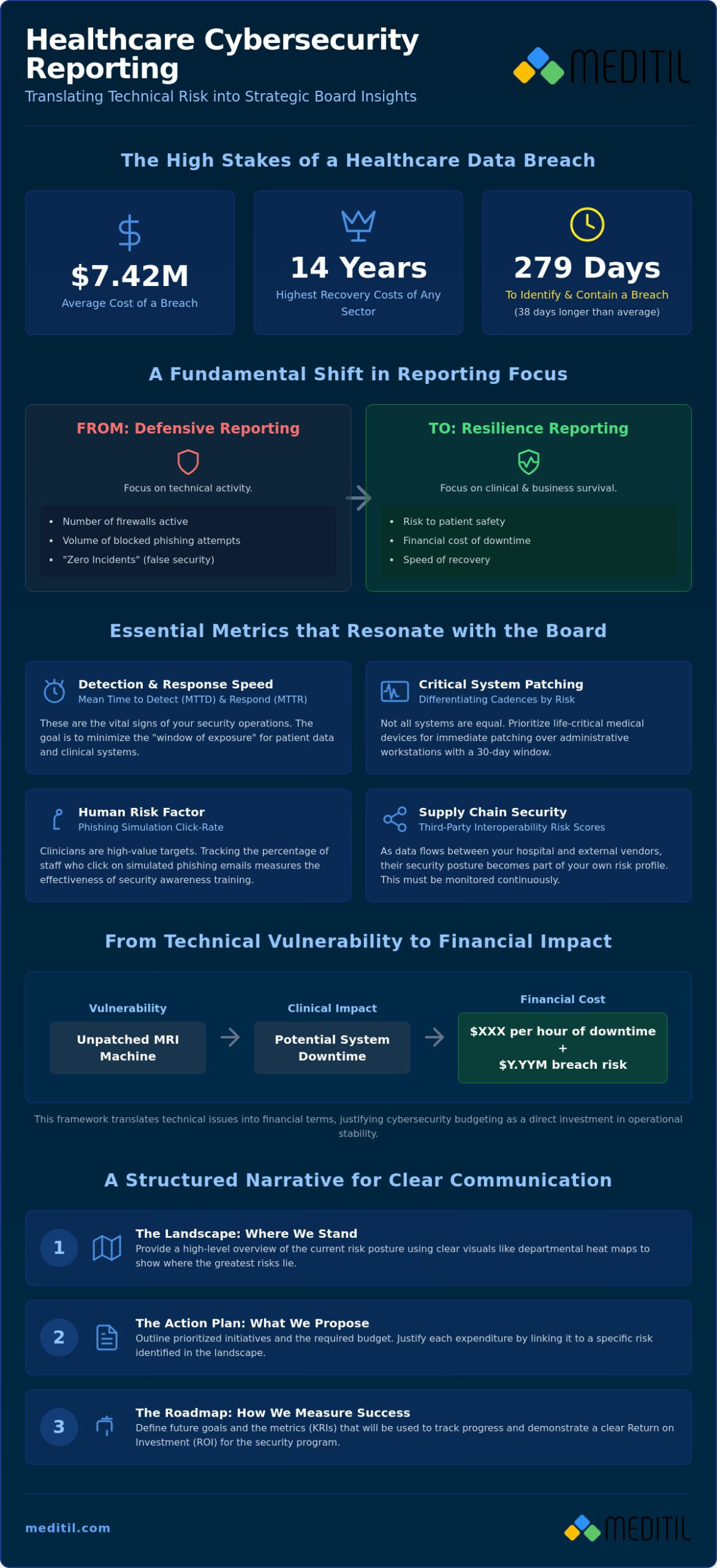
Boardrooms are no longer satisfied with technical tallies. For years, IT departments presented metrics like the number of firewalls active or the total volume of blocked phishing attempts. These figures fail in the boardroom because they don’t correlate to clinical outcomes or financial stability. While these data points reflect foundational cybersecurity principles, they offer no insight into the organization’s ability to sustain operations during a crisis. In 2026, the mandate for leadership has shifted. We’ve moved away from defensive reporting, which focuses on what we stopped, toward resilience reporting, which focuses on how we survive.
Directors hold a clear fiduciary duty to oversee risk management. In a healthcare environment, this responsibility extends beyond the balance sheet to include patient safety. When a system goes down, care is delayed. When data is breached, trust is eroded. Effective board-level metrics must function as vital signs for the organization. They should provide a steady, reliable view of whether the current healthcare cybersecurity budgeting is actually buying down risk or merely funding activity. Clear reporting ensures that every detail of the security infrastructure is being handled with precision and purpose.
Operational vs. Strategic Metrics
It’s vital to distinguish between technical Key Performance Indicators (KPIs) and strategic Key Risk Indicators (KRIs). Technical KPIs measure the efficiency of a tool. Strategic KRIs measure the likelihood of a business failure. Many leaders mistakenly believe that “zero incidents” is a gold-standard metric. It’s not. In fact, reporting zero incidents often signals a lack of detection capabilities rather than a perfect defense. It’s a misleading metric that creates a false sense of security. Strategic reporting focuses on impact rather than activity. Instead of reporting how many patches were installed, report the percentage of critical clinical systems that remain vulnerable to known exploits. This shift helps the board understand the actual gap between their current posture and their risk appetite.
Regulatory Pressures in 2026
The regulatory environment has intensified. New reporting requirements from the SEC and HHS have placed healthcare boards under a microscope. These mandates require directors to demonstrate active oversight of cyber risks. Transparent, data-driven reporting is the best way to reduce individual liability for board members. It moves the conversation from “are we safe?” to “how much risk are we willing to accept?” This requires the economic quantification of cyber risk. By assigning a dollar value to potential downtime or data loss, you can align healthcare cybersecurity budgeting with specific business objectives. This methodical approach ensures that the board isn’t just spending money; they’re investing in the long-term stability of the patient care mission.
Essential Risk Exposure and Resilience Metrics for Healthcare
Data points only gain value when they reflect operational reality. For a healthcare board, the most critical metrics are those that measure the speed of detection and the efficiency of response. Research indicates that healthcare organizations take an average of 279 days to identify and contain a data breach. This is 38 days longer than the global average across other sectors. These statistics underscore the unique healthcare cybersecurity challenges faced by clinical leaders. Boards must track Mean Time to Detect (MTTD) and Mean Time to Respond (MTTR) with a focus on minimizing the window of exposure for patient records.
Strategic allocation for healthcare cybersecurity budgeting requires prioritizing systems that directly impact patient care. This involves differentiating patching cadences between administrative workstations and critical medical devices. While a 30 day patching window might be acceptable for the billing department, life-critical systems require more immediate attention. Additionally, leadership should monitor phishing simulation results among medical staff. Because clinicians often work in high-pressure environments, they are frequent targets for social engineering. Tracking the “click rate” over time provides a clear indicator of the organization’s human risk factor. Finally, third-party risk scores for interoperability partners are essential. As data flows between hospitals and vendors, the security of your partners becomes part of your own risk profile.
Clinical Continuity and Downtime Metrics
Clinical resilience is measured by the ability to maintain patient care during a system outage. Boards should focus on Electronic Health Record (EHR) availability percentages and the Recovery Time Objective (RTO) for life-critical data. If a cyber event forces the hospital into patient diversion, the cost is measured in both revenue loss and patient outcomes. High-performing organizations define resilience by their ability to avoid diversion entirely through redundant systems and rapid recovery protocols. If you are unsure of your current recovery capabilities, a strategic IT assessment can identify the gaps in your continuity plan.
Asset Management and Shadow IT
You cannot protect what you cannot see. Unmanaged medical devices, or “Shadow IT,” often represent the greatest vulnerability in a clinical network. Boards need visibility into the percentage of legacy systems that are no longer supported by vendors but remain essential for care. Utilizing specialized healthcare cybersecurity services allows for the continuous monitoring of medical IoT devices. This proactive oversight ensures that healthcare cybersecurity budgeting addresses the actual inventory of the hospital, rather than an idealized version of the network infrastructure.
Quantifying Cyber Risk: Financial Impact and ROI
Boardrooms operate on the logic of fiscal responsibility. To secure necessary funding, leadership must move beyond technical threats and present cyber risk as a quantifiable financial liability. This begins with calculating the precise cost per hour of clinical downtime. When systems fail, the loss isn’t merely the absence of revenue. It includes the cost of idle clinical labor, the operational friction of manual charting, and the long-term reputational damage that follows patient diversions. By assigning a dollar value to these disruptions, you provide the board with a clear metric for evaluating healthcare cybersecurity budgeting as a tool for business continuity.
The financial implications of Protected Health Information (PHI) breaches have reached unprecedented levels. Beyond the immediate costs of forensic investigations and patient notification, organizations face significant regulatory exposure. Adhering to CISA guidance on healthcare cybersecurity is no longer optional; it’s a financial necessity. Furthermore, cyber insurance premium trends in 2026 show that insurers are rewarding organizations with higher security maturity. Demonstrating robust controls doesn’t just protect data. It directly reduces the annual cost of risk transfer by lowering insurance premiums and deductibles. When you compare the cost of preventative controls against the projected loss of a single major event, the return on investment becomes undeniable.
Compliance as a Financial Metric
Compliance shouldn’t be viewed as a checklist, but as a financial safeguard. HIPAA violation penalties in 2026 range from $145 to $73,011 per individual violation, with annual caps exceeding $2 million per provision. These figures represent a direct threat to the bottom line. Board reports should track HIPAA audit readiness scores and the completion rate of annual Security Risk Assessments (SRA). Many organizations find that the cost of maintaining this posture is significantly lower when utilizing managed it services for healthcare. This approach shifts the financial burden from unpredictable penalty exposure to a stable, predictable operational expense.
Budget Alignment and Strategic Roadmap
Effective healthcare cybersecurity budgeting requires a disciplined balance between proactive and reactive spending. Leaders should benchmark their security spend against peer healthcare organizations in the USA, where the average IT budget allocation for security is approximately 6%. If the majority of your spend is reactive, you’re likely overpaying for emergency remediations. Aligning your investments with a it budgeting for medical practices framework ensures that every dollar spent is tied to a specific strategic outcome. This methodical alignment transforms cybersecurity from a “black hole” of IT spending into a transparent, results-oriented investment in organizational resilience.
Framing the Board Report: A Healthcare-Specific Narrative
Technical data serves as the raw material for a report, but the narrative is what drives action. Directors don’t need a comprehensive list of every vulnerability discovered. They require a concise story that connects technical health to clinical safety. A structured three-slide approach often proves most effective for these high-stakes meetings. The first slide should define the organization’s current posture, the second identifies emerging threats, and the third outlines specific strategic needs. This methodical progression respects the board’s time while ensuring they grasp the direct link between healthcare cybersecurity budgeting and the protection of patient care.
Visualizing risk through heat maps is a powerful way to communicate impact across different clinical departments. If the oncology department is marked as high-risk due to legacy imaging equipment, the board immediately understands the potential for diagnostic delays. Storytelling with data can also bridge the gap between abstract threats and operational reality. Describing a “near miss,” such as a neutralized phishing attempt that targeted a lead surgeon, provides a concrete example that justifies future expenditures. Every slide must answer the “So What?” from a director’s perspective, focusing on how a security investment prevents clinical friction or financial loss.
Visualizing Security Performance
Dashboards should be designed for clarity rather than complexity. One common pitfall is the “Green Dashboard trap,” where a sea of green indicators creates a false sense of security. If every metric is perfect, the board may question the necessity of continued healthcare cybersecurity budgeting. It is far more effective to present trend lines rather than static, point-in-time data. Showing a steady reduction in the time it takes to patch critical systems over six months demonstrates a maturing security posture. This longitudinal view provides evidence that the organization’s defensive capabilities are improving through disciplined oversight.
The Executive Summary for Healthcare Directors
The executive summary must be direct and actionable. It should highlight the top three risks to clinical operations, such as ransomware, third-party vendor vulnerabilities, or medical device security. Each risk must be paired with a clear ask for the board, whether that involves a budget approval, a policy change, or support for a cultural shift in security awareness. A sample summary sentence for 2026 might read: “While our ransomware detection speed has improved by 15% this quarter, current 2026 threat intelligence suggests we must prioritize the encryption of all patient records to remain compliant with the Health Care Cybersecurity and Resiliency Act.” To ensure your reporting meets these strategic standards, consider partnering with an expert for project-based IT consulting.
Strategic Leadership: The Role of the Fractional CIO
Strategic oversight requires more than just high-quality data; it requires a seasoned interpreter. A Fractional CIO serves as the critical link between technical IT teams and the boardroom, ensuring that complex security initiatives are understood as business priorities. While automated tools provide evidence of compliance, they can’t replace the strategic judgment needed to prioritize investments. This leadership model allows organizations to refine their healthcare cybersecurity budgeting by focusing on high-impact initiatives that protect patient care rather than chasing every minor technical vulnerability.
Independent, third-party reporting provides an unbiased perspective that’s essential for board trust. Internal teams may inadvertently overlook systemic weaknesses or struggle to communicate risks that reflect poorly on their own operations. A Fractional CIO provides an objective, steady hand to verify that all protection measures are functioning as intended. This external oversight ensures that the security roadmap remains aligned with long-term clinical goals, such as maintaining interoperability between disparate health systems without compromising data integrity. MEDITIL’s approach centers on this disciplined advisory role, empowering directors to make informed decisions with precision and confidence.
Why Healthcare Practices Choose Fractional Leadership
Practices often face a significant talent gap. Research shows that nearly 75% of healthcare leaders report challenges in hiring full-time cybersecurity professionals. Fractional leadership provides access to enterprise-level expertise at a fraction of the cost of a permanent C-suite executive. Utilizing virtual CIO services allows for the creation of a sophisticated strategic IT roadmap that evolves with changing regulatory standards. This model is particularly effective for navigating the complexities of systems integration, ensuring that new telehealth or remote monitoring tools are implemented within a secure, verified infrastructure.
Next Steps for Board Members and CEOs
The journey toward clinical resilience begins with a comprehensive Security Maturity Assessment. This baseline allows the board to understand the current gap between their existing posture and the requirements of the Health Care Cybersecurity and Resiliency Act of 2026. Once a baseline is established, leadership must set a consistent reporting cadence. While annual updates were once the norm, the rapid evolution of AI-driven threats makes quarterly updates a strategic necessity. Taking these steps ensures that healthcare cybersecurity budgeting remains proactive rather than reactive. To begin securing your clinical environment, partner with MEDITIL for expert Fractional CIO and Cybersecurity oversight.
Securing the Future of Clinical Resilience
The shift toward resilience-based reporting is a fundamental requirement for the modern healthcare board. By moving beyond technical tallies and focusing on the economic and clinical impact of cyber risk, leaders can foster genuine confidence in their security posture. Effective healthcare cybersecurity budgeting ensures that every dollar spent directly supports the mission of uninterrupted patient care and regulatory stability. It’s no longer enough to report that systems are active; directors must understand how the organization will survive and recover from a disruption.
Implementing these sophisticated frameworks requires a steady hand and deep industry expertise. MEDITIL provides the authoritative guidance necessary to navigate the complexities of the 2026 regulatory environment while maintaining a focus on operational excellence. Our proven framework for HIPAA compliance and security helps US medical boards translate complex data into actionable strategic decisions. We invite you to secure your strategic roadmap with MEDITIL’s Fractional CIO services and ensure your organization remains a stable, protected environment for the patients you serve. With the right leadership and a methodical approach to reporting, your board can transition from reactive oversight to proactive clinical protection.
Frequently Asked Questions
What are the top 3 cybersecurity metrics every healthcare board must track?
Leadership should prioritize Clinical Downtime Risk, the HIPAA Compliance Gap, and the Human Risk Factor. Clinical Downtime Risk quantifies how many hours of care would be lost during a system outage, while the HIPAA Compliance Gap identifies specific vulnerabilities that could lead to CMS penalties. The Human Risk Factor tracks the effectiveness of staff training through phishing simulation click rates. These metrics provide a more accurate view of organizational health than technical firewall logs.
How do we translate technical vulnerability scores into board-level risk?
Technical scores should be mapped directly to clinical impact and financial exposure. Instead of reporting a list of Common Vulnerabilities and Exposures (CVEs), categorize them by the systems they affect, such as diagnostic imaging or the Electronic Health Record. This allows the board to see that a “high” score on a critical medical device is a direct threat to patient safety, which justifies specific healthcare cybersecurity budgeting requests.
How often should cybersecurity be on the board meeting agenda in 2026?
Cybersecurity must be a standing agenda item for every quarterly board meeting. In the 2026 regulatory environment, the pace of AI-driven threats and legislative changes, such as the Health Care Cybersecurity and Resiliency Act, requires more frequent oversight than the traditional annual review. Emergency briefings should also be triggered if the organization’s risk profile changes significantly between scheduled meetings.
What is the difference between a KPI and a KRI in healthcare security reporting?
Key Performance Indicators (KPIs) measure the efficiency of your security team, such as the percentage of systems patched within 30 days. Key Risk Indicators (KRIs) are forward-looking metrics that track the likelihood of a future negative event, such as the percentage of legacy devices that cannot be patched. While KPIs show that your team is working, KRIs show the board where the organization remains vulnerable.
How can we measure the ROI of our cybersecurity investments?
ROI is measured by the reduction in the “Annual Loss Expectancy” and the stabilization of insurance premiums. By comparing the cost of a security control against the $7.42 million average cost of a healthcare breach, you can demonstrate significant cost avoidance. Additionally, many insurers in 2026 offer lower deductibles to organizations that can prove high security maturity through verified audits.
What role does the board play in ransomware incident response planning?
The board’s role is to define the strategic “line in the sand” regarding ransom payments and clinical restoration priorities. Directors don’t manage the technical recovery, but they must approve the communication strategy for patients and regulators. Having these decisions documented in advance ensures a steady hand at the wheel during the high-pressure environment of an actual attack.
Should we use a third-party to present cybersecurity metrics to our board?
Engaging a third-party, such as a Fractional CIO, provides the unbiased oversight necessary for fiduciary duty. Independent experts can bridge the gap between technical IT staff and the boardroom, offering a “second set of eyes” on internal reports. This objective perspective is essential for ensuring that healthcare cybersecurity budgeting is based on verified risk rather than internal department biases.
How do we report on third-party and supply chain cyber risk for medical vendors?
Leadership must track the security scores of every vendor that has access to the clinical network or patient data. Reports should include the percentage of vendors who have completed a formal Security Risk Assessment (SRA) and those who meet interoperability security standards. This oversight is critical because a breach at a small software vendor can have the same clinical impact as a direct attack on the hospital.