
Infrastructure upgrades are not hardware projects; they are clinical stability initiatives that determine whether your practice thrives or falters under 2026 regulatory pressures. Prioritizing strategic clinic IT infrastructure upgrades is the most effective way to resolve physician burnout caused by sluggish systems and the persistent anxiety of a HIPAA audit. It’s exhausting to manage data silos that block billing automation and force your team into manual, error-prone workarounds. These technical failures represent a direct threat to your patient care standards and your operational security.
This guide provides a strategic roadmap to help you modernize your systems, eliminate clinical friction, and stabilize your operations. We will explore how to achieve seamless interoperability between systems and a zero-downtime clinical environment. You’ll learn to move from reactive troubleshooting to a predictable, expert-led IT strategy that secures your clinic’s future and ensures total compliance with evolving standards like the HTI-1 final rule.
Key Takeaways
- Identify the specific technical debt triggers that compromise patient safety and necessitate a shift toward proactive modernization.
- Learn why successful clinic IT infrastructure upgrades shouldn’t start with a hardware quote but with a strategic roadmap led by expert guidance.
- Explore the core components of a resilient network, including N+1 redundancy and healthcare-specific cybersecurity protocols designed for 2026 standards.
- Discover implementation strategies that achieve a zero-impact goal, allowing for system improvements without disrupting active patient care hours.
- Understand how healthcare-exclusive managed services provide the continuous oversight needed to maintain operational stability and regulatory compliance.
Recognizing the Drivers for Clinic IT Infrastructure Upgrades in 2026
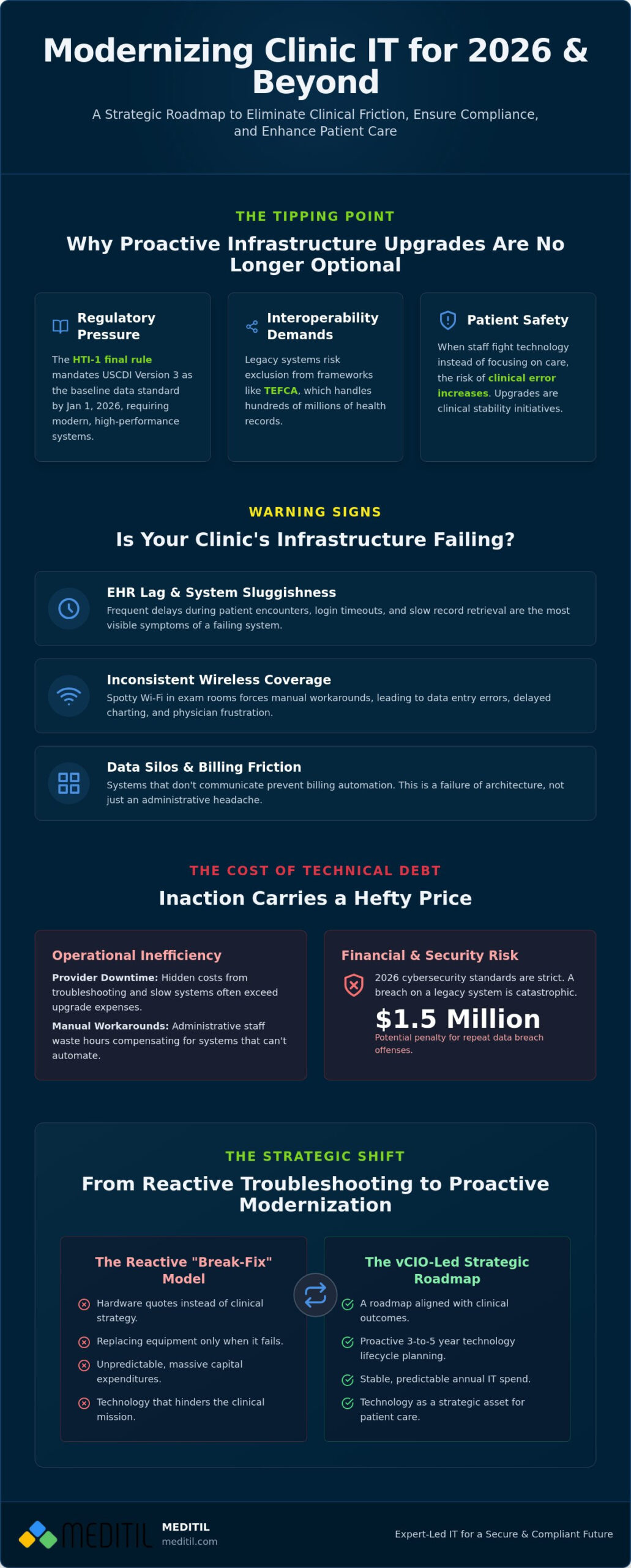
Technical debt in a clinical setting eventually reaches a critical mass where it begins to compromise patient safety. When your practitioners spend more time troubleshooting login delays than reviewing patient histories, the risk of clinical error increases. Strategic clinic IT infrastructure upgrades are no longer optional projects for the future; they’re essential for maintaining the integrity of modern care delivery. Understanding What is Health Information Technology (HIT) provides the necessary context for how these interconnected systems must function to support a high-performing practice.
Legacy hardware creates significant bottlenecks for modern EHR and EMR platforms. These applications now require high-performance networking and specific processing capabilities to handle the data-heavy requirements of the HTI-1 final rule. As of January 1, 2026, this rule adopts USCDI Version 3 as the baseline standard for all certified health IT. If your infrastructure can’t support these standards, your clinic faces more than just slow screens. You risk non-compliance and exclusion from nationwide interoperability frameworks like TEFCA, which has already facilitated the exchange of nearly 500 million health records as of February 2026.
Signs Your Clinic Infrastructure is Failing
EHR lag is the most visible symptom of a failing system. If your physicians experience frequent delays during patient encounters or login timeouts, your infrastructure is failing the team. Inconsistent wireless coverage in exam rooms often leads to data entry errors or delayed charting. Finally, data silos that prevent automated billing aren’t just an administrative headache; you can learn more about how specialized payment processing solutions can help streamline your clinic’s revenue cycle. They represent a failure of the underlying architecture to support the seamless interoperability required by current patient-access standards.
The Cost of Technical Debt in Healthcare
The hidden expense of provider downtime is often higher than the cost of the upgrade itself. Administrative workarounds to compensate for slow systems drain clinic budgets every single day. A “break-fix” IT model is inherently reactive and unpredictable, whereas managed modernization provides a stable path forward. With 2026 cybersecurity standards requiring multi-factor authentication (MFA) across all systems and annual penetration tests, the financial impact of a data breach on a legacy system is catastrophic. Penalties for repeat offenses can reach up to $1.5 million, making clinic IT infrastructure upgrades a vital safeguard for your practice’s financial health. Beyond digital threats, ensuring the physical safety of your facility is also a critical part of a comprehensive risk management strategy; for advanced window and door protection, check out Boss Security Screens.
Strategic Planning: The vCIO’s Role in Your Upgrade Roadmap
A hardware quote is not a clinical strategy. Successful clinic IT infrastructure upgrades require a sophisticated understanding of how technology facilitates patient care and practice growth. Too often, clinics treat IT as a series of isolated purchases rather than a unified system. By utilizing virtual CIO services, practice administrators can bridge the gap between technical requirements and clinical outcomes. A vCIO ensures that your technology roadmap aligns with the national goals for health IT, focusing on quality improvement and the reduction of medical errors through better data access.
Strategic planning allows you to move away from reactive spending. Instead of replacing servers only when they fail, a vCIO helps you build a 3-to-5-year technology lifecycle plan. This proactive approach stabilizes your annual IT spend and prevents the sudden, massive capital expenditures that often plague unmanaged practices. It’s about creating a predictable environment where technology supports the mission rather than hindering it.
The Clinical Workflow Audit
Before selecting new hardware, you must perform a comprehensive clinical workflow audit. This process involves mapping patient data flow from the initial check-in through the final billing cycle. We look for friction points where slow systems or poor connectivity force medical staff into manual workarounds. A thorough audit ensures your new clinic IT infrastructure upgrades specifically support modern requirements like telehealth and remote patient monitoring (RPM). If you’re struggling to identify these bottlenecks, professional IT consulting can provide the objective analysis needed to prioritize your next steps.
Building a Phased Modernization Roadmap
Modernization should occur in phases to minimize disruption. We prioritize high-impact upgrades first, usually focusing on network stability and backbone security before addressing end-user devices. This phase includes setting milestones for HIPAA-compliant cloud migrations and essential server refreshes. Integrating it budgeting for medical practices into this planning phase is critical. It allows the clinic to allocate funds for essential 2026 requirements, such as enhanced multi-factor authentication and automated backup systems, without compromising the practice’s daily cash flow.
Core Components of a Modernized Healthcare Network
A resilient network serves as the nervous system of a modern medical practice. While the strategic roadmap defines your goals, the physical and virtual architecture determines your daily operational capacity. Modern clinic IT infrastructure upgrades must prioritize high-performance networking that supports the massive data throughput required by USCDI Version 3 standards. This isn’t just about speed; it’s about the structural ability to facilitate fluid data exchange between EHRs, imaging centers, and external laboratories. Understanding the core components and functions of modern health IT is essential for building a system that remains stable under the pressure of 2026 regulatory and clinical demands.
Data management in 2026 favors a hybrid approach. While cloud platforms offer superior scalability for data analytics and interoperability, certain critical clinical systems benefit from on-premises infrastructure to ensure local access during external outages. This hybrid model provides a balanced framework for medical data management and backup, which is vital for specialized practices; for example, you can learn more about Minimally Invasive Neurosurgery of Texas and how they manage complex patient data. It allows your clinic to leverage the power of the cloud while maintaining a localized “safety net” for life-critical operations. The goal is to create a seamless environment where data moves securely between local servers and cloud environments without latency or friction.
Network Stability and Life-Critical Redundancy
Digital-first clinics can’t afford a single point of failure. Implementing dual-internet lines with automated failover systems ensures that a service provider outage doesn’t halt patient care or telehealth sessions. Upgrading to WiFi 6E or WiFi 7 is necessary to support the high density of medical devices and tablets used in modern clinical bays; often, these digital upgrades are paired with physical renovations featuring durable surfaces and specialized storage from Countertops and Cabinetry By Design to maximize space efficiency. N+1 redundancy in a 2026 clinical environment refers to the implementation of an independent backup component for every critical system, ensuring that if one unit fails, a secondary unit immediately maintains 100% operational uptime. This level of preparation is the difference between a minor technical glitch and a complete operational shutdown.
Cybersecurity as an Infrastructure Layer
Security is no longer a software add-on; it’s a foundational layer of your network architecture. Modern clinic IT infrastructure upgrades must include the implementation of a Zero Trust architecture, which treats every user and device as a potential threat until verified. Utilizing specialized cybersecurity services allows for the integration of advanced SIEM (Security Information and Event Management) tools. These systems provide proactive monitoring and real-time threat detection, identifying anomalies before they escalate into breaches. It’s also vital to ensure all hardware, from routers to storage drives, supports modern encryption standards for data at rest to meet updated HIPAA Security Rule requirements.
Implementation Strategy: Minimizing Clinical Friction During Upgrades
Implementation is the most volatile phase of any modernization project. A “Zero-Impact” goal ensures that clinic IT infrastructure upgrades don’t interfere with patient hours or compromise care quality. We achieve this by scheduling major hardware deployments and network cutovers during off-peak hours or weekends. This methodical approach respects the physician’s time and prevents the clinical friction often associated with technical transitions. It’s about maintaining a steady hand during the most complex parts of the migration to ensure patient safety remains the primary focus.
Pilot programs are essential for risk mitigation. Before a clinic-wide rollout, we test new infrastructure within a single department to identify unforeseen issues in a controlled environment. This allows us to refine the configuration and resolve any hardware conflicts before the full deployment. Post-implementation auditing follows, where we verify that the new systems meet the performance and compliance benchmarks established during the planning phase. We analyze throughput speeds and latency metrics to ensure the network performs as promised. If your current provider lacks a clear transition plan, consider partnering with an expert team for your implementation.
Phased Rollout Best Practices
The “Big Bang” approach to IT upgrades frequently fails in healthcare because it introduces too many variables at once. We recommend a phased rollout that prioritizes stability. Setting up a temporary “sandbox” environment for EMR testing allows medical staff to interact with new workflows without affecting live patient data. Utilizing an augmented IT team provides the additional manpower needed for rapid, after-hours deployment. This ensures that your core staff remains focused on patient care rather than hardware installation. It also allows for a more granular level of quality control during the cutover process.
Training for Adoption and Efficiency
Technology only provides value if it’s adopted correctly by the clinical team. We develop quick-start guides tailored for physicians and nursing staff to streamline the transition. These guides focus on high-frequency tasks to ensure immediate productivity. Establishing a high-priority help desk during the first 48 hours of go-live provides immediate resolution for any end-user challenges. We also measure the impact of the upgrade on clinical documentation speed to ensure the new infrastructure actually reduces administrative burden. This focus on the human element is what transforms a technical project into a clinical success. We monitor these metrics closely to verify that the investment is delivering the expected operational improvements.
Partnering with MEDITIL for Seamless Infrastructure Modernization
Selecting a partner for clinic it infrastructure upgrades is a critical decision that influences your practice’s operational resilience and financial health. MEDITIL provides a specialized, healthcare-only focus that generalist providers often lack. We recognize that technical failures in a medical setting carry higher stakes than in other industries. Our approach ensures that every component of your network is optimized for the specific demands of a clinical environment. We manage the complete lifecycle of your infrastructure, from the initial audit and strategic planning to deployment and proactive monitoring. This comprehensive oversight allows practice leaders to focus on care delivery while we handle the complexities of the underlying technology. To see how a premier multidisciplinary provider maintains high standards of patient care through operational excellence, you can visit Sincere Healthcare Group.
Your Strategic Healthcare IT Partner
MEDITIL functions as an integral extension of your clinical operations team. By utilizing our managed it services for healthcare, you ensure that your systems remain compliant with the latest HIPAA and HTI-1 standards without taxing your internal resources. Ongoing management is essential for preventing the re-emergence of technical debt, which often occurs when systems are left to age without a strategic roadmap. We also address the administrative side of the practice by implementing medical billing automation solutions that eliminate data silos and improve cash flow. Our history of successful clinic-wide overhauls demonstrates our ability to deliver stability in high-pressure environments, acting as a steady hand during complex migrations.
Ready to Modernize Your Practice?
The first step toward a friction-free clinical environment is a comprehensive strategic infrastructure assessment. We analyze your current hardware, network architecture, and security protocols to identify where your system is falling short of 2026 benchmarks. From this audit, we develop a customized roadmap that aligns your IT spending with your practice’s long-term growth objectives. We don’t believe in generic solutions; every plan is tailored to your specific clinical workflows and patient volume. This disciplined approach ensures that your clinic IT infrastructure upgrades are completed on time and with zero disruption to patient care. Contact MEDITIL today to begin your strategic IT modernization.
Securing Your Clinic’s Operational Future
The transition toward USCDI Version 3 and the expansion of interoperability frameworks like TEFCA represent a fundamental shift in how medical practices must operate. We’ve detailed how modernizing your network serves as a direct solution to physician burnout and administrative bottlenecks. By integrating high-performance networking with healthcare-specific security protocols, you create a zero-downtime environment that prioritizes patient care. Strategic clinic IT infrastructure upgrades aren’t merely technical requirements; they’re the foundation of a resilient, compliant, and profitable practice in 2026.
MEDITIL provides the seasoned expertise and healthcare-exclusive focus needed to navigate these complex migrations. Our proven vCIO leadership framework ensures that every technology decision supports your clinical mission and long-term financial goals. We manage the entire lifecycle of your modernization, providing the steady hand at the wheel that your staff and patients deserve. Book Your Strategic Infrastructure Assessment with MEDITIL to begin the journey toward a modernized practice. Your team is ready for a system that works as hard as they do, and we’re here to help you build it.
Frequently Asked Questions
How much does a typical clinic IT infrastructure upgrade cost in 2026?
Project costs are highly variable and depend on the current state of your technical debt, the size of your facility, and your specific interoperability goals. Factors such as network redundancy requirements, cybersecurity layers, and compliance with the HTI-1 final rule will influence the final investment. We focus on creating a predictable technology lifecycle plan that stabilizes your annual spend rather than relying on reactive, emergency purchases.
How can we upgrade our network without shutting down the clinic?
We achieve a zero-impact transition by scheduling major network cutovers and hardware deployments during off-peak hours or weekends. Our team utilizes a phased rollout strategy, testing new configurations in isolated sandbox environments before they go live. This methodical approach, supported by an augmented IT team, ensures that your clinical operations continue without interruption while the underlying systems are modernized.
What are the most critical IT components for HIPAA compliance during an upgrade?
The most critical components include robust encryption for data at rest and in transit, multi-factor authentication (MFA) across all access points, and a Zero Trust network architecture. Additionally, the updated 2026 standards require automated, verifiable backup systems and proactive threat monitoring tools. These elements work together to protect patient records from ransomware and ensure your practice meets the latest HIPAA Security Rule benchmarks.
Does our clinic really need a virtual CIO for an infrastructure project?
A virtual CIO (vCIO) is essential for ensuring that clinic IT infrastructure upgrades align with your clinical and financial objectives. While a hardware vendor might focus on individual sales, a vCIO provides the strategic leadership needed to manage complex migrations and long-term roadmaps. This oversight prevents the purchase of incompatible systems and ensures that your IT spend directly supports practice growth and provider efficiency.
How long does a full IT modernization project usually take for a mid-sized clinic?
A comprehensive modernization project typically requires three to six months to complete from the initial audit to final verification. This timeline allows for a thorough clinical workflow audit, procurement of healthcare-grade hardware, and a phased implementation that minimizes risk. We prioritize a steady and intentional pace to ensure that each component is fully tested for stability and compliance before the project is finalized.
What is the lifespan of modern healthcare IT hardware?
Most healthcare-specific networking equipment and servers have a reliable operational lifespan of three to five years. Beyond this period, hardware failure rates increase and the ability to support modern encryption or high-density wireless standards like WiFi 7 diminishes. Implementing a regular refresh cycle as part of your strategic roadmap prevents the accumulation of technical debt and keeps your clinic’s performance consistent.
Can an infrastructure upgrade help reduce physician burnout?
Infrastructure improvements are a direct solution to the technical friction that leads to provider frustration and burnout. By eliminating EHR lag times and ensuring seamless connectivity in every exam room, clinic IT infrastructure upgrades allow physicians to focus on patient care instead of troubleshooting slow systems. A reliable, high-performance network restores the efficiency that medical teams need to manage their daily patient volume effectively.
How do we ensure our new infrastructure is compatible with our current EHR?
We ensure compatibility by conducting a pre-implementation audit that maps your EHR’s specific latency and throughput requirements against the new network design. Our team collaborates with your software vendors to verify that the upgraded infrastructure supports all necessary data exchange protocols and interoperability standards. Testing these connections in a controlled pilot environment before the full rollout identifies and resolves any potential conflicts early.