
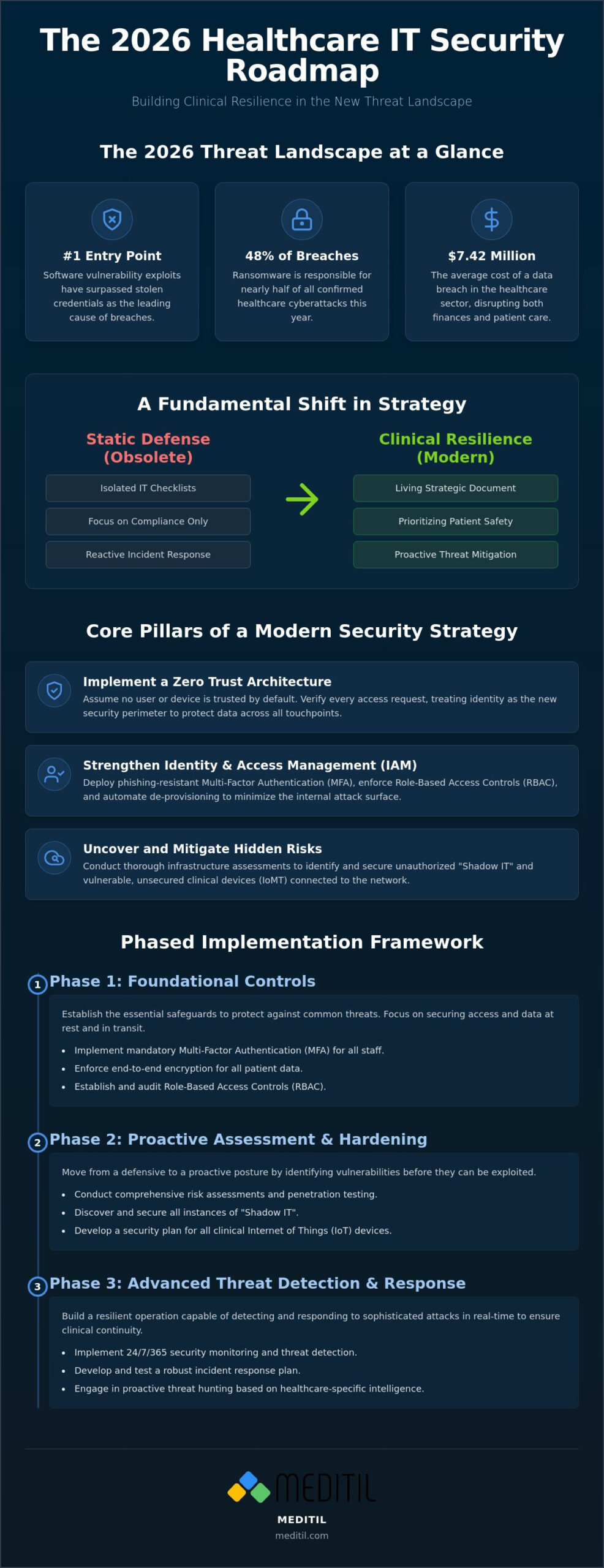
In 2026, exploitation of software vulnerabilities has officially surpassed stolen credentials as the leading entry point for healthcare cyberattacks. This shift, combined with ransomware accounting for 48% of all confirmed breaches this year, makes a sophisticated healthcare IT security roadmap a clinical necessity. It’s understandable if you feel pressured by the proposed HIPAA Security Rule updates or the ongoing shortage of specialized IT talent. You’re likely balancing the need for seamless connectivity with the reality of siloed data that complicates your risk profile.
This guide provides a structured approach to building a future-proof strategy that prioritizes clinical resilience over simple compliance. You’ll learn how to execute a phased plan for security upgrades. This includes implementing mandatory encryption and MFA while aligning your technical infrastructure with patient safety. We’ll preview the strategic steps necessary to reduce the risk of ransomware-induced downtime and protect your organization from the $7.42 million average cost of a healthcare data breach.
Key Takeaways
- Transition from static defense to a strategy focused on clinical resilience, ensuring that cybersecurity directly supports patient safety and operational stability.
- Implement a modern identity-centric perimeter using Zero Trust principles to manage the complexities of medical staff access and remote clinical connectivity.
- Identify hidden risks within your infrastructure by conducting thorough assessments that uncover unauthorized “Shadow IT” and unsecured clinical devices.
- Execute a phased healthcare it security roadmap that moves from foundational safeguards like MFA to advanced 24/7 monitoring and threat detection.
- Leverage strategic leadership through a Fractional CIO to align technical upgrades with 2026 regulatory compliance and long-term institutional goals.
The 2026 Healthcare Threat Landscape: Why Static Security Roadmaps Fail
We are currently witnessing the “Convergence of 2026,” where sophisticated AI-driven threats meet the persistent vulnerabilities of legacy Health information technology (HIT). Attackers now use automated tools to exploit unpatched systems at speeds that manual intervention cannot match. A security roadmap is the alignment of clinical goals with technical safeguards. This alignment ensures that every technical upgrade directly supports the stability of patient care and the protection of the provider’s reputation.
The Evolution of Ransomware in Clinical Settings
The nature of ransomware has shifted from simple data encryption to the targeted disruption of life-critical systems. In 2026, attackers prioritize the immobilization of diagnostic equipment and real-time monitoring tools to maximize pressure on providers. We’ve also seen the rise of “extortion-ware,” where criminals threaten to release highly sensitive patient records unless demands are met. To help reduce the availability of personal data that can be used in these extortion attempts, you can learn more about deleteme and their information removal services. This environment necessitates a proactive posture. Organizations must move beyond reactive recovery and focus on building resilient infrastructure that can maintain core clinical functions even during an active incident.
Regulatory Pressures: Beyond HIPAA Compliance
Compliance requirements have intensified, with the 405(d) Aligning Health Care Industry Security Approaches becoming a central framework for federal audits. National providers also face a complex patchwork of state-level data privacy laws that often exceed federal standards. It’s vital to view compliance as a floor, not a ceiling, for your security posture. A robust healthcare it security roadmap anticipates these regulatory shifts by integrating high-level standards into daily operations. This approach transforms compliance from a periodic burden into a continuous byproduct of a well-managed IT environment.
Core Pillars of a Modern Healthcare Security Strategy
A resilient healthcare IT security roadmap must be anchored in structural integrity. In an era where the boundaries between clinical settings and remote access have blurred, we can’t rely on the legacy concept of a “trusted” internal network. Identity has become the primary perimeter. This shift requires a strategy that protects every touchpoint of patient data, from bedside IoT devices to cloud-based analytics platforms. By focusing on these pillars, organizations move from a reactive state to a posture of steady, predictable protection.
Practical Zero Trust is no longer a theoretical framework; it’s a operational necessity. It assumes that every request for access, whether originating inside or outside the hospital walls, is a potential threat. By verifying every user and device every time, organizations build a resilient defense that survives even when individual credentials are compromised. This approach ensures that data governance remains intact across increasingly interoperable platforms, maintaining the accuracy and availability of clinical information.
Strengthening Identity and Access Management (IAM)
Identity management is the first line of defense in a modern healthcare IT security roadmap. Implementing phishing-resistant Multi-Factor Authentication (MFA) is critical to prevent account takeovers. Beyond authentication, Role-Based Access Control (RBAC) ensures that medical staff only access the specific records necessary for their duties. This follows the principle of least privilege, which significantly reduces the internal attack surface. Automated de-provisioning is equally vital. It ensures that access is revoked immediately when staff members depart, preventing the risk of “orphan accounts” lingering in the system. These measures align with HIPAA Security Rule requirements for maintaining strict control over electronic protected health information.
Securing Interoperability and EHR Data Flows
As healthcare moves toward greater connectivity, securing data in motion is a top priority. Information often flows between Electronic Health Records (EHR) and medical billing automation solutions, creating potential points of exposure. Robust encryption must be applied both at rest and in transit to protect patient identifiers. The adoption of FHIR (Fast Healthcare Interoperability Resources) APIs offers a standardized way to exchange data, but these APIs require rigorous security protocols to prevent unauthorized queries. Organizations should conduct regular audits of these data flows to ensure that interoperability doesn’t come at the cost of security. If you’re uncertain about how your current integrations measure up, a professional security assessment can identify hidden vulnerabilities in your data pipeline.
Assessing Maturity: Identifying Gaps in Your Current Infrastructure
Before constructing a healthcare IT security roadmap, an organization must honestly evaluate its current maturity level. This process involves a dual approach. Internal teams provide necessary context on daily clinical workflows, while external experts offer an objective view of vulnerabilities that internal eyes might overlook. Technical debt acts as a silent multiplier of cyber risk, where outdated code and unpatched systems create compounding vulnerabilities that grow more dangerous over time. Identifying these gaps is the only way to move from a state of reactive “firefighting” to a disciplined, proactive posture.
Clinical departments frequently adopt unauthorized applications or personal devices to bypass perceived workflow bottlenecks. This “Shadow IT” creates invisible entry points for attackers. Simultaneously, evaluating third-party vendors and business associates is vital for institutional stability. A breach at a partner level can be just as devastating as one within your own servers, especially as interoperability increases. A thorough assessment ensures that every link in the digital supply chain meets your established security standards.
Inventory and Asset Management
Inventory management remains a significant hurdle in complex medical environments. Many hospitals struggle with “unknown” devices, such as unsecured smart infusion pumps or legacy imaging workstations, that appear on the medical network without proper vetting. Mapping data silos is the next step to understand where high-value assets reside. By using the NIST Cybersecurity Framework, organizations can align their inventory with recognized national standards. Utilizing OSINT (Open Source Intelligence) allows your team to see the organization’s digital footprint through the eyes of an attacker, identifying exposed ports or leaked credentials before they are exploited by malicious actors.
Remediating Technical Debt in Legacy Systems
Legacy systems are often the weakest links in clinical environments because they weren’t designed for the modern threat landscape. Strategies for securing end-of-life hardware include strict network segmentation and “virtual patching” when physical updates aren’t possible. It’s essential to prioritize patches based on potential clinical impact rather than relying solely on raw CVSS scores. A vulnerability in a life-support system is always more critical than one in a back-office printer. For specialized guidance, organizations can utilize Healthcare Cybersecurity Services to establish a rigorous assessment framework that addresses these legacy challenges, ensuring your healthcare IT security roadmap remains grounded in operational reality.
Executing the Roadmap: A Phased Implementation Framework
Executing a healthcare IT security roadmap requires a methodical, multi-year commitment to operational excellence. Organizations often encounter friction when they attempt to implement high-level security controls before establishing a stable foundation. By breaking the strategy into manageable phases, healthcare leaders can ensure clinical continuity while steadily improving their defensive posture. This structured approach prevents resource exhaustion and allows for the gradual integration of security into the daily clinical workflow.
- Phase 1: Foundation Building. The initial stage focuses on securing the most vulnerable entry points. This includes the immediate rollout of phishing-resistant MFA, rigorous verification of offline backups, and aggressive patching of critical vulnerabilities. These “quick wins” provide the highest immediate return on investment for clinical stability.
- Phase 2: Visibility and Monitoring. Once the foundation is stable, the focus shifts to oversight. Implementing a Security Information and Event Management (SIEM) system alongside 24/7 Managed Detection and Response (MDR) ensures that anomalies are identified before they can escalate into clinical disruptions.
- Phase 3: Advanced Resilience. This phase moves beyond monitoring into active defense. It involves the full deployment of Zero Trust architecture and the introduction of automated incident response protocols. These systems work to isolate threats without requiring manual intervention from overstretched IT staff.
- Phase 4: Continuous Optimization. The final phase ensures the roadmap remains a living document. Regular penetration testing and adaptive risk assessments help the organization stay ahead of the evolving threats documented in 2026.
Budgeting for Security: Aligning Costs with Risk
Justifying security spend to a board of directors requires a shift from technical jargon to a risk-based financial narrative. Leaders should present cybersecurity not as a cost center, but as a strategic investment in clinical uptime and patient safety. Transitioning from unpredictable Capital Expenditure (CapEx) to a stable Operating Expenditure (OpEx) model is often best achieved through managed IT services for healthcare. For a detailed breakdown of long-term financial planning, refer to our comprehensive guide on it budgeting for medical practices. This alignment ensures that every dollar spent directly reduces a documented institutional risk.
Staff Training and Culture: The Human Firewall
Your staff members represent the final line of defense in any technical framework. Developing a culture of security requires moving away from annual compliance videos that clinicians often view as a burden. Instead, implement regular, bite-sized training sessions that address specific threats relevant to their roles. Simulated phishing attacks should be treated as educational opportunities to build confidence, not as disciplinary measures. When security becomes an intuitive part of the clinical culture, the entire organization becomes significantly more resilient. If you’re ready to begin your transition, our team can help you develop a customized execution plan tailored to your specific clinical needs.
Partnering for Resilience: The Role of the Fractional CIO
While many providers offer managed IT support, general services often lack the strategic foresight required to manage a multi-year healthcare it security roadmap. Technical support teams excel at resolving immediate tickets; however, they rarely have the administrative depth to navigate complex regulatory shifts or long-term infrastructure planning. A successful roadmap requires a leader who understands both the clinical mission and the technical requirements of a high-stakes medical environment. Strategic leadership becomes the primary differentiator for long-term institutional stability.
The primary advantage of virtual CIO services lies in their ability to navigate these regulated landscapes with precision. An augmented IT team provides the “steady hand” necessary to guide an organization through the phases of implementation discussed earlier. MEDITIL’s approach focuses on tailored infrastructure management, ensuring that every security upgrade is verified and aligned with the specific operational goals of the practice. This partnership ensures that your security posture remains robust without requiring the overhead of a full-time executive hire.
Bridging the Gap Between Strategy and Operations
A vCIO acts as a translator between business objectives and technical execution. They manage the lifecycle of the healthcare IT security roadmap through disciplined Quarterly Business Reviews (QBRs). During these sessions, progress is measured against established benchmarks, and the roadmap is adjusted based on new threat intelligence or regulatory changes. This proactive oversight ensures that security improvements actually reduce clinical friction rather than creating new hurdles for medical staff. By focusing on seamless connectivity and verified protection, the vCIO ensures that IT remains an enabler of care, not a bottleneck.
Selecting the Right Healthcare IT Partner
Choosing a partner for long-term resilience requires looking beyond basic technical proficiency. You need a specialist who understands the mission-driven nature of healthcare and the unique pressures of patient-facing environments. Key criteria include deep compliance expertise, industry-specific experience with EMR/EHR systems, and a proven track record of strategic advancement. A reliable partner doesn’t just provide services; they act as a consultant invested in your long-term outcomes. If you’re ready to secure your organization’s future, consult with MEDITIL to begin your 2026 security assessment and build a roadmap that protects your patients and your practice.
Securing Your Clinical Resilience for 2026 and Beyond
A successful healthcare IT security roadmap is more than a technical requirement; it’s a commitment to patient safety and operational stability. By prioritizing identity-centric perimeters and addressing the technical debt within legacy systems, organizations can transition from reactive defense to proactive resilience. The complexity of the 2026 regulatory environment demands a structured approach that aligns technical safeguards with clinical outcomes. You don’t have to navigate these challenges alone.
Strategic leadership is the engine that drives this transformation. Implementing a phased plan protects sensitive data while reducing clinical friction for your providers. Secure your clinical future with a custom 2026 IT Security Roadmap from MEDITIL. Our team provides tailored healthcare-specific security frameworks and Fractional CIO leadership for essential strategic guidance. Supported by 24/7 proactive monitoring and risk management, we maintain the steady presence your practice requires. Take the first step toward a more secure and compliant clinical environment today.
Frequently Asked Questions
What is a healthcare IT security roadmap?
A healthcare IT security roadmap is a living strategic document that outlines the phased implementation of technical and administrative safeguards over a multi-year period. It serves as a guide to align your clinical workflows with cybersecurity requirements. By documenting current maturity levels and future objectives, the roadmap ensures that security investments directly support patient safety and institutional stability. It moves beyond simple checklists to provide a comprehensive vision for long-term resilience.
How often should a medical practice update its security roadmap?
Organizations should formally review their roadmap during Quarterly Business Reviews (QBRs) and perform a comprehensive update annually. The threat landscape in 2026 changes rapidly, with new vulnerabilities emerging at an accelerated pace. Regular updates allow your leadership to adjust for regulatory shifts from the HHS or OCR. This iterative process ensures your strategy remains relevant as your clinical environment and technical infrastructure evolve.
Does a security roadmap guarantee HIPAA compliance?
A roadmap provides the structural framework necessary for compliance, but it doesn’t serve as a one-time guarantee. HIPAA compliance is a continuous state maintained through the disciplined execution of the roadmap’s controls and policies. While the roadmap aligns your infrastructure with the HIPAA Security Rule, your team must consistently follow the established protocols. It treats compliance as a baseline for security rather than the ultimate goal.
How much does it cost to implement a healthcare security roadmap?
Implementation costs depend on your organization’s current maturity and the scope of required upgrades. Rather than focusing on a single price point, most healthcare leaders transition to an operational expenditure (OpEx) model using managed services. This approach provides predictable monthly costs while allowing for the steady deployment of advanced security tools. Investing in the roadmap helps mitigate the much higher financial impact of a successful data breach.
What are the most common gaps found in healthcare security assessments?
Common gaps include unpatched legacy hardware, lack of visibility into clinical “Shadow IT”, and insufficient endpoint protection for medical devices. Many assessments also reveal that organizations rely on outdated multi-factor authentication methods that are vulnerable to sophisticated phishing. Identifying these specific weaknesses is a critical first step in the healthcare it security roadmap. Addressing these gaps ensures that your most valuable clinical assets remain protected against modern exploitation.
Can a small clinic benefit from a fractional CIO for security planning?
Small clinics often see the most significant benefit from a fractional CIO because they gain high-level expertise at a fraction of the cost of a full-time executive. A vCIO provides the steady hand needed to architect a sophisticated healthcare IT security roadmap tailored to limited budgets. This strategic oversight ensures that small practices aren’t just buying tools, but are building a cohesive defense. It bridges the gap between basic IT support and enterprise-level protection.
What is the difference between a security assessment and a roadmap?
A security assessment is a snapshot of your current vulnerabilities and maturity, while a roadmap is the strategic plan for remediation. Think of the assessment as a diagnostic tool that identifies where your defenses are failing. The roadmap is the treatment plan that outlines the specific phases, timelines, and resources needed to fix those issues. Both are essential components of a proactive and disciplined security posture.
How do we secure medical IoT devices within our roadmap?
Securing medical IoT devices requires strict network segmentation and the implementation of Zero Trust principles. These devices often lack modern security software, so they must be isolated on their own VLANs to prevent lateral movement by attackers. Your roadmap should include continuous monitoring of these device communications to identify anomalies. By treating IoT as a separate, high-risk category, you can ensure that patient-facing equipment doesn’t become a gateway for a broader system compromise.